Step into the old mall, and you enter a hallway where the skylights are dimmed by layers of grime. The floor tiles are broken and uneven, and the air carries a sharp, burnt-concrete smell.
Graffiti covers the walls up to about eight feet, while everything above that line remains clean and untouched. In 2016, a film crew turned this area into a futuristic prison for Westworld.
In 2002, another crew used a different section to create a bright, high-end shopping world for Minority Report. The building has worked better as a film set than it ever did as a mall. It shut down in 1999 after just over twenty years in business.
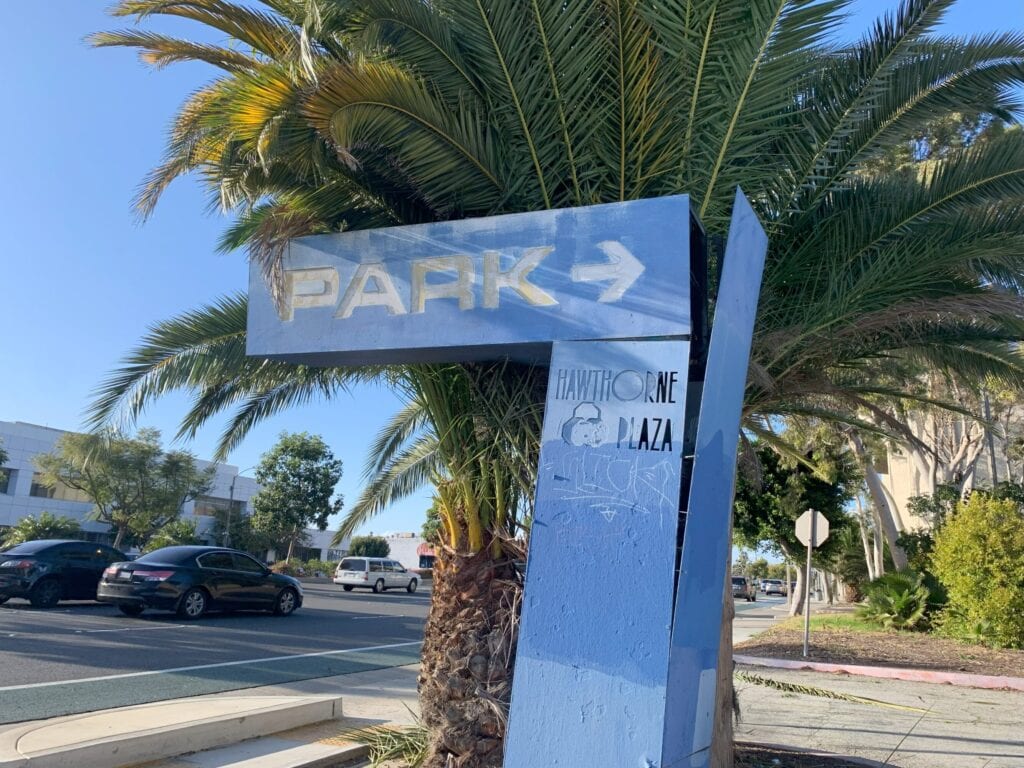
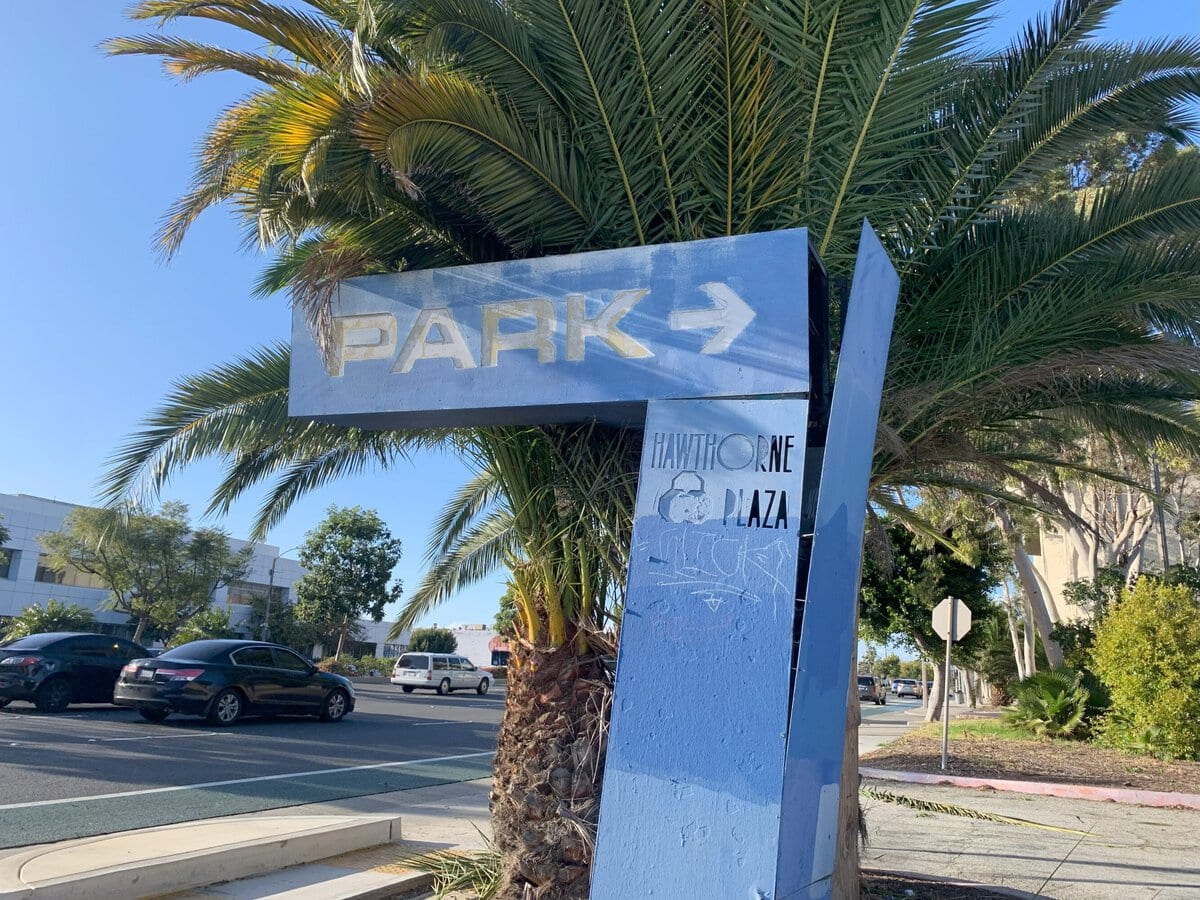
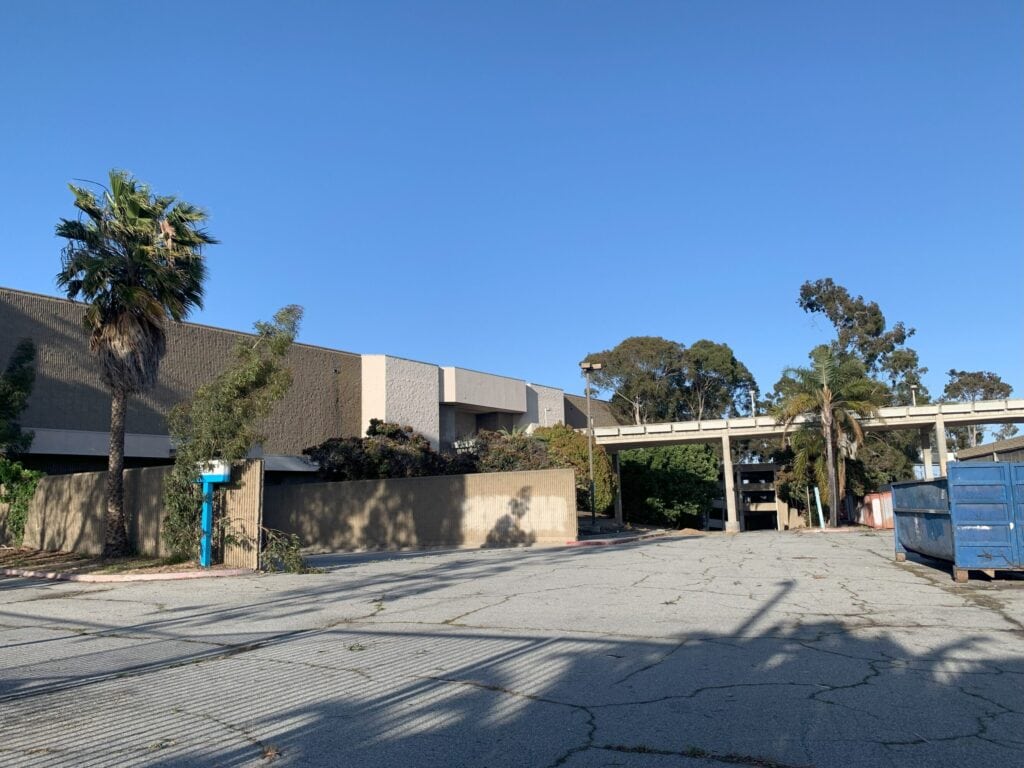
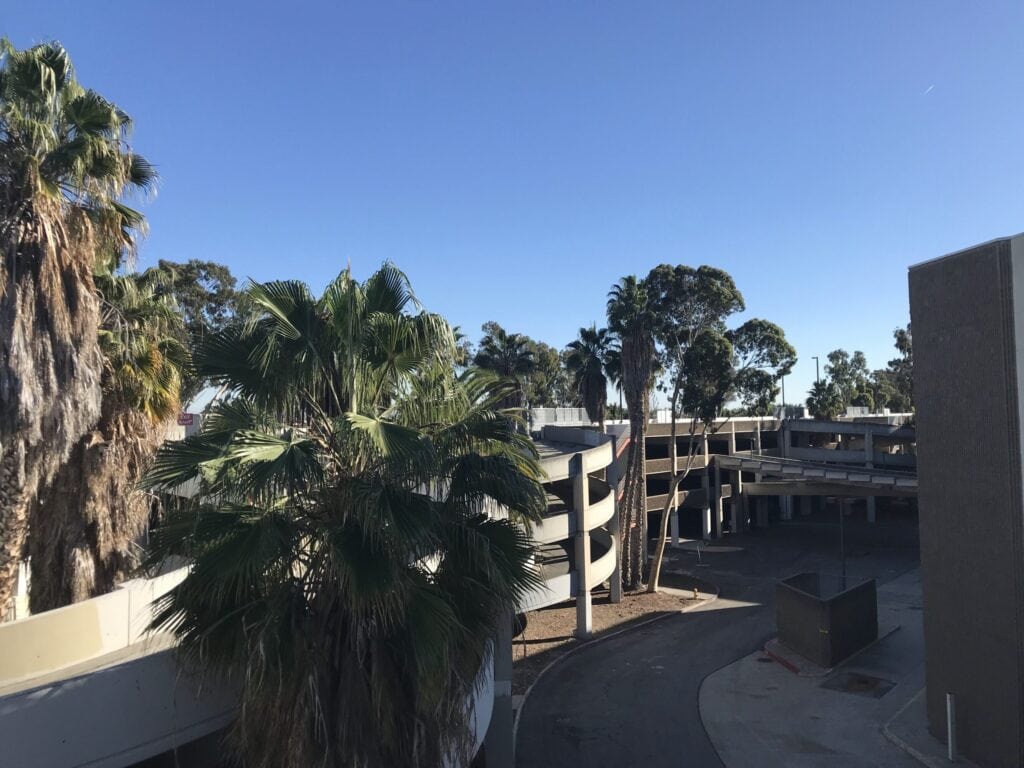
The structure still stands at 12000 Hawthorne Boulevard, spanning about 915,000 square feet. Parking garages and open lots surround it, now filled with stored Tesla vehicles.
A court order from September 2025 requires the owner to begin redevelopment or demolition by August 31, 2026.
Hawthorne Plaza: Born from a City's Big Ambition
Hawthorne took a major step in the summer of 1968. The city's redevelopment effort expanded, and officials set aside part of its old downtown as the Hawthorne Plaza Project.
It brought in Victor Gruen Associates, known for early enclosed mall designs, to write a planning report. Larry Smith and Associates handled an economic feasibility study.
That study pointed to a gap in retail options in the central South Bay. It said Hawthorne Plaza could become the largest multi-use regional center in the area.
The city chose tax increment financing to pay for the project. Any increase in property tax revenue within the project area would go toward redevelopment costs instead of the general fund.
By the early 1970s, local coverage treated the project as a major urban renewal effort.
Construction began in January 1974. The site covered 35 acres between 120th Street and El Segundo Boulevard. Officials marked the start by burying a time capsule.
They also said the idea had been in motion since at least 1967, after redevelopment efforts were already underway.
The Architects and a 200-Yard Cash Tube
Ernest W. Hahn, Inc. served as co-developer and general contractor, with Carter Hawley Hale Properties and Urban Projects as partners.
Charles Kober Associates handled the architecture. The site was long, narrow, and hemmed in by an existing street grid rather than spread across open suburban acreage.
Kober's solution was a two-level "Y" plan with interior and exterior hanging gardens, skylights angled to shift the quality of light through the day, and grooved exterior block surfaces.
Seventeen bridges connected multiple parking structures directly to the retail floors.
A 200-yard pneumatic tube system let store clerks send cash to Security Pacific Bank from a booth near J.C. Penney. The parking structure was the world's longest, according to local coverage in 1976.
By late 1975, more than one-third of the retail space was already leased, including Security Pacific, Citizens Savings and Loan, and Miki's Restaurant.
AMC announced a six-screen multiplex for the Birch Avenue side in spring 1976.
By November 1976, the first freestanding businesses at the south end were open while crews were still finishing drywall inside the main mall, with roughly 75% of the retail space under lease.
Opening Day and the First Signs of Trouble
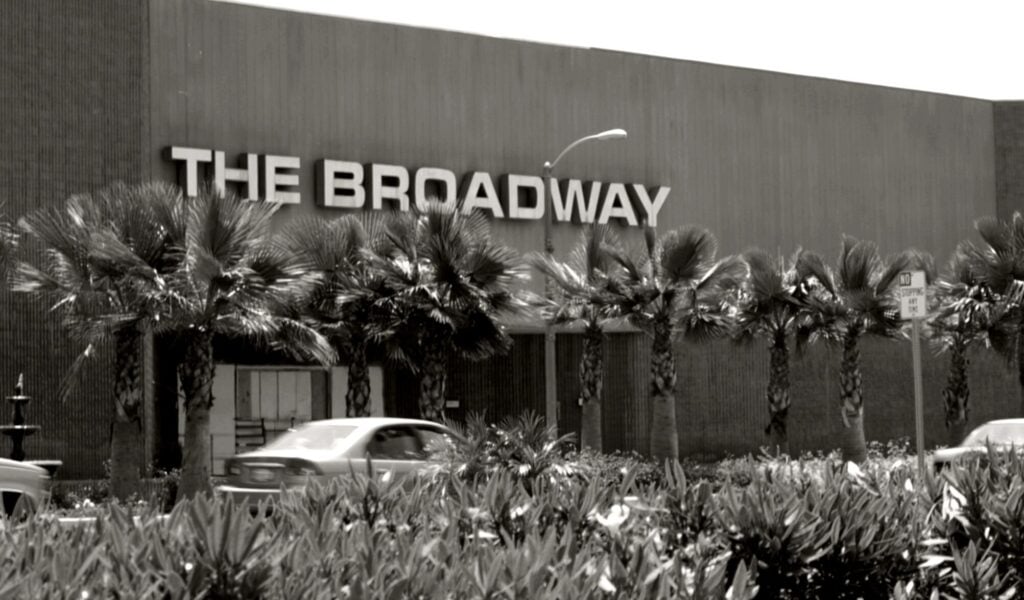
The Broadway opened on February 12, 1977, ahead of the rest of the mall.
A charity preview drew nearly 7,000 attendees and raised $40,000 for Hawthorne Community Hospital. The grand opening for the public took place on February 21.
Fred Collings, the mall manager, estimated opening-day attendance at about 100,000 people. In the following weeks, weekend crowds ranged from 60,000 to 70,000 visitors per day.
The ceremony included a mascot called Count Nate Hawthorne, the Hawthorne High School Band, and the Hawthorne Boy Scout Color Guard.
Advertising described the mall as "your community center with 133 climate-controlled stores." Management distributed parking diagrams to local residents.
The mall employed 20 full-time security guards equipped with radios, along with a direct connection to Hawthorne police, which was an uncommon level of security for a newly opened mall.
In spring 1979, after Proposition 13 reduced property tax income across California, the state passed a special law allowing Hawthorne to establish an assessment zone around the mall.
This prevented a default on about $24 million in bonds that had funded the parking structure.
Two shootings inside the mall occurred later in 1979. These were the first publicly recorded incidents.
The Late-1980s and 1990s Unraveling
Job losses in the aerospace industry hit Hawthorne hard during the 1980s.
The cuts reduced employment across much of the surrounding area, and many middle-class residents moved to other parts of the South Bay.
At the same time, competing malls in Culver City, Redondo Beach, and Torrance drew shoppers away.
Hawthorne Plaza tried to compete by keeping prices lower than those of South Bay Galleria, Manhattan Village, and Del Amo Fashion Center.
It leaned on cheaper stores, even as its customer base continued to shrink. By fall 1982, the Hawthorne Police Department had opened a community service center inside the mall and operated it rent-free.
In May 1992, the Los Angeles riots reached Hawthorne. Montgomery Ward lost its electronics, auto parts, jewelry, and clothing during the unrest.
The decline continued into the 1990s. In January 1994 alone, eight stores closed. That left 87 tenants, down from 130 just a few years earlier. Annual sales dropped 3% in 1993, totaling $27 million.
Owner Larry Faigin fell behind on mortgage payments, missing more than $900,000. In February 1994, a Superior Court-appointed trustee took control of the property.
The mall still brought in nearly $1 million a year in sales tax for the city of Hawthorne, but that figure was continuing to fall.
Receivership, Empty Anchors, and the End
In 1995, Danny Bakewell, Lonnie Bunkley, and a San Diego firm bought the property out of receivership.
In 1997, they announced a plan to replace the six-screen theater with a 15-screen cinema to drive foot traffic back.
By 1997, only 73 stores were operating. Macy's Clearance Center - the successor to The Broadway after Federated Department Stores purchased that chain - closed in December 1997.
Montgomery Ward closed around the same time.
With two of the three anchor spaces empty, vacancy hit 50%, and the owners began discussing whether to demolish the enclosed structure and replace it with an open-air shopping center.
A 14-acre parcel on the south side of the property was already being cleared for a Lucky Food Center, a Sav-On Drugs, and family restaurants.
J.C. Penney, the last remaining anchor, left in 1998. Occupied stores fell to around 70.
The enclosed mall closed in 1999, ending a retail run of just over 22 years. The southern portion of the property was demolished in 1998 and rebuilt as a strip mall that still operates today.
Stalled Plans and a Federal Bribery Case
The Charles Company purchased the property in 2001 for $7 million.
Over the next twenty years, redevelopment followed the same pattern again and again: a plan would be announced, gain approval or support, then stall and fall apart.
In 2006, a filing outlined a proposal for about 1.5 million square feet of office, retail, restaurant, and related uses, plus 610 residential units.
In 2014, a new idea surfaced for an outlet mall.
In March 2016, Hawthorne adopted the Downtown Hawthorne Specific Plan and labeled the former mall site as Transformative Project T1.
Environmental reports estimated 608 housing units and about 2.5 million square feet of nonresidential development.
The owners later submitted plans for a $500 million redevelopment. The City Council approved the project, but in 2018, the city withdrew that approval after construction never began.
At the same time, developer Arman Gabaee was working to secure a $45 million lease with Los Angeles County for office space at the site.
In 2018, federal prosecutors charged that Gabaee had made monthly cash bribe payments and tried to purchase a $1.1 million house for a county official to win the deal.
On December 15, 2022, a federal judge sentenced Gabaee to four years in prison after he admitted to paying dozens of cash bribes to a county official.
The Ruin That Hollywood Keeps Coming Back To
Since 2001, the mall has appeared in at least two dozen films, television shows, and music video productions. Minority Report used the site in 2002, presenting its corridors as a sleek retail future.
The Fast and the Furious: Tokyo Drift was filmed there in 2006, followed by Gone Girl in 2014.
Taylor Swift shot "...Ready for It?" at the location in 2017, and Travis Scott used it for his Astroworld trailer in 2018.
Christopher Nolan filmed scenes for Tenet there in 2019.
The location can be adapted in different ways. When set up and restored, it can pass for an active mall. When left stripped down, it resembles a post-apocalyptic ruin.
Some areas remain in use. A police training center occupies the former Montgomery Ward space.
The Hawthorne School District maintains an administrative office on the north side. Much of the interior was removed in the mid-2000s.
On January 26, 2022, a fire broke out beneath the mall in connection with a homeless encampment.
More than 80 firefighters responded, and the fire burned for about two hours. It caused major damage to both the former Broadway entrance and the central entrance.
A Court Order and an August 2026 Deadline
In November 2021, Hawthorne filed a nuisance-abatement lawsuit against the owners, citing illegal dumping, graffiti, homeless encampments, trespassing children, and more than 50 code violations found during inspections earlier that year.
The owners had also been running an illegal parking-rental business in the lots since 2018.
In 2023, the property went on the market through Cushman and Wakefield, listed as a 20.5-acre redevelopment opportunity with about 935,000 square feet of existing structure, pitched to housing developers, office users, and studio production companies.
On September 9, 2025, Hawthorne obtained a permanent court injunction requiring the owners to begin redevelopment or demolition no later than August 31, 2026.
The order requires structural and asbestos testing, daily site cleanup, new perimeter fencing, and on-site security. If the owners miss the deadline, the city says it will seek a court-appointed receiver to take control.
As of spring 2026, graffiti, trash, and trespassing continued at the site, and no demolition or redevelopment had begun.
The building has now been closed for longer than it was ever open.