At Third Street and Fairfax Avenue in Los Angeles, a double-decker trolley moves along a broad brick street with decorative lamp posts and mature trees.
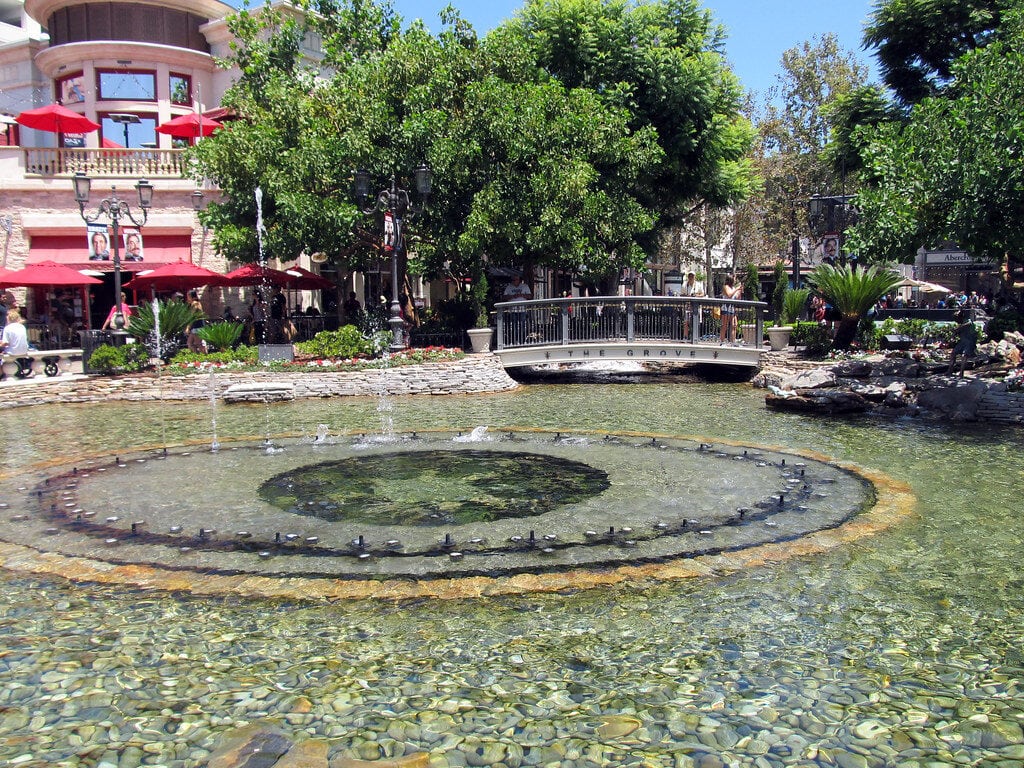
Fountain jets rise 70 feet into the air in time with music, while people walk past stores in a setting that looks long-established.
But it is not old. The bricks, lamp posts, fountains, and other details were all installed as part of a project that began in 2000. The Grove is at 189 The Grove Drive in Los Angeles, next to the Original Farmers Market.
It is an outdoor complex for shopping, dining, and entertainment. Developer Rick Caruso built it with the A.F. Gilmore Company for $160 million.
The design takes cues from Los Angeles in the 1930s and 1940s. Its main street is private property, even though it is designed to feel like a public sidewalk.
Long before the first stores opened, the land had many other uses. It was used for dairy farming, then oil drilling, then baseball, and later drive-in movies.
The history of The Grove dates back more than 100 years before 2002.
What the Land Beneath The Grove Used to Be
In 1880, Arthur F. Gilmore and a partner bought two dairy farms in the Los Angeles area.
Gilmore later took control of a 256-acre ranch at Third Street and Fairfax, and by 1905, oil drilling had largely replaced the dairy business.
In the decades that followed, the property developed into a mix of oil operations, commercial activity, and entertainment.
The Original Farmers Market began in July 1934, when about a dozen farmers and merchants started selling produce at Third and Fairfax, with permanent stalls in place by October that year.
Gilmore Stadium also opened in 1934. Gilmore Field followed in 1939 as the home of the Hollywood Stars baseball team. By 1948, a drive-in theater stood on roughly the same land where The Grove stands today.
Also on the property is the Gilmore Adobe, a rancho-era structure that predates the Gilmore family's ownership and was later expanded and remodeled.
By the time developers began eyeing the site in the 1980s, the land had already passed through more than a century of commercial use, and that layered history would shape every argument over what should come next.

Years of Failed Plans Before a Deal Got Done
Through the late 1980s and into the 1990s, a series of large development proposals for the land next to the Farmers Market were put forward and blocked.
A 1989 plan called for a 31-acre, $300 million development with department-store anchors and more than 100 smaller shops.
By 1990, the proposal had grown to roughly 2 million square feet, then scaled back by about 30 percent - and neighbors still pushed back.
A city-appointed design team warned in 1990 that a large new project would bring too much traffic and argued for housing on the site instead.
The breakthrough came in May 1998, when Rick Caruso proposed a 25-acre center that would leave the Farmers Market alone.
By early 1999, the plan had taken shape as a roughly $100 million, 640,000-square-foot development with restaurants, upscale stores, and movie theaters.
Nordstrom joined in July 1999. After community meetings and traffic commitments, the project won unanimous approval from both the Planning Commission and the City Council.
Building a Street That Never Really Existed
The 17 acres Caruso took on were a mix of surface parking lots, a nursery, and a bank building.
He structured the project as a long-term ground lease from the Gilmore family, with equity financing, a Bank of America-led construction loan with PNC and Union Bank, and permanent financing from Lehman Brothers.
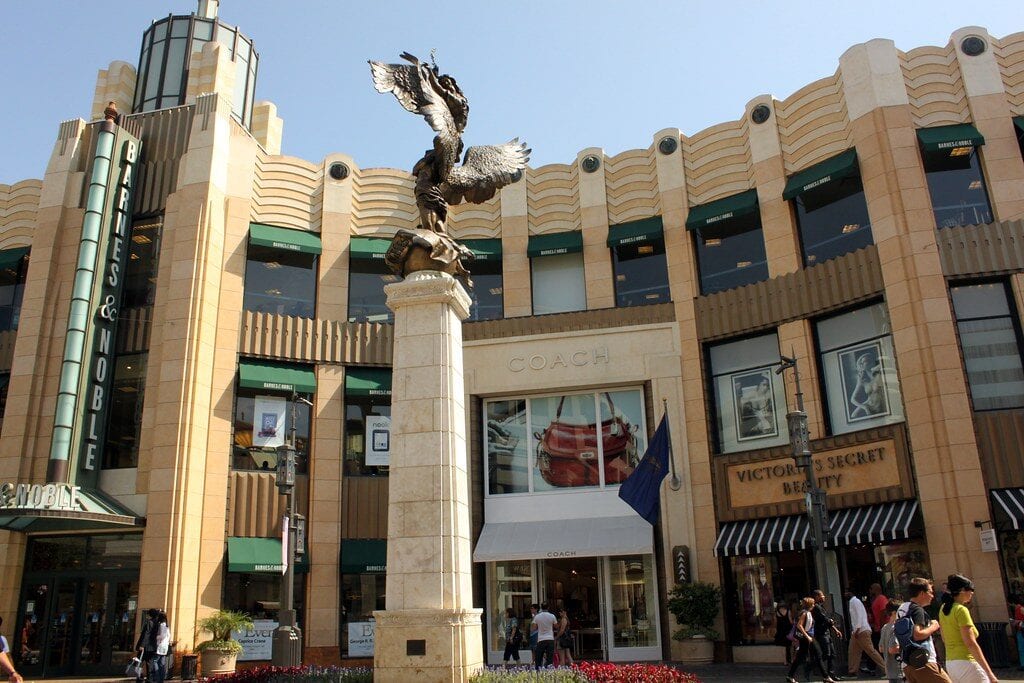
Architects Elkus/Manfredi led the design with the goal of making the buildings look older than they were - drawing on 1930s and 1940s Los Angeles streetscapes without copying any one place exactly.
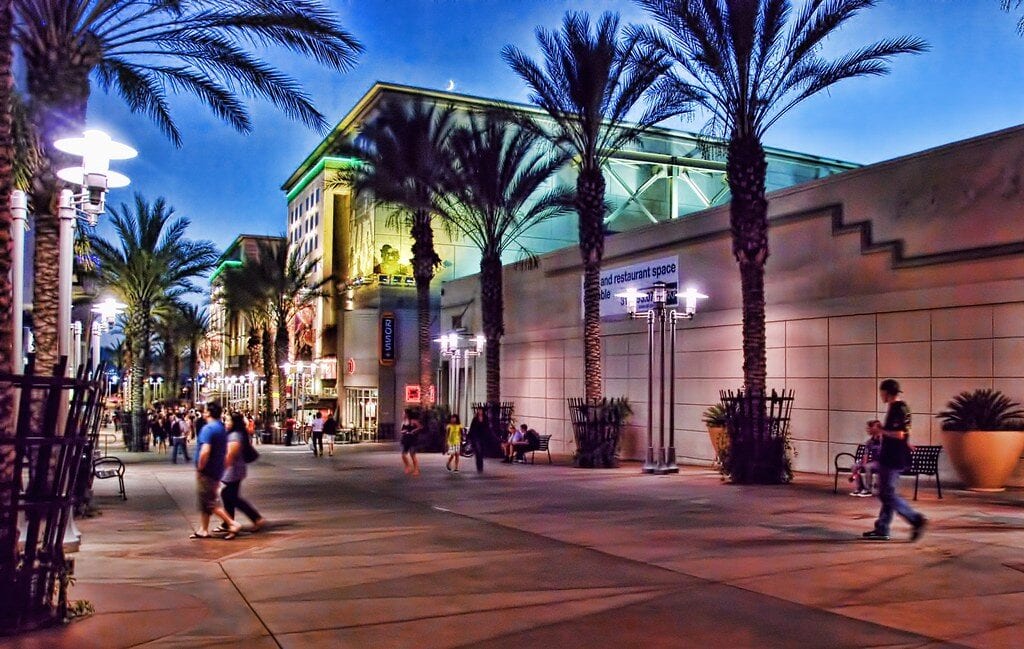
The central feature was a pedestrian-only internal street, more than a quarter-mile long and about 60 feet wide.
Around it, the team built a one-acre green with a small lake, a bridge, lawns, and choreographed fountains that could send jets 70 feet into the air.
A seven-level parking structure with 3,500 spaces sat nearby, and the cinema got a street-facing marquee.
The trolley was built on the undercarriage of a 1950s Boston streetcar and was the first transit system in the United States to use inductive power technology.
Retired Disney Imagineer George McGinnis developed it.
The Strong Opening in March 2002
Construction started in December 2000, and The Grove opened on March 15, 2002. On opening day, visitors saw chandeliers, limestone finishes, mature trees, a double-decker trolley, and fountains set to music.
The theater covered 80,000 square feet. It had reserved leather seats and a lobby designed more like a hotel lobby than a typical multiplex.
The opening included changes on the Farmers Market side as well. Four new market buildings were added, and the clock tower was restored.
A 1955 Gilmore bank building was demolished to make space. The project kept some historic features and removed others.
The business results were unusually strong. The center opened fully leased, with no vacant space, and there was already a waiting list for additional tenants.
Average yearly sales were more than $500 per square foot. Shoppers came from 78 ZIP codes, and the center recorded a 92 percent conversion rate.
In about its first year, roughly 16 million people visited. That total was higher than Disneyland's nearby attendance during the same period.
Stores Change, but the Overall Approach Does Not
Some of the stores that opened in The Grove's early years did not stay. FAO Schwarz closed after its parent company went bankrupt.
American Girl Place moved into that space in spring 2006. In 2013, Topshop and Topman opened in the former Banana Republic space and drew about 10,000 shoppers.
At that time, it was the biggest retail opening in the center's history. Nike opened a flagship store in 2015 and is still part of the current lineup.
The theater changed operators after the pandemic. Pacific Theatres' movie business collapsed during the COVID-19 closures.
In July 2021, AMC signed a long-term lease with Caruso to take over the 14-screen theater and planned premium-format upgrades before reopening it.
The theater is now listed as AMC The Grove 14.
The complex also became more visible in popular culture. In 2010, the entertainment news show "Extra" moved to The Grove and made it a regular setting for celebrity interviews.
The holiday program also became one of the center's best-known traditions.
Each season, it includes nightly artificial snowfall and a large Christmas tree.

A Place Both Celebrated and Argued Over
Almost from the start, The Grove attracted questions about what it actually was.
In 2007, the Los Angeles Times labeled it a "scripted space" - a place that looked like a public street but was privately controlled property with its own security and rules.
Caruso put annual visitation at 17 million that year, with average spending of $126 per visit.
A 2013 Vanity Fair profile noted that he had studied commercial streets in Charleston and Boston, wanting to build a main street for a city that lacked one.
Admirers saw vision. Critics saw an imitation.
In 2020, during unrest following the murder of George Floyd, stores including Nordstrom and Apple were vandalized and looted, and a police kiosk was set on fire.
In October 2023, The Grove shut down for the first time in 21 years for the world premiere of Taylor Swift's concert film "The Eras Tour." The Original Farmers Market next door stayed open.
Newer tenants continue to arrive: Zara opened a 25,800-square-foot store in June 2025, and Revolve opened its first flagship there in January 2026.