Miami in August is intensely hot, humid, and often windless. Even walking two blocks can feel like a chore. That is what makes the stretch of South Miami Avenue just north of Eighth Street stand out.
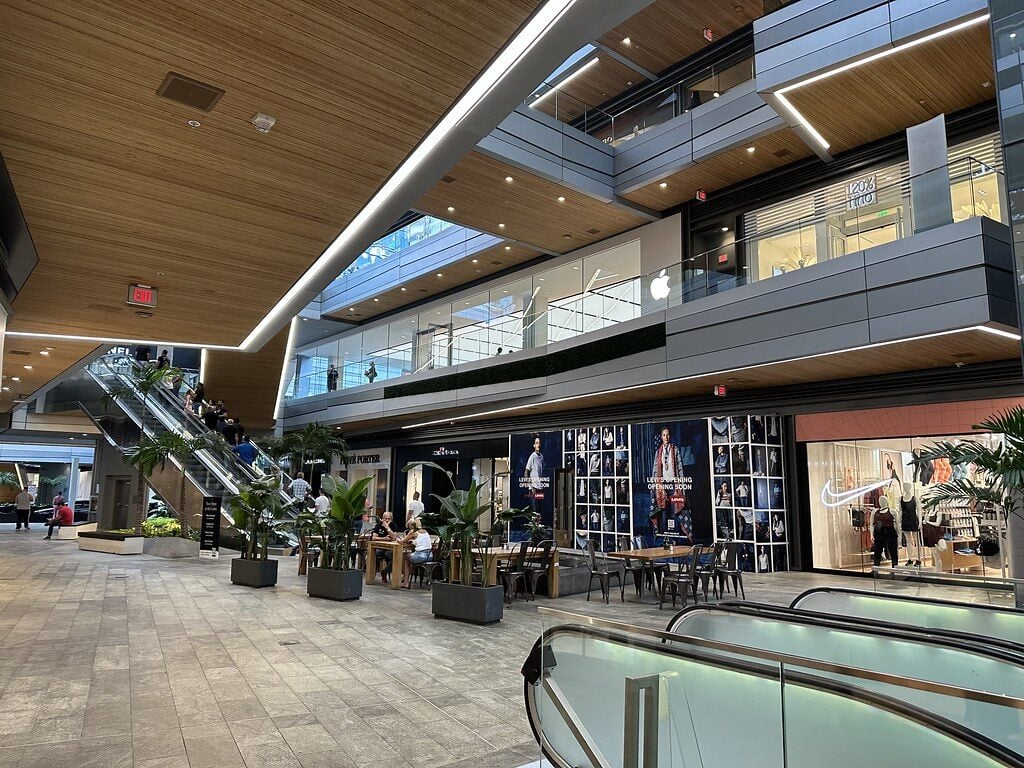
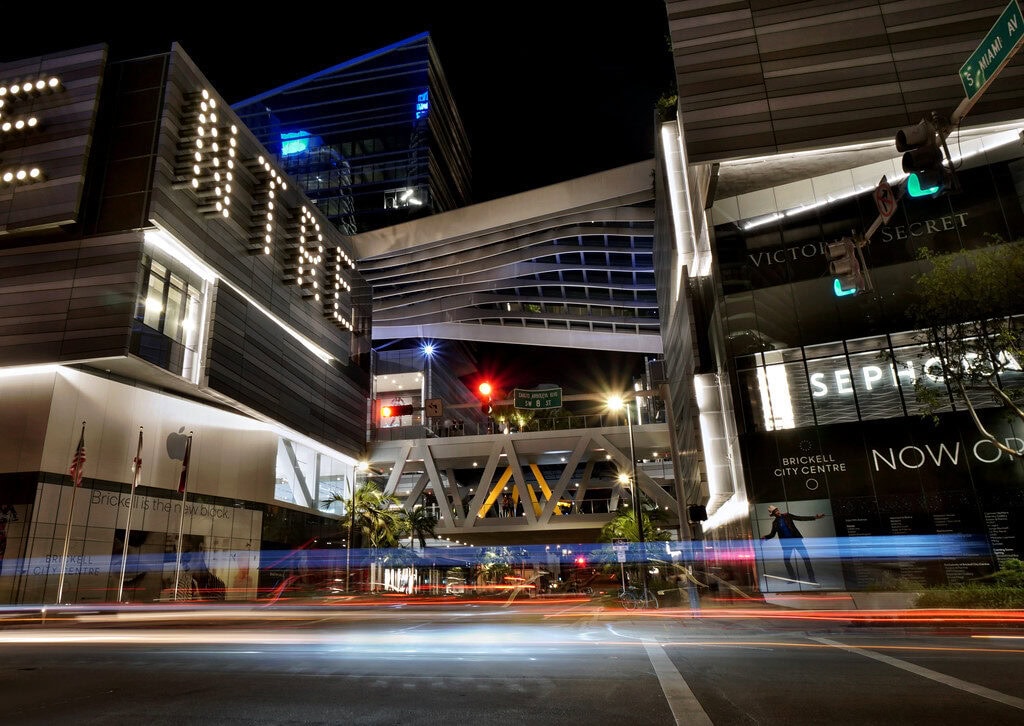
A glass-and-steel canopy extends over three city blocks of sidewalk, and the air beneath it keeps moving. It is not the cold air of an enclosed mall. It is real outdoor wind.
The canopy's curved shape directs the southeast trade winds that come in from Biscayne Bay and keeps them moving at street level.
A woman sitting at an outdoor table and looking at her phone is comfortable. A man in a suit walks from the Metromover station into an office lobby without slowing down.
The air around them is being controlled by the design of the structure, even though most people do not think about it.
The canopy is called the Climate Ribbon.
Hugh Dutton & Associates engineered it to shade the pedestrian streets between the towers, direct the usual breezes through the site, and collect rainwater - about 5 million gallons each year.
It covers a nine-acre development at 701 South Miami Avenue.
That development includes two office towers, two residential towers, a hotel, a shopping center, and a rebuilt Metromover connection for the full complex.
Brickell City Centre Grew Out of a Tennis Club
In 2008, when many developers were pulling back from South Florida, Swire Properties began buying land in Brickell. The Hong Kong-based company first bought about 5.6 acres.
More than two years later, in 2011, it added two more parcels. One was the Brickell Tennis Club. Another was Eastern National Bank's former headquarters.
That brought the site to more than nine acres, and that size was important.
Miami's zoning code, called Miami21, took effect in 2010. It included a rule for sites of at least nine acres. Those sites could be approved as special area plans.
That meant a developer could plan the entire property as one connected district instead of filing separate plans for each building, one lot at a time.
For a project of this size and complexity, that made a major difference.
Swire presented its plan to the city in 2011.
The proposal included a hotel, two residential towers, an office building, major retail space, bowling, restaurants, two levels of underground parking, and a redesigned Metromover station built into the complex.
The project covered 9.1 acres and had 4.6 million square feet of floor area.
Groundbreaking took place in June 2012. The budget was $1.05 billion. Bal Harbour Shops became a retail partner in January 2013. Simon Property Group joined in April 2015.
The Most Difficult Part Was Building Below Ground
Building underground in Miami is unusually hard. The ground is made of porous limestone, and the water table sits close to the surface.
Because of that, large underground construction projects in South Florida have often been seen as more trouble than they were worth.
The plan for Brickell City Centre included a two-level parking garage running under four city blocks. No Miami developer had tried to build underground on that scale before.
Engineers handled the problem with deep-soil mixing, a method that blends cement into the existing ground to create a stable mass below the excavation area.
They also used perimeter sheet piling, which places steel sheets around the edges of the site to keep groundwater from flowing in from outside.
Construction began in July 2012. The underground area covered about seven acres. Long auger-cast piles were drilled deep into the ground to support the weight of the towers.
Major utility lines under the surrounding streets had to be relocated as the underground work progressed. At the same time, the surrounding Brickell district had to remain open and operational.
While that work was happening below ground, Arquitectonica was designing the towers above ground.
The Climate Ribbon canopy was also being tested in wind tunnels and checked with computer simulations to make sure it would work as planned.
Brickell City Centre Opened in Phases
Things opened in stages, beginning with one of the two office towers. Three Brickell City Centre, a twelve-storey building, welcomed its first tenants in March 2016.
Law firm Akerman LLP took 110,500 square feet - about 80 percent of the tower - as the anchor tenant.
The building was LEED Gold pre-certified and was the only office tower in the Brickell area physically attached to the Metromover structure.
EAST, Miami came next. The hotel opened on May 31, 2016, with 352 guest rooms in total, including eight suites and 89 residence suites.
Arquitectonica designed the tower, and Clodagh Design handled the interiors. The rooftop bar Sugar became one of the hotel's signature attractions.
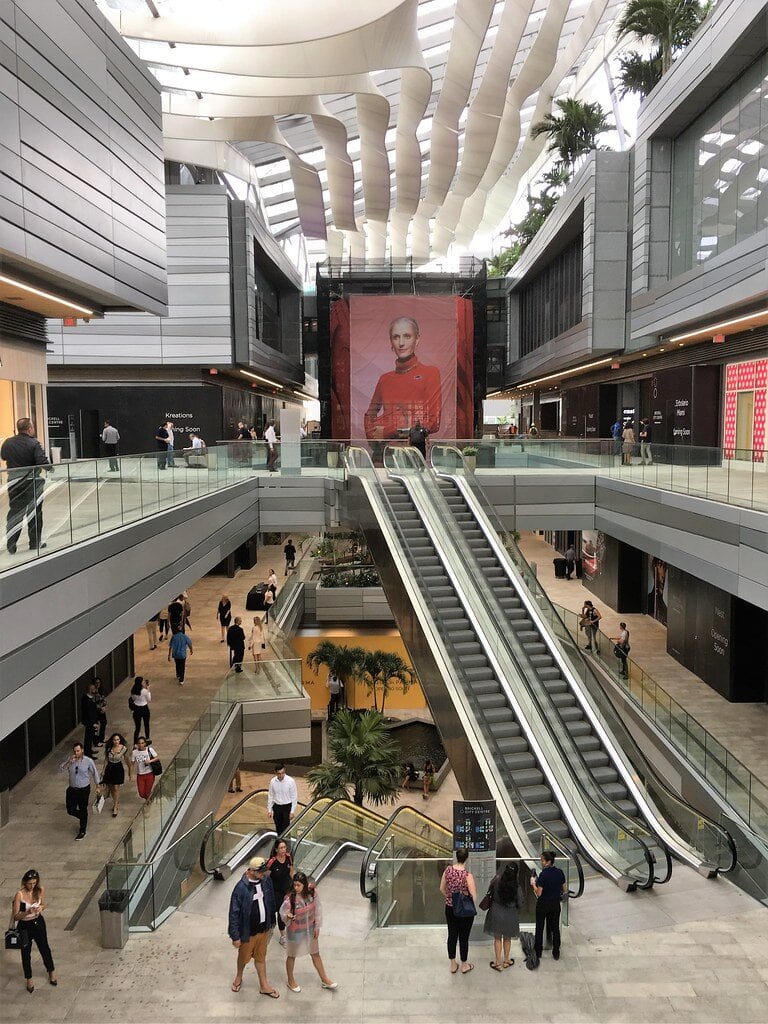
The shopping center opened to the public on November 3, 2016, and its grand opening followed on November 4, with more than 2,000 guests attending the launch.
The center offered 125 stores in total, though not all were open on the first day. Saks Fifth Avenue anchored the retail component with three floors and 107,000 square feet, plus its own street entrance.
A luxury dine-in Cinemex theater led the entertainment offering.
Two Brickell City Centre, the other office tower, was completed later in 2016 and opened in February 2017. Both office towers were fully leased by the end of 2017.
The two residential towers, REACH and RISE, each had 390 units, and all remaining units were sold by 2021, with the final batch sold in bulk rather than to individual buyers.
Swire Finished and Then Started Letting Pieces Go
Swire did not hold the finished complex for long. Starting in 2020, the company began selling off individual pieces, usually while keeping the management contracts.
The two office towers were sold in July 2020 to affiliates of Northwood Investors, with Swire retaining property management for both.
The EAST Miami hotel was sold in October 2021 to an institutional investor.
Swire Hotels kept the management role - the staff, the brand, the day-to-day operation all stayed the same, and only the legal ownership changed.
The shopping center was doing well through all of this. It reached 100 percent occupancy by the end of 2023, with retail sales growing 24 percent in 2022 and another 13 percent the following year.
H&M opened a two-level, 26,000-square-foot store in October 2024.
That same month, Swire announced eleven new tenants for a North Block expansion - 65,800 square feet, Anthropologie, Aritzia, Marc Jacobs, and Lacoste among them.
The development land adjacent to the complex, held for years as the planned site of an 80-storey tower called One Brickell City Centre, was sold in May 2025 for approximately $211.5 million.
The tower had been in Swire's plans since at least 2013. It was never built.
Simon Took Control of Brickell City Centre's Retail and Parking
Simon Property Group had owned 25 percent of the retail part since 2015.
In April 2025, Swire bought Bal Harbour Shops' 12 percent stake for $73.5 million. That increased Swire's share to 75 percent.
Two months later, in June 2025, Swire sold that 75 percent stake to Simon for up to $548.7 million. The sale also included the parking structure and certain shared facilities.
Leasing activity continued during those ownership changes. In June 2025, nine new leases covering more than 29,000 square feet were announced.
In June 2025, Brickell City Centre said Dior Beauty, Alo Yoga, and Joe & The Juice were already open, while Massimo Dutti was among the brands scheduled to open later in 2025 or early 2026.
The ownership structure is now split across different parts of the project. Simon owns the mall and the parking components.
The components do not share a single address, though the retail center remains linked across three city blocks by the Climate Ribbon canopy.