The Shops at Sunset Place opens, and jams up
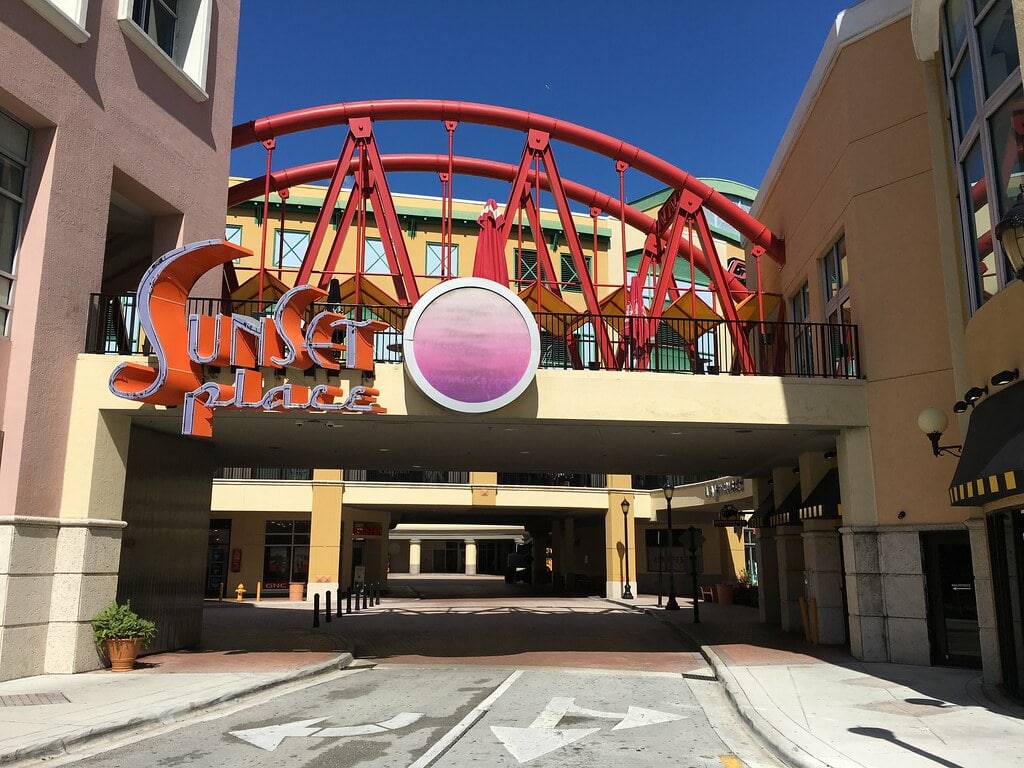
In January 1999, The Shops at Sunset Place opened at U.S. 1 and Red Road in South Miami, across from the South Miami Metrorail station and just south of the University of Miami.
It was planned as a destination mall, built around the idea of an all-day visit. The project opened with about 510,000 square feet of retail and entertainment space.
Its largest tenant was a 24-screen AMC multiplex with an IMAX. Early tenants included Virgin Megastore, GameWorks, FAO Schwarz, Barnes & Noble, Gap, Banana Republic, Urban Outfitters, and Esprit.
Construction was reported at about $150 million, with more than $6 million set aside for architectural effects.
The main plaza featured a large artificial banyan tree. A central water feature spilled over painted cement rocks and plastic ivy.
Wilderness Grill, one of the restaurants, used staged effects such as fake lightning and rain. Some critics described the overall look as "the Heart of Shopping Mall Darkness" and "the Death Star."
Parking problems appeared immediately. The mall opened with a garage holding about 1,800 spaces.
The garage filled quickly, producing long delays. Drivers reported waits of around 45 minutes to park and similar delays to exit.
Nearby homeowners complained about cars spilling into local streets and onto lawns.
City officials also raised concerns about access to the dedicated Metrorail parking lot across U.S. 1, which required crossing six lanes of traffic.
Riviera Theatre opens, closes, almost instantly
In the mid-1920s, the area at U.S. 1 near Red Road was developed for entertainment.
Brothers Harold and Robert Dorn, who had moved from Chicago in 1910 and worked in fruit farming and real estate during the Florida land boom, built the Riviera Theatre.
Architects L.R. Patterson and E.R. Robertson of Robertson & Patterson designed the building in Mediterranean Revival and Spanish Moorish styles.
It was constructed of steel and concrete and seated about 1,000 people. The exterior featured a wide stairway leading to arched entrances, decorative carvings and coat-of-arms details, and a barrel-tile hip roof.
The interior was finished as a high-ceilinged auditorium, with ceilings rising to about 37 feet and hand-painted beams overhead.
A gently sloping floor led toward the stage. Columns lined the aisles. The theater included a large Wurlitzer organ, described as "the largest south of Atlanta," with pipes installed on both sides of the stage.
Organist Gilbert Edwards played at the opening.
The Riviera opened on September 4, 1926. The inaugural film was Universal's "Her Big Night," starring Laura LaPlante.
On September 18, 1926, the Great Miami Hurricane struck South Florida. The theater sustained minor damage, but the storm disrupted the region's economy and services.
Electric power took weeks to restore. Attendance dropped as residents struggled financially. The theater closed in 1927, about a year after it opened.
Holsum turns a theater into a bread engine
In 1934, Fuchs Baking Company bought the long-vacant Riviera Theatre building and converted it into a bakery that produced Holsum Bread, popularly known as the Holsum Bakery.
The company had operated since the early 1910s from Homestead. The conversion required major interior alterations to fit production.
The open stairway and the arched entrances stayed in place, so the former theater still looked like itself from the street.
The bakery grew into a large operation and became the most consistently successful use of the property. At full capacity it could produce about 10,000 loaves per hour.
Distribution ran across South Florida and extended to Puerto Rico, Cuba, and other Latin American markets.
In South Miami, the bakery was also known for its daily presence in the air. The smell of fresh bread carried through the surrounding area for decades.
Around 1940, Holsum added a public tradition at the front of the building. Each holiday season, the facade was covered with elaborate themed Christmas displays.
The displays drew thousands of spectators each year. Postcards featuring the scenes circulated from at least 1948 through the 1950s.
Holsum operated on the site until 1982, when it moved northwest to Medley to expand and modernize. The relocation ended nearly fifty years of baking.
Bakery Centre rises, then drops after ten years
After Holsum left in 1982, the property was purchased for a new retail project that kept a reference to the site's recent past in its name.
The Bakery Centre opened in 1986 on the former Holsum bakery site.
It was built as a large, five-level complex combining offices and retail. The project included a movie component, the AMC Bakery Centre 7 Theatres multiplex, bringing a cinema back to the corner.
The center did not develop into a stable shopping destination. It lacked major anchor tenants and did not attract enough consistent customer traffic to sustain the tenant mix.
The complex remained in place through the late 1980s and early 1990s, but vacancies and turnover persisted.
After the Bakery Centre was demolished in 1996 (with the parking garage remaining), the site sat cleared while a new retail and entertainment complex was planned and built in its place.
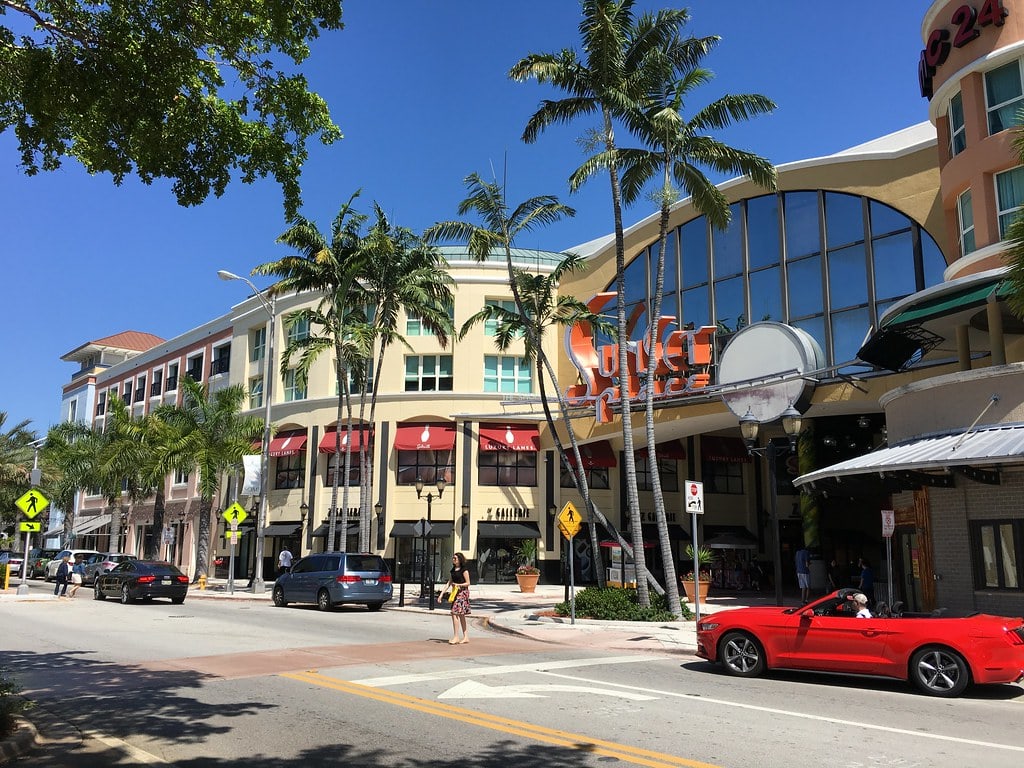
The Shops at Sunset Place debuted in late 1998 and held its opening in early 1999. In the years that followed, the site became a familiar gathering spot, especially for moviegoers, students, and teenagers.

Teen years: movies, music, and a shuttle stop
In the early 2000s, The Shops at Sunset Place functioned as a regular gathering place for teenagers and college students.
The property offered long interior walks, food and seating areas, and a concentration of entertainment that kept people on site for hours.
The 24-screen AMC theater drew crowds for new releases and opening nights. Barnes & Noble served as a common place to spend time indoors.
Virgin Megastore operated as a music and media anchor, and its early period included a grand-opening appearance by Ricky Martin that drew lines of shoppers before dawn.
University of Miami students reached the mall easily from campus. The free student "Hurry 'Canes Shuttle" included Sunset Place as a stop. Stores promoted discounts for UM students.
Buffalo Wild Wings tied one promotion to Hurricanes football, offering free wings when the team's defense forced fourth-down punts during home games.
The tenant lineup combined retail with entertainment. GameWorks provided a large arcade. Apparel stores, including Gap, Urban Outfitters, Victoria's Secret, and Forever 21, filled the mid-market shopping mix.
In 2008, Splitsville Luxury Lanes and Dinner Lounge opened at the property, adding a bowling venue with food and drinks and extending evening activity beyond the movie theater.
A mall that faces inward learns isolation
By the late 2000s, The Shops at Sunset Place began to lose shoppers and tenants. The building's layout was inward-facing and organized around interior corridors and plazas.
From the street, much of the structure presented a large concrete exterior with limited transparency and few storefronts oriented outward.
The design reduced visibility from U.S. 1 and surrounding streets and limited casual, walk-in shopping from the adjacent area.
During the same period, shopping patterns changed. More purchasing shifted online, and newer retail projects in the region emphasized open-air formats with storefronts facing sidewalks and streets.
Sunset Place remained a contained interior environment, and the gap between the building and its surroundings became more noticeable as foot traffic declined.
Competition increased. Dolphin Mall became a stronger retail draw in the Miami market by the mid-2000s. At Sunset Place, some entertainment uses changed hands rather than expanding.
By 2014, the property housed the Miami area's only GameTime location, which replaced the original GameWorks arcade.
By the 2020s, vacancy and wear were prominent. Some visitors described dirty walls, stairs, and floors and referred to the property as "cursed."
University of Miami students reported choosing other shopping areas, including Shops at Merrick Park, or not visiting Sunset Place at all.
2015 sale, stalled plans, then the pandemic
In October 2015, Simon Property Group sold The Shops at Sunset Place for about $110 million.
The buyer was a joint venture led by Federal Realty Investment Trust, with Grass River Property and the Comras Company. The new ownership group proposed a major redevelopment.
The concept called for reducing the amount of retail space, adding offices, and demolishing a large portion of the existing mall to make room for apartment buildings and a hotel.
The plan also aimed to reorient retail outward to face streets rather than interior corridors. The proposal did not advance to construction.
By 2019, the property was reported at 62 percent leased. Average base rent was reported at about $17 per square foot. In March 2019, Yumbrella opened as a 6,500-square-foot food hall within the mall.
In 2020, major tenants and attractions closed as the COVID-19 pandemic disrupted retail and entertainment. The AMC theater closed.
GameTime and Splitsville also closed. In June 2020, the owners reported the property's carrying value at about $113 million.
In September 2020, Federal Realty defaulted on a $61 million nonrecourse CMBS loan when it matured.
Federal Realty decided to exit the property. Midtown Opportunities acquired Sunset Place for $65.5 million. The transaction closed at the end of 2020, and ownership carried into 2021.

Heatherwick arrives and brings back the streets
After Midtown acquired the property, the development team moved away from incremental renovation and began planning for full demolition and a complete redesign of the site.
They visited New York City and became interested in work by Heatherwick Studio, including "Little Island." Midtown then hired the London-based firm to develop a new concept for the South Miami site.
The design approach replaced the enclosed mall format with an extension of the surrounding street grid.
The plan called for a network of smaller streets and lanes running through the site, with smaller retail and food-and-beverage spaces arranged along them.
The concept emphasized storefronts with direct street access and a layout that allowed pedestrians to move through the property rather than into an interior corridor system.
Thomas Heatherwick described the intent as removing the sterile atmosphere of the former mall and restoring streets as the organizing element.
The massing plan used slim residential towers raised on columns, creating open circulation space at ground level.
Heatherwick Studio served as master planner and lead designer. ODP Architecture & Design was named executive architect, and additional local firms involved.
Numbers, phases, and the long countdown
On October 15, 2024, the South Miami City Commission unanimously approved a comprehensive redevelopment plan for the property, branded as "Sunset Place." The site plan divides the 10.1-acre parcel into four zones: Sunset Zone, Village, Central, and the US-1 Gateway.
The approved program totals about 1.47 million square feet of development. It includes 1,513 residential units and a 287-room hotel. The plan calls for nine towers ranging from 12 to 33 stories.
The commercial program is smaller than the housing component.
Retail is planned at roughly 140,500 to 150,000 square feet, with about three-quarters allocated to restaurants and dining and the remainder to traditional retail.
Office space is planned in the range of 60,000 square feet. The plan includes a 1,300-seat theater intended for movies and performing arts.
Public open space totals about 3.37 acres, organized as plazas, gardens, and pedestrian areas.
Parking is planned at 2,418 spaces, provided through below-grade and structured facilities, with the existing garage expected to remain in use.
Demolition of the current mall is scheduled for the first quarter of 2026, pending final permits and pre-sales. Condo sales are expected to begin before demolition.
The project is planned in phases, with a first phase targeted for 2029 that includes new streets, public-realm work, a residential condominium tower, and the hotel.
Full buildout is projected for 2035. Interim uses, including temporary installations, pop-ups, and public spaces, are planned during construction.