
Spend a morning in Palm Coast, and you start to get it. There are paths behind the grocery store that spill into the oak hammock.
Canal-side bike lanes that suddenly dead-end at a boardwalk over open swamp. A fishing pier where dolphins show up uninvited.
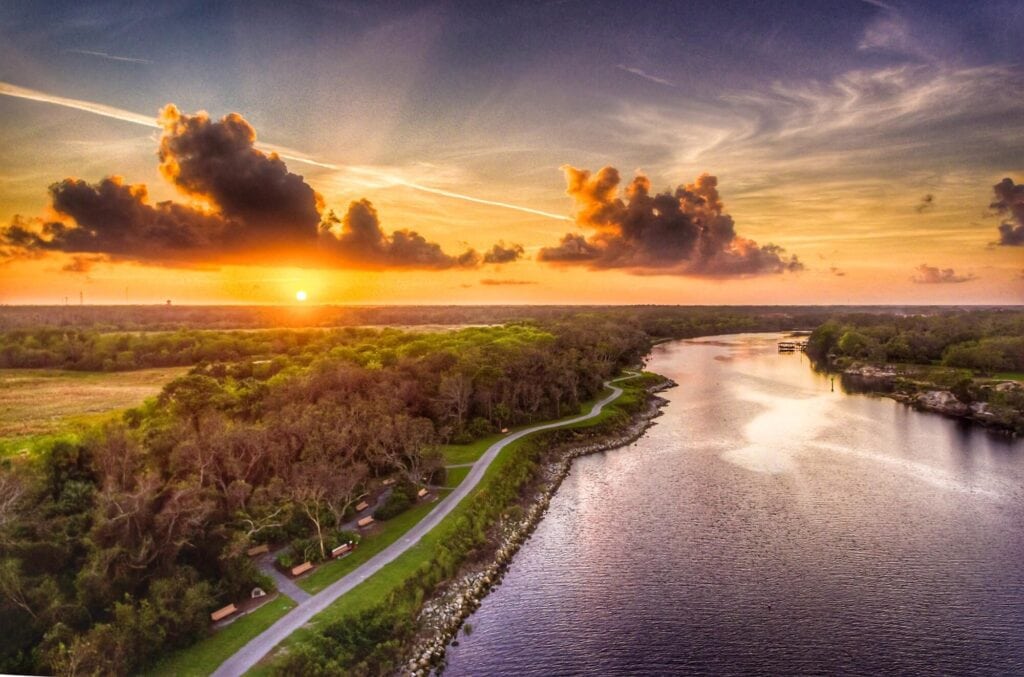
More than 130 miles of connected trails run through this city, and the reason isn't luck or tourism strategy - it's how the place was physically built, and what the land around it happens to be.
Master-planned layout: Palm Coast was carved out of pine forest and swamp starting in the late 1960s.
Roads, drainage canals, and open-space buffers were built in together, leaving corridors that became the skeleton of today's trail network.
Compressed geography: Freshwater swamp, Intracoastal waterfront, salt marsh, coastal scrub, and Atlantic barrier island habitat all sit within a few miles of each other here, giving trails genuine variety rather than the same scenery on repeat.
A network, not a collection: The trails are designed to connect - neighborhood to greenway, greenway to preserve, preserve to waterfront.
Waterfront Park's 20 acres are linked by trail to Linear Park's 57 acres, which hooks into St. Joe Walkway, which reaches the Intracoastal.
Big natural preserves with open access: Graham Swamp holds more than 2,500 acres of wetland hardwood swamp. Princess Place Preserve runs to 1,500 acres.
Betty Steflik Memorial Preserve adds salt marsh boardwalks, black mangrove, and a gopher tortoise nesting ground. None of it is locked away.
The A1A corridor: The 72-mile A1A Scenic and Historic Coastal Byway stitches together state parks, nature preserves, estuaries, and beaches - and feeds directly into the city's own trail system.
Planning that backed it up: The city formally treats trails and parks as infrastructure, not amenities.
The 2023 Parks and Recreation Master Plan mapped and assessed the entire system countywide, using GIS analysis and public surveys to set priorities for expansion.
Palm Coast's Planned Origins Created the Trail Framework
In the late 1960s, the land that became Palm Coast was mostly pine flatwoods, wetland, and scattered small farms.
A private developer moved in and started building the physical skeleton of a planned community from scratch - roads, a water-management canal system, drainage easements, neighborhood blocks, and open-space buffers all laid out together.
That sequencing matters. The preserved corridors between subdivisions, the utility easements along canals, the green buffers between road sections - those became trail routes before anyone called them that.
The city was incorporated in 2000 and inherited that framework.
Today, it uses 9.9 acres of parkland per 1,000 residents as a planning standard, a figure that reflects the open-space decisions baked into the original design.
Why the Geography Gives Palm Coast Unusual Trail Variety
Graham Swamp sits to the west of the city. Its basin covers more than 2,500 acres of wetland hardwood swamp, and its headwaters historically fed Bulow Creek.
The swamp absorbs and filters stormwater runoff from development to its north and west - functional conservation land doing real ecological work, not just a scenic backdrop.
Heading east, the Intracoastal Waterway cuts through the center of the city.
The Atlantic coast is a short drive beyond that, where River to Sea Preserve at Marineland covers 90 acres from the ocean to the Intracoastal, protecting a maritime scrub environment that has mostly disappeared from this stretch of Florida.
Washington Oaks Gardens State Park adds coquina rock shoreline, oak hammock, and Matanzas River frontage.
The variety isn't manufactured. It's just what happens when a city sits at this particular junction of inland and coastal Florida.
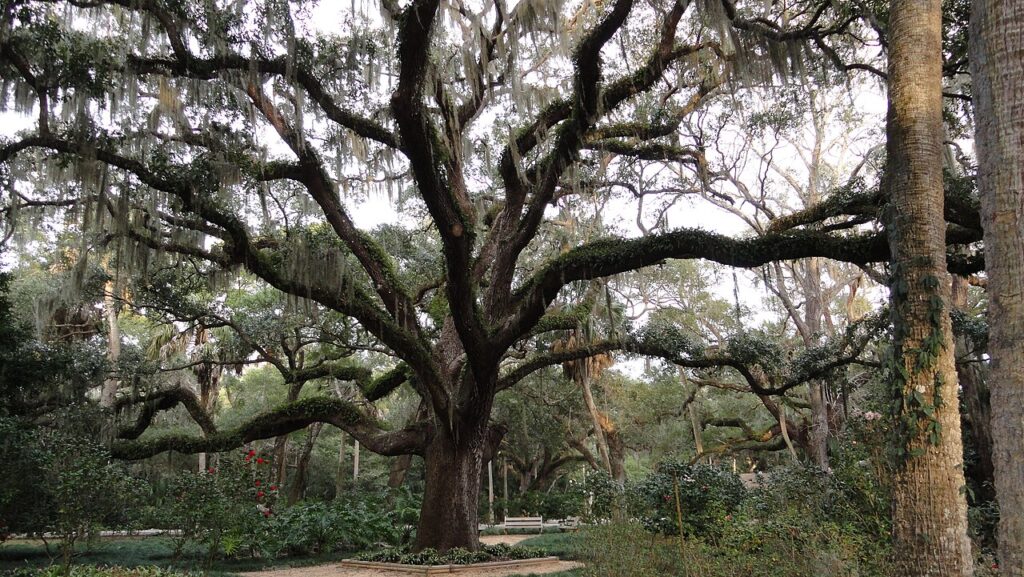
" by Andyrkellergmail is licensed under CC BY-SA 4.0
How 130-Plus Miles of Connected Trails Define the City
The named corridors alone make a long list: Old Kings North and South Greenways, Lehigh Rail Greenway, Seminole Woods Greenway, Town Center Greenway, Linear Park Greenway, Graham Swamp Trail, Easthampton Trail, Pine Lakes Trail, South Belle Terre Greenway, Sesame Boulevard Trail, Mulberry Branch Trail, Waterfront Park Greenway, the Northeast Corridor Greenway, Bulow Creek, and more.
The point isn't the number of names - it's that they link up. A multi-use path along a road connects to an off-road trail, which connects to a boardwalk over a wetland, which connects to a rail corridor.
Linear Park's 57 acres of oak and palmetto habitat sit between the eastbound and westbound lanes of Palm Coast Parkway, with short internal trails - Live Oak, Magnolia, Sabal Palm, Saw Palmetto - that feed out to St. Joe Walkway, a one-mile connector to the Intracoastal.
In 2024, a StoryWalk with 20 kiosks was added along that connector, spreading pages of a monthly themed story across a half-mile of trail.
Lehigh Trail: From Cement Spur to Backbone Route
The Lehigh Portland Cement Company operated here for decades, and a railroad spur ran from its plant to the Florida East Coast Railroad.
That spur is now Lehigh Trail, a rail-trail running east-west through Town Center and alongside the Lehigh Canal before pushing into Graham Swamp toward U.S. 1 north of Bunnell.
Rail-trails have a specific character - long, flat, and direct - and Lehigh Trail uses that to function as one of the main spine routes connecting Palm Coast's otherwise scattered trail pieces.
The Lehigh Trailhead at the western end has lighted parking, restrooms, community garden plots, and separate small and large dog park enclosures.
The trail moves through developed Town Center, then into swamp-edge conservation land, a range that few single-corridor trails can manage.
Graham Swamp: Boardwalks on One Side, Rock Gardens on the Other
The eastern entrance to Graham Swamp Preserve leads to an unpaved mountain bike trail built for people who want difficulty - exposed roots, sudden dips, coquina rock gardens, sand patches, steep technical climbs, and sharp downhill drops through dense forest.
The western side is a different place: a wide coquina multi-purpose path and elevated boardwalk sections along the swamp's edge, flat and accessible, with room for birders and walkers who want none of the technical stuff.
White-tailed deer, river otter, fox, wading birds, and waterfowl use the same preserve.
That split between trail types inside a single conservation area is part of why Palm Coast's outdoor reputation holds up across different kinds of users.
What A1A Adds to the Trail Picture
A1A received National Scenic Byway designation in 2002 and became Florida's second All-American Road in 2021.
It's a 72-mile run through Flagler and St. Johns counties that strings together coastal parks and preserves that would otherwise be separate experiences.
Near Palm Coast, the byway connects Washington Oaks Gardens State Park, River to Sea Preserve, MalaCompra Greenway Trail, Gamble Rogers Memorial State Recreation Area, Betty Steflik Memorial Preserve, Bulow Creek State Park, and Bulow Plantation Ruins Historic State Park.
Betty Steflik brings salt marsh boardwalks, black mangrove habitat, and gopher tortoise nesting areas. Princess Place Preserve adds 1,500 acres with equestrian trails and historic lodge structures along Pellicer Creek.
Bulow Creek State Park has a nearly seven-mile trail connection and the Fairchild Oak, one of the largest southern live oaks in the state.
Birding, Paddling, Archaeology, and What Else Pulls People Out
St. Joe Walkway and Linear Park both carry Great Florida Birding and Wildlife Trail designations.
More than 200 bird species have been recorded across Flagler County's parks and preserves - bald eagles, pileated woodpeckers, barred owls, red-shouldered hawks, black-and-white warblers, and common yellowthroats.
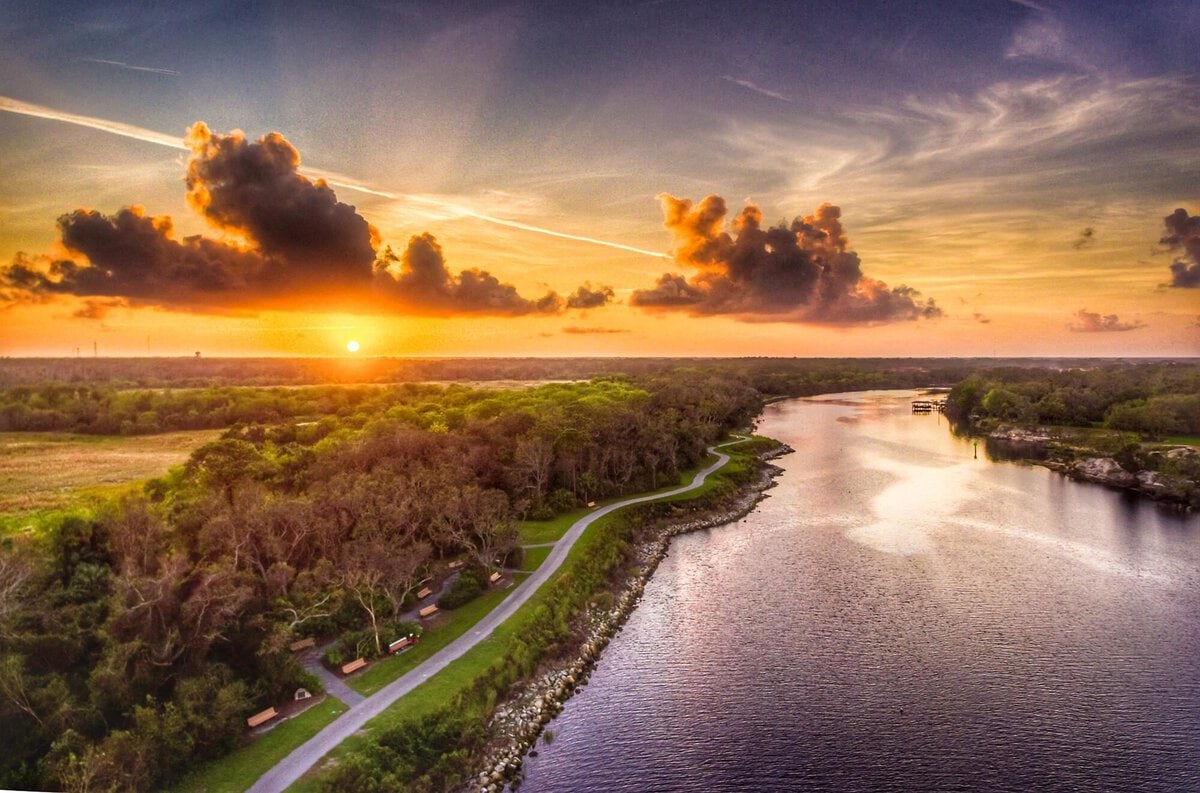
Dolphins and manatees turn up regularly along the Intracoastal Waterway Trail near Waterfront Park's fishing pier.
Long Creek Nature Preserve, a nine-acre site between Long Creek and College Waterway, has a six-mile paddling route toward Bing's Landing that follows 19th-century shipping corridors toward the Hernandez Landing Site, an archaeological resource from the early 1800s Plantation Period.
The 2023 Parks and Recreation Master Plan formally assessed this entire picture - trails, facilities, natural areas, programs - using onsite reviews, citizen surveys, GIS analysis, and public forums across Palm Coast and Flagler County.
Palm Coast's reputation for trails and parks holds up because the physical evidence is there: 130-plus miles of connected routes, 12 municipal parks, a rail-trail backbone, large natural preserves open to the public, a nationally designated coastal byway, and consistent planning that keeps adding to it.
The network works because the city was built in a way that made it possible, and the land around it gave it somewhere worth going.
Independent Publisher Notice
BestAttractions is an independent editorial publisher. We are not affiliated with, endorsed by, or acting on behalf of any location, business, property owner, manager, government agency, or organization described in this article. Comments posted on this page are not forwarded to, reviewed by, or acted upon by any entity mentioned in the article. For official inquiries, complaints, applications, bookings, or other requests, please contact the relevant entity directly through its official website or other verified channels.