Swan House's early years on Buckhead's high hill
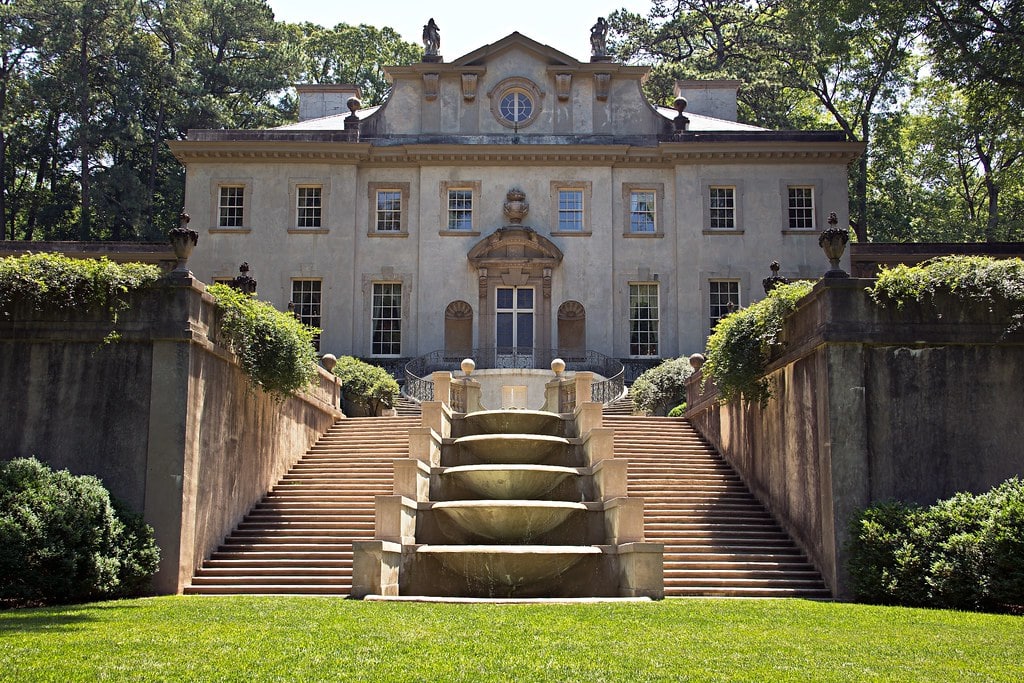
The Swan House stands at 130 West Paces Ferry Road NW in Atlanta's Buckhead neighborhood. It sits on high ground above formal gardens.
Stone walls, terraced lawns, and a motor court frame the approach, and behind the house a long staircase runs down the slope beside a water cascade.
Edward Inman and Emily Inman planned the house in 1924 as a private residence on a 25-acre estate. The estate included support buildings such as a garage, servants' quarters, and a barn.
Construction began in 1926, and the work finished in December 1928. The Inmans moved in as soon as it was completed.
Philip Trammell Shutze designed the house and the formal grounds.
Swans show up again and again as a decoration inside the house, and the house's common name, Swan House, seems to have come from this pattern, although no one knows for sure where the name started.
The house was built for family life and formal entertaining, and its plan matched that purpose.
It included a vestibule, a library, a morning room, a dining room, four bedrooms, a sitting room, a basement, and an apartment in the attic.
Shutze and Emily Inman planned the decoration and furnishings together so the rooms could hold her antiques.
Philip T. Shutze and the 1920s build
Philip Trammell Shutze trained as an architect at the Georgia School of Technology, Columbia University, and the American Academy in Rome.
He began professional work as a draftsman for the Atlanta firm Hentz, Reid, and Adler. He later became known for classical design, precise proportions, and detailed ornament.
Swan House reflects the work he studied in Italy and England. He placed the mansion on the hill so the house and the grounds would read as one design.
He used strong geometry in the building massing and in the garden layout, then carried the same classical theme into the exterior setting with fountains and stone elements placed outside the house.
The site design includes a dramatic water cascade descending the hill. The cascade follows the Palazzo Corsini in Rome, which Shutze studied while at the American Academy.
The gardens use terraced levels, stone retaining walls, and formal planting areas, with broad open lawns set alongside smaller boxwood garden rooms that create more private outdoor spaces.
What the house looked like when finished
The Swan House was finished in a style that brings back the look of the Renaissance. It combines classic Italian and English design.
On the west side, the front is even and balanced, like Italian Renaissance buildings. The garden waterfall adds to the feeling of an Italian villa.
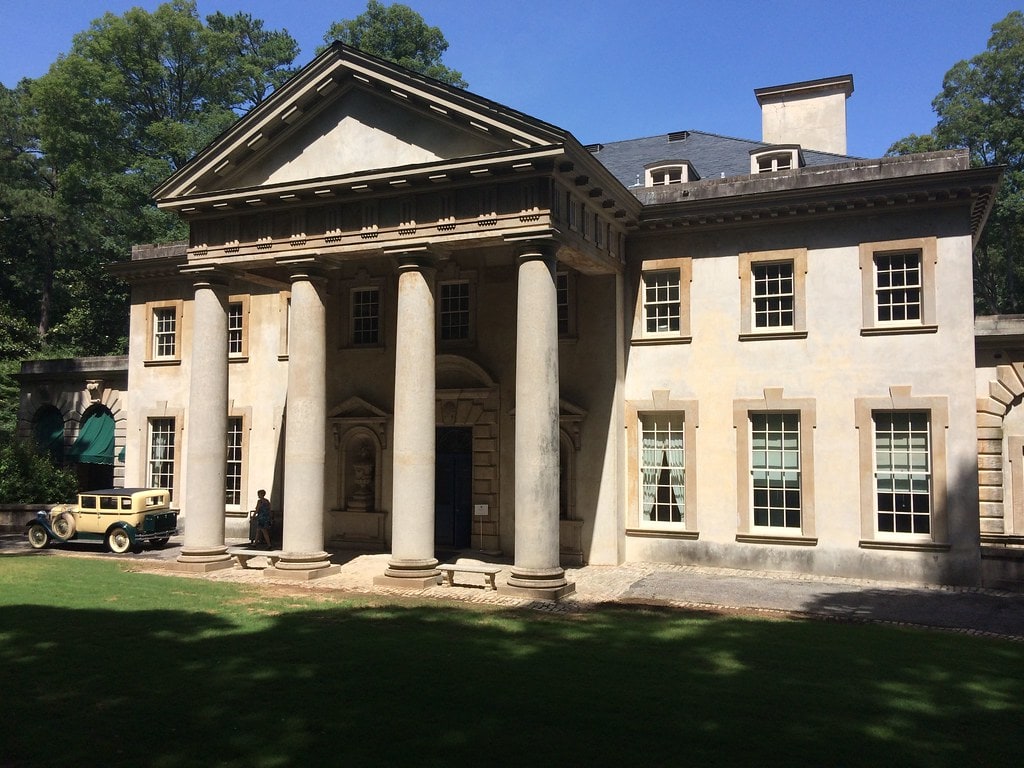
On the east side, the main entrance has a portico, which is a covered entry held up by columns, and it uses an English style that connects Italian ideas to the country houses found in England.
Outside, the grounds and outside walls have stone obelisks, fountains, and other old-fashioned building features.
The main entrance has a porch with columns and a triangular roof above the door. Experts say this porch is similar to those found on old English country houses, like Duncombe Park in Yorkshire.
Statues showing Spring and Autumn are on the front of the building above the entrance.
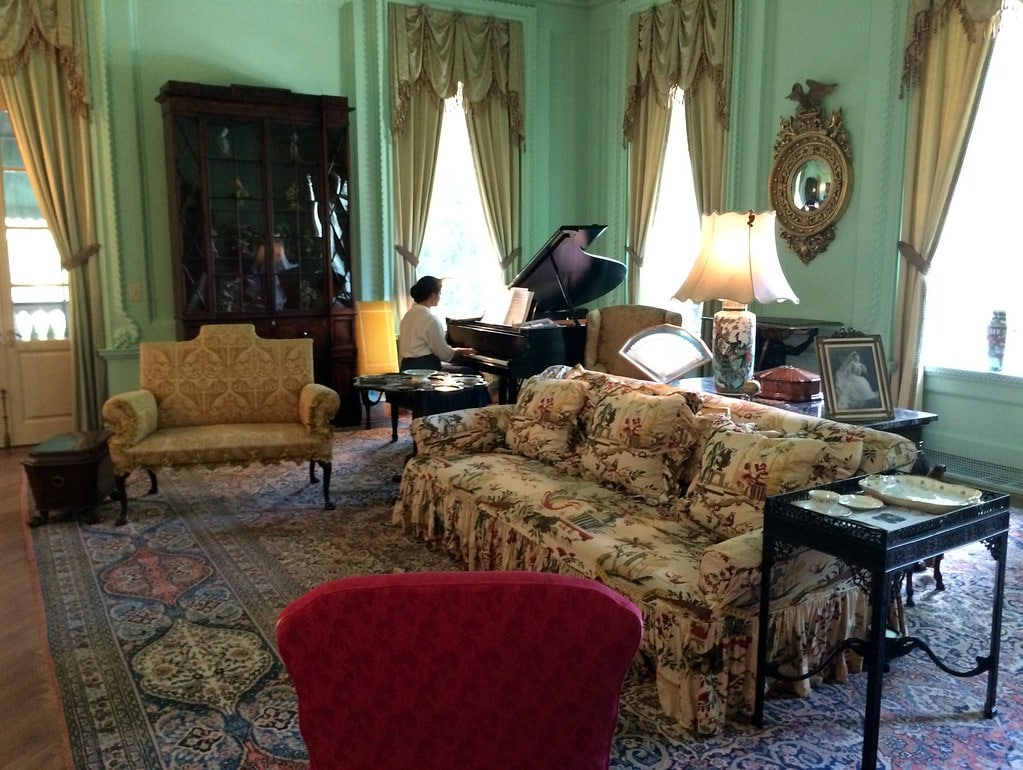
Inside, carved and shaped details are deep enough to make shadows as sunlight moves through the rooms. Wood carving and wall decorations have the same English style as the outside.
The rooms use designs from the 1700s, but the furniture shows the style of the 1900s and what the Inman family liked to collect.
Family life after the move-in in 1928
The Inman family built its wealth in the cotton industry. After the Civil War ended in 1865, thay used part of that wealth to help rebuild Atlanta.
Edward Inman and Emily Inman later inherited that cotton fortune. The Inmans moved into the house in December 1928.
Edward Inman died suddenly at age 49, just three years after the move-in, in 1931.
After his death, Emily Inman asked her oldest son, Hugh, to live with her. Hugh moved in with his wife, Mildred, and their two small children.
Grandchildren Sam and Mimi grew up in the home, and they moved out after they were married.
Emily Inman made strict rules about how people could use the house to keep the parts she cared about safe.
To keep the steps of the main staircase in good shape, she had some family members, especially the children and grandchildren, use the back stairs instead, especially when going between the first and second floors.
Emily remained in the Swan House until her death in 1965. During her lifetime, the house and grounds stayed tied to the original estate plan, with the main house and support structures still part of one property.
1966 purchase and the 1967 opening to tours
In 1966, the Atlanta Historical Society purchased the Swan House. The goal was to preserve the property and use it as a new headquarters for the Society, and the purchase drew broad community interest and participation.
After the purchase, the mansion did not provide enough space for all headquarters functions.
A new building was constructed on the estate grounds to serve as the headquarters. With that change, the Swan House shifted into primarily museum role.
The property opened to the public for tours in 1967. The tours offered visitors a view into Atlanta society in the 1920s.
The house was restored to its original state, with interior and exterior work intended to match the historic appearance.
The gardens remained central to the visit, and the terraces, walls, and water cascade continued to shape how the property is seen and used.
Historic designations and screen uses
The property has formal historic protections. Swan House was added to the National Register of Historic Places on September 13, 1977.
The City of Atlanta later designated the site as a Landmark Building Exterior on October 14, 1989.
In 1990, the Atlanta Historical Society consolidated its properties into one Atlanta History Center, and the Swan House became part of that unified site.
The property has also been used as a filming location and television setting. It appears in the opening sequence of the 1980 film Little Darlings. It served as the finish line for the 19th season of The Amazing Race.
It was used for scenes in the 2013 film The Hunger Games: Catching Fire and in the 2015 film The Hunger Games: Mockingjay, Part 2, where it served as a White House equivalent within the films' alternate world.
It was set for use for "TCM Remembers 2014" on Turner Classic Movies. It was featured on The CW's soap opera series "Dynasty."
The exterior was used as Crump Manor in Haunted Mansion (2023 film) and in Descendants: The Rise of Red (2024 film).
Today's status and visiting details
Swan House remains part of the Atlanta History Center's Buckhead campus. The campus operates Tuesday to Sunday from 9 am to 4 pm (historic houses open at 11 am), and the museum and grounds are closed on Mondays.
Admission covers the full 33-acre campus, including the 1928 Swan House and 22 acres of gardens.
The house continues in public use as a museum house within the Atlanta History Center, with the grounds included as part of the visit.
The gardens remain part of the same experience as the building.
The terraces, stone walls, and water cascade still set the route through the property and keep the original hill-and-garden layout visible during everyday touring.