Gurnee Mills opens its doors to crowds
The mall unlocked its doors at 8:00 a.m., letting people in two hours before the stores opened. Many arrived just to walk around the building before shopping began.
They moved into the common areas and began taking the route on foot, turning corners and finding the benches and seating pockets along the corridor.
The air still smelled like new tile, with the first hints of food starting to come from the food court areas. By 10:00 a.m., the crowd was estimated at about 70,000 visitors.
Families walked together in small groups. Shoppers sipped coffee as they moved along, while kids searched for things to do in a mall designed to be more than just a row of stores.
When the stores opened, the crowd spread out through the mall rather than surging in one direction.
A time capsule was buried that day at Entry B. It was sealed with 1991 memorabilia and placed there as an opening-day marker.
The gesture was small compared to the size of the mall, but it suited the occasion. Gurnee Mills opened with the hope that people would keep coming back and that future visitors would remember this day.
Annexed fields, big plans, louder doubts
In the late 1980s, the Mills Corporation - working then as Western Development Corporation - planned a Landmark Mills super-regional center at Grand Avenue and the Tri-State Tollway.
In 1988, Western Development announced it would annex more than 300 acres of unincorporated land into the Village of Gurnee to make the project possible.
The site was mostly farmland owned by the Lamb family. The sale came with conditions that some old trees and wetlands on the property would be preserved.
The dispute started before there was anything to tour. Some residents and nearby businesses argued that a mega-mall would pull customers away from small shops and from Lakehurst Mall in Waukegan.
The village approved the project anyway. The location was treated as an advantage - between Chicago and Milwaukee, close to Six Flags Great America, and right off the tollway.
The design was set to look like a place with local references, even at that scale. The concept used a rural Americana theme.
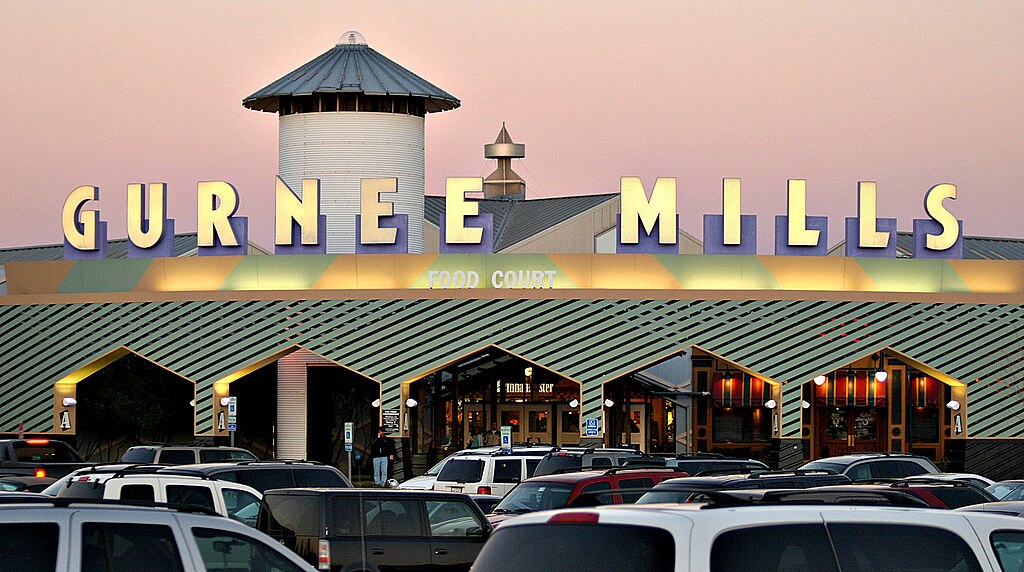
A barn-like silo was planned at one entrance as a marker for motorists. Inside, the look drew from Midwestern farm imagery, 1950s roadside diners, and Frank Lloyd Wright's Prairie Style.
The plan settled into a single-story, Z-shaped corridor about 4,400 feet end-to-end, built to hold roughly 200 stores across about 1.7 million square feet.
Outlet mythmaking and the bus-tour years
The early tenant lineup made it easy to understand what this place was supposed to be. It was bargain retail, but with enough range that you could stay all day without repeating yourself.
The original anchors were Waccamaw Pottery, Phar-Mor, Spiegel Outlet, Bed Bath & Beyond, Marshalls, and a Sears Catalog Outlet store.
Other large spaces filled in soon after. Filene's Basement arrived in October 1991. Gurnee Mills opened about 70% leased, which was considered a strong start for something this large.
From the beginning, it was set up to keep people inside once they had parked.
Two food courts - the Dine-O-Rama and the Lake County Fare - gave the trip a couple of built-in pauses. There was also a small broadcast studio.
A 15-foot video wall showed short videos made by the mall on screens throughout the property, giving both information and setting the mood.
The marketing focused on how big Gurnee Mills was. It was advertised as "the world's largest outlet mall" and shown as a place to visit near a theme park.
This message attracted the first crowds. About 60% of visitors came from more than 40 miles away, and tour buses started arriving from Wisconsin, Indiana, and other places.
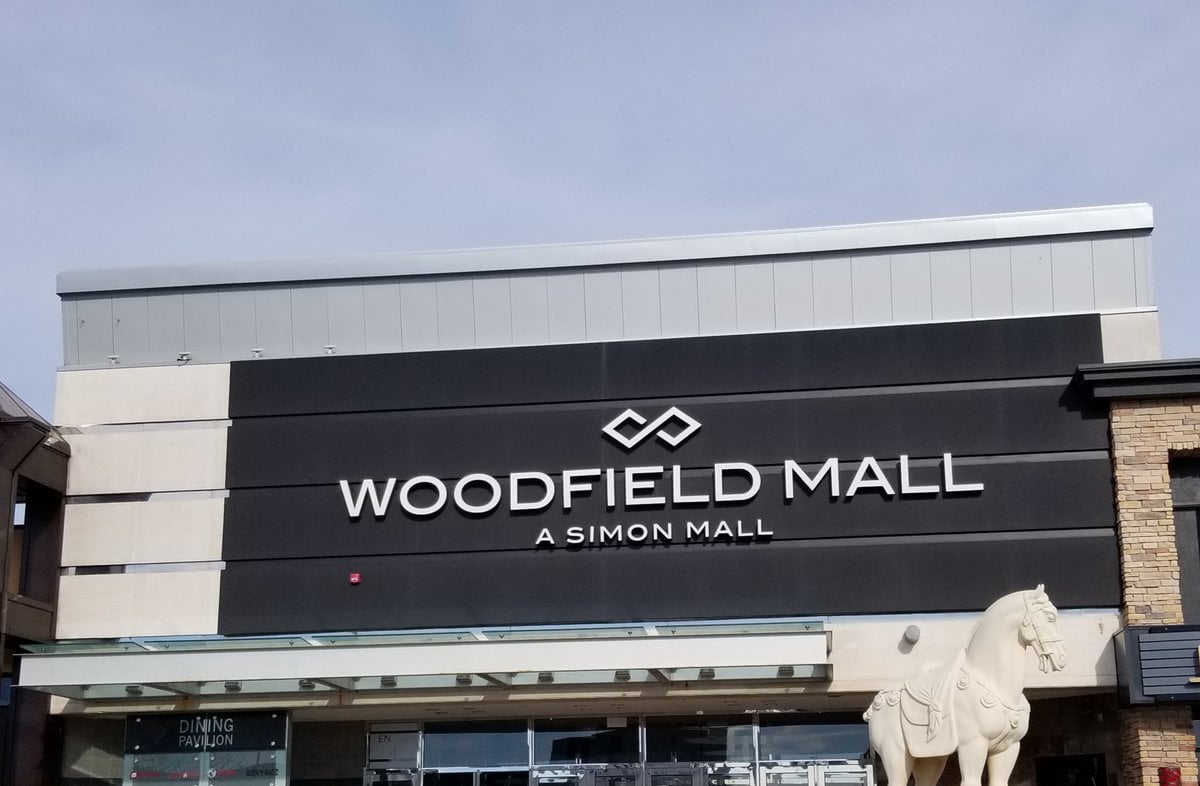
In 1995, around 3,000 tour buses visited. That year, Gurnee Mills drew an estimated 14.4 million visitors and was described as the second-most-visited tourist attraction in Illinois, behind Woodfield.
Rainforest Cafe, Marcus screens, and Serpent Safari
By the mid-1990s, Gurnee Mills was adding anchors and attractions as traffic increased. In 1993, a new wing opened to house Burlington Coat Factory.
That year brought additional tenants, including Foot Locker, Syms, and "The Clearinghouse by Saks Fifth Avenue," a Saks outlet that did not last.
On December 10, 1993, a 10-screen Marcus Theatres cinema opened. It was among the first Marcus theaters in Illinois.
Around the same period, Circuit City built an electronics store outside the mall perimeter along Grand Avenue.
In 1992, Phar-Mor closed after only a year at the mall. The space was backfilled by Value City. New entertainment and restaurant concepts followed.
Rainforest Cafe arrived in 1996 as a jungle-themed restaurant. In July 1997, Planet Hollywood opened its second Illinois location at the mall.
In November 1997, Bass Pro Shops Outdoor World opened in a 125,000-square-foot buildout. It was the second 'true' Bass Pro Shops Outdoor World destination megastore (the heavily themed superstore format) in the chain.
By 1998, annual visitation had climbed to roughly 21 million. In January 1999, Serpent Safari opened as an indoor reptile zoo and pet store.
The attraction featured "Baby," an 18 ft 10 in Burmese python, once recognized by Guinness World Records as the world's largest Burmese python.
In August 1999, Rink Side Sports opened with an NHL-size ice rink, arcade games, and children's play areas.
Makeovers, Sears Grand, and Wannado plans
The early 2000s brought the familiar retail mix of recession pressure and tenant mortality. In 2001, Syms and Waccamaw Pottery closed, with Waccamaw's parent company going bankrupt.
In early 2003, Spiegel shut down all its outlet stores as the catalog company slid into financial trouble.
Planet Hollywood, which had filed for bankruptcy in 1999, and closed its Gurnee Mills location. A short-lived McDonald's-owned "Madrid" tapas restaurant also disappeared in that restaurant shakeout.
Management responded by shifting the mix away from pure outlet logic.
In fall 2003, the mall demolished the old Spiegel outlet and built a full-line Kohl's department store in its place, a deliberate move toward everyday retail.
After Syms closed, Circuit City relocated into the mall around 2003, filling that former anchor spot.
A 2003 report described a stretch of churn that included the closures of Ann Taylor Loft, Filene's Basement, Macy's Outlet, and Spiegel Outlet.
It landed in the middle of a $10 million interior makeover meant to freshen the look and pull younger shoppers back in.
Abercrombie & Fitch's Abercrombie kids outlet and a Hollister Co. outlet were announced as part of that push.
Sears returned in a different mood.
After ending its catalog outlet division and closing that store in 1993, Sears came back in 2004 with a 201,000-square-foot Sears Grand, one of five pilot locations nationwide, built into the former Waccamaw space with a major expansion.
Around the same era, a Wannado City children's theme park was announced in 2005 as a future in-mall attraction, then stalled and ultimately died as corporate conditions worsened.
Other ideas - like adding a second level in parts of the mall or building an adjacent open-air lifestyle center - floated through the years without becoming steel.

Simon arrives, strips the silo, and adds Macy's
In 2006, The Mills Corporation was under an SEC formal investigation tied to its accounting problems and restatements.
In related litigation, the company was alleged to have overstated shareholders' equity by roughly $350 million. The company moved toward a sale.
In early 2007, Simon Property Group and Farallon Capital Management acquired the Mills portfolio. In April 2007, Simon took over management of Gurnee Mills.
In March 2012, Simon bought out Farallon's interest in a $1.5 billion deal and gained full ownership of 26 Mills centers, including Gurnee Mills.
After the change in control, Simon began updating the property's look and finishes.
In 2010, Simon announced a $5 million renovation plan to modernize interiors and amenities. The work was completed around 2011. The agrarian decor was removed.
Entrances were redesigned. The entrance silo was taken down around 2012. The interior moved toward a more neutral look intended to hold up over time.
In 2011, Gurnee Mills announced plans to demolish the vacant Circuit City building and replace it with a new Macy's.
The plan also reshaped space between Kohl's and Value City Furniture into a full-price wing. The Village of Gurnee approved up to $10 million in public financing to support the buildout.
Construction continued through 2012. On July 24, 2013, Macy's opened at Gurnee Mills. It anchored a corridor planned to combine outlet-oriented tenants with conventional mall retail.
The village budget and the mall's gravity
Gurnee Mills added stores, but it also brought steady traffic and sales tax revenue that shaped local finances.
When the mall opened, Gurnee's population was roughly 14,000 to 15,000. Over the next 25 years, it grew to about 30,000.
Commercial development expanded around the Grand Avenue interchange. Dealerships, hotels, big-box stores, and restaurants clustered near the route in and out of the mall.
Other nearby retail projects, such as Grand Hunt Center (1993) and Gurnee Town Center (2002), also opened in the Grand Avenue / I-94 corridor.
The area became a common place for people to shop, with Six Flags Great America close by and the mall always bringing in visitors.
By 2000, sales tax revenue tied to the mall and surrounding retail was high enough that the village ended its municipal property tax.
The budget relied more on what people bought and what visitors spent. By 2016, about 65% of the village's main money came from sales tax, including a 1% local sales tax.
The growth had effects beyond Gurnee. Lakehurst Mall in Waukegan lost tenants through the 1990s and closed in 2001 as competition increased.
In 2016, Gurnee Mills marked its 25th anniversary by opening the time capsule that had been buried at the mall's opening.
Splitting anchors, fixing entertainment, updating space
In the late 2010s and 2020s, the mall's survival strategy became visible: break big problems into smaller boxes, then lease the boxes.
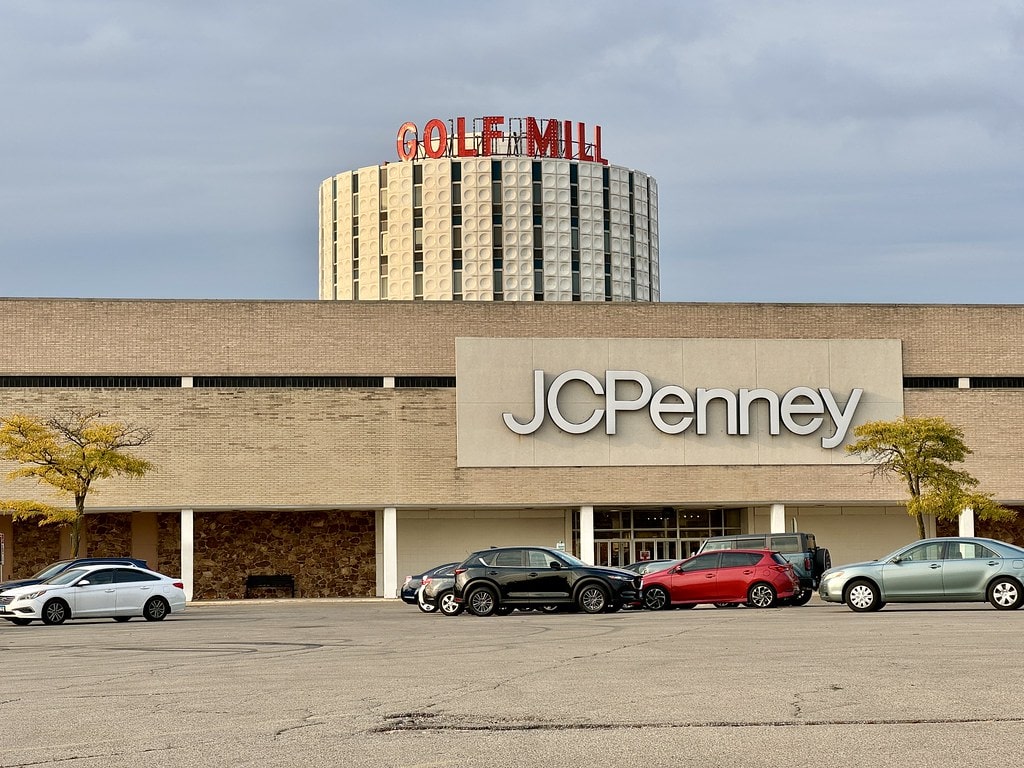
JCPenney closed its outlet store in 2009. Shoppers World moved into that vacancy in 2011, lasted until 2016, and the space was later converted into a Floor & Decor store that opened by January 2017.
Entertainment wobbled, too. After mechanical failures shut down the ice rink in 2017, a plan emerged for Tilt Studio to renovate and reopen it.
That version did not survive the pandemic year, and the rink returned in 2021 under a new operator as Top Shelf Ice Arena.
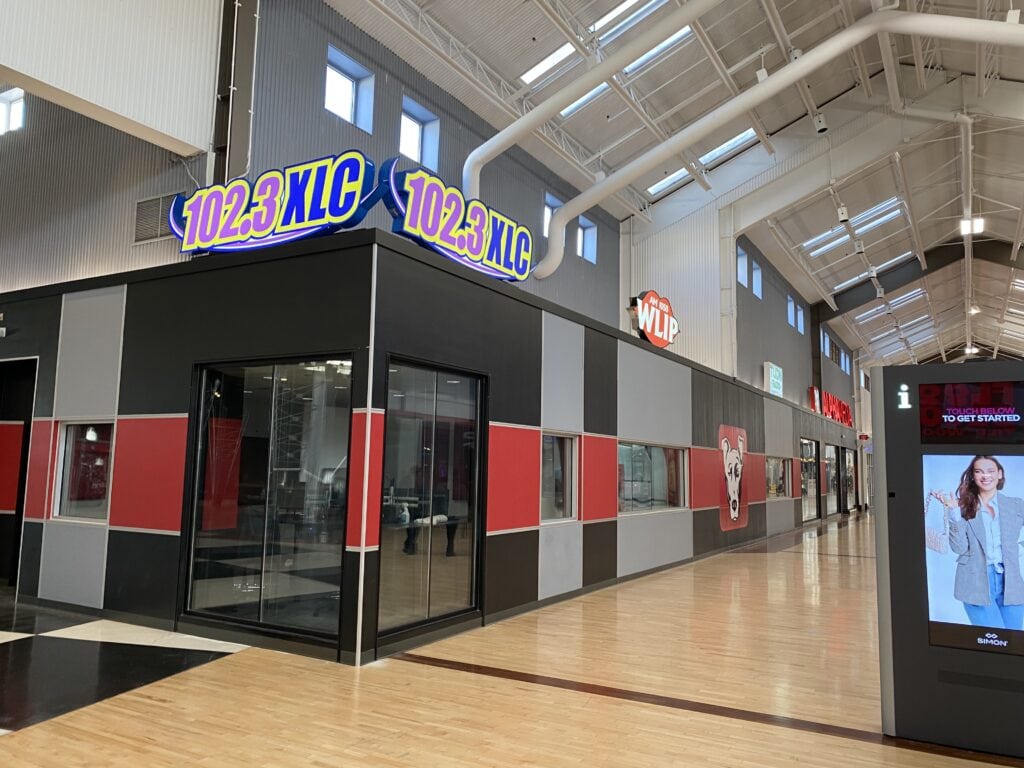
In late 2017, Simon also budgeted about $6 million to update food courts and common areas, including a refreshed theme for the Dine-O-Rama.
Sears Grand closes, then the leasing wave
Sears Grand closed on September 2, 2018, as Sears continued a major downsizing and store-closure wave ahead of its October 2018 bankruptcy filing. The former Sears Grand space was later divided.
Hobby Lobby opened in January 2022. Round One opened in the middle of 2024. Another part of the old Sears Grand area stayed empty into early 2026.
Other large boxes changed hands during the same period. Bed Bath & Beyond closed in 2022 after running as a combined Bed Bath & Beyond and Buybuy Baby store since 2012.
The RoomPlace closed in December 2024 after about six years at Gurnee Mills, amid the retailer's Chapter 11 case and subsequent store-closing activity.
New leases continued to be announced as spaces turned over. In July 2025, Miss A and an expanded Boot Barn were reported as open.
On September 8, 2025, the mall announced eight additions with openings projected later in 2025, early 2026, or spring 2026: Hangry Cluck, Just Cozy, Kako Claw, Off the Rax, Pretty Pretty Print Press, Primark, Sky Zone, and Spirit Halloween.
On September 29, 2025, a 40,103-square-foot lease was announced for Sky Zone in space tied to The RoomPlace.
On December 1, 2025, the Village of Gurnee approved a $2M incentive/redevelopment agreement to help redevelop the last empty space in the old Sears Grand area for an unnamed "global home furnishings retailer."