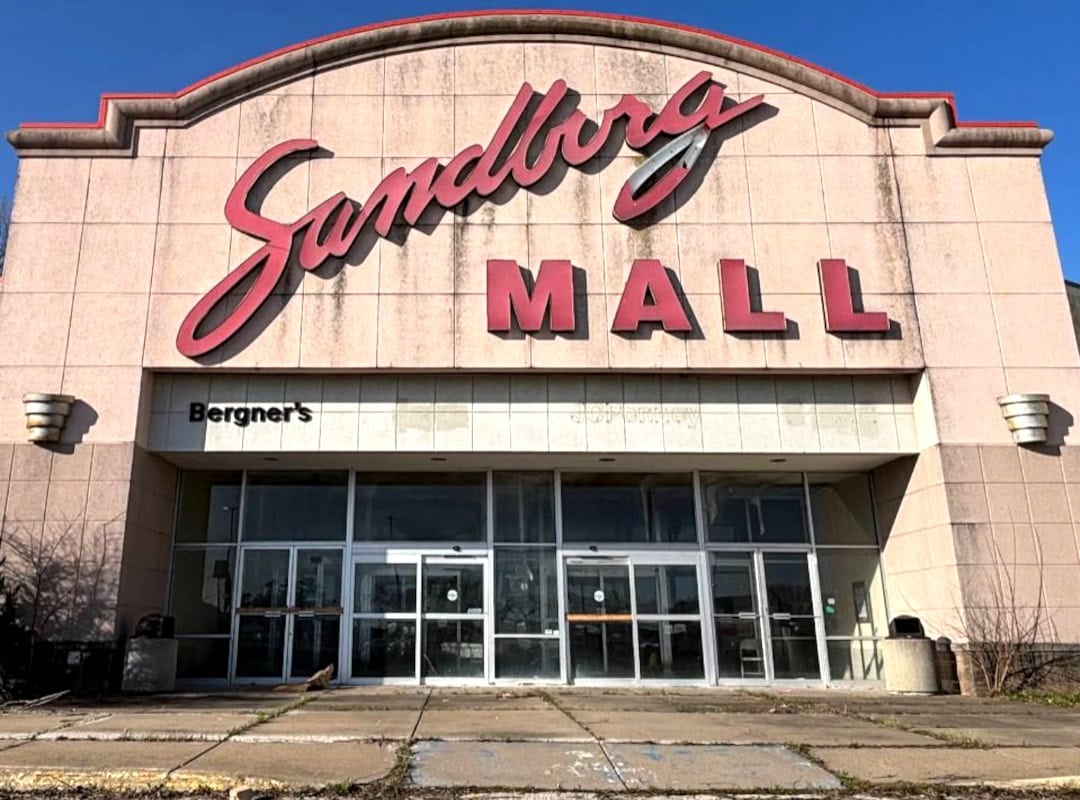
Sandburg Mall: from cornfields to climate-controlled retail
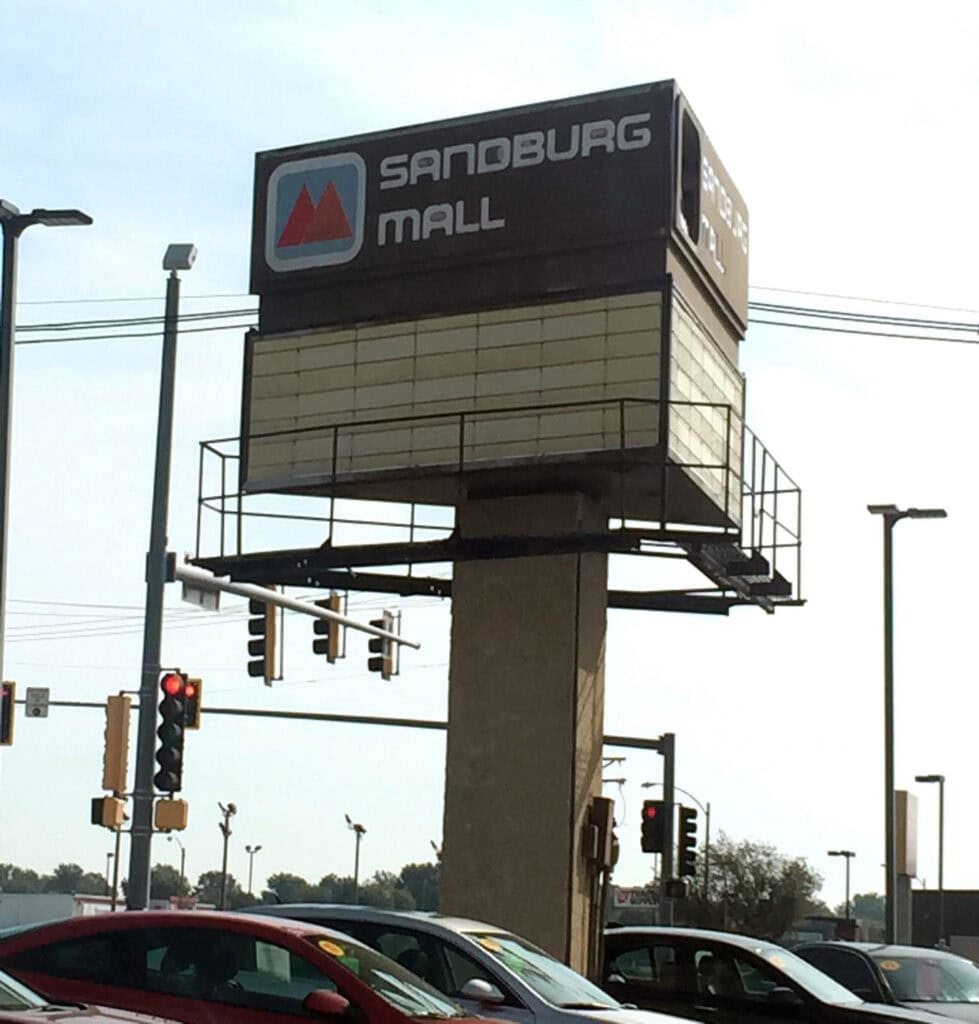
Before it became a ruin you could see from the bypass, Sandburg Mall began as a clean idea on paper.
In 1971, Kenroy, Incorporated, a developer from Skokie, picked out about 97 acres of ground near the intersection of Henderson Street and U.S. Route 34, on the northwest edge of Galesburg, and proposed a $15 million shopping center.
Construction started in February 1974. Within a year, the cornfield was covered by steel, concrete, and a sprawling parking lot laid out like a diagram of American aspiration.
The name was borrowed from the city's most famous son. Carl Sandburg - born in Galesburg on January 6, 1878 - had written about working people, railroads, slaughterhouses, and the brutal charm of big cities.
His "Chicago Poems" and "Cornhuskers" and his six-volume biography of Abraham Lincoln had won him a place in the country's literary canon. Now, his name went over a mall entrance.
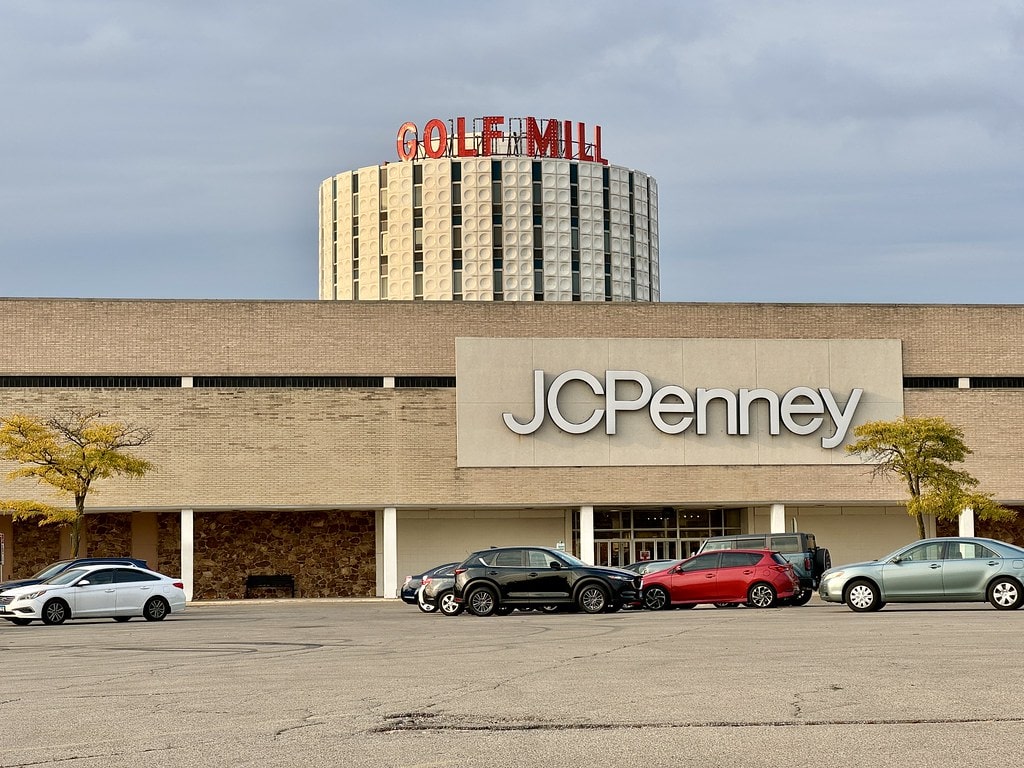
Sandburg Mall opened on October 1, 1975, under the ownership of General Growth Properties. Three anchors held its corners: JCPenney, Bergner's, and Sears. Between them, 46 interior shops lined three wings.
The roster feels like a time capsule now - Osco Drugs, Bresler's Ice Cream, Team Electronics, Garcia's Pizza-in-a-Pan, GNC, Karmelkorn, Musicland - but it added up to something powerful in 1975: climate-controlled abundance, all under one roof, with the poet's name on the sign out front.
The boom years: cinema, Kmart, and a regional mall at its peak
During the 1980s, the mall did what successful malls usually did: it got bigger. In 1982, a Kerasotes-run, two-screen movie theater opened near the JCPenney store.
This made the mall feel like it had everything. You could shop for back-to-school clothes at Penney's, grab pizza at Garcia's, then see a movie, with the smell of popcorn in the hallways.
The next big change came in 1992, when Kmart opened as the fourth main store in its own section. This made the mall larger and gave shoppers more ways to save money.
Two years later, in March 1994, Target opened next to the mall, turning the area into a busy place with some of the most popular stores around.
Sandburg Mall became more than just a local shopping center. People from smaller towns would drive in to visit.
The mall stayed busy through the 1980s and into the 1990s. It was a place to shop and to be seen. Teens hung out at Musicland, parents lined up at Osco, and seniors walked laps around the mall before the stores opened.
The Kerasotes twin theater finally closed on December 18, 2003, and people started going to the new ShowPlace 8 that opened the next day at 1401 West Carl Sandburg Drive.
Even that change felt like moving forward, not going backward. The new theater was bigger and more up-to-date, just up the road from the old twin inside the mall.
When the factories fade, and the leases come due
The real damage started off-site. In the late 1990s and early 2000s, Galesburg was hit by industrial losses, including the closing of the Maytag appliance factory.
The shock worked its way through paychecks and household budgets. A mall calibrated for factory-era disposable income now faced a town with less money to spend.
Around this time, General Growth Properties sold Sandburg Mall. Management passed to Ken Tucker and Associates.
On paper, it was a routine transfer; in practice, it marked the point where the mall lost its original institutional backing and slipped into the orbit of smaller owners who were trying to manage decline rather than invest in growth.
Meanwhile, the thirty-year leases signed in the mid-1970s began expiring. Chains taking a hard look at shrinking local incomes and a changing retail landscape were increasingly willing to walk away.
Online shopping, still young but growing quickly, began siphoning off categories like music and electronics.
Empty storefronts started to appear along the interior wings - one here, another there - until the dead spaces became harder to ignore than the living ones.
The mall was still running, but the shine of inevitability was gone. It was no longer assumed that Sandburg Mall, once built, would simply exist forever.
Sheriff's sales and a hollowing mall
In 2007, a new owner took over. Sandburg Mall Realty Management bought the property for $3.3 million.
They got not just an old building but also had to deal with the financial crisis that came a year later, more people shopping online, and a country moving away from malls like theirs.
By 2014, the company filed for bankruptcy, with over $2 million in debt and not enough rent to pay it off.
One of the founding anchors fell the same year. On April 30, 2014, Sears closed its Sandburg Mall store, ending more than 85 years of Sears' presence in Galesburg; the chain had opened its first local location in 1928.
The closure stripped one side of the mall of its original purpose and left a large, quiet box attached to increasingly empty corridors.
After bankruptcy, the property was sold by the sheriff. In the summer of 2015, Mall Group Investments bought it for $1.3 million, much less than it cost to build.
The new owner struggled to find stores to fill the mall, which was quickly becoming outdated.
In July 2016, Kmart, which had been added in 1992, closed, taking away another big store and many shoppers.
The next month, Mall Group Investments tried to sell the property online, starting at $300,000, a price that showed how many problems the mall had, despite its size.
After the mall dies, the anchors improvise
On October 25, 2016, a Texas investor named G.L. "Buck" Harris bought Sandburg Mall for $690,000. Harris had already bought other struggling malls like Six Flags Mall in Arlington and Sunrise Mall in Corpus Christi.
In Galesburg, he said he wanted to tear down the inside of the mall and turn the area into an outdoor shopping center, keeping the big stores as separate buildings.
In reality, those plans never moved forward.
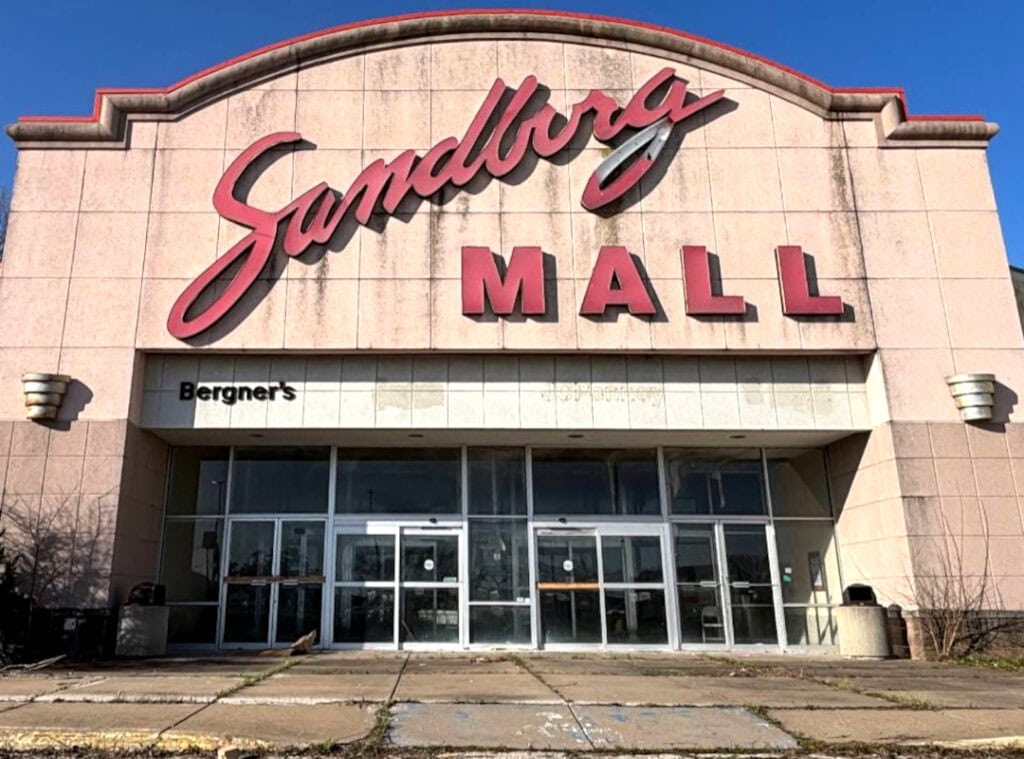
The big stores kept leaving. JCPenney closed in May 2018. Bergner's, one of the original stores from 1975, closed on August 26, 2018.
Inside, almost all the mall's stores were gone. The nutrition store GNC, the last one left inside, finally closed on September 28, 2018, moving to Seminary Square.
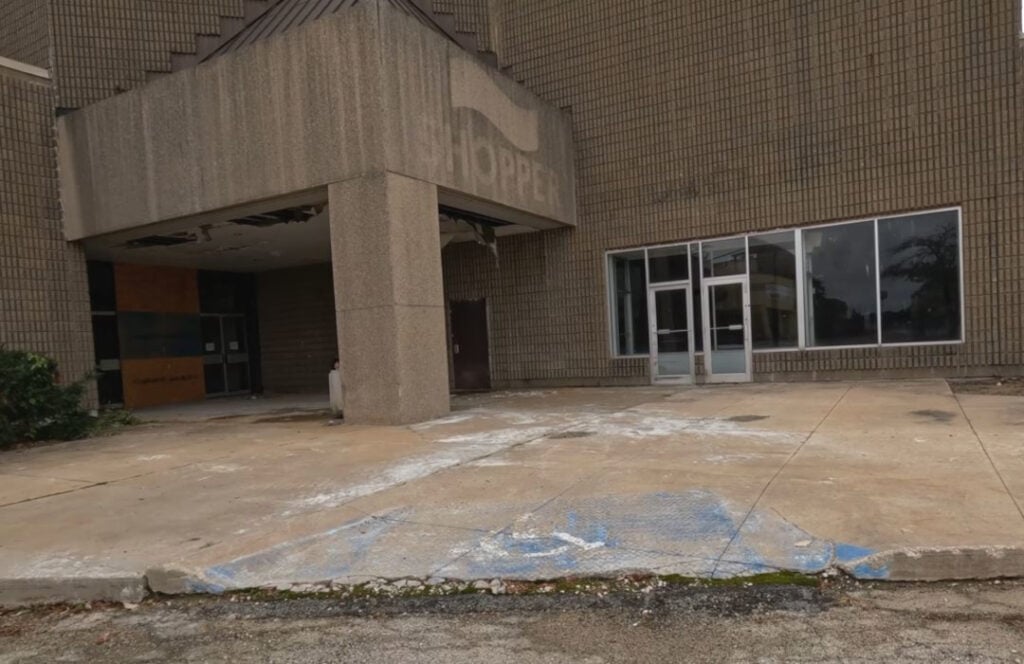
After that, the main part of Sandburg Mall was no longer a mall.
But the property was not completely empty. By then, only three businesses were left: a car repair shop, a building-supply store, and a moving truck rental business.
In 2018, U-Haul started using the old Kmart Garden Center. The old big stores were used in new ways. Galesburg Warehouse Bargains moved into the old JCPenney space.
Karmark Tire & Automotive, which had already been in the JCPenney auto area for a long time, kept working there; by then, it had been in that spot for 20 years.
In April 2019, the city's Planning and Zoning Commission agreed to divide the property to allow for these different uses.
Clinic money, city strategy, brownfield hope
For a moment, the former Bergner's building looked destined to become a convention center. That idea was floated and dropped. A different future stuck.
The Department of Veterans Affairs chose the box as the new home for the Lane A. Evans Community-Based Outpatient Clinic, relocating from its previous Galesburg space into nearly 20,000 square feet at 1090 West Carl Sandburg Drive, Suite 100.
After a multi-million-dollar renovation, the clinic opened in November 2024.
Inside the old department store, racks of clothing and cosmetics gave way to primary-care exam rooms, radiology, laboratory space, expanded physical therapy, mental health offices, telehealth setups, an audiology booth, optometry services, and a women's health exam room.
It was the clearest proof that the mall site still had value if someone was willing to strip it down and start over.
Wider strategy followed. In October 2024, Galesburg adopted a new strategic plan that named the redevelopment of the Sandburg Mall site and its surroundings as a long-term priority.
A few weeks earlier, on August 19, the city had put the vacant interior portion of the mall - about 250,000 square feet, including the former Sears box and the dead interior wings, but excluding the three major anchors - up for auction with a minimum bid of $200,000.
No one met the reserve. The dead core remained unsold, its future unresolved.
Texas investors, basic cleanup, and first-aid for a dead mall
The deadlock ended with a private sale. On December 11, 2024, investors from Texas, through Galesburg Investment LLC, bought the interior wings, main area, and former Sears store from SMB LLC for $500,000.
The main people involved were Houston accountant Omar Kasani of Oak Advisors CPAs and his partner, Brett Norwich. In late January 2025, they traveled to Galesburg, toured the property, and met with city officials.
Their first priority was basic cleanup: remove graffiti, close off the open entrances, and clear away trees and bushes that had grown around the empty building.
They hired a local contractor for the job and a national real estate company to look into what could be done with the property.
Ideas included apartments, small businesses, housing, or a new shopping center designed for today's needs.
Demolition plans, EPA grants, and the mall's second life
Kasani did not pretend the old building could just be saved. He said clearly that he thought it would have to be torn down.
Keeping an empty mall from the 1970s did not make sense, and letting it fall apart was even worse.
The real question was how to pay for the work.
The city offered help through Enterprise Zone incentives, like possibly skipping construction permit fees, not charging sales tax on building materials, and lowering property taxes on future changes.
Galesburg had also gathered more than $1.2 million in EPA brownfield grants, including a $500,000 grant that could be used, if the owner agreed and the site qualified, to check the environmental conditions and possible new uses for the mall property.
In August 2025, Galesburg Investment LLC had hired an engineering company and other helpers to look at ways to redevelop the site.
That fall, a project listing showed up for "Demolition of the Sandburg Mall," a city job at 1150 West Carl Sandburg Drive with bids due October 31, 2025, work planned to start November 10, and an estimated cost of $1,385,885.
The listing was at the stage where bids had been received, which meant demolition was now a real plan, not just a possibility.
By late 2025, Sandburg Mall was split between an empty inside and a ring of still-working stores, waiting to see if the next use would be more shopping, a group of homes, or just open land again, about 50 years after a developer first paved over a cornfield and named it for a poet.