Tippecanoe Mall and the ribbon-cut years
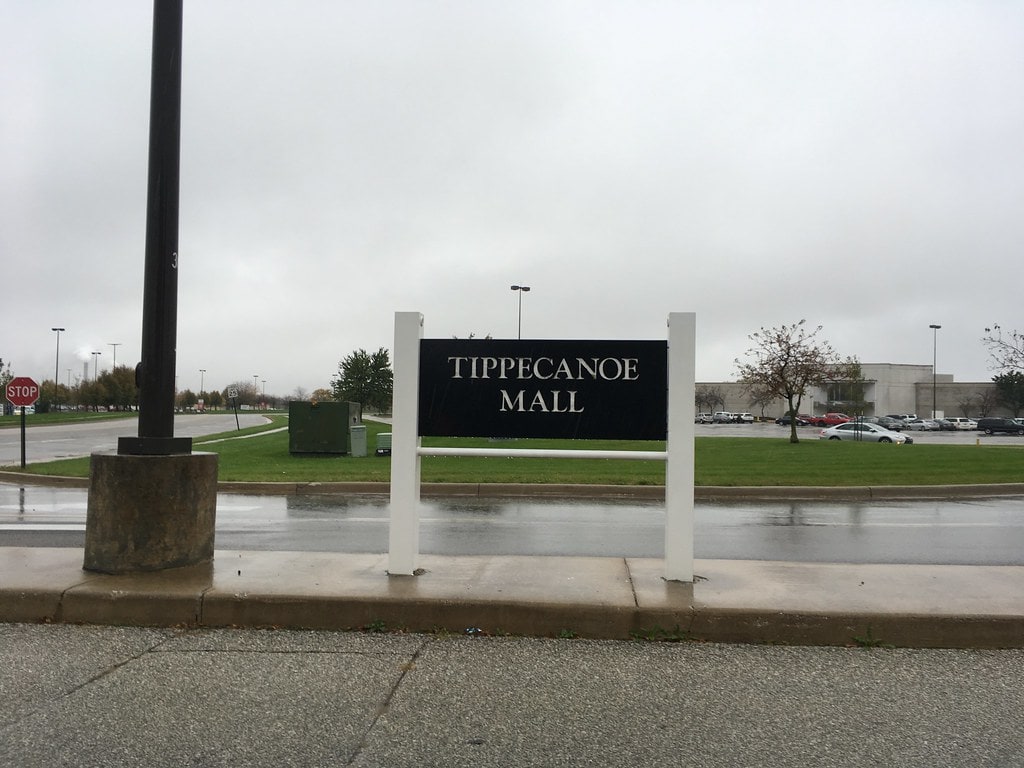
Tippecanoe Mall opened on August 8, 1973, at 2415 Sagamore Parkway South, Lafayette, IN, and it did not pretend to be shy.
The grand opening ran ten days, beginning August 7 with a gala and ribbon cutting and continuing with prize raffles, a bluegrass music festival, antique shows, promotional sales, and back-to-school events.
In the 1970s, a new enclosed mall was not merely a place to buy things. It was a public statement that the future would be comfortable, climate-controlled, and convenient.
Greater Lafayette had reasons to welcome that promise. Purdue University keeps the region in motion, and Tippecanoe offered a neutral indoor space that did not care about rain or wind.
People could meet without committing to a restaurant, browse without admitting they were browsing, and leave with the reassuring sense that the corridors would still be there next weekend.
The ten-day pageantry set a tone Tippecanoe would spend decades defending: the mall as a destination, not an errand.
Melvin Simon, highways, and pre-leasing
The confidence had a person behind it. Melvin Simon started Melvin Simon & Associates in 1960 and, by the mid-1960s, had focused the company on building indoor malls, an idea that still seemed a bit untested.
Simon's real breakthrough was not about how the malls looked but about where they were built. He saw that the interstate highway system did more than just help people travel. It changed where people wanted to shop.
Tippecanoe showed Simon's way of making deals: get promises from big national stores before the building was finished, then build everything else around those main stores.
Pre-leasing made things less risky and set up a kind of self-fulfilling promise. If the main stores were coming, people expected the mall to happen.
The opening party turned signed deals into real crowds. In later years, that same steady approach, choosing tenants carefully and being ready to spend money, became more important than just remembering the past.
Tippecanoe later showed that this way only works if the property keeps changing to stay up to date.
Anchors drift: Block's, Penney, Ward
Tippecanoe's main store plan changed before shoppers ever saw a map. The mall was supposed to open with Montgomery Ward and Federals, a department store from Detroit, as the main stores.
The list of stores changed. It was a reminder that the store map is never final here.
JCPenney, which was originally supposed to open with the mall instead of Federals, did not open until 1974.
The third anchor, William H. Block Company, had a bigger reputation. Blocks had been in business since 1874, and its main store in downtown Indianapolis had been made bigger and updated many times.
By the time it opened at Tippecanoe, Blocks was Indiana's second-biggest store after L.S. Ayres.
Its move to the suburbs matched the trend of people shopping less downtown and more near the highways, where there was lots of parking and indoor shopping.
The 1983 Tippecanoe Mall wind damage
In April 1983, Montgomery Ward closed its Tippecanoe location, and the mall lost its first big main store. Later that year, it faced a more direct kind of trouble.
On November 20, 1983, high winds estimated at 55 to 65 miles per hour struck Lafayette and damaged the property.
Parts of the roof were blown off the William H. Block store and the Osco Drug, a smaller main store.
Several stores in the middle of the mall were damaged and had to close for a long time to be fixed. A mall worker was hurt.
Block's damage was so bad that the store had to move its goods into the empty Montgomery Ward space until repairs were done.
The solution was simple but worked well: the mall used an empty store to help out. The windstorm became one of the biggest natural disasters in Tippecanoe's history.
It took a lot of money to fix what shoppers usually think will always be there: the roof.
Expansion at 21: Sears, Ayres, minimalism
By 1985, Kohl's took the place of Montgomery Ward, and Tippecanoe's main stores started to change more often, something that would soon become normal.
In 1987, Block's became Lazarus after Federated Department Stores acquired Allied Stores, reflecting the 1980s wave of department-store consolidation that often replaced local banners with larger brands.
In 1994, Tippecanoe announced its biggest growth since it first opened, planned for its twenty-first year. A new section led by Sears and L.S. Ayres brought in about forty new stores.
Ayres moved from Lafayette's Market Square Mall, bringing all its local stores together in one place, and Kohl's also grew inside Tippecanoe.
The renovation gave the mall a simple 1990s modern look: useful, plain, and called "inoffensive" at the time.
The building became less fancy and easier to change, giving up its unique style for more flexibility. It was a sensible choice, not an exciting one, and Tippecanoe would rely on that practical style for years.
Hat World opens, a niche becomes a signal
On November 3, 1995, Tippecanoe became an unlikely origin point for a national brand.
Hat World opened its inaugural store here, founded that year by George Berger, Glenn Campbell, and Scott Molander, with headquarters in Sioux Falls, South Dakota.
The second store opened soon after at Muncie Mall, and the company later tied operations and warehousing to Indianapolis.
Hat World was the 1990s specialty-retail idea in pure form: athletic headwear, and nothing else, sold as a kind of wearable affiliation.
What looked like a narrow focus was, in fact, a scalable concept. The company would later rebrand as "Lids" through acquisitions and consolidation in sports retail, but the first storefront remained in Lafayette.
The Hat World debut matters because it shows Tippecanoe as more than a container for established department stores.
It could also function as a testing ground, where a new retail category tried itself out on a regional crowd and learned that the crowd was willing to play along.
Demolition, rebrands, and pop-up survival
The 2000s brought bigger changes to Tippecanoe than just looks. Lazarus closed in 2002. By 2004, its building was torn down to make room for Dick's Sporting Goods and hhgregg.
Having these two big stores showed a move away from old-fashioned department stores and toward stores that focus on one type of product.
In 2006, L.S. Ayres turned into Macy's, as part of a countrywide name change that combined several May-owned store names into one.
The next ten years brought more changes and more stores closing. In 2012, H&M opened, taking over the old MC Sports spot and bringing quick, trendy clothing to Lafayette.
In 2017, hhgregg closed after going bankrupt, and the space started hosting different temporary stores, like Spirit Halloween.
Tippecanoe's list of stores also shows how much retail has changed.
Stores like Abercrombie & Fitch, Best Buy, Body Central, Gymboree, Justice, Payless ShoeSource, and RadioShack all used to seem like they would always be there, but they eventually left.
The Sears gap and the mall's reinvention
Sears left the mall in a way that felt personal, because the store had long been a familiar kind of pull.
On May 31, 2018, Sears announced that it would close the Tippecanoe store as part of a nationwide plan to close seventy-two stores.
The store shut on September 2, leaving Tippecanoe with JCPenney, Macy's, Kohl's, and Dick's Sporting Goods as its main stores.
The closure also left a big problem you could see: a Sears-sized empty space, about 105,000 square feet. In many malls, an empty main store makes people think the whole mall could soon fall into disrepair.
Tippecanoe was Greater Lafayette's main indoor mall, and the nearest enclosed alternative, like Markland Mall in Kokomo, was far enough away that the Sears-sized vacancy became a regional talking point.
When you're the default place people go, everyone notices when a huge space sits empty.
Tippecanoe's answer was not to bring in another department store, but to show that today's mall stays open by offering fun things to do as well as things to buy.
Malibu Jack's turns retail into playtime
Malibu Jack's opened in the old Sears store in November 2022, turning the empty space into an indoor theme park that is open all year and kept at a comfortable temperature.
Started by the Hatton family in 2013, with other locations in Kentucky, it brought hands-on fun to the mall. It is, in today's words, a spot people like to share on Instagram.
The Lafayette location has bowling with comfortable seats and large TVs, go-karts, laser tag, a theater with moving seats, tropical mini-golf, bumper cars, an arcade, and a basketball shooting game.
For younger kids, 'Bounce Beach' is a huge playground with slides, tunnels, and things to climb. New rides include the Twist N Shout spinning roller coaster and the Wipeout ride.
The space also hosts birthday parties, field trips, team-building activities, and company events.
Local officials described the project as an investment meant to improve the quality of life and emphasized that the attraction is designed to appeal to a wide range of ages.
Tippecanoe Mall in late 2025: tenants and condition
By December 2025, Simon still owns Tippecanoe Mall, the only regional enclosed mall in the Greater Lafayette area. It spans 831,500 square feet and has about 100 stores and dining tenants.
The anchors are JCPenney, Macy's, Kohl's, Dick's Sporting Goods, and Malibu Jack's. Junior anchors: H&M, Old Navy, and Barton's Home Outlet.
Original inline tenants still in place include Englin's, General Nutrition Centers, and Claire's.
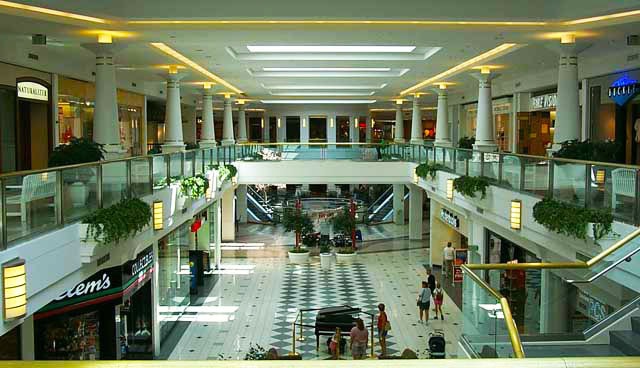
Tippecanoe Mall is mostly in good shape, but still wears its 1990s renovation: functional, minimalist, and "inoffensive."
Inside, it feels clean, bright enough, and well cared for, and it does not feel like an empty or dying mall.
The hallways and common areas look well-kept, and it is easy to spend time there without worrying about the building falling apart.
But it also looks its age. Some of the finishes seem old, and the whole place has that slightly worn, been-here-a-long-time look.
The outside is the weakest part. The parking lot and landscaping look like they could use more care.
Overall, it feels solid and still worth visiting, just not updated in a way that makes it feel new.