May 1, 1873. The first patients walked through the door. The north wing was only half-built, and construction crews were still on the grounds.
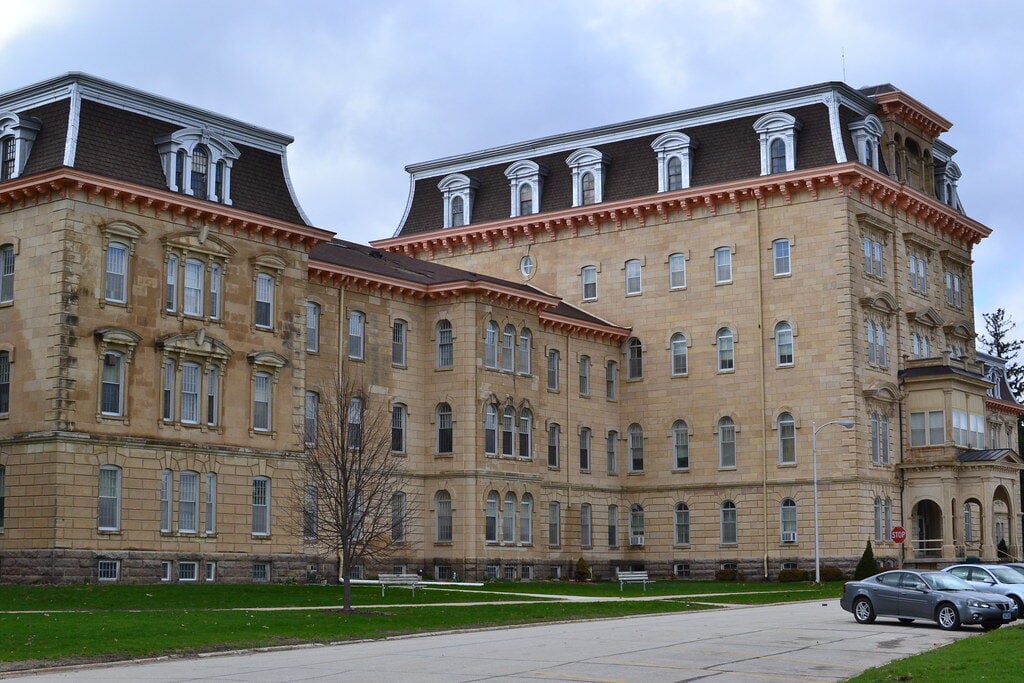
Iowa had appropriated $290,000 for this place already - a sandstone-faced building on a rise in Independence, four stories in the center, wings spreading more than 762 feet across the front.
Mansard roofs, projecting pavilions, a ventilation system - the state had hired an architect from Madison, Wisconsin, and told him to build something that would last.
By 1946, 1,800 people were living here. A city run by a single institution, on 1,360 acres of Iowa farmland. Many of them had been admitted years earlier and had simply never left.
There was a cemetery associated with the campus. Tunnels ran beneath parts of the complex.
A dedicated ward held hydrotherapy equipment for procedures that the hospital's own later museum would preserve as relics of another era.
For about 70 years, this was where Iowa sent people it did not know what else to do with. The building still stands. The institution's census was 43 patients on January 1, 2026.
Independence State Hospital was Iowa's second hospital
Iowa's first state mental hospital opened in Mount Pleasant in 1861, but within six years, it could not handle the number of patients.
During the winter of 1867 to 1868, Senator W. G. Donnan proposed creating a second hospital. The Iowa Legislature passed the measure on April 6, 1868.
The law required a site of at least 320 acres, located within roughly two miles of Independence, and it had to be provided to the state at no cost.
A Board of Commissioners - E. G. Morgan, Maturin L. Fisher, and Albert Clark - was given $125,000 along with the power to pick the location and start construction.
Some people in Independence opposed the idea. They worried the patients might be dangerous or disruptive. Despite those concerns, residents raised money to donate the land.
On June 8, 1868, the commissioners chose a site about one mile west of the city. It was an open prairie, sitting 50 to 100 feet above the river, with reports of a reliable supply of soft water.
To decide on a design, the commissioners visited hospitals in Cincinnati, Washington, Philadelphia, and Trenton. Some doctors supported the cottage plan, which used smaller, separate buildings for patients.
The commissioners declined that approach and instead selected the older corridor-style design, believing it would better serve the patients they expected.
Shipman's drawings and Josselyn's changes
Stephen V. Shipman of Madison, Wisconsin, secured the contract. He had prior experience designing psychiatric institutions in Elgin and Anna, Illinois, as well as in Oshkosh and Mendota, Wisconsin.
His plan for Independence followed the Kirkbride corridor model from the 1850s, with long wings extending from a central section so that each ward would receive light and air.
George Josselyn, who had worked at Mount Pleasant, reviewed the plans before construction started and introduced a series of revisions.
He added mansard roofs, projecting towers, and a rear center block. He also strengthened fireproofing and improved ventilation.
He was then appointed superintendent of construction and directed the project from the beginning.
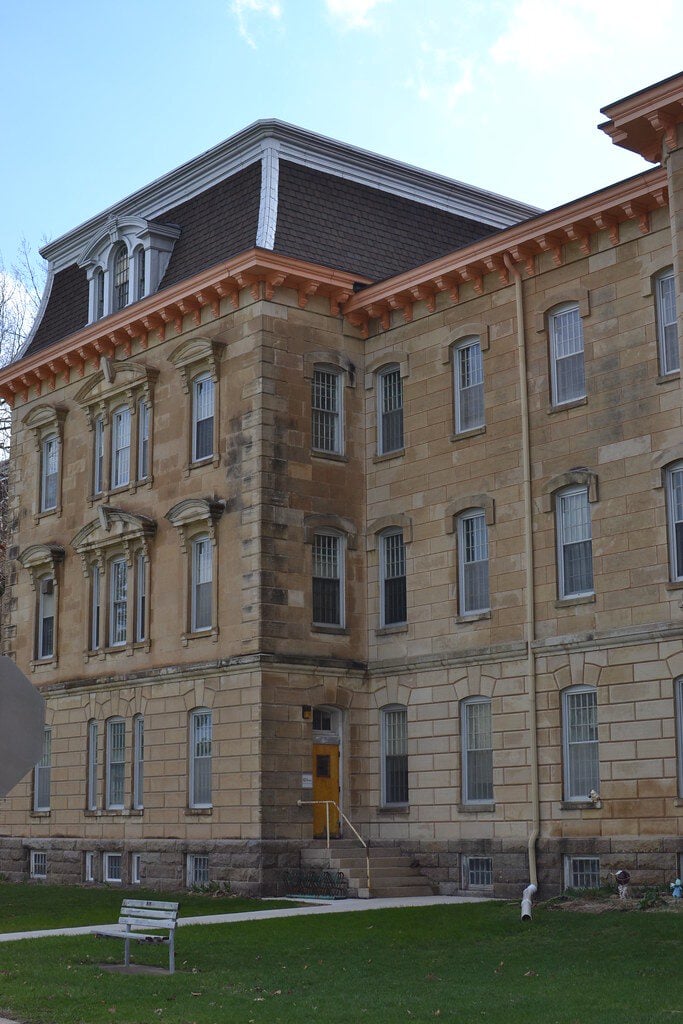
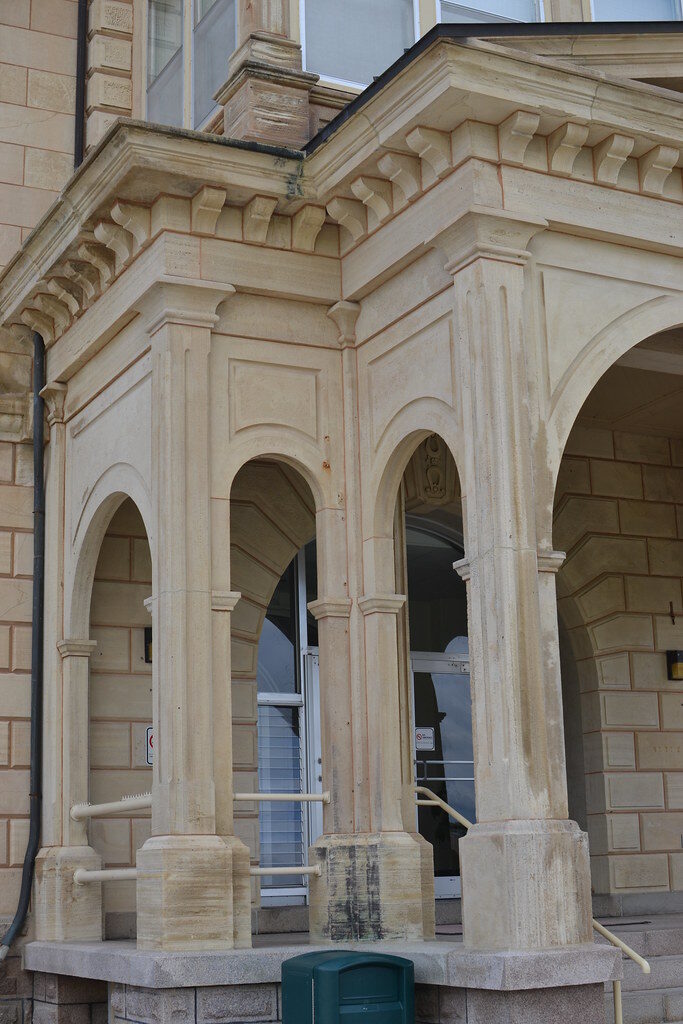
The building that still stands, now known as the Reynolds Building, features a four-story central pavilion with three-story wings on either side.
It is built with limestone walls, along with brick made from local clay for the upper walls.
The structure includes slate roofs, galvanized iron cornices, and steam heating. The north wing was used for men, and the south wing for women.
Construction costs climbed well past $290,000 before a single patient arrived
The first contract went to David Armstrong on November 7, 1868, for part of the north wing. The project ran into money problems almost right away.
The law required limestone exterior walls, which cost more than the brick the commissioners had expected to use.
At the same time, labor and materials kept getting more expensive. Armstrong ran out of funds.
In April 1870, the state stepped in and took over. It approved another $165,000 and put Josselyn in charge of hiring and purchasing.
He set up shops on the grounds for woodworking and machinery. Workers produced sash, doors, finished lumber, and moldings on site.
By spring 1871, the grounds were being developed. Crews planted 200 apple trees, 50 cherry trees, and 100 ornamental trees.
In 1872, the legislature added another $200,000. Even with that, delays continued. The state treasury was sometimes empty.
Some workers refused payment in state warrants. Heating unfinished buildings added to the cost. The Chicago Fire of 1871 likely pushed some construction costs up by 30 to 40 percent.
When the first patient arrived on May 1, 1873, only part of the north wing was ready. The full construction effort did not finish until 1884.
Overcrowding by the first winter
Complaints about overcrowding began by December 1, 1873, eight months in.
Male and female patients were still sharing the north wing because the south wing was unfinished, which made the classification system staff's dependence on it nearly impossible to enforce.
Albert Reynolds had been appointed superintendent in October 1872 and served until 1881. The institution kept adding buildings as the population climbed.
Farmer's Lodge in 1883, $25,000, for 100 non-disabled working men. Grove Hall in 1886, $40,000, for 100 chronic infirm male patients.
Sunnyside Villa in 1894, $40,000, for 100 chronic infirm women.
In 1907, a new psychopathic hospital, $125,000, fireproof concrete and brick, 134 beds, an operating room, hydrotherapy equipment, electric-light baths, and electrotherapeutic devices.
On July 1, 1898, management passed from the Board of Trustees to the Board of Control of State Institutions.
By the mid-1910s, the institution held roughly 1,200 patients, employed nearly 200 staff, farmed 1,360 acres, and carried a total property value of about $1,130,000.
Spinal fluid tests, ward attendants, and 1,800 patients
In the 1910s, hospital physicians met together for nine hours each week. Patients were brought into the psychopathic ward and examined in front of the full staff. Outside physicians and medical students also attended.
The psychopathic department treated about 15 patients each day. Common methods included hydrotherapy and massage. Doctors regularly tested spinal fluid as part of routine examinations.
They also carried out urine and blood tests, grew bacteriological cultures, and performed autopsies when families agreed.
During World War II, the hospital hosted Civilian Public Service Unit 137-01. Unit 137-01 operated from December 1944 to September 1946, with 18 conscientious objectors working as ward attendants.
By 1946, the hospital population had grown to about 1,800 patients. Across all four of Iowa's state mental health institutes, the average daily population peaked in 1945 and 1946 at more than 6,600.
From 1,800 patients to 300 in about a quarter-century
For roughly its first 70 years, Independence held people for the long term - many for the rest of their lives.
In the late 1950s, new psychiatric medications arrived, and the hospital began recruiting more qualified clinical staff.
The patient population fell from approximately 1,800 in 1946 to approximately 300 in 1970. By June 30, 1967, the count had dropped to 353.
The fall came partly from outright discharge, but also from shorter stays, higher turnover in admissions, growing use of county homes and private facilities for long-term cases, and expanding outpatient programs.
By the late 1960s, Independence held Joint Commission accreditation and was running a psychiatric residency program.
In 2015, Clarinda and Mount Pleasant stopped providing inpatient state mental-health services on June 30, leaving Independence and Cherokee as the only two state inpatient psychiatric facilities in Iowa.
A 2023 change in Iowa law then designated Independence specifically for the specialized treatment of behaviorally complex youth, and Cherokee for court-ordered state-custody adults.
The tunnels, the museum, and 43 patients
The institute today is still a psychiatric hospital. But its role is more limited than it was in the 19th and early 20th centuries, and more focused on acute care.
Nobody sealed the tunnels. The passages on the campus have been there for decades, and some still remain. Staff used these same routes to move patients through Iowa winters without taking them outside.
The Days of Yore Museum holds what the institution built up across a century of practice: hydrotherapy tubs, lobotomy instruments, and equipment the state now presents as a record of what it once did to people in its care.
Tours run by appointment. The cemetery is on the grounds.
In 2023, the institute turned 150 and formally marked the occasion inside a building that still looks much like it did in its earliest photographs. The difference is hard to spot.
On January 1, 2026, there were 43 patients inside - 20 adults and 23 children and adolescents - in a facility licensed for 56 beds.