In the late 1980s, part of Boyd County, Kentucky, near U.S. 60, was a flat piece of land that had once been a golf course.
Developers chose that site for a new enclosed shopping mall. The plan was to bring in shoppers from the tri-state area, where Kentucky, Ohio, and West Virginia meet.
Construction moved ahead, and Cedar Knoll Galleria opened on November 8, 1989.
From the first day, the mall had four anchor stores: Sears, Stone & Thomas, Phar-Mor, and Kmart. Inside, smaller stores included Rex TV and Appliances, and Pollock's Jewelry.
The food court included White Mountain, Luca's Pizza, Pretzel's-Plus, and Italian Oven.
The mall stood at 10699 U.S. 60 in Boyd County and covered about 600,000 square feet.
When it opened, it looked like a project built to stay for a long time. Later, every anchor store left. The mall's name changed more than once.
The building itself was eventually gutted and rebuilt from the inside. In November 1989, none of that had happened yet.
Cedar Knoll's early struggles
Cedar Knoll Galleria ran into problems almost as soon as it opened. Ashland Town Center, another mall in downtown Ashland, had opened only a few weeks earlier.
That meant both malls were trying to attract the same shoppers right away.
Cedar Knoll also faced a problem with location. It was farther from the main shopping areas, and a Walmart Supercenter about a mile away kept drawing customers to lower-priced, easier-to-reach store.
Even in the mall's strongest years, occupancy reached only 69 percent.
By 2001, the food court was nearly empty. This was not a successful mall that declined much later. It was a property under strain from close to the beginning.
In 2002, Phar-Mor and Kmart closed. Their former spaces did not remain completely vacant.
By late 2004, Artrip's Market and a flea market were operating there on a temporary basis. That made clear how far the property had fallen since its 1989 opening.
Big Anchors Leave and a New Owner Steps In
After Zamias's bankruptcy troubles earlier in the decade, Eggleston-related ownership purchased the property in 2005.
The new owners invested in repairs, updated interior areas, and gave the mall a new identity.
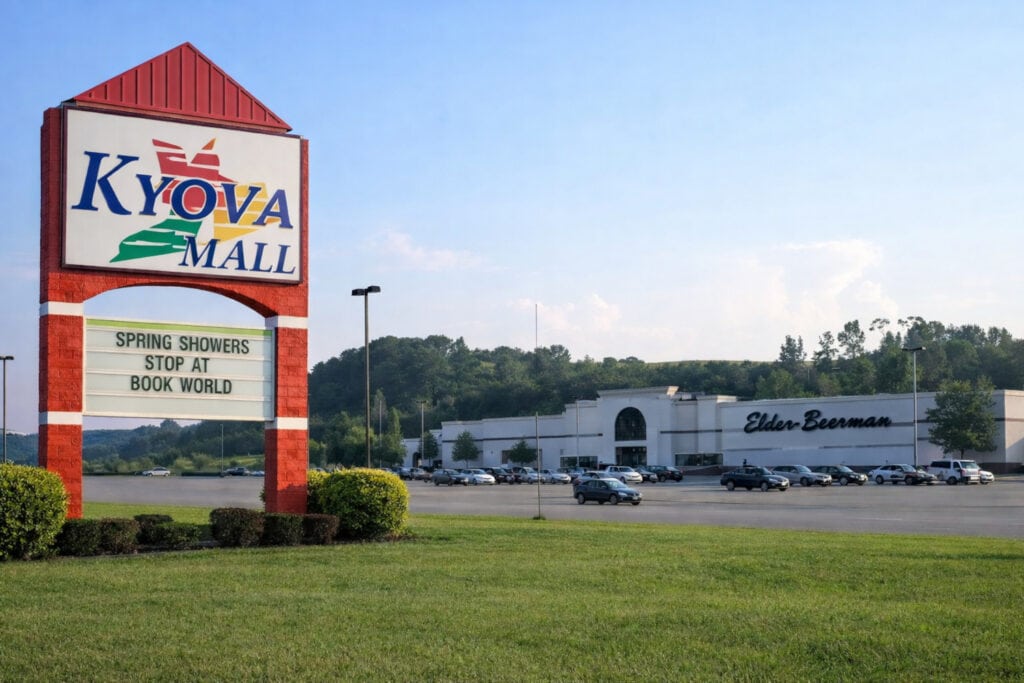
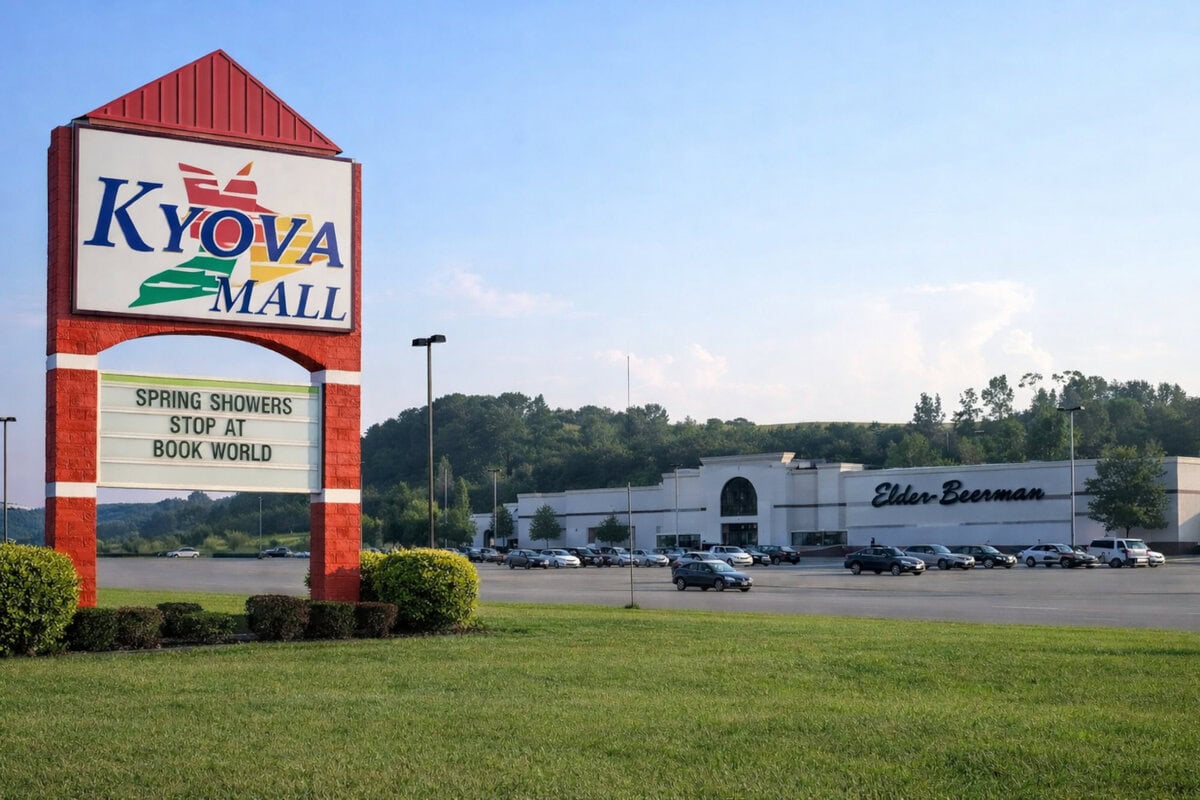
They renamed it Kyova Mall, a name meant to reflect the tri-state region of Kentucky, Ohio, and West Virginia that they wanted to serve.
In November 2005, Steve & Barry's opened in the former Artrip's and flea market space, bringing a large active tenant back to a building that badly needed one.
The owners also had ambitious plans for the old Phar-Mor space: a stadium-seating movie theater.
Great Escape was announced as the operator in 2006, but then backed out. Phoenix Theatres stepped in and carried the project through.
The theater opened in May 2007 as Phoenix 10 Theatres, also marketed as KYOVA 10 Stadium Theatres.
The rebrand, the repairs, a large new retail tenant, and a working theater gave the property more energy than it had seen in years.
It was the most optimistic stretch in Kyova Mall's history.
A Theater, a Vote, and a Push Toward Restaurants
The new owners were doing more than filling empty storefronts. They were trying to make Kyova Mall a place people would visit for food and entertainment.
One clear step came in 2007. The owners wanted restaurants at the mall to be able to sell alcohol, but Kentucky law required a local-option vote before that could happen.
Supporters collected nearly 6,000 petition signatures to get the measure on the ballot. On May 22, 2007, voters approved it with about 67 percent in favor.
The new rules allowed alcohol sales at restaurants that met minimum requirements for seating and food sales.
That change, along with the new theater that opened the same spring, gave Kyova Mall a short period when it functioned as a mix of uses rather than just a shopping center.
The owners had already reached a basic conclusion: traditional retail alone would not keep the property going.
A Library Branch and Fewer Anchor Stores
During the 2010s, Kyova Mall kept losing anchor stores. Sears closed its location there on May 11, 2014.
Rural King took over the former Steve & Barry's space in August 2015, which filled one large space, but the larger pattern was still more empty storefronts.
In April 2018, Elder-Beerman announced that it was closing and liquidating as part of the collapse of the Bon-Ton chain.
Stone & Thomas had already been folded into Elder-Beerman years earlier. When Elder-Beerman left, the mall lost its last direct link to the original anchor lineup from 1989.
By the middle of the 2010s, parts of Kyova Mall were also being used for public services. The Boyd County Public Library operated a branch in Suite 920.
Lease records from 2017-2018 still listed the branch at the mall, with the lease continuing through 2021.
A Quiet Mall and a Property in Decline
By late 2020, Kyova Mall's condition was plain to see. The building was quiet and mostly empty. County officials publicly called it a symbolic "black cloud" over the local economy.
The company that owned the mall had invested about $20 million in the property. Its CEO publicly stated that he was willing to work with anyone who could help make the site successful.
Over the years, different ideas had come up for the property, including a multiuse facility and a distribution center, but none turned into an actual plan.
Eggleston Associates had owned the mall since 2005 and had tried several different approaches over the years.
Even so, the building remained largely vacant. The retail environment around the site had changed completely since 1989.
The Walmart Supercenter about a mile away was still attracting customers. Online shopping had also taken a large share of the remaining business.
Camp Landing Begins Redevelopment and Has a Strong First Year
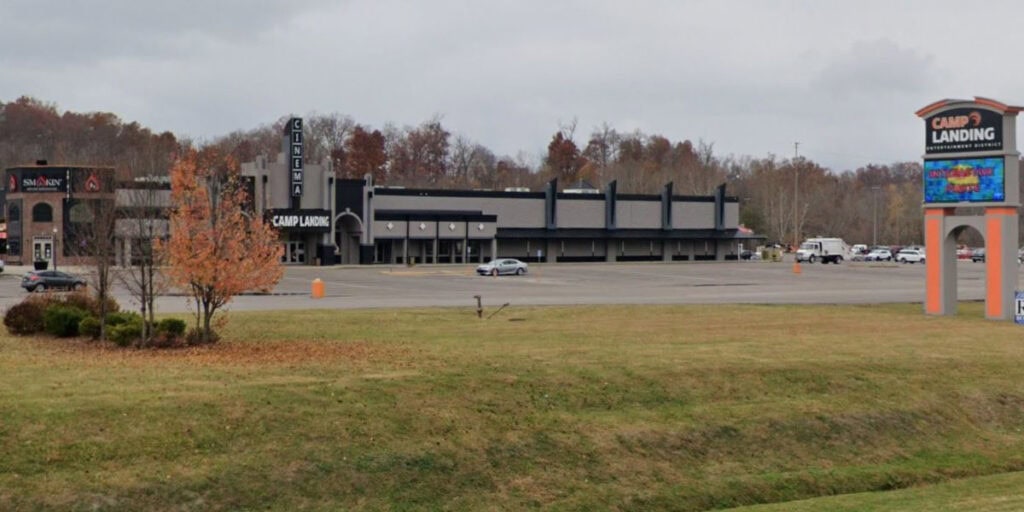
On July 14, 2021, the 92-acre property sold for $8.5 million. The buyers were a group that included Jason and Elisabeth Camp, the Glockner family, and Boyd County.
The redevelopment plan was large from the start.
It called for about $30 million in initial investment and included a convention center, hotel space, restaurants, Malibu Jack's family entertainment center, an updated theater, a farmers market, a sports complex, residential units, a distillery, and added features such as a kayaking slip and a walking trail.
Boyd County invested $5 million to turn the former Sears building into a 75,000-square-foot convention and expo center. As work began, material removed from the old mall was donated to Habitat for Humanity.
Malibu Jack's opened in December 2021 in the former Elder-Beerman space. It created 70 jobs.
By August 2022, the project had moved past its early expectations. Twelve businesses were operating during the first year.
More than 1,000 jobs were projected, and the site had attracted 400,000 visitors. Total investment was heading toward $50 million to $60 million as plans for a hotel and sports complex moved forward.
Racing, Gaming, and a New Vision for the Old Site
In the summer of 2022, Boyd County approved leasing part of the Camp Landing site for a horse-racing gaming operation.
That facility, Sandy's Racing & Gaming, opened in October 2023 and covered about 74,000 square feet.
It contained more than 700 slot-style historical horse-racing machines, a 5,200-square-foot BetMGM sportsbook lounge, two performance stages, and roughly 200 to 250 employees.
Behind the facility, a 182-acre quarter-horse racetrack called Sandy Ridge was under construction as part of what developers described as a $120 million-plus investment in Boyd County.
Boyd County moved ahead in 2025 with a sports complex at Camp Landing, purchasing 92,000 square feet with a total project cost of around $19 million.
The planned facility would include basketball, volleyball, and pickleball courts, a turf area, an archery suite, and a multiuse event space.
Demolition of parts of the old mall interior continued into early 2026, with a January bid covering about 59,900 square feet.