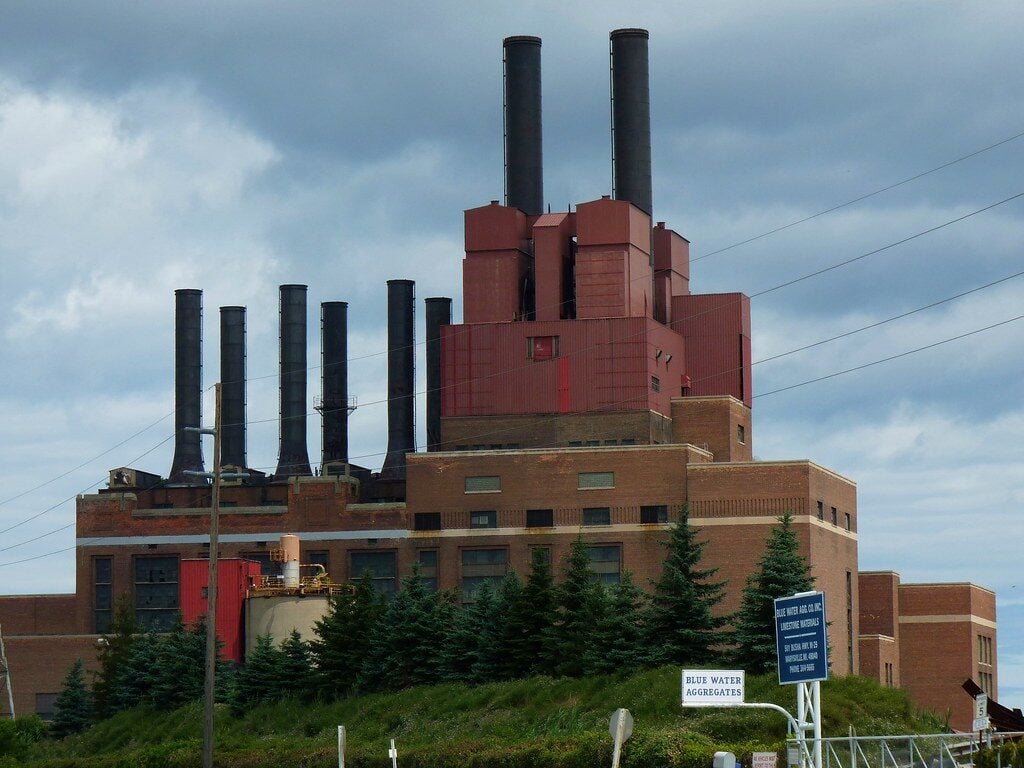
The Marysville Power Plant was a coal-fired generating station in Marysville, Michigan, on the west bank of the St. Clair River in St. Clair County, part of Michigan's Blue Water region.
Detroit Edison built the facility to supply electricity to communities across the northern part of Metro Detroit and the greater Port Huron area.
The plant sat on a 20-acre riverfront site at 301 Gratiot Boulevard, along the St. Clair River corridor directly across from Ontario, Canada. At its peak, the station produced up to 300 megawatts of power.
It began operating in 1922 and ceased operations in 2001, running for nearly eighty years as one of Detroit Edison's earliest and most important plants outside its main service center.
Coal Smoke Across the Water
In the 1942 photograph, the shot is taken from the roof of the coal crusher house, looking down at the dock. The self-unloading steamship Norman J. Kopmeier sits alongside the bank, unloading directly into the crusher.
You are looking at the St. Clair River behind it, and across that water, narrow enough that you could shout and be heard on a quiet day, sits Ontario.
That was the setup for eighty years: coal arriving by Great Lakes freighter to a dock on the Michigan bank, a crusher built into the riverfront, and Canada watching from across the river.
Seven generating units. Three hundred megawatts at full capacity. About 250 people at the plant's peak.
Detroit Edison built it as one of its primary outlying stations, and the people of Marysville gave it a nickname that said everything about how they felt about it: the Mighty Marysville.
Nobody applied that name to the plant in its final years.
By 2001, when the last unit shut down, two high-side generators were all that remained operational, producing 167 megawatts between them - little more than half what the plant had been designed to run.
The 300-megawatt station had been shrinking for years before it finally stopped.
Before the Marysville Power Plant: Bunceville and Bunce Creek
Before the first boiler ever arrived, the land had already served two distinct purposes.
Its earliest documented use appears to date to the 18th century, when a lumber mill operated near the edge of the St. Clair River at Bunce Creek.
For many years, the site was defined by timber activity.
Zephaniah W. Bunce came to the area in 1817. He served as a legislator and judge.
After settling along the river, the community became known as Bunceville, and the creek that crossed the property took the Bunce name as well.
His household became the center of a small settlement in the 19th century. Over time, it merged with neighboring river towns and became part of what is now Marysville.
Detroit Edison acquired the land in the 1910s, and the power plant was built in the years that followed. The Bunce home was later demolished.
Bunce Creek, which had flowed across the surface for many years, was enclosed in an underground channel beneath part of the plant site.
A rock and plaque were placed on the Detroit Edison property to mark the location of the old homestead.
That marker is one of the few visible reminders of Bunceville. The creek still runs below ground nearby, out of sight.
Wartime Expansion and the High-Pressure Side
The first two units at Marysville began operating in 1922, followed by two more in 1926.
This was part of Detroit Edison's broader expansion in the 1920s, which also included the Trenton Channel and Delray 3 plants, as the company expanded its generating capacity in that era.
The work that defined the plant for the rest of its life came about twenty years later.
In April 1941, Electrical World reported that Detroit Edison had approved substructure work for a 75,000-kilowatt turbo-generator along with two additional boilers.
Most of that investment landed in 1942, when Boilers 9 and 10 were installed. A 1946 engineering paper described protective arrangements for a new high-pressure turbine.
Workers referred to this phase as the "high side," meaning equipment that ran on higher-pressure steam than the original units and could drive 75-megawatt generators.
The SEC service years listed in DTE's 2000 filing - 1943 and 1947 - show when those generators formally went into service.
At the same time, the plant was used for ongoing engineering work. Papers from the mid-1940s document research into corrosion and erosion affecting feed pumps and regulating valves.
In 1946, a sample was taken from the mud drum of a boiler that had been in continuous operation for 24 years.
December 18, 1953
The ceremony at Marysville on December 18, 1953, was directly tied to Michigan electricity.
Two power interconnections between Detroit Edison and Ontario Hydro were being formally dedicated, and one of those lines ran from the Marysville plant across the St. Clair River to Ontario Hydro transmission infrastructure south of Sarnia.
The geography made the choice obvious. The river was much wider than sixty feet at Marysville. Ontario Hydro was on the other side.
The two utilities ran a wire between them and held a ceremony to mark it, with officials from both countries standing on the Michigan bank.
The Ontario shore was visible behind them the entire time.
The plant had been receiving coal by ship at that same riverfront since 1922. Now it was also the American endpoint of an international power link.
Nothing about the building changed - the same boilers, the same dock, the same smokestacks - but after December 18, it appeared in a different category of infrastructure: cross-border electrical interconnection, St. Clair River crossing, Marysville, Michigan.
Two separate lines were dedicated that day, and the Marysville crossing was one of them.
Canadian and American officials shook hands at a coal plant on the Michigan riverbank, and electricity started moving from the United States to Canada.
Two Shutdowns and a Long Standby
The plant went idle in 1988. It was not taken apart or retired, just shut down. It returned in 1992, but only partly.
The two high-side units came back and produced a combined 150 megawatts. The low-side units, the older parts of the plant, did not return to regular operation.
The next shutdown came in 2001, and that one held. A 2004 Michigan Public Service Commission filing states it directly: Marysville Power Plant, cold standby status, not operated in 2004.
DTE kept the property and did not walk away from it. For nearly ten years, the plant remained listed as a reserve facility in utility records even though it was no longer in use.
In 2011, DTE formally decommissioned it, and the site was later put up for sale.
The final rated output - the number used in DTE's 2001 SEC filing and again in its 2013 and 2014 sale documents - was 167 megawatts.
The site covered 20 acres along the St. Clair River. At its busiest, 250 people worked there in shifts. By the time the cold standby status appeared in the MPSC filing, there were no workers left.
Sold, Abated, and Demolished
DTE ran an auction for equipment still worth pulling out of the plant, then announced a preliminary sale in December 2013.
The deal closed in May 2014. Commercial Development Company took ownership and moved into the abatement phase almost immediately.
The job included asbestos removal and demolition of the main station and 13 outbuildings. DTE said the buyer expected the site to be development-ready within 18 months of closing.
The turbine hall came down first, followed by a historic clubhouse on the property.
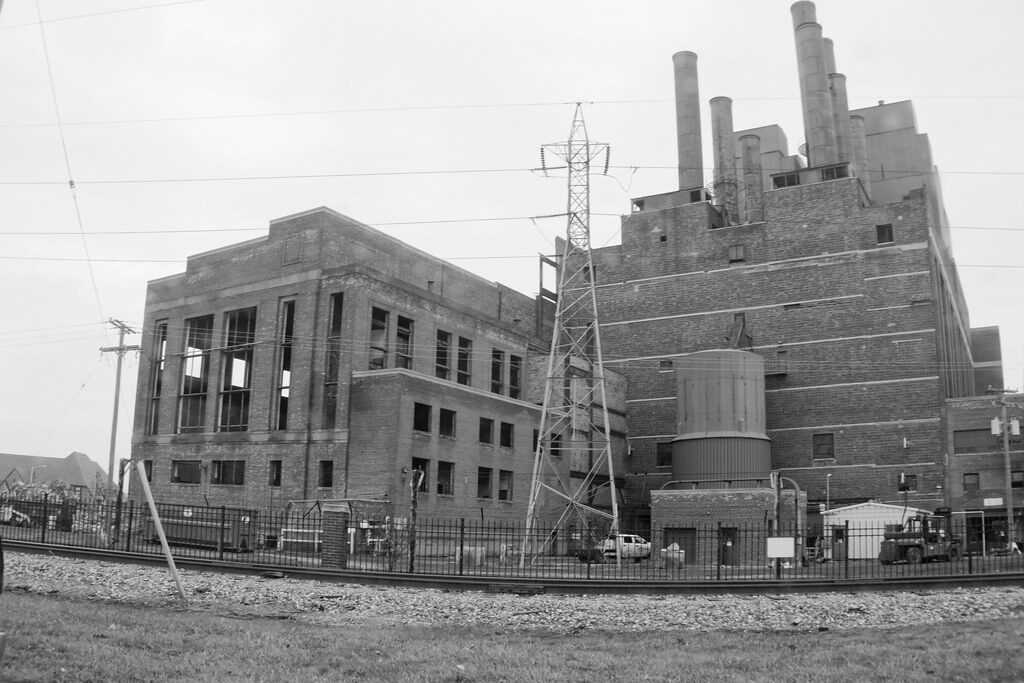
What stood longest was the boiler house - the largest structure, the one visible from Ontario, the piece of the plant that had defined the Marysville riverfront skyline for most of a century.
On November 7, 2015, the boiler house was imploded. Crowds gathered on both banks. The AP reported the structure was 93 years old.
People standing on the Ontario shore watched it fall from across the river - the same distance from which they, and their parents, and in some cases their grandparents, had watched it stand.
DTE's Range Road Landfill, which had been accepting coal ash from Marysville for decades, had already been formally notified that no more ash would arrive.
The 100-Room Hotel That Was Never Built
Commercial Development Company put forward a detailed plan for the riverfront property.
The Marysville Riverfront Master Plan called for a 100-room hotel, plus restaurants, retail and office space, a marina, and pedestrian walkways.
The design was supposed to reflect the site's 1920s industrial past. It also included a historical kiosk to tell visitors about the plant's history.
By January 2025, none of it had been built. Sean Quain, Marysville's planning and zoning administrator, told Inside Climate News there had been no redevelopment at all.
He called the plan "wishful thinking" and said the promises were not kept. The investigation came out more than ten years after the sale and more than nine years after the demolition.
The site at 301 Gratiot Boulevard - once a lumber mill in 1786, later the home of Zephaniah Bunce in 1817, later a dock for coal ships through two world wars, and later still a crossing point for Ontario Hydro interconnection lines - sat empty.
For most of the 20th century, a 300-megawatt plant operated there. Now there is nothing on the surface. Beneath it, Bunce Creek continues to flow through its buried channel.