
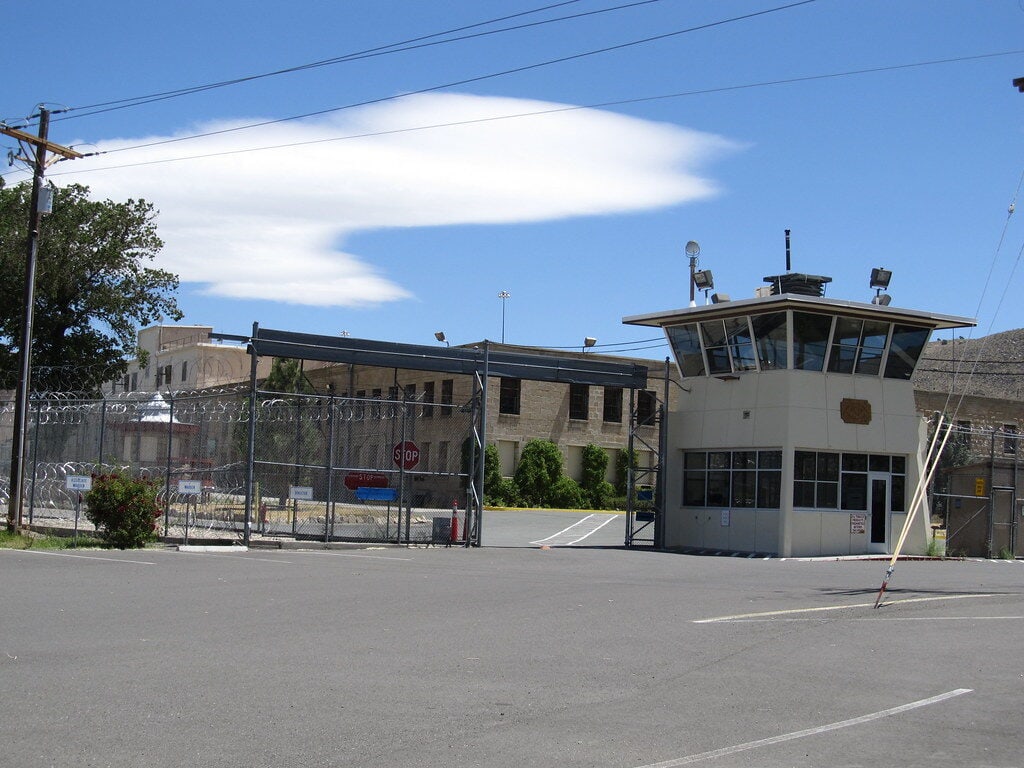
Nevada State Prison sits on East Fifth Street on the east side of Carson City, Nevada. It's a walled sandstone complex.
It opened in 1862 as a leased prison in Abraham Curry's Warm Springs Hotel, almost three years before Nevada was a state. The territory bought the site and its quarry in 1864. Cell blocks kept going up into the early 1960s.
The Legislature approved closure as a budget cut in 2011. That September the prison held 219 inmates in space rated for 841. The state decommissioned it on May 18, 2012.
The state still owns it. Tours run through the cell blocks, the yards, and the gas chamber, and the 2026 season is on the calendar.
The hotel that became Nevada State Prison
Abraham Curry and his partners bought the Eagle Ranch property in Eagle Valley in 1858 for $1,000.
The land, east of what is now downtown Carson City, had warm springs and a sandstone deposit, and Curry quarried the stone to build the Warm Springs Hotel.
Nevada's first Territorial Legislature met in that hotel in 1861 and arranged to keep the territory's prisoners on Curry's property.
The lease took effect on January 1, 1862, and Curry became the first territorial warden.
The prison is older than the state around it by almost three years.
In 1864 the territory bought the site, 20 acres, and the quarry for $80,000 in bonds. Nevada joined the Union that October 31.
Two fires, a breakout, and artillery at the gate
Fire took the buildings on May 1, 1867, along with the prison's records.
The place burned again in 1870, and the second rebuild used sandstone cut by prisoners.
On Sunday, September 17, 1871, with staffing reduced, 29 prisoners overpowered a guard during the evening lockup and moved through ceiling and crawl spaces into the warden's quarters.
The warden, Frank Denver, was also the lieutenant governor.
He shot the ringleader and was badly wounded. The escapees took his keys and emptied the armory.
A guard and a Carson City man who came to help were killed. Of the 29, 18 came back into custody and 11 never did.
When the commissioners appointed Pressly C. Hyman warden in March 1873, Denver refused to hand over the prison and locked the governor out.
Governor Lewis R. Bradley sent 60 armed men and artillery, and Denver surrendered.
The quarry that built the Capitol
The quarry ran from the 1860s into the 1950s.
The Nevada State Capitol, finished in 1871, is built from its stone, as is the 1869 Carson City U.S. Mint, now the Nevada State Museum.
In 1931 the prison started stamping Nevada license plates.
In the late 1870s and early 1880s, quarry work also exposed fossil trackways left by mammoths, horses, wolves, and ground sloths.
Some prints ran 18 to 21 inches long, and a few observers read them as the footprints of giant humans.
Edward Drinker Cope backed that reading, Othniel Charles Marsh said ground sloth, and Marsh won.
When the state rebuilt the prison in 1924 and 1925, it made the quarry wall part of the West Wing.
From the gallows to the gas chamber
Nevada moved executions from county sheriffs to the prison in 1903.
John Hancock was hanged there on September 8, 1905, and four men were hanged there that November 17.
In 1912 Andriza Mircovich chose shooting over hanging, and with no firing squad available, the state built a machine fitted with rifles.
It was the only time.
A 1921 law adopted gas, and on February 8, 1924, Gee Jon was executed in a makeshift sealed chamber, the first person in the United States executed by gas.
Between 1924 and 1979, 32 men went to Nevada's three gas chambers. The state then switched to injection and adapted the last one.
The last execution in Nevada was carried out here on April 26, 2006.
Poker inside, and an escape that lasted 45 years
In 1923 Leonard Fristoe rode to Reno in Warden Tom Slater's car, was left unattended, and walked off. He stayed gone for 45 years.
California police arrested him in 1969 after a domestic disturbance exposed his real name. He was pardoned in 1970.
From 1932 the inmates ran a casino inside the walls, the Bullpen, dealing poker and blackjack.
The prison minted its own brass tokens from 1945 to 1964.
Warden Carl Hocker went after the operation in 1967.
A bill to outlaw the games failed in the state Senate, so he asked the Nevada Gaming Control Board whether the prison held a gaming license.
It did not. The casino closed, and a slab of concrete near the old culinary area is what's left of the building.
Down to 219 inmates in an 841-bed prison
A-Block was finished in 1925, B-Block in 1948, and C-Block in 1961.
Northern Nevada Correctional Center opened in 1964 on the old prison farm land, and the old prison was no longer the whole system.
Ely State Prison took the maximum-security role in 1989.
New housing went up on the northeastern bluff in the 1980s, and officers found they couldn't see into parts of their own units.
Budget planners flagged the prison for closure in 2010, and the 2011 Legislature approved it.
That September it held 219 inmates in a prison that had been rated for 841.
The last transfers went out that winter, and the state decommissioned Nevada State Prison on May 18, 2012, after 150 years.
Tours now run through the cell blocks
The state still owns the site. The Nevada State Prison Preservation Society formed on November 1, 2012.
Assembly Bill 377, passed in 2015, designated the historic portions for use as a historical, cultural, educational, and scientific resource and cleared the way for public access.
The National Register of Historic Places listed the prison that same year.
By 2019 the preservation society put the cost of opening it more fully as a museum at $50,000.
Visitors on scheduled programs walk the cell blocks, the yards, and the gas chamber.
The historic core remains largely intact, and Carson City's 2026 visitor season has prison tours on the calendar.
Independent Publisher Notice
BestAttractions is an independent editorial publisher. We are not affiliated with, endorsed by, or acting on behalf of any location, business, property owner, manager, government agency, or organization described in this article. Comments posted on this page are not forwarded to, reviewed by, or acted upon by any entity mentioned in the article. For official inquiries, complaints, applications, bookings, or other requests, please contact the relevant entity directly through its official website or other verified channels.