The Strange History of the 1890 House Museum
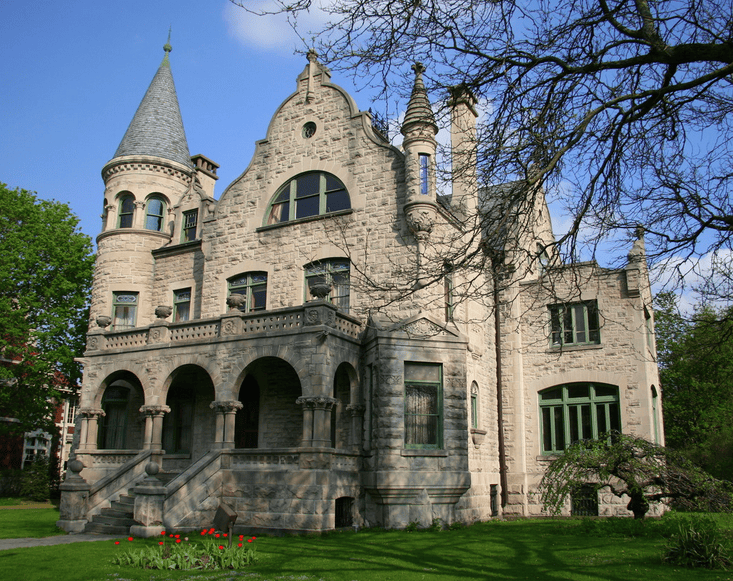
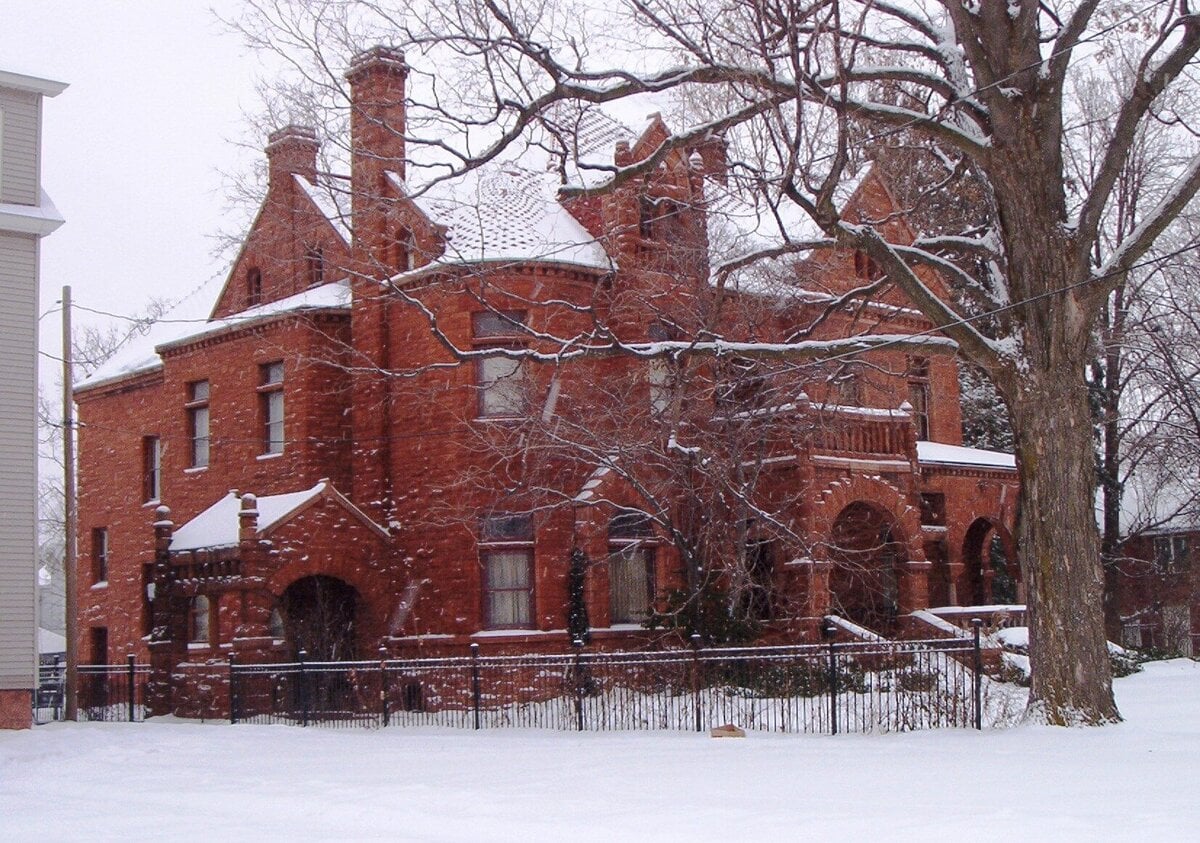
1890 House at 37 Tompkins Street in Cortland, New York, is a mirror image of a circus manager's mansion in Harlem. Not a rough resemblance - an actual architectural mirror image, deliberately designed that way by the same architect.
James Anthony Bailey ran Barnum and Bailey's circus. Chester Wickwire made wire screens and horse muzzles in upstate New York.
Neither of those facts explains how a working-class industrial city ended up with a French chateau on one of its residential streets. And yet.
Architect Samuel B. Reed had already completed a Romanesque Revival mansion for Bailey in Harlem, New York City, when Wickwire hired him to do essentially the same job again, flipped.
Wickwire got his version finished in 1890 at 37 Tompkins Street, and it has been standing there ever since - 15,000 square feet of carved limestone, turrets, and mosaic stained glass windows designed by artist Henry F. Belcher.
Cortland is a city of maybe 17,000 people, and the building towers over its residential block in a way that still catches visitors off guard.
The family that built it is long gone. The last Wickwire to live there died in 1973, after which the contents were auctioned, and local preservationists stepped in before the building could follow them.
Today it operates as the 1890 House Museum, open Thursday through Sunday, offering guided tours and, periodically, late-night paranormal investigations - both of which reliably sell out.
Chester Wickwire, Hardware Man Turned Millionaire
Chester Wickwire was born in 1843 in McGrawville - now just McGraw - to a farming family.
His father, Raymond, moved the family to Cortland when Chester was twenty two, opened a grocery store on Main Street, and then died.
Chester's brother Chauncey took over Raymond's duties and also died at twenty-seven, at which point another brother, Theodore, stepped in.
Somewhere between the deaths and the grief, the grocery store became a hardware store, and Chester and Theodore ran it together.
Chester married Ardell Rouse of Greene, New York, on October 2, 1866, and they had three children.
The oldest, Raymond, died of scarlet fever at age six in 1878. Charles and Frederic survived and eventually went into the family business.
The hardware business ticked along until 1873, when a customer named Rowland Hall paid his bill with a carpet loom instead of money.
Chester took it and started experimenting, and he figured out that the loom could weave wire just as easily as fabric - and that he could do it cheaper than any other manufacturer in the country.
By 1876, the hardware store was behind him entirely. He and Theodore built a proper factory on South Main Street in 1881.
By 1883, Wickwire Brothers was the second-largest wire goods producer in the United States.
When Chester died in 1910, his estate was valued at $1,677,498.12 - that oddly precise figure comes from the probate records.
Wire Screens, Horse Muzzles, and the Panama Canal
The products the Wickwire Brothers factory made were not glamorous. Barbed wire, window screens, chicken wire, corn poppers, coal sieves, dish covers, horse muzzles, seed spreaders.
Useful things, not flashy ones - but in rural America of the 1880s, most households could not get by without them.
What made Chester rich was not only the products themselves but the patents. He owned the rights to every machine in the plant, which meant competitors could not copy his manufacturing process.
That kept his prices lower than anyone else could manage, and it kept buyers coming back.
The factory in 1890 employed 170 men and 35 women, paid at $39.50 a month - somewhere around $1,407 in current money.
Chester hired heavily from immigrant communities: Germans, Irish, Italians, Ukrainians, Russians. He was, by most accounts, a fair employer, though the factory floor was another matter.
Unguarded machinery, constant noise, leather belts running overhead. Seven industrial accidents were recorded between 1887 and 1897.
The Wire Works eventually supplied wire for the construction of the Panama Canal.
Between 1879 and 1915, the brothers put up at least eleven expansions to the original factory building on South Main Street, and the company became Cortland's largest employer by 1910.
Running a 15,000-Square-Foot House in 1890
The Wickwire family moved into 37 Tompkins Street on June 1, 1890 - Chester, his wife Ardell, and their surviving sons Charles, who was ten, and Frederic, who was seven.
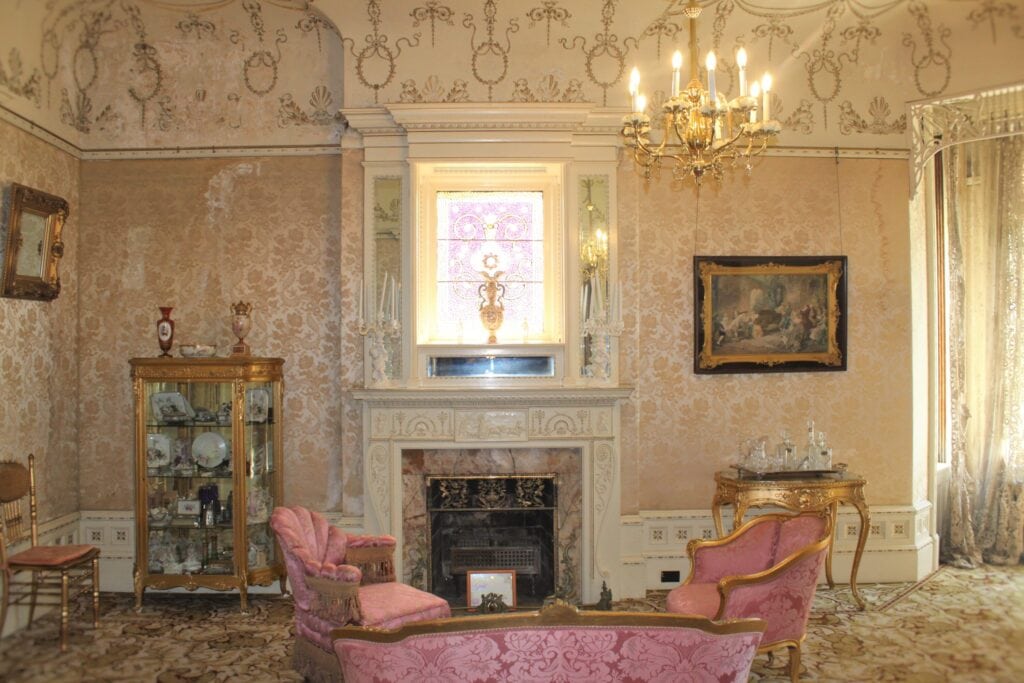
Ardell managed the household from the start. Each morning, she met the servants in what the family called the Morning Room and went through their daily assignments before the rest of the house was up.
Once a week, she held an "at home" day in the same room - women came for tea, the Cortland equivalent of a standing social appointment, and these were not idle afternoons.
Ardell served on the Finance and Entertainment Committees of the Cortland Library Association, the Social Committee, and the Women's Auxiliary of the YMCA, and spent years pushing for the construction of what is now Guthrie Cortland Medical Center.
By 1911, the Wickwire family had given $95,000 toward the hospital.
Chester took the boys to the World's Columbian Exposition in Chicago in 1893, to New York City, Saratoga Springs, and the West Coast.
Both sons took banjo and French lessons, attended a weekly club where only French was permitted, then went on to Phillips Andover Academy in Massachusetts and Yale University.
Charles married his childhood neighbor, Mabel Fitzgerald, in 1902 and later built the red mansion directly to the left of the 1890 House - now the SUNY Cortland Alumni House.
Margaret Stack and a Summer Sailing to Ireland
The servants who worked at 37 Tompkins Street mostly pass through the historical record unnamed, which makes Margaret Stack one of the more fortunate exceptions.
Stack emigrated from Athea, County Limerick, in 1904, arriving at Ellis Island at twenty-one with two of her siblings.
Her aunt, Catherine Stack Quirke, was already living in Cortland and likely arranged the position for her as cook in the Wickwire household.
The work schedule for domestic servants in that era allowed for Thursday afternoons off and every other Sunday - that was more or less the industry standard.
On free Sundays, Stack probably attended St. Mary's Church on North Main Street, which served the city's Irish Catholic population.
A March 1910 item in the Cortland Standard places her at a St. Patrick's Day banquet hosted by the Ladies Auxiliary of the Ancient Order of Hibernians, where she danced in a four-person Irish reel.
The Order helped Irish immigrants get settled and protected Catholic parishes from anti-Catholic harassment.
That same summer - 1910 - the Wickwires gave Stack the entire season off.
She and her fiancé, John Lane, an Irish immigrant she had met in Cortland, booked tickets through a local agent named James Grant and sailed for Ireland aboard the Baltic, a White Star Line ship - the same company that operated the Titanic.
They married in Athea and spent the summer at her family's home. She came back to Cortland in the fall, worked another year, and then returned to Ireland permanently, where she and Lane ran a grocery store together.
When Frederic and Marian Finally Moved In
After Ardell died in 1915, the house sat empty for eight years - 15,000 square feet going dark on Tompkins Street while the city went on around it.
In 1923, Frederic, the younger son, moved back in at age forty with his wife, Marian Goodrich, and their four children: Chester Frederic, Cynthia Margaret, Lyman Goodrich, and Winthrop Rouse.
He had worked at the Wickwire Brothers factory since college, eventually as General Superintendent and Secretary of the Board.
He also brought a Pionus parrot named Jac, who was given the run of the house and flew wherever it liked.
The house they moved into was still largely as Chester had left it, and Frederic and Marian set about changing that.
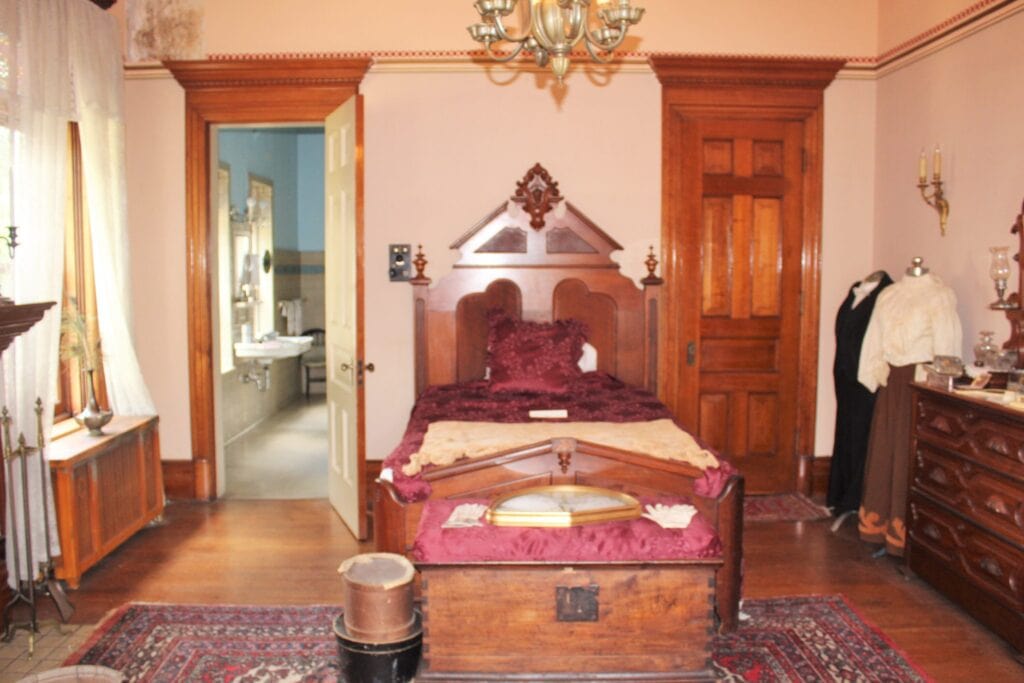
They added a sunroom called the Fernery, stripped the mantles off the fireplaces, and applied Lincrusta wallpaper - pressed with carved cherub figures - to the second and third floor walls.
Marian ordered the chandelier for the Fernery herself; it is covered in more cherubs, which apparently reflected her taste throughout.
Somewhere in the library's pantry, accessible through a trapdoor, Frederic's childhood signature - "Fred" - is still visible on the inside of the door.
Frederic died in 1929 after a long illness. Marian remarried local judge C. Leonard O'Connor in 1931, and together they updated the kitchen and bathrooms.
When O'Connor died in 1971, Marian kept writing poetry and planning garden parties until the staircase became too much, at which point someone installed a lift on the bannister. She died in 1973, at eighty-five.
An Auction, a Rescue, and a Museum Fifty Years On
After Marian died, everything in the house was sold at auction - the furniture, the objects, and everything else inside.
In 1973, a Gilded Age mansion with its original contents going up for sale could be a rare chance to save it or a quick way to lose it, depending on who acted first.
A group of Cortland County leaders acted in time, including the Landmark Society and members of the Wickwire family.
The house became a museum in 1975. The surrounding Tompkins Street Historic District was listed on the National Register of Historic Places on March 18, 1975.
The 1890 House Museum is often described locally as the district's "anchor," though that wording isn't an official NRHP label.
The organization later received its New York State charter in 1984, and its federal 501(c)(3) tax-exempt status dates to 1978.
A building with old limestone and stained glass that is more than a century old needs ongoing repair. The museum received $10,000 from the Preservation League of New York State for window restoration.
It also received a separate $7,500 Technical Assistance Grant to study water getting into the roof and the stone facade. Those findings will guide a longer restoration plan.
That preservation work supports the museum's public role today. Guided tours run about 60-90 minutes and take visitors through all four floors of the house.
The tours also go beyond the Wickwire family and include the servant quarters, the factory workers, and the social circles the family moved in.
The museum is open Thursday through Saturday from 11 a.m. to 4 p.m. and Sunday from noon to 4 p.m.
Ghosts, Victorian Tea, and Easter With Willy Wonka
Not everyone who shows up at 37 Tompkins Street is there for a lesson about wire manufacturing.
The museum carries a well-established reputation for unexplained activity - footsteps in empty rooms, doors opening and closing, shadows crossing hallways, shapes appearing in the windows.
Staff and visitors have been reporting these things for years, and in 2013, the building appeared on the television program "Ghost Hunters." The museum now runs private late-night investigations as a ticketed event, and they sell out.
The spring 2026 schedule covers a fair amount of ground. A Victorian Afternoon Tea runs March 1, with a hat contest and the option to dress in period clothing.
A paranormal investigation with Lost Souls and Empirical Paranormal fills March 14.
The Annual Easter Family Fun Event on March 28, organized with the Kiwanis Club of Cortland, is themed around Willy Wonka and the Chocolate Factory this year - admission is $5, children two and under are free.
A Group Psychic Reading with Phil Jordan lands April 24, and a Pre-Mother's Day Victorian Afternoon Tea closes the season May 3.
The house has been standing since 1890. Chester Wickwire moved in with a wife and two young sons.
A hundred and thirty-six years later, the building is still there, still drawing people in, and still, if the reports are to be believed, not entirely empty.