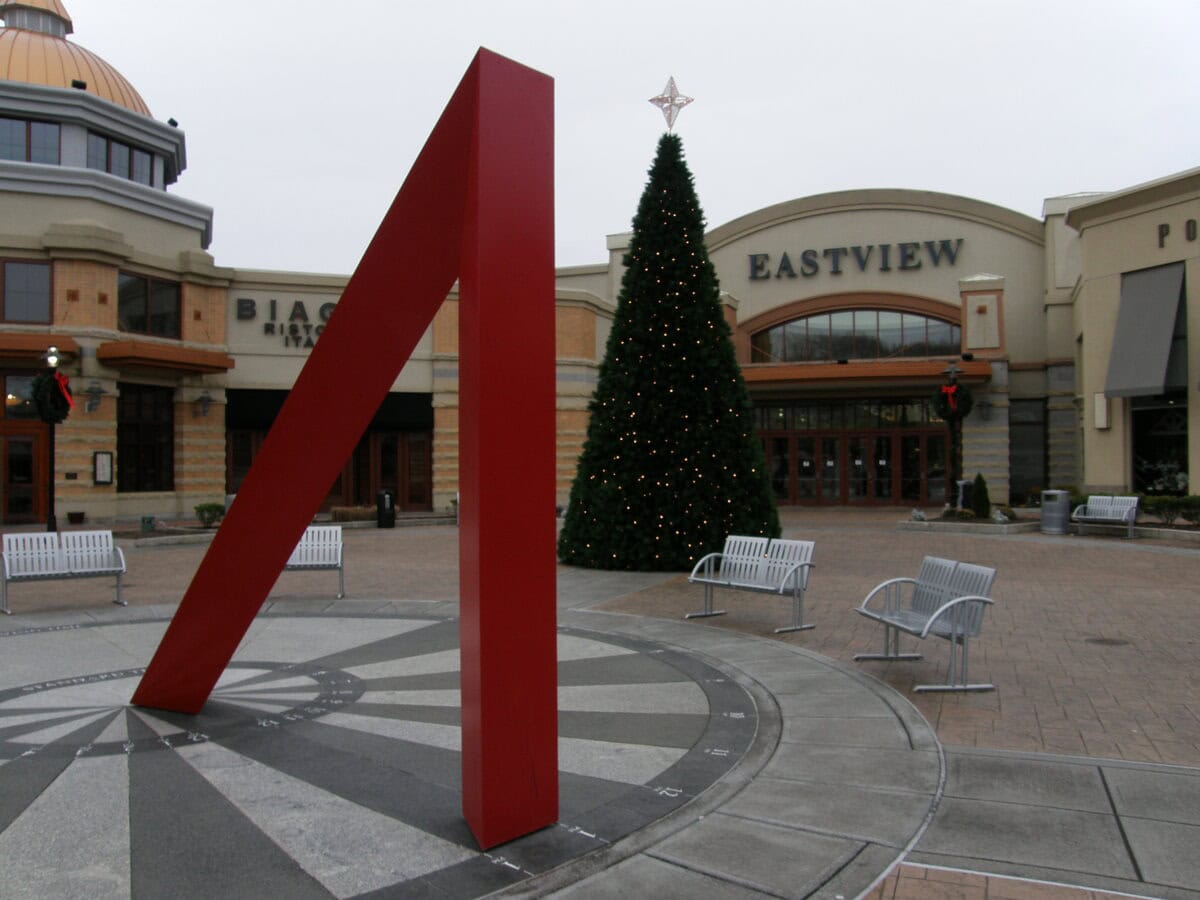
You pull into the parking lot on Harry L Drive, and the first thing you notice is the noise. Behind the old JCPenney, you can hear a concrete pump going.
Orange construction fencing now slices through the old west parking lot, and a flatbed sits idling near where the KeyBank branch used to be before crews knocked it down last fall.
And yet the place is busy. There is a line at the Beer Tree bar. A woman is hauling gym bags toward the Lourdes fitness entrance.
A dad near the main doors is trying to figure out which wing leads to Dick's House of Sport while his kids argue about something unrelated.
Oakdale Commons at 601-635 Harry L Drive in Johnson City, New York, covers just under 964,000 square feet and has been in some state of active transformation for most of the last decade.
It serves the Binghamton area and does not follow the usual story of a mall that closed and never reopened.
That story does get told about plenty of malls across the country. It simply does not fit here. What happened at Oakdale Mall is more complicated than a simple downfall and much more interesting.
The Shoe Company That Built Johnson City
Before there was a mall, there was a shoe factory.
In the 1890s, the Lester Brothers Boot and Shoe Company built the first factory of that kind along the Delaware, Lackawanna and Western Railroad in what was then called Lestershire.
The village was officially incorporated in 1892. By 1900, the village had about 3,111 residents, rising to about 3,775 by 1910.
On March 21, 1916, the village took the name Johnson City to honor George F. Johnson.
He had transformed a failing shoe business into the Endicott-Johnson Corporation, which grew into one of the world's largest shoe manufacturers.
At its peak, the company employed 20,000 people. It also built parks and worker housing and helped bring electric service to Main Street.
The last factory closed in 1993. At that time, the town had already begun searching for a new economic center.
In 1962, the Oakdale Annexation increased the village's land area by nearly one-third. It added mostly open land on the outskirts that had largely been farmland.
Five years later, construction started on New York State Route 17, which later became Interstate 86. Over the next decade, the highway cut through the area.
It led to the demolition many homes and Johnson Field, the old ballpark where the Triplets minor league team played. It also changed how businesses and traffic moved through town.
Highway exits brought drivers straight into the newly annexed Oakdale area. A developer saw those empty acres for what they were.
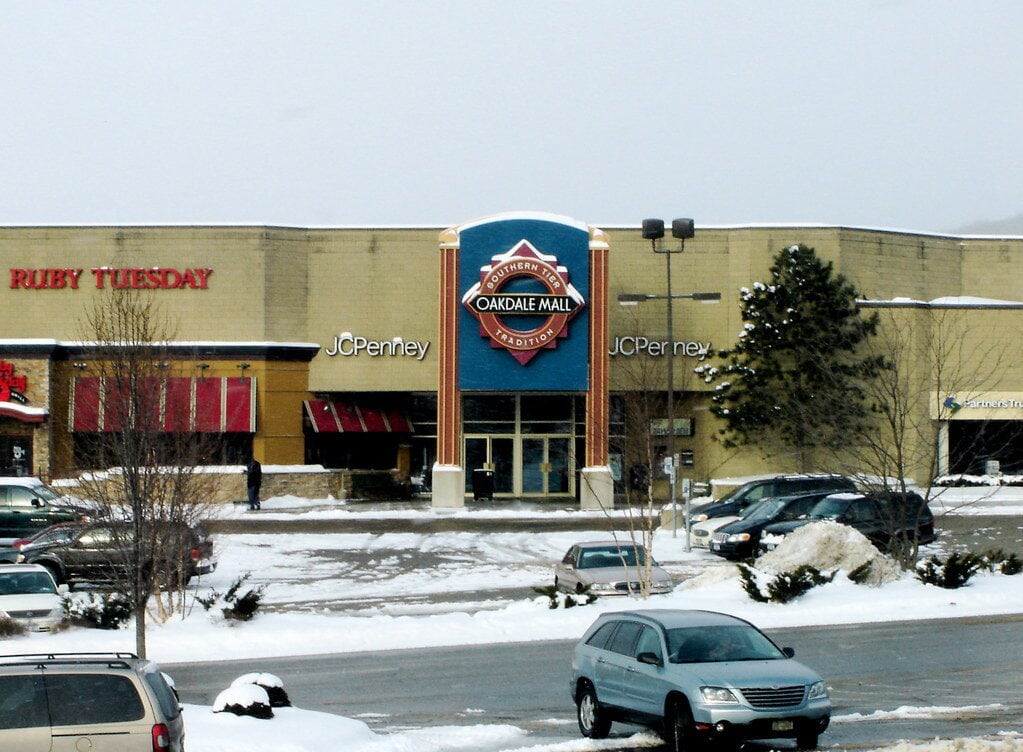
The Mall That Drew a Crowd Before Opening Day
In November 1973, a Chicago-based department store chain called Montgomery Ward opened its doors at what was still very much a construction site on Harry L Drive.
The rest of the mall was nowhere near finished.
Workers were still running wire and hammering things into place in sections that would eventually hold dozens more stores. Montgomery Ward chose not to wait. It opened its doors, and customers showed up.
By August 1975, the rest of the building was close enough to completion that the developers, Interstate Properties, held a preview event.
Admission was five dollars, with all proceeds supporting local charities.
Around 40,000 people came to walk through the unfinished halls and get a glimpse of what was ahead. No advertising campaign could have created that kind of excitement.
The official grand opening came on October 1, 1975, and what stood on Harry L Drive was immediately the first enclosed super-regional shopping center in all of Broome County.
The Binghamton area had never had anything remotely like it.
The mall was meant to be the main shopping place for the Tri-Cities area, which includes Binghamton, Johnson City, and Endicott, and the big crowd at the opening showed that idea worked.
Oakdale Mall quickly became an important part of the community. More than a collection of stores. More than a building. A place.
When the Mall Was Simply Where You Went
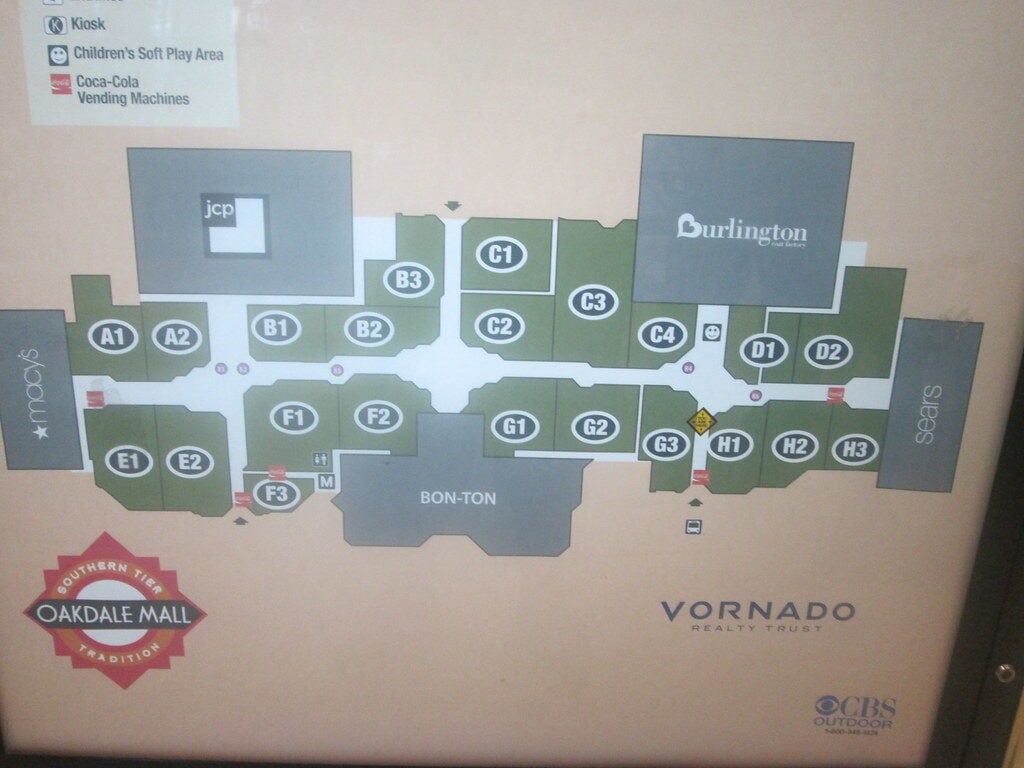
Through the late 1970s and into the 1980s, the Oakdale Mall kept adding names and square footage. Sears came in as a major anchor tenant.
The 1980s also brought a rotating restaurant, which sounded really exciting at first, but keeping the spinning floor working turned out to be too much trouble. It closed.
McAlpin's joined the anchor list in 1992. Kaufmann's opened in 2000 in the former Montgomery Ward space at the south end of the mall, and it was rebranded as Macy's in 2006.
The Bon-Ton, which had operated in Johnson City for years before under the name Fowler's, anchored another wing.
Burlington Coat Factory opened an 85,000-square-foot location in August 2003, and at its fullest, the mall held more than 125 stores.
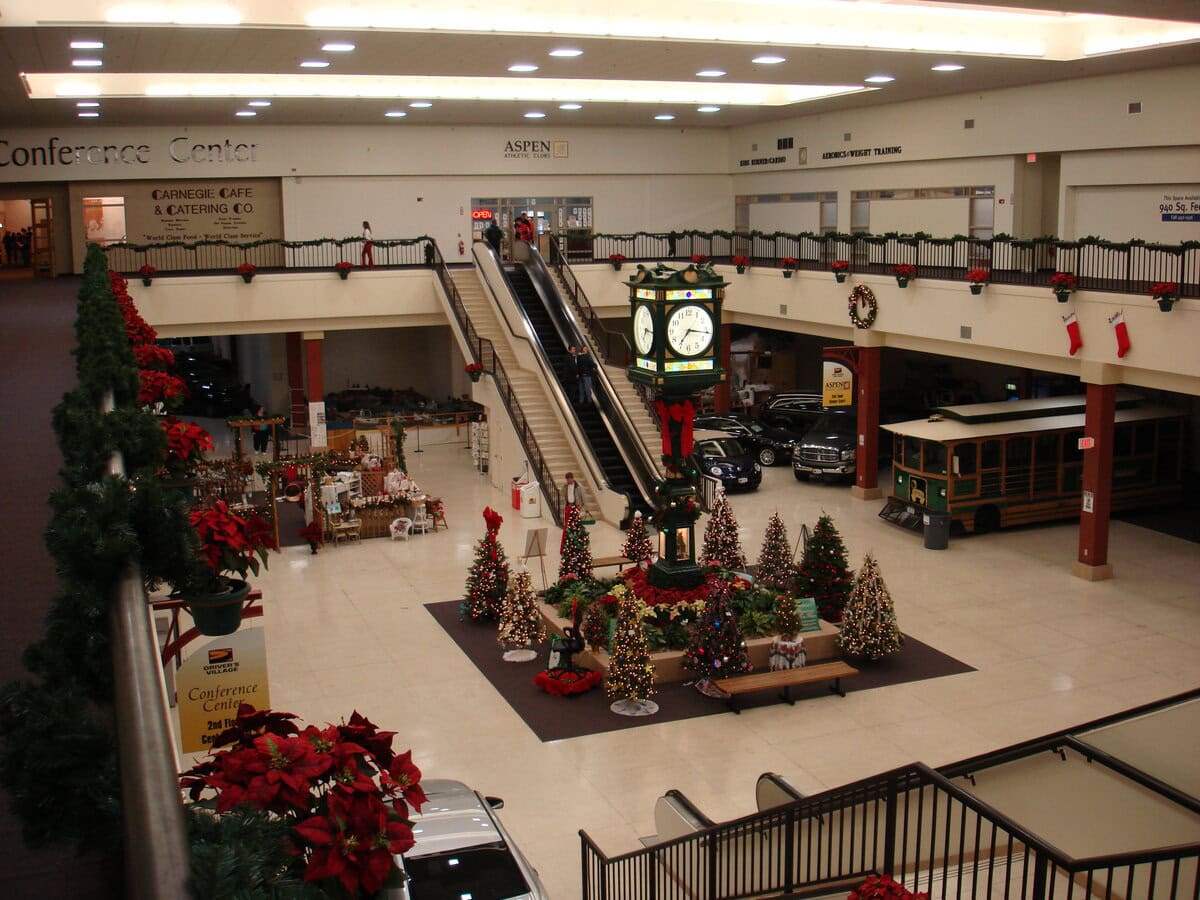
For families in the Binghamton area over those years, the Oakdale Mall was a normal part of life. You went there for back-to-school shopping, for Christmas, or on a rainy Saturday when you had nothing else to do.
The Gap, Eddie Bauer, Chemung Canal Trust, a food court that was busy every day at lunch - the building was part of everyday life in the Southern Tier for almost forty years, and nobody really thought that would ever change.
Most Anchors Left Within About a Year and a Half
The first warning sign was easy to overlook.
In 2015, Sears Holdings moved 235 of its properties - including the Sears at Oakdale Mall - into a separate holding company called Seritage Growth Properties. It was a financial restructuring.
Two years later, store closures started happening quickly. Macy's closed its Oakdale store in April 2017. Sears closed in September 2017.
Within six months, two of the mall's biggest anchor stores were gone, and smaller stores nearby felt the drop in customer traffic almost right away.
The Bon-Ton chain went out of business, and its Oakdale store closed in August 2018.
Burlington had been in the building since 2003, longer than almost any other tenant.
In October 2022, the company's website indicated it would move to a new location at Town Square Mall in Vestal.
By then, the hallways that once held more than 125 stores were down to about eight operating retailers and one place to eat.
Anyone who had spent years in that building and walked through it in 2020 or 2021 could feel the change. The mall was unusually quiet, and the space felt strange in a way it had not before.
New Owners, New Name, a Completely New Idea
In January 2022, a company called Spark JC, LLC, bought the mall, previously owned by Vornado Realty Trust, out of foreclosure from special servicer Rialto Capital.
The new owners were local developers Doug Matthews and Marc Newman, and they were not shopping for replacement department stores.
They wanted to turn the building into a mixed-use complex where you could see a doctor, join a gym, eat dinner, drink a beer brewed on site, shop for sporting equipment, and eventually live nearby too - none of which had ever been the point of a mall before.
Phase I centered on the old Sears space.
That building became the Lourdes Pavilion, a facility with three pools, a steam room, a sauna, a full fitness floor, physical therapy offices, primary care, a drive-through pharmacy, and lab services.
The former Sears space also became Factory by Beer Tree, a two-story restaurant and brewery that quickly became one of the more popular spots in the Binghamton area.
Broome County moved more than 200 employees into office space on site. Dick's House of Sport opened in the former Macy's space in 2023. The mall got a new name: Oakdale Commons.
By the time Phase I was done, the redeveloped sections of the building had over 500 people working in them and were drawing thousands of visitors each day.
The proof of concept had worked. The harder parts were still ahead.
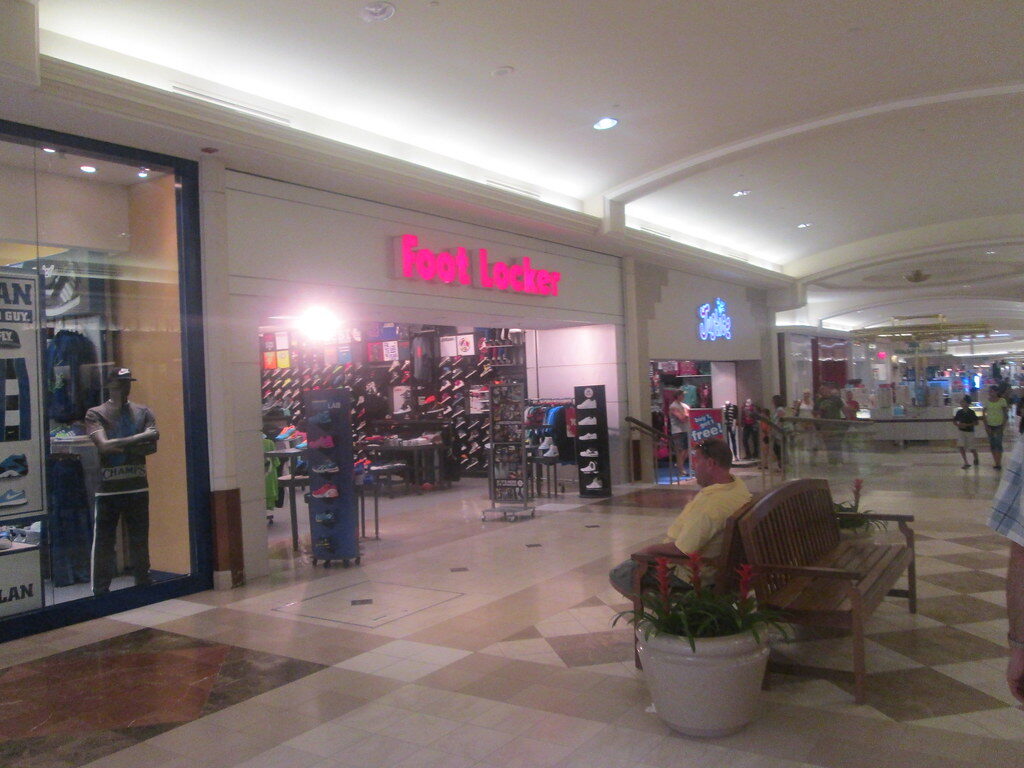
What's Under Construction at Oakdale Commons
The Johnson City Planning Board approved the Phase II site plan in December 2024, and construction is active across several sections of the property.
A BJ's Wholesale Club opened in January 2024 on the site of the former Bon-Ton building, which had been fully demolished and rebuilt from scratch.
Dave & Buster's opened on July 29, 2024. The new 25,000-square-foot restaurant and arcade offers more than 100 games, a sports bar with a 40-foot TV screen, and space for parties and events.
Five Guys opened at Oakdale Commons on January 24, 2025. The restaurant took over the former Ruby Tuesday location and offers about 80 indoor seats, along with outdoor seating available during warmer months.
New York State provided $18 million through the Upstate Revitalization Initiative toward a total project cost estimated at around $200 million.
That funding will support several major projects. It includes an 85,000-square-foot regional medical campus, anchored by a Guthrie orthopedic and spine center.
It also includes a 20,500-square-foot child care facility run by Broome County, with space for up to 208 children. In addition, the plan includes 125 units of workforce housing on the north end of the property.
The former Burlington space is already being converted into a Guthrie surgical center. A HomePLUS furniture showroom is preparing to open.
The old KeyBank branch was knocked down in late 2025, clearing the way for a Chick-fil-A expected sometime in 2026.
You could spend a long time cataloguing what is planned, what is under construction, and what just opened last months.
But the more useful thing to notice is what the place feels like now - busy in a way that has nothing to do with retail nostalgia, and loud for reasons that suggest it intends to stay that way.