
Old Zoo Nature Trails sits on a rocky bluff above Lake Cisco, north of Cisco, Texas, in Eastland County.
The site opened as the Cisco Zoo in the mid-1920s, part of a lake resort with cottages, a beach, and a swimming pool the city promoted as the world's largest. Enclosures were fitted among natural sandstone outcrops.
Money was already squeezing it. Maintenance ran about $2,500 in 1931, and officials planned to cut at least $500 the next year. The zoo was disbanded in 1938.
The enclosures stayed ruins for more than 80 years. They're open again, free and year-round, with the ruins left as ruins rather than rebuilt.
Cisco's first zoo animals lived inside a dam
The first animals in Cisco's zoo lived inside a dam. Partitions inside the concrete structure below Lake Cisco were adapted into shelters and cages.
A man from Gorman donated a deer. A woman from Caddo loaned a bear. Others followed as interest grew.
Cisco had grown fast on the oil boom and needed water, so it dammed Sandy Creek north of town, in Eastland County, Texas.
State authorization came on June 16, 1920. A four-mile railway hauled construction materials to a camp built for about 200 workers.
The dam was finished on September 7, 1923, and the lake began filling behind it.
The animals stayed under the dam about a year.
Cages cut into the sandstone bluff
Then the cages moved uphill, to the rocky bluff below the dam.
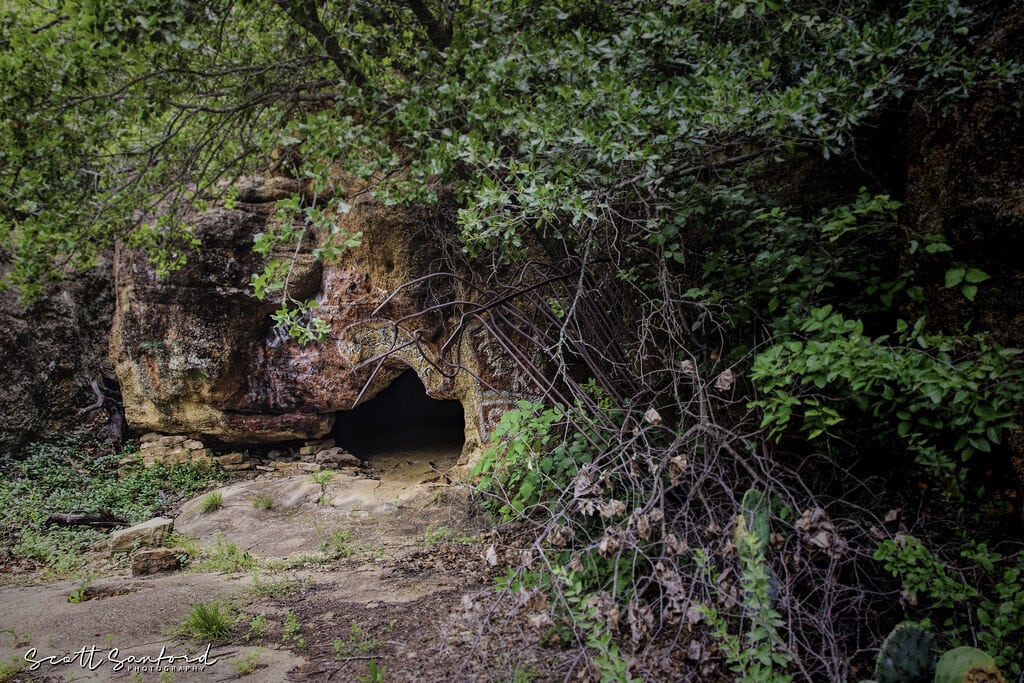
Builders used what was already there: stone, concrete, iron bars, wire, and the natural sandstone faces of the hillside, with paths and stone steps linking enclosures at different elevations.
Some animals could back into cave-like spaces in the rock.
Dr. Charles H. Hale ran it as superintendent from the mid-1920s.
In August 1926, a visitor watched a bear retreat into its cave and wolves move among the boulders.
Deer, black bears, wolves, coyotes, a panther, foxes, monkeys, and flamingos turn up in accounts of what lived on the hill.
Promoted as the world's largest concrete pool
The zoo was one piece of a resort. Williamson Dam was dedicated on July 4, 1925, before an estimated 10,000 people.
Businessmen led by F. E. Harrell had organized the Lake Cisco Amusement Company the year before.
Their first swimming spot was a 100-by-100-foot wooden platform sunk near shore to make an artificial beach.
Swimming in the reservoir was later prohibited, and a pool and bathhouse on the hill lasted about a year.
In 1927 the company built the one people still talk about, below the dam: 370 by 700 feet, depths from two feet to at least 16, an island-like section in the middle, and a slide.
Cisco promoted it as the world's largest concrete swimming pool.
On warm Sundays the zoo took more than 400 visitors, many of them driving in from towns with no zoo of their own.
The poisoned bear didn't close the zoo
The familiar version of the ending has a poisoned bear and a lost deer shutting the zoo down. Both losses happened years before it closed.
In January 1932, with Hale entering his seventh year, the original deer had been gone four years and the original bear had been poisoned by someone never identified.
The zoo was open and drawing crowds through all of it.
Animals got out sometimes. In 1928, three teenagers caught a black bear cub that had been loose from the zoo for about three months.
Breeding went badly.
Hale reported trouble raising cubs born in the cages because the mother wouldn't nourish them, and earlier attempts at artificial feeding had failed.
$2,500 a year, and the city almost cut it
At the start of 1932, the City of Cisco took the zoo over directly, placing the menagerie under the sanitary department with Commissioner Elliott responsible at city hall and Hale still running it day to day.
The handover came during severe financial strain, and officials openly discussed abolishing the zoo to save money.
Residents argued it pulled visitors to Lake Cisco. The zoo stayed.
Maintenance had cost $2,500 in 1931, and the 1932 estimate was cut to $2,000, which meant no new large animals.
Hale suggested monkeys instead, plus a local zoological society funded by membership fees to pay for replacement animals.
The amusement company had its own trouble that year: on October 28, 1932, a Texas appellate court decided Padgett v. Lake Cisco Amusement Co., over a claim that a defective slide at the company's park had caused injuries.
The animals left in 1938, and the brush moved in
Cisco disbanded the zoo in 1938 and shipped what remained to Forest Park Zoo in Fort Worth: two black bears, a panther, a fox, two coyotes, several other animals, and birds.
The bluff enclosures had nothing left to hold.
The rest of the district outlasted them by decades.
The giant pool kept operating into the 1970s, possibly to around 1980; the exact year isn't settled.
A fire in 1977 destroyed the building associated with the skating rink, and the pool eventually fell out of use.
Up on the bluff, the paths grew over, the ironwork rusted, the masonry broke down, and graffiti went up.
Because the cages were heavy stone and concrete set into natural rock, much of the structure survived 80 years of neglect.
What Old Zoo Nature Trails looks like now
In 2021, volunteers working through SAFE, short for Students, Athletics, Families, and Education, started hauling out brush and trash and reopening blocked paths.
A longtime Cisco resident who remembered the lake area came back with his grandson to help clear it.
The ruins were left as ruins. Crews added directional signs, cleared the stone steps, and set animal medallions along the route as a scavenger hunt.
Walk it now and you get rock dens, cage foundations, surviving ironwork, concrete shelters, walls, and stairways, plus remains tied to the zoo offices and nearby cottages.
Depending on which loops you count, the trail runs 0.9 to 1.5 miles.
Old Zoo Nature Trails is on County Road 112 near Lake Cisco, several miles north of downtown.
It's free, it's open year-round, there are public restrooms, and the old pool below the dam is a water-filled basin people fish.

Independent Publisher Notice
BestAttractions is an independent editorial publisher. We are not affiliated with, endorsed by, or acting on behalf of any location, business, property owner, manager, government agency, or organization described in this article. Comments posted on this page are not forwarded to, reviewed by, or acted upon by any entity mentioned in the article. For official inquiries, complaints, applications, bookings, or other requests, please contact the relevant entity directly through its official website or other verified channels.