
Charleston Town Center still has a working post office, a parking office, mall security, and two West Virginia music museums. What it no longer has is a department store.
It opened as a full regional mall with major department stores, about 130 shops, restaurants, a food court, and a hotel connection.
Today, fewer than 30 tenants are left, and some of the doors still lead to a state agency rather than a store. The directory reads less like a mall and more like a building looking for a purpose.
It is still called a mall, and it still keeps mall hours. Whether it is still a mall is the open question.
A Charleston neighborhood came down first, and the block sat empty for years
Before the mall there was the Super Block, cut out of the Triangle District, a mixed downtown neighborhood of homes, small businesses, and community institutions.
The neighborhood was cleared for redevelopment.
Then very little happened. The ground sat vacant for more than a decade while the plan caught up to the bulldozers.
In the 1970s, Charleston assembled that land under Mayor John Hutchinson, who backed the civic center, the parking garages, and the land work that made a downtown mall possible.
The thinking was common for the era.
Suburban shopping centers were pulling stores and customers out of city centers across the country, and Charleston wanted to keep its own.
So the city decided to put the suburb's main attraction in the middle of downtown.
$100 million, four anchors, and the suburban mall rebuilt downtown
Forest City Enterprises of Cleveland and the Cafaro Company of Youngstown built the mall for $100 million, on a design by RTKL of Baltimore.
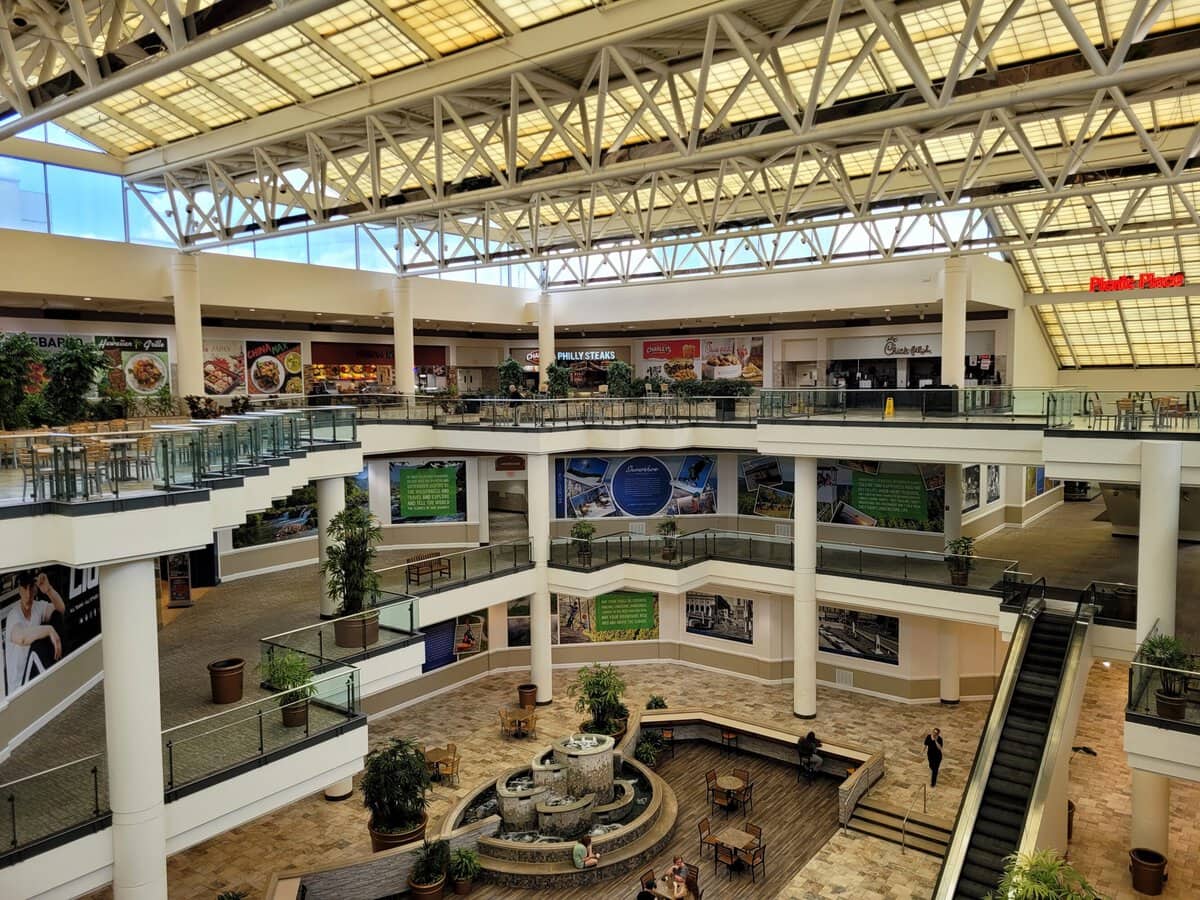
It opened in November 1983: three levels, 931,000 square feet, an entire downtown block, clay brick-tiled passageways, skylights, and the waterfall.
Four anchor stores defined it.
JCPenney, Sears, Kaufmann's, and Montgomery Ward gave the mall the depth of a true regional center, and around them ran about 130 specialty stores, plus restaurants and a food court.
Promoted as one of the largest downtown enclosed malls east of the Mississippi, it changed how the Kanawha Valley shopped.
It also did something harder to sell.
Two blocks east, Capitol Street had been Charleston's shopping street for generations.
The mall helped pull those customers indoors, and the older storefronts lost some of the business that had kept them open.
A project built to defend downtown hollowed out part of the downtown it was defending.
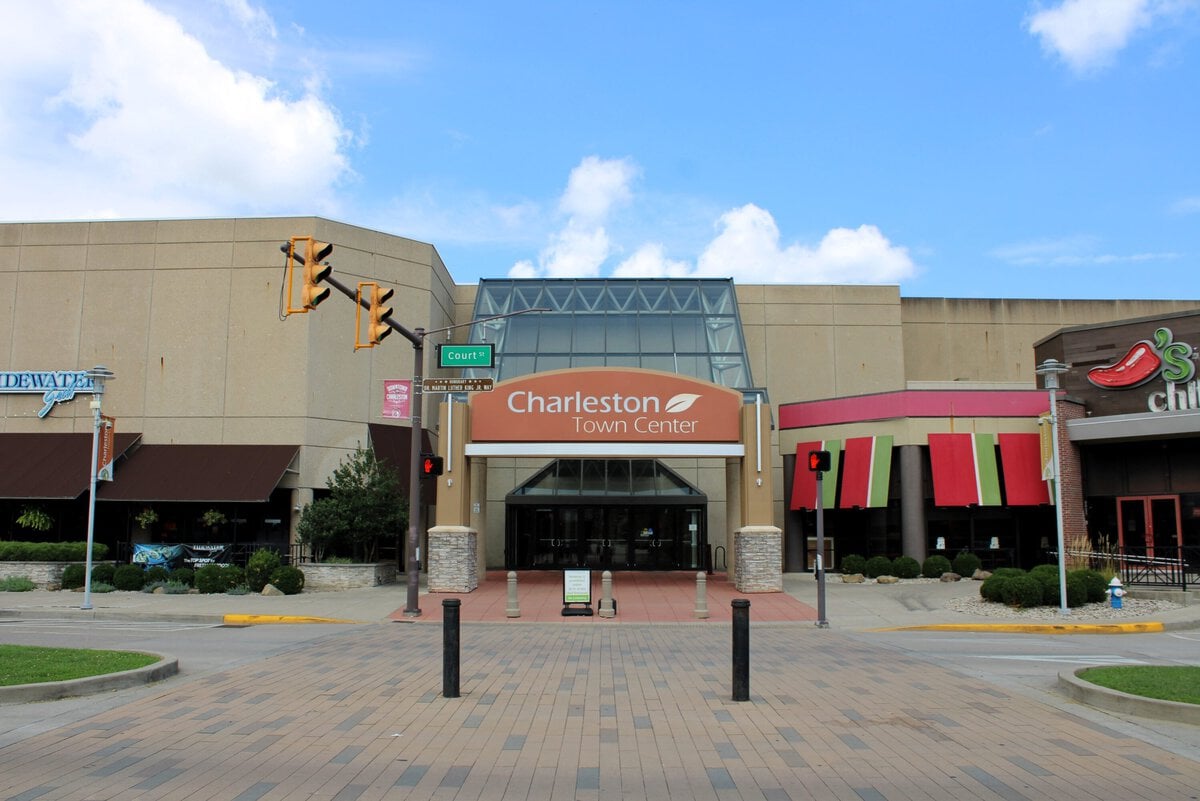
At its peak, the mall ran on $200 million a year
Near the end of the twentieth century, the mall took in $200 million a year.
It drew shoppers from a wide regional trade area, and it was the retail piece of a downtown plan that linked shopping to hotels and conventions.
The Charleston Marriott Town Center opened with 352 rooms, tied into the mall through interconnecting parking garages, and shared the parking system.
The Civic Center, now the Charleston Coliseum and Convention Center, stood nearby.
Federal grants of $14 million had paid for two mall garages and the Marriott garage, and a separate federal grant funded a walkway tying Capitol Street to the center.
Charleston Urban Renewal Authority owned the land beneath the garages and collected $300,000 a year from the mall in quarterly payments, money that later helped support downtown facade grants.
For a while, the whole arrangement held together: park, shop, eat, stay, and barely step outside.
The waterfall ran for years, then Charleston Town Center shut it off
For 22 years, water dropped three stories down granite steps into a courtyard garden inside a downtown block.
The waterfall sat at the center of Charleston Town Center and was its landmark and meeting place.
In 2005, it was turned off.
The waterfall never came back, and the mall stayed open without it.
One anchor left in 2001, and the rest followed over 24 years
Montgomery Ward went first, closing in 2001 in the chain's final liquidation.
Its space never found another department store.
A Dillard's deal was discussed and did not come together.
Steve & Barry's took part of it and closed in 2008.
The food court was going the same way: by 2006, half of it had become government office space.
Sears closed in spring 2017 and took its auto center with it, leaving a large empty stretch along one edge.
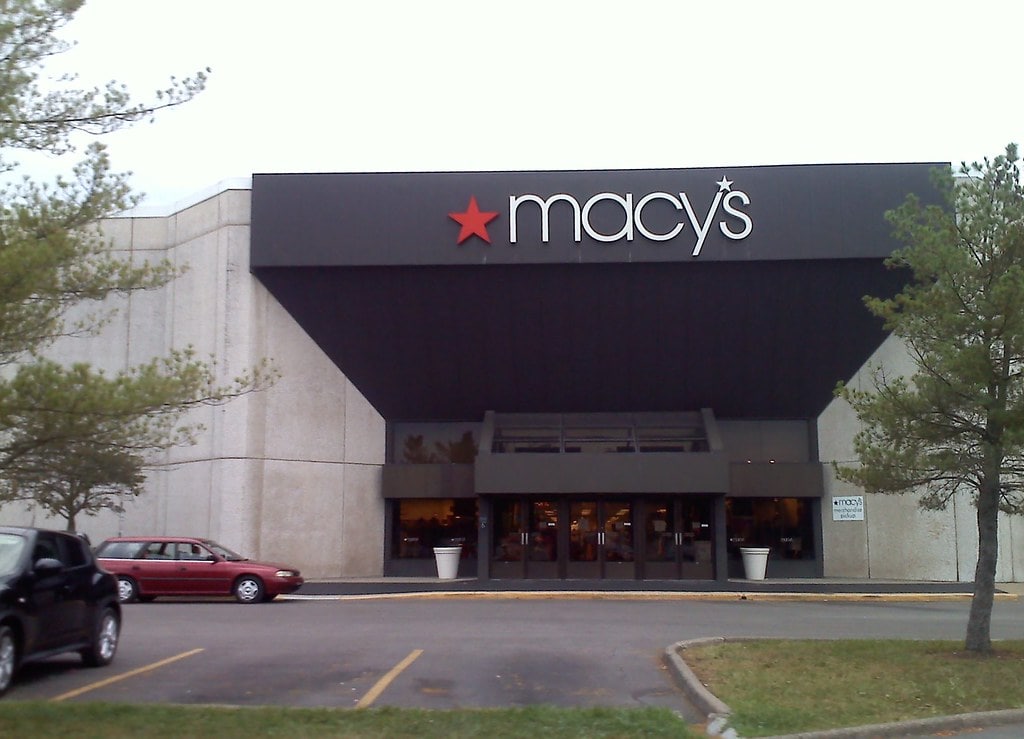
Kaufmann's had become Macy's in the department-store consolidation of the mid-2000s, and Macy's announced its exit in January 2019.
That left JCPenney as the last traditional anchor.
The smaller stores thinned out alongside the anchors.
Through 2020 and early 2021, Francesca's, Hollister, Sephora, Talbots, Chico's, and the WVU Fan Store all closed or set their closing dates.
The public directory still listed dozens of store and restaurant names, but the count of places actually open kept dropping.
JCPenney held on until 2025. It announced the closing on January 27 and locked the doors for good on May 25, 2025.
For the first time since 1983, Charleston Town Center had no department store at all.
A $93 million default put the mall in a courtroom
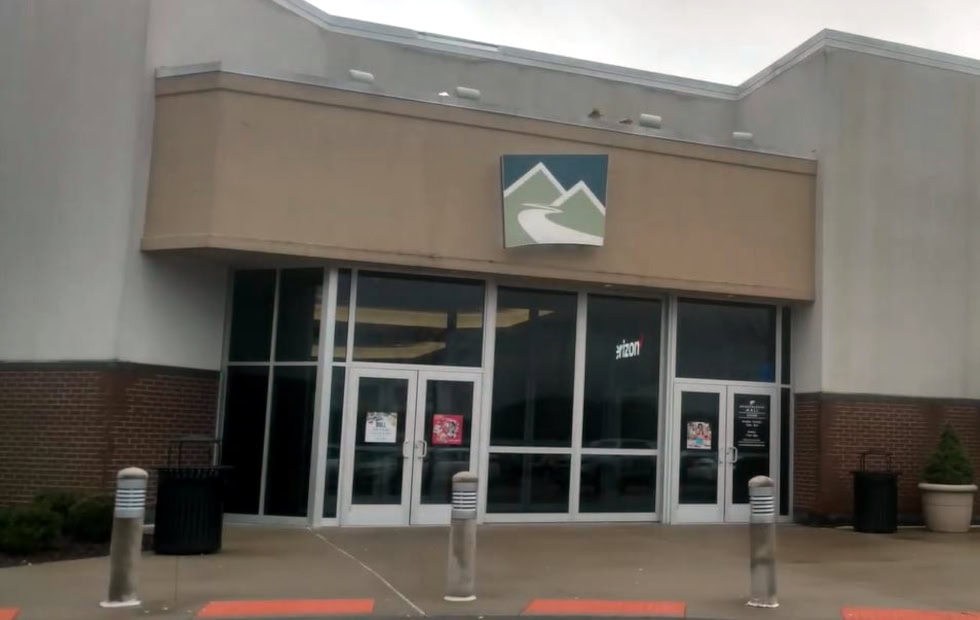
The money came apart in 2017. The mall owed about $93 million on a $100 million loan and missed its maturity.
A proposed sale of Forest City's interest to the Australian group QIC, part of a larger deal for several Forest City malls, fell through for this property.
Charleston Urban Renewal Authority even waived a transaction fee worth $13 million to help a sale go through.
It did not matter; QIC walked away from the Charleston property.
U.S. Bank National Association went to court.
In January 2018, a Kanawha County judge placed the mall in receivership, and CBRE took over daily operations: leasing, staffing, tenant recruitment, the works.
The city and the urban renewal authority joined the case, because those missed payments were funding downtown programs.
In January 2019, the bank bought the mall itself for $35 million at a county courthouse auction.
In May 2021, it sold for $7.5 million to Hull Property Group of Augusta, Georgia, a company that buys struggling malls.
A mall built as a $100 million project had changed hands, 38 years later, for $7.5 million.
The anchors came down, and white walls went up over the empty stores
Sears was the first building to go.
After the store closed, a plan to demolish it for a stand-alone Hilton-brand hotel stalled in a fight over the wall between the Sears structure and the rest of the mall.
In July 2022, a Kanawha County court cleared the demolition to proceed.
Macy's followed. Its former building became the site for a proposed sports complex, and demolition began in April 2024.
The same month, two of the mall's longest-running restaurants closed without warning: Tidewater Grill, after nearly 40 years, and The Chop House, after more than two decades, both run by Mainstreet Ventures.
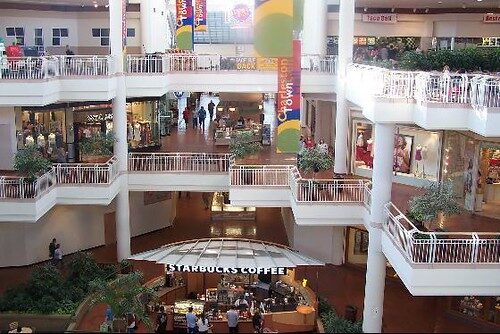
Inside, the change was plainer to see. Empty storefronts on both retail levels were covered with plain white walls.
Paths into at least one old anchor wing were blocked off.
The concourses still ran, but you walked them past more wall than store.
A sports complex, a city takeover, and a plan to undo the enclosed mall
Two separate plans now sit on or around the property.
The first is the Capital Sports Center, proposed in August 2022 for the former Macy's site.
The initial plan was priced at about $80 million for a roughly 250,000-square-foot complex.
In May 2025, it went on hold when a $7 million federal earmark was held up, and construction costs climbed.
In February 2026, county and city leaders said the $7 million had come through after all, with a smaller plan: basketball and volleyball courts, pickleball, a fitness center, and a walking track, with the earlier aquatic center and climbing wall left out.
The second project is bigger.
In January 2026, the mayor said the city was talking with Hull about taking the mall property, possibly as a donation, and handing it to a development organization to plan.
City officials called it the largest potential economic development effort in Charleston in more than 40 years.
City leaders had described the mall as physically central to downtown yet cut off from the investment happening around it.
The enclosed design that kept weather off shoppers in 1983 had become one of the things redevelopment would have to open back up.
The early direction is mixed use: housing, shops, offices, restaurants, and traffic pulled back through a block that has faced inward since it opened.
What is gone, what is left, and why the doors still open
As of 2026, the mall is still open, 10 to 9 most days and 12:30 to 6 on Sundays.
Fewer than 30 tenants remain, and none is an anchor.
What is left tells you where the building is going.
American Eagle, Hot Topic, Foot Locker, Bath & Body Works, and Build-A-Bear still trade, and so do Chick-fil-A, Chili's, and Outback.
Alongside them sit a post office, parking services, mall security, the state Bureau of Senior Services, and two West Virginia music museums.
The vacant JCPenney box was up for sale on its own in early 2026: 120,000 square feet on 1.8 acres, asking $3.2 million.
The mall around it waits on a transfer that has not closed and a plan that does not yet exist.
Charleston built this place to hold downtown together.
Forty-three years later, holding it up is the city's problem again.
Independent Publisher Notice
BestAttractions is an independent editorial publisher. We are not affiliated with, endorsed by, or acting on behalf of any location, business, property owner, manager, government agency, or organization described in this article. Comments posted on this page are not forwarded to, reviewed by, or acted upon by any entity mentioned in the article. For official inquiries, complaints, applications, bookings, or other requests, please contact the relevant entity directly through its official website or other verified channels.