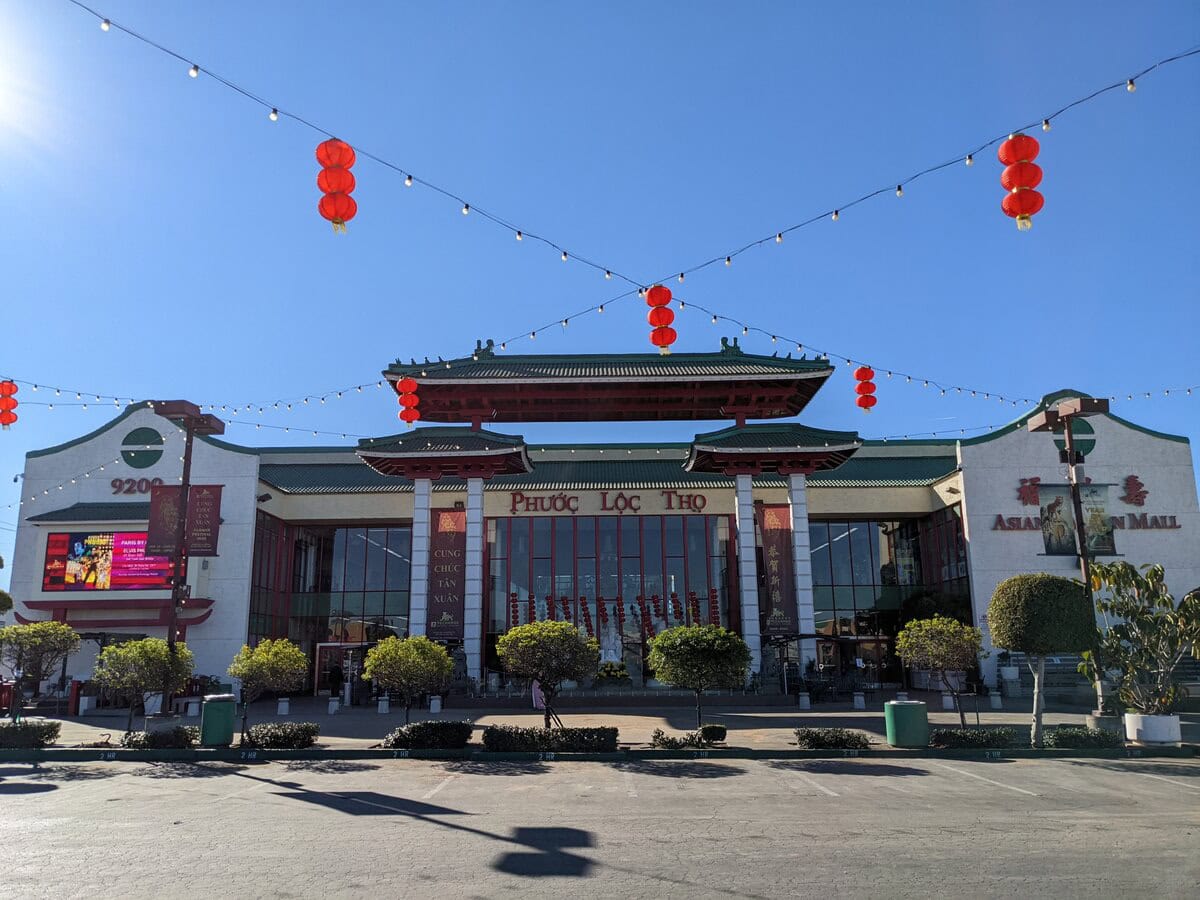
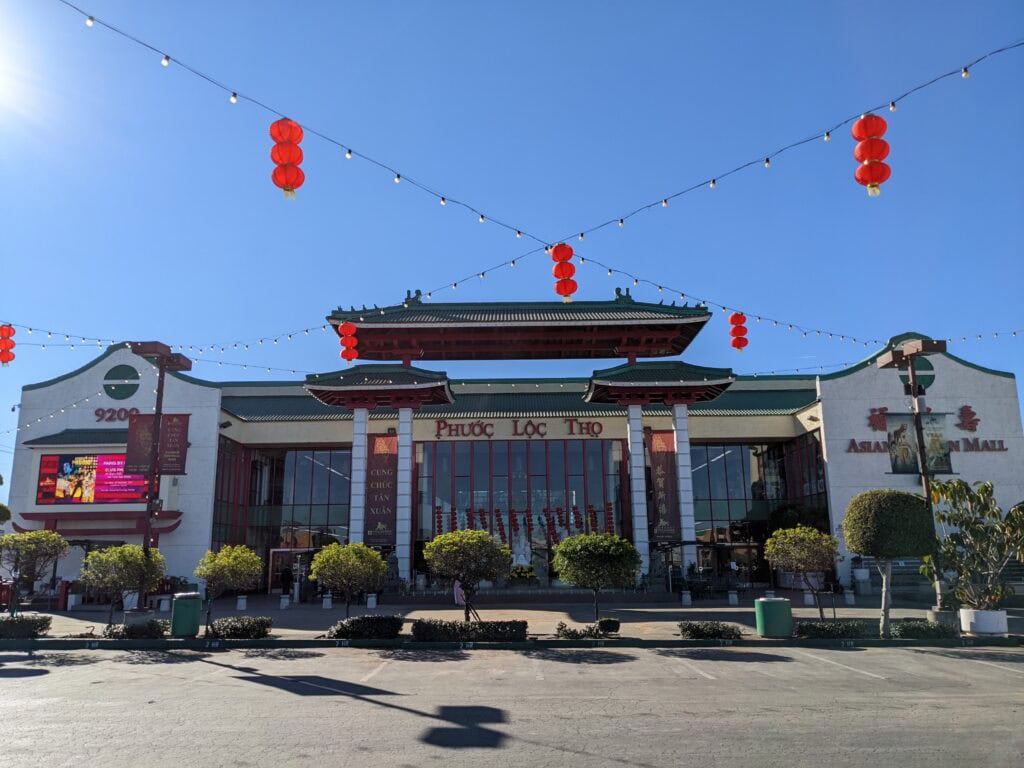
The building rises two stories at 9200 Bolsa Avenue in Westminster, California. Green tiles cover the roof, and marble statues stand at the entrance.
There is a smiling Buddha and three gods who represent fortune, prosperity, and longevity. These gods give the place its Vietnamese name: Phuoc Loc Tho.
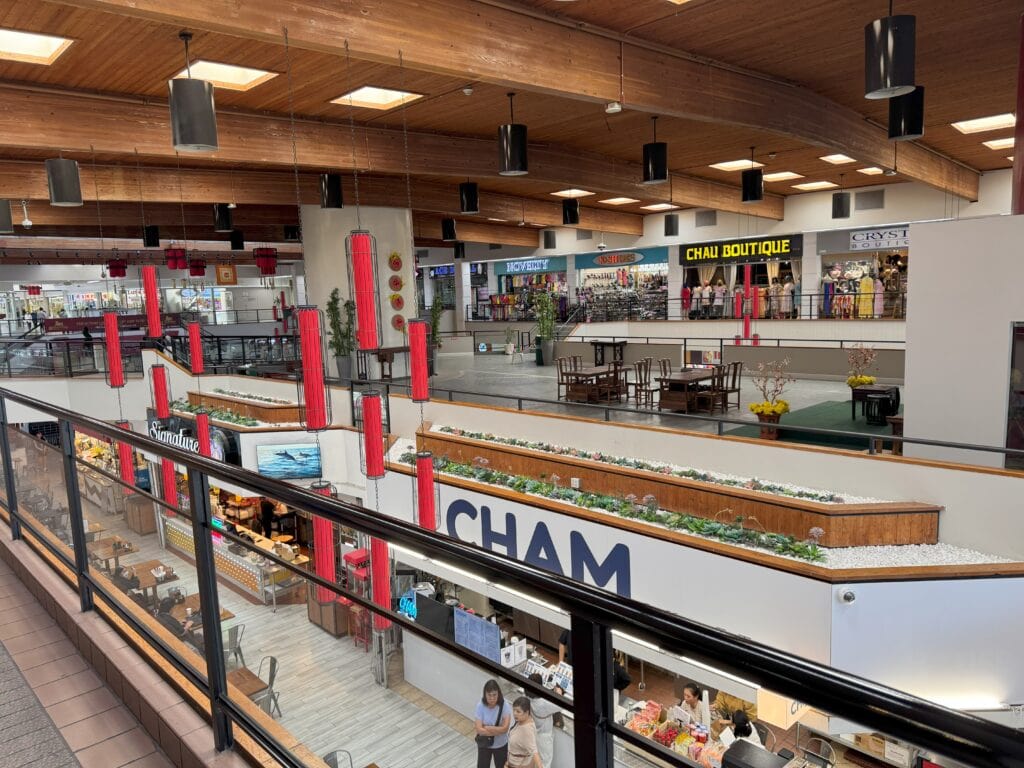
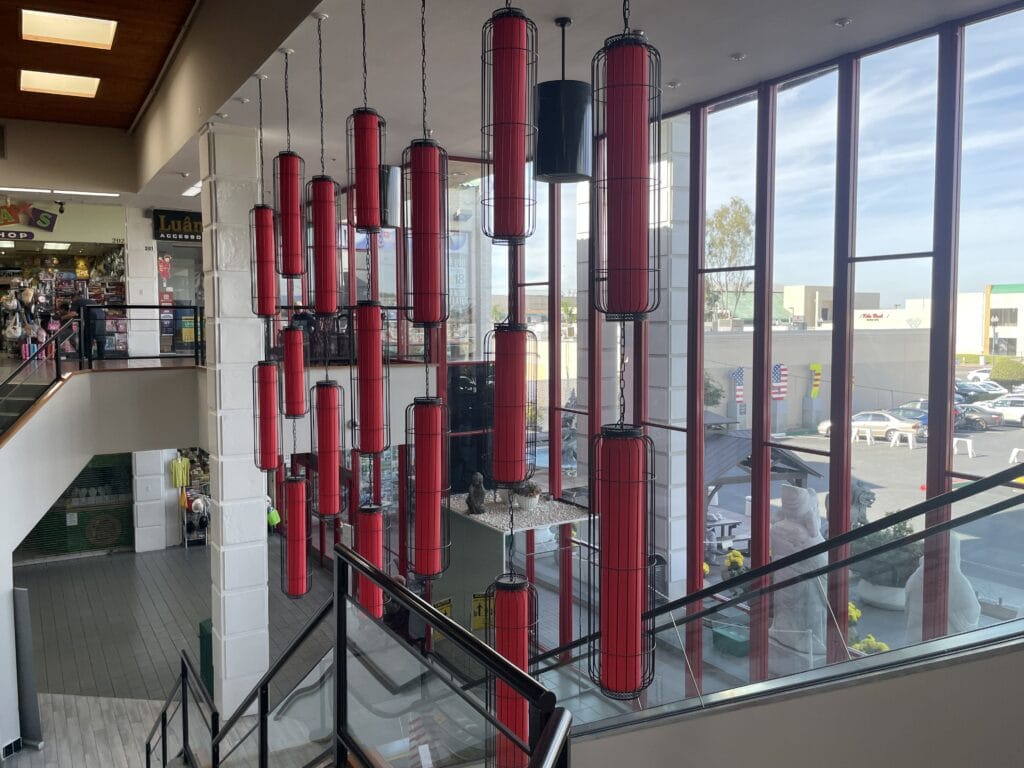
Inside, red paper lanterns hang from the ceiling while the smell of pho and banh mi drifts up from the food court. Jewelry shops line the upper floor, their cases full of gold and diamonds.
This is the Asian Garden Mall, which opened in 1987 as the second Vietnamese-American shopping center in the United States (after Eden Center opened in 1984 in Falls Church, Virginia).
Developer Frank Jao built the 150,000-square-foot structure for $15 million with money from overseas investors. In the first year, between 20,000 and 50,000 people came to shop here every weekend.
The building sits between two major freeways, a few miles from Disneyland, between Los Angeles and San Diego - a perfect location for drawing visitors from across Southern California and beyond.
Vietnamese Refugees Build a New Home
The story begins in 1975 when the Vietnam War ended, and the U.S. government brought 130,000 refugees to four processing centers in America.
One center was Camp Pendleton Marine base in San Diego County, where many refugees who had worked with the South Vietnamese military and government were processed.
After completing their immigration papers, churches in Orange County sponsored families and brought them north, less than an hour up the freeway.
Westminster in the mid-1970s had about 60,000 people living among industrial machine shops, strawberry fields, orange groves, and plant nurseries.
The first Vietnamese-owned businesses - a doctor's office and a pharmacy - opened around 1977. Rent was cheap, and the location was good, so people stayed together in family units and groups from the same hometowns.
Businesses multiplied in the late 1970s, and by the 1980s, around 500 Vietnamese businesses had opened in the area. The community grew organically, unlike the pre-planned developments in nearby Irvine.
Frank Jao Escapes Saigon
Frank Jao escaped Saigon in 1975 on the second-to-last American transport plane as gunfire rang out.
At 27 years old, he moved into a small apartment in Whittier with his wife, Catherine, and got a job selling Kirby vacuum cleaners door-to-door on his first days in America.
Jao was born in Haiphong in North Vietnam, the seventh of 11 children of an impoverished government clerk.
When communists took over the north in 1954, his family moved south to Danang. By age 14, he was supporting himself by delivering newspapers and employing other boys to help.
He learned English through classes at a Vietnamese American association, then enlisted in the military at 17 and worked as an interpreter for U.S. Marines in Danang.
Later, in Saigon, he worked as a salesman for a General Electric and Westinghouse distributor before fleeing the country.
Building a Real Estate Empire
Within weeks of arriving in America, Jao decided not to wait on assistance and went straight to work.
He quit selling vacuums to take a midnight security guard shift while also working part-time teaching auto mechanics and studying finance, real estate, and construction at local colleges.
By 1976, he and Catherine had moved to Garden Grove, where he worked full-time as a real estate agent, earning about $1,000 per house sale.
Through 16-hour workdays, he made over $100,000 in his first year.
In 1978, Jao switched to commercial real estate and opened his own office after realizing development made more money than brokering.
He developed his first project - a small shopping center in Westminster - for a Hong Kong investor, then began working with mostly Asian investors, including ethnic Chinese partners like Usman Admadjaja and Roger Chen.
American banks financed the projects.
Jao founded Bridgecreek Development, which, over four decades, developed $400 million worth of shopping centers and residential buildings across more than 50 acres in Westminster and nearby cities.
He became the landlord to 1,200 Vietnamese businesses.
Competing Visions for Little Saigon
Jao had ambitious plans for Bolsa Avenue.
He wanted to build an Asian shopping center that would attract many different customers, worried that focusing only on Vietnamese customers would cause the area to lose business, as other ethnic neighborhoods had.
He launched a campaign to call the area "Asiantown" instead of "Little Saigon," which explains why he named his building "Asian Garden Mall" instead of "Vietnamese Garden Mall."
The community fought back hard. Grassroots activists and ethnic Vietnamese Americans pushed for recognition of their specific identity.
In 1988, Governor George Deukmejian made "Little Saigon" the official name for the area bordered by Westminster Boulevard, Bolsa Avenue, Magnolia Street, and Euclid Street.
Both locals and visitors ignored Jao's English name and called the mall by its Vietnamese name - Phuoc Loc Tho, meaning Luck, Prosperity, and Longevity.
The Vietnamese community made up the majority of shoppers, whether Jao had intended it that way or not.
A Building Full of Culture and Commerce
Asian Garden Mall is laid out with parking lots in the front and the back, and the entrance is marked by an ornate gateway with a curved roof and decorative ridge ornaments.
Once inside, the space is filled with Vietnamese and Asian symbols. Red paper lanterns hang overhead.
Fans, statues, and figurines sit throughout the corridors and storefronts, giving the building a strong cultural look as you move through it.
The lower level is where the day-to-day pace is easiest to feel. Stalls and small markets sell authentic Vietnamese food, along with French-Vietnamese sandwiches and Chinese dishes.
Mixed in with the food are the everyday services and shops, including hair stylists, shoe shiners, and clothing boutiques.
The upper level holds the famous jewelry center with 200 booths dealing in diamonds, gold, and Rolexes.
In Vietnam, gold jewelry often served as a discreet way to hold portable wealth, and the mall's large jewelry market attracted shoppers from across Southern California and other regions.
Record stores line the halls as well, feeding the local reputation for music and media production that leads some people to call Little Saigon the "Vietnamese Nashville."
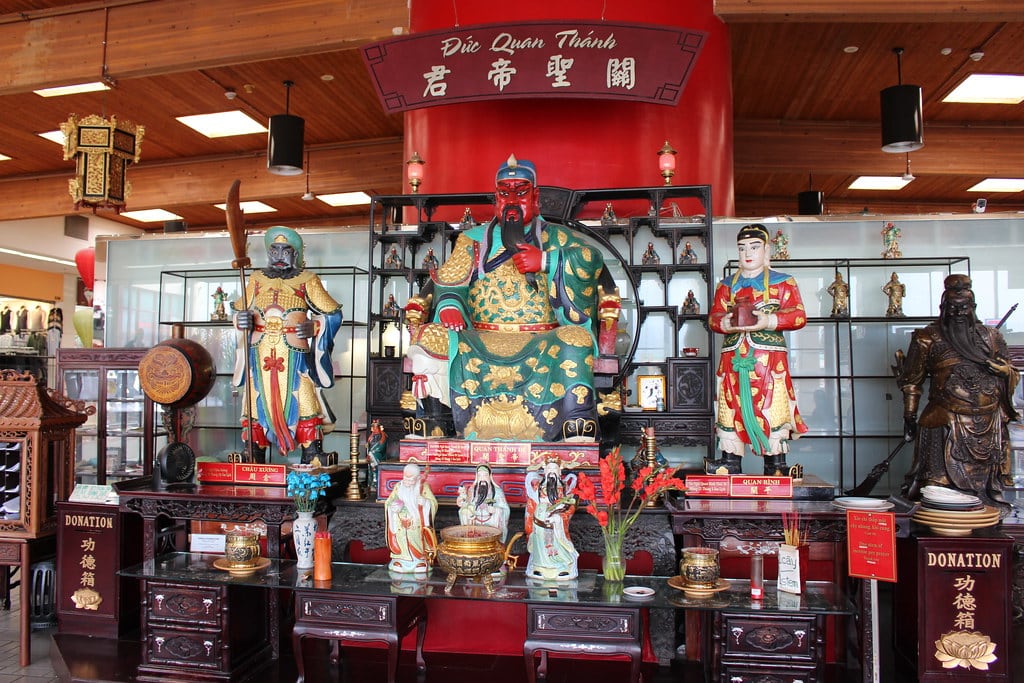
On the upper level, a shrine dedicated to Quan Vu, a third-century Chinese general who became the patron saint of business, gives visitors a place to pray and draw fortunes.
Across both floors, the mall holds about 300 shops run by over 200 minority-owned businesses.
Annual Celebrations Bring Thousands
Asian Garden Mall evolved into far more than a shopping center - it became a cultural hub where multiple generations come together to celebrate and preserve traditions through events held throughout the year.
For Tet (Lunar New Year), the portion of Bolsa Avenue passing through the mall serves as the route for Westminster's annual parade.
Firecrackers explode in front of the mall to signal the start of festivities that have run over two decades, happening on the weekend closest to the holiday and attracting about 20,000 people while local Vietnamese-language TV and radio stations broadcast live.
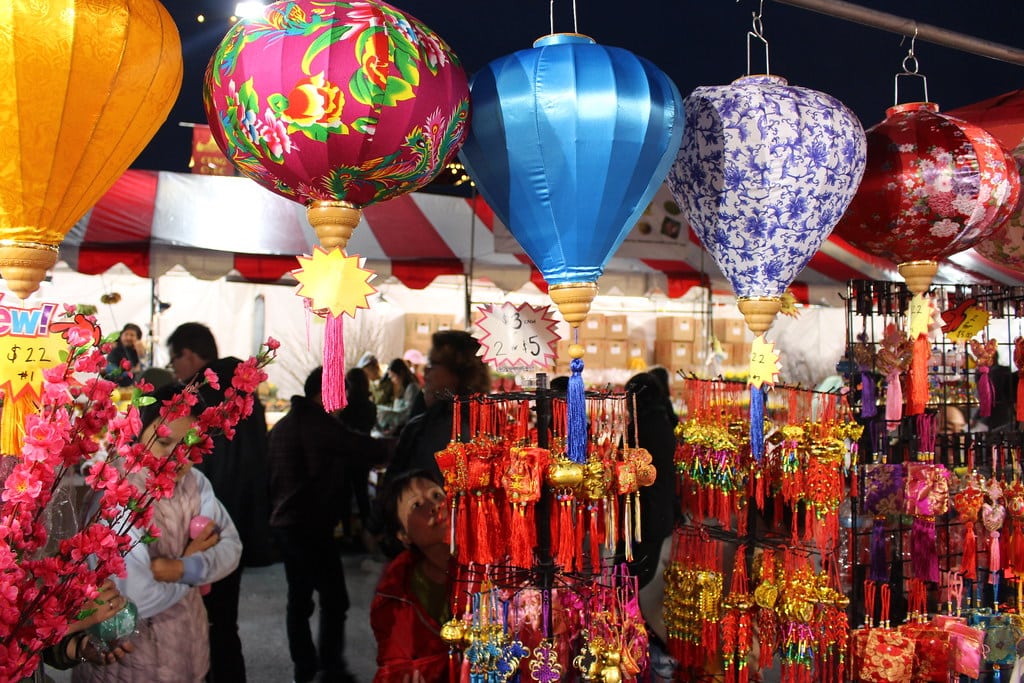
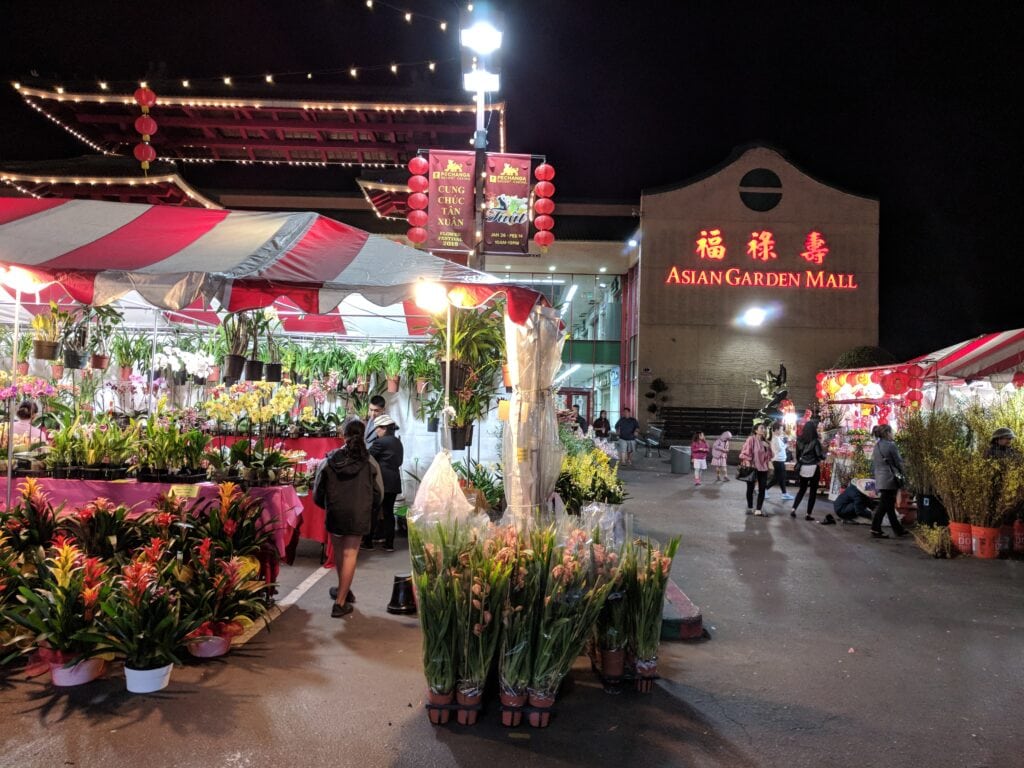
For several weeks before Tet, the front parking lot transforms into a holiday market selling flowers and festive items.
Days before the holiday, Little Saigon TV organizes contests inside, including competitions for making banh chung (traditional rice cakes), decorating fruit, and wearing the traditional ao dai dress.
On summer weekends, the parking lot turns into a night market, drawing about 3,000 visitors each night for Vietnamese snacks that evoke the street markets of Vietnam.
The Heart of the Community
Community leaders call the mall the "center" or "heart" of the Vietnamese-American community. Surveys show about half of the visitors come from outside Orange County, but many of the people inside are regulars.
Many older visitors come to meet friends, drink coffee, and play Chinese chess. Others use the mall as a meeting spot before heading out together.
For many older Vietnamese visitors, the place also feels like home in another way. It reminds them of Saigon before 1975, a memory of home kept alive while living far away.
It is where they go to remember Vietnam before the war ended, in a place where everything is Vietnamese and where people can fully be themselves.
People still shop, but the meaning is bigger than that. The mall holds memories, and it also shows what the community can become.
Since the mall is so important to the community, it has become a popular spot for political events.
Republican Party candidates held rallies there when trying to win Vietnamese-American votes, including Bob Dole, John McCain, and George W. Bush.
A National Symbol Takes Shape
George W. Bush's 2000 visit as a presidential candidate turned the mall into a well-known symbol of the Vietnamese community.
As the mall's profile rose, so did Vietnamese political representation.
Tony Lam won election to the Westminster City Council in 1992 as the first Vietnamese elected official in the U.S., while Tri Ta became Westminster's first Vietnamese American mayor in 2012.
In 2017, artist James Dinh unveiled a public art piece titled "Of Two Lineages" in front of the mall, commemorating 40 years of Vietnamese American history in Orange County.
Little Saigon had expanded regionally by then, with about 2,000 businesses and 125,000 residents of Vietnamese descent across the Greater Little Saigon area in Orange County.
Harmony Bridge Controversy
By the mid-1990s, the mall risked becoming unimportant as younger Vietnamese Americans became part of American society and moved farther away from Little Saigon.
In 1996, Jao proposed building Harmony Bridge - a pedestrian structure 500 feet long and 30 feet wide across Bolsa Avenue to connect Asian Garden Mall and Asian Village.
The community rose up in strong opposition. People objected to the Chinese-influenced decorations, complaining that the design was "too Chinese" and did not accurately represent Vietnamese culture.
His company ultimately scrapped the plan.
Even though the bridge plan failed, Jao kept working on projects in Little Saigon, including Asian Village and the New Saigon Mall behind it.
The mall's courtyard had a Confucius statue and a long stone wall with pictures showing Vietnamese history.
New Saigon Mall opened in January 1997, but struggled early. In August 1999, Jao announced it would close and be demolished.
By January 2002, the mall was gone and the site was being marketed for tract housing.
Pandemic Brings Outdoor Markets
When the COVID-19 pandemic forced Asian Garden Mall and other malls in California to close, the usually busy stalls went quiet after Governor Gavin Newsom's order.
Shop owners and vendors responded by setting up an outdoor flea market in the parking lot to keep serving loyal customers and keep their businesses going.
The parking lot was filled with booths and tents. Traditional Vietnamese music played from speakers, and a sugarcane juice truck parked at the entrance.
Even though the mall was closed, rent was still due. So people kept working, doing whatever they could to get by. The mall reopened in May 2020 at limited capacity.
The Future of Asian Garden Mall
A lot of owners look ahead and feel things are changing. Younger generations are taking jobs in other places, and the area is also facing rising rents, new building projects, and bigger economic changes.
That is why some groups have stayed busy trying to protect what is here.
The Vietnamese American Arts & Letters Association and the Vietnamese American Heritage Foundation work to keep stories and cultural traditions from being forgotten, and there are efforts underway to get special recognition for important places, including Asian Garden Mall.
Even with that worry in the air, the mall keeps doing what it has always done: it keeps holding events.
The Asian Garden Flower Festival 2026 happens every day from January 29 through February 15, and food stands are open Thursday through Sunday evenings.
The Lunar New Year Firecracker Show is set for February 17 at noon, with firecrackers, music, and a lion dance to celebrate the Year of the Horse.
Outside the mall, Little Saigon has grown into the largest Vietnamese enclave outside Vietnam, with about 9,000 Vietnamese-owned businesses and about 216,000 Vietnamese-origin residents countywide.
Asian Garden Mall sits in the middle of that growth. It shows how a group of people who came as refugees created a lively and successful cultural center.