On February 20, 1961, a shopping mall opened on land in a San Diego valley that had previously been used for dairy farming and was known to flood.
Many people in the city had paid little attention to the area before. The site lay between two freeways, and the San Diego River would overflow there during periods of high water.
In early 1958, May Centers, a Los Angeles developer, proposed rezoning 90 acres of the land. The San Diego City Council approved the change unanimously in June of that year.
Construction began the next year. Deems-Lewis, an architectural firm based in San Diego, designed the complex.
Because of the flood risk, engineers placed the stores one level above the parking garage. In strong storms, water could fill the lower level while shoppers remained dry above.
This decision shaped the overall design of the mall. When it opened, the center included two large anchor stores, 70 smaller shops, and a central courtyard.
Montgomery Ward occupied one anchor space, and May Company took the other.
Merchants in downtown San Diego viewed the project with concern.
One account from the time called it "Old Town's Revenge," a name that reflected a real shift: a suburban mall connected to freeways was drawing customers away from the city center.
Mission Valley Center became San Diego's second major regional mall, opening just seven months after College Grove Center.
The May Company Building, Mission Valley's Original Anchor
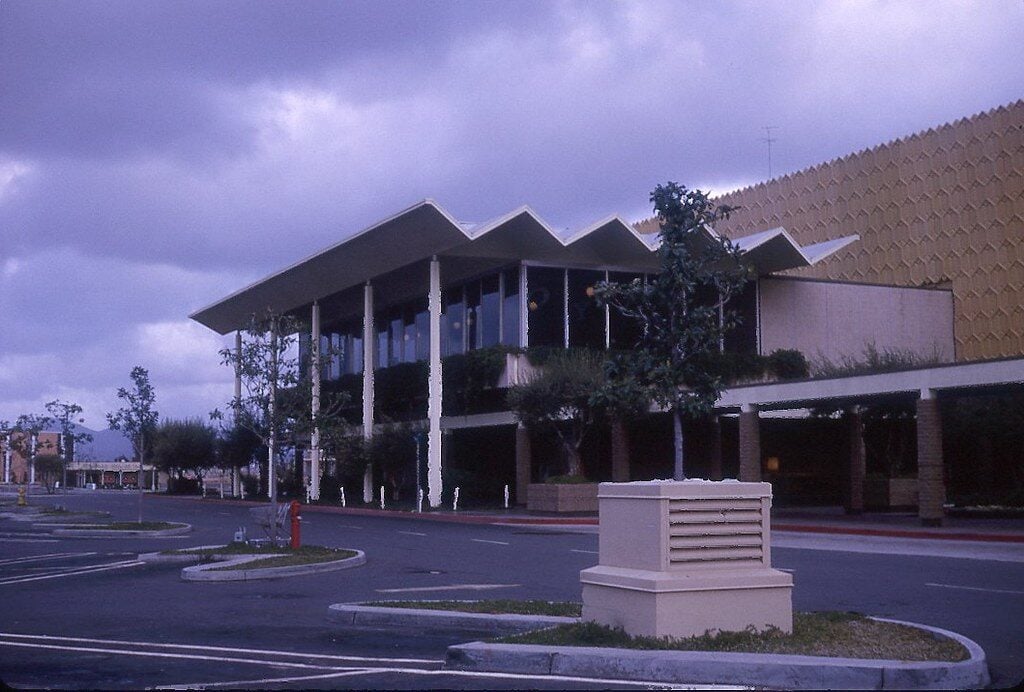
The May Company building at 1702 Camino del Rio North was the first department store built in Mission Valley and a central part of the mall as it took shape around it.
William S. Lewis Jr., working for the Los Angeles firm AC Martin, designed it in 1959. Frank L. Hope and Associates handled local support on the project.
The structure had three floors over a basement, with precast concrete panels across the upper exterior, a pebble-textured finish at street level, projecting upper floors, and a folded-plate roof at the southeast corner flanked by large glass walls.
San Diego architectural historian Darren Bradley described it as a jewel box with striking architecture - cladding designed to play with light and shadow throughout the day.
When it opened, it was the largest department store south of Los Angeles.
The city's Historical Resources Board, reviewing the building decades later, credited its placement near Highways 8 and 163 as deliberate - the building was sited to be seen from across the valley and easy to reach from anywhere in the metro area.
A 2015 historical report found the building met several criteria for the San Diego Resources register under Modern Contemporary Architecture of 1955 to 1965.
Then, it was concluded that it did not qualify because too many original elements were gone. Some tiles replaced, the 1958 canopy demolished, pop-out display windows removed, and more than half the original exterior surface altered.
The Historical Resources Board had already moved ahead anyway, recommending and approving historical designation in 2016, with a period of significance running from 1959 to 1961.
Expansion, Peso Devaluation, and a New Wing
The first major expansion came in 1975, when a new Bullock's store opened and increased the number of anchor stores to three.
In 1983, the mall added a new wing along with a Saks Fifth Avenue store. The timing was important.
A financial crisis in Mexico and a sharp drop in the value of the peso reduced sales at San Diego shopping centers, including Mission Valley.
Shoppers from Mexico had made up a significant share of revenue at local malls. As the peso lost value against the dollar, that group of customers shrank quickly.
By 1985, Mission Valley Center and Mission Valley Center West together had 88 retail establishments and covered about 1,219,000 square feet of retail space across 77 acres.
Major retailers included May Company, Montgomery Ward, Bullock's, Walker Scott, and J.J. Newberry. The main center alone had 6,681 parking spaces.
Mission Valley Center West, the strip mall across the road, was already operating as part of the larger retail complex at that time.
It was not something added later in the 1990s renovation, but a companion development that had grown alongside the main mall over several years.
The Westfield Redevelopment and the AMC Megaplex
The Australian Westfield Group took control of the mall in the mid-1990s and immediately began the most visible transformation in the property's history.
A city permit approved in February of that year allowed a 76,344-square-foot expansion of what was then a 1,285,293-square-foot complex.
The work included a new 20-screen AMC Theatres multiplex built above an existing parking area, demolition of 32,000 square feet of existing space, and a 41,900-square-foot childcare facility with an above-ground play yard.
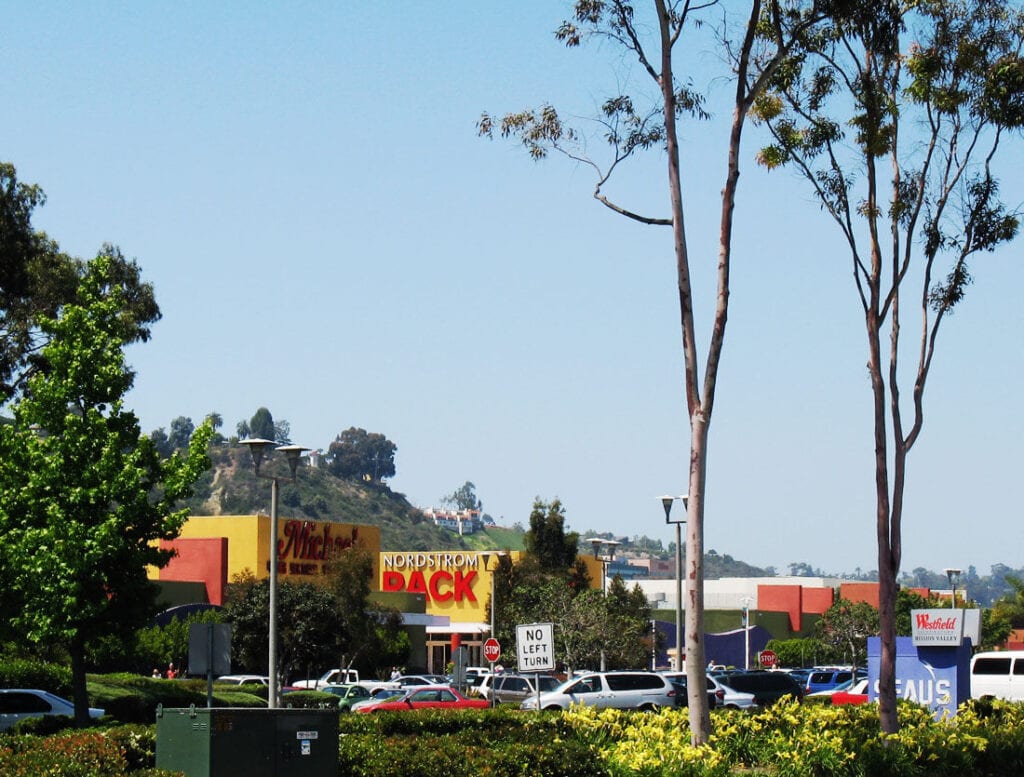
New tenants followed: Nordstrom Rack, Loehmann's, Bed Bath & Beyond, and Michaels moved into the northeast wing.
The original central courtyard, built with a children's playground, was enclosed to make room for a Ruby's Diner.
Across Mission Center Road, Borders, Marshalls, DSW, The Good Guys, and Old Navy joined Mission Valley West in 1998.
Macy's absorbed the Bullock's chain during this period, converting that anchor into a Macy's Home store.
Robinsons-May - the name the original May Company had carried since a 1993 merger with J.W. Robinson's - continued operating in the landmark Lewis-designed building.
Westfield renamed the property Westfield Shoppingtown Mission Valley in 1998, then dropped "Shoppingtown" in June 2006.
Montgomery Ward Closes, and Westfield's Mixed-Use Plan Stalls
Montgomery Ward had been at Mission Valley since opening day in 1961.
The chain went bankrupt and shuttered around 2000, ending a 40-year run as one of the mall's two founding anchors. Target opened in the former Ward's space a year later.
A separate Ward's Tire and Automotive Center building on Mission Center Road sat empty longer before Westfield converted it into a 16,000-square-foot multi-tenant retail building.
In August 2008, Westfield applied to amend the Mission Valley Community Plan to allow residential and office uses alongside retail.
The proposal called for 500,000 additional square feet of retail, 450,000 square feet of office or hotel space, and 250 residential units on the existing footprint.
Real estate analysts called it a long-term project that could take five to ten years. None of it was built. The 2010s arrived without a single residential or office component in place.
In March 2017, Macy's closed its apparel store in the Lewis-designed building as part of a national round of 68 closures - ending the structure's 56-year run as a department store and leaving the most architecturally significant building on the site vacant.
Smaller Changes That Added Up Through the 2010s and 2020s
Junior Seau's restaurant closed in 2012 after his death, and Buffalo Wild Wings moved into that space in 2013.
Loehmann's liquidated its Mission Valley location in 2014, and Bloomingdale's The Outlet Store replaced it in 2015.
Ruby's Diner, which had occupied the covered courtyard for more than 20 years, posted a closure notice on its doors in April 2018.
Sport Chalet filed for bankruptcy and closed in 2016. Michaels took the portion of that space facing the north parking lot in 2018.
F21 Red, Forever 21's clearance concept, opened in the remaining section of the former Sport Chalet space that same year - its placement blocked mall access to the Michaels entrance - then closed a year later after Forever 21 filed for Chapter 11 and announced widespread store closures.
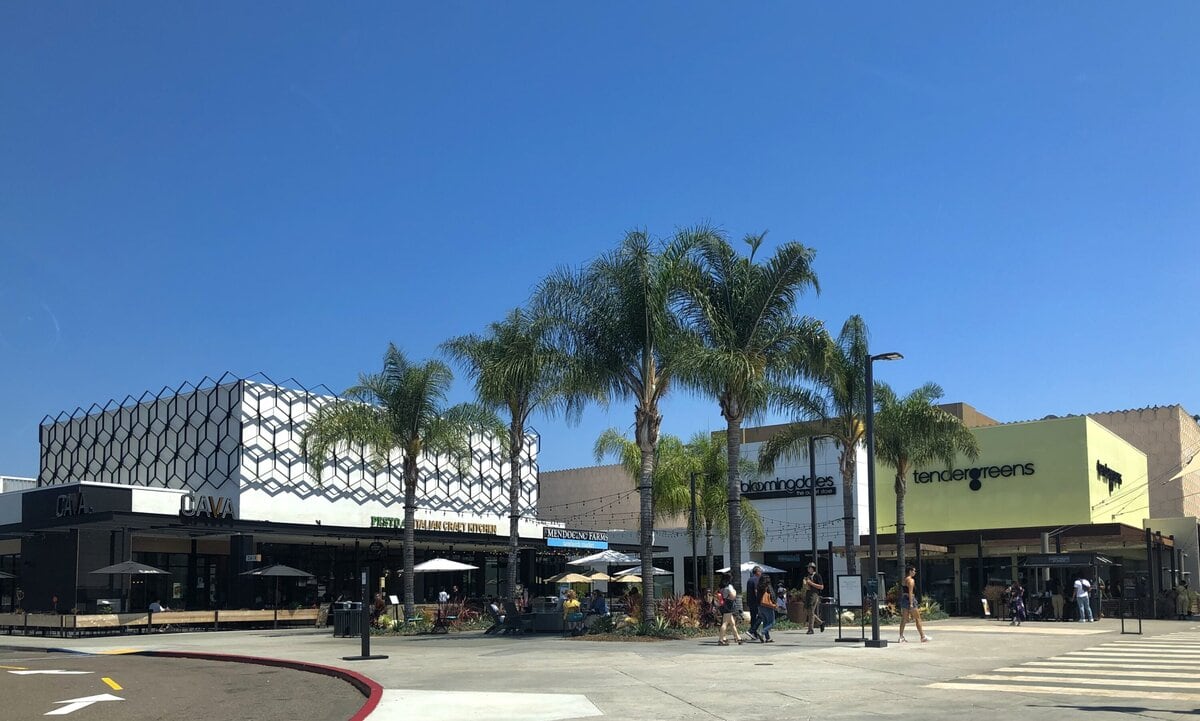
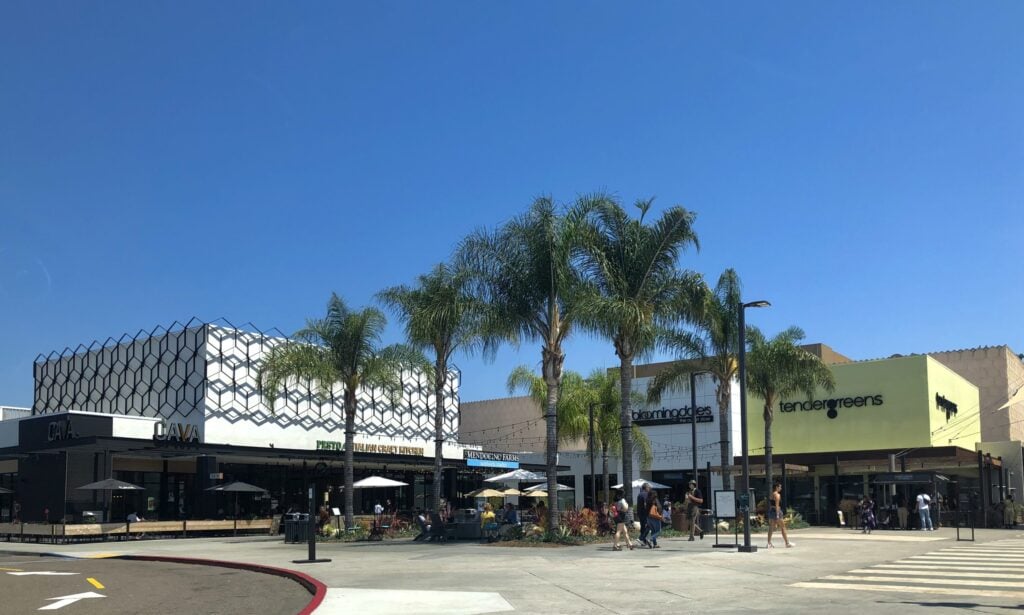
Westfield subdivided the former Michaels Arts and Crafts building into restaurant spaces. Havana Grill, CAVA, Pesto Italian Craft Kitchen, and Mendocino Farms all opened there over the next few years.
The last active Macy's-branded anchor at Mission Valley, the Home and Furniture store, closed on December 14, 2024.
The $290 Million Sale and What Came Next
In July 2023, Unibail-Rodamco-Westfield sold both Mission Valley properties for $290 million. The combined property totaled 1.5 million square feet and was 71 percent occupied at the time.
Real Capital Solutions and Lowe bought the main east side mall, which spans 1.1 million square feet.
Mission Valley West was purchased by Sunbelt Investment Holdings Inc. Centennial, based in Dallas, was brought in to manage the east side, and the Westfield branding was removed from both centers.
Lowe and Real Capital Solutions shared specific redevelopment plans. They aim to reposition the main mall as a walkable, transit-oriented mixed-use development.
This includes adding multifamily housing, upgrading public areas, expanding outdoor dining, and attracting tenants focused on food, entertainment, and experiences.
Centennial's current tenant mix includes Target, Nordstrom Rack, Bloomingdale's The Outlet, Michaels, 24 Hour Fitness, and AMC Mission Valley 20.
In January 2025, a separate 9.3-acre former department store property at 1555 Camino de la Reina next to the mall was sold for redevelopment under flexible mixed-use zoning.
Kura Revolving Sushi Bar was expected to open in Suite 218 later in 2026. The Stand was projected to open in summer 2026, and Philz Coffee was being planned for 1640 Camino del Rio North.