Stonewood Center, before the doors exist
Firestone and Lakewood Boulevards already carried regular traffic in the early 1950s. Cars queued at the lights and moved through in short waves.
The land east of the intersection was still largely open, but Downey was expanding, and William M. Lansdale and his wife set out to anchor a larger retail center there.
In 1953, they secured a 99-year lease on 63 acres of the former Jenison Ranch. The project was first known as Lansdale Shopping Center.
Lansdale partnered with developer E. Morris Smith and brought in the architects Jacobson, Coppedge, and Huxley to plan an open-air complex arranged as five separate buildings.
The plan called for more than 335,000 square feet of leasable space. The budget was reported as high as $12 million.
Early work focused on the pieces that could open first and pull daily traffic. In February 1956, construction began on a $750,000 standalone coffee shop, the Stonewood Restaurant, designed by Pereira and Luckman.
A community bank followed. A 40,000-square-foot Shopping Bag supermarket came next. Before the main retail mix arrived, the site was already being built around routine stops and repeat visits.
Opening day, October 1958, open-air
Stonewood Center opened on Thursday, October 9, 1958, as a 390,000-square-foot open-air shopping center with nearly 40 stores.
The property was arranged as separate buildings linked by outdoor walkways. Shoppers moved along open corridors between tenants.
The opening lineup mixed large chains with smaller local-serving stores. J.C. Penney opened a new multi-level store of about 60,000 square feet. W. T. Grant and F. W. Woolworth opened large variety stores.
Thrifty Drug Store opened as a pharmacy and general drug retailer. Other early tenants included Hardy Shoes, Downey Music, and the Hollander Cafeteria.
The center opened without a traditional large full-line department store anchor. The largest tenants at the start were J.C. Penney and Woolworth's.
Stonewood drew customers from Downey and nearby communities and competed with established shopping areas, including downtown Huntington Park.
Broadway, ice cream, screens, and growth
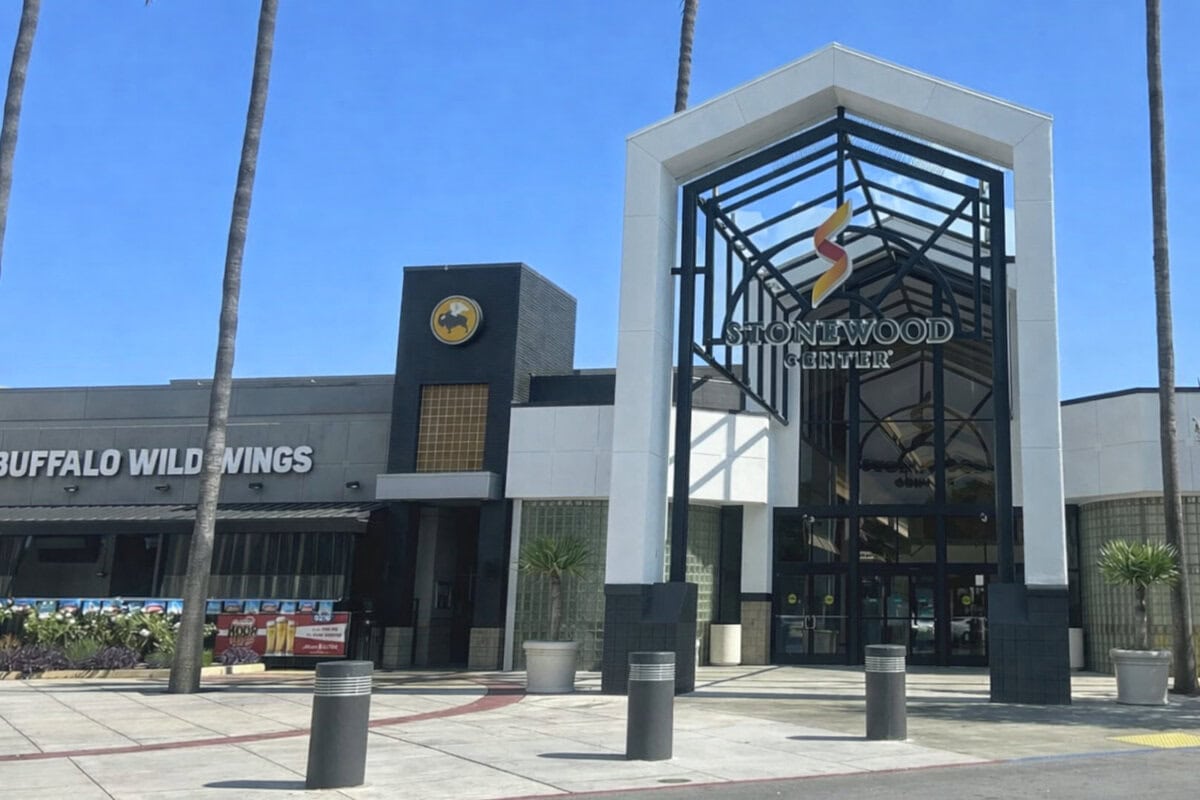
By the mid-1960s, Stonewood Center had expanded to about 65 stores and promoted itself as a "city within a city." The property continued to operate as an open-air center with separate buildings and outdoor walkways, but the tenant mix and added services increased the length of a typical visit.
In 1965, Stonewood added its major department store anchor when The Broadway opened on the south end.
The store was built as a three-level branch of about 143,000 square feet and became the largest single tenant on the property at the time.
In 1966, Stonewood Center added new entertainment and food uses. Farrell's Ice Cream Parlour opened in the center, and a Showcase Cinema opened the same year.
These additions provided on-site dining and moviegoing alongside the existing retail lineup.
Around 1969, J.C. Penney relocated within the center. The chain moved from its original location into a newly built, larger two-level store on the northwest side. The replacement store measured 192,000 square feet.
Mervyn's arrives as the 80s approach
Stonewood Center kept expanding through the 1970s as new retail space was added across the original 63-acre site.
By the late 1970s, the property housed almost 80 stores, and more of the remaining open areas had been built out into additional corridors and storefronts.
In 1981, Stonewood added another anchor on the north side. A two-story Mervyn's opened in a wing measuring 80,600 square feet.
Additional shop space was added around the new store, bringing the mall's size to roughly 858,000 square feet and widening the department store lineup.
By the early 1980s, Stonewood Center functioned as Downey's primary retail district, taking a larger share of shopping traffic that had previously gone to the city's historic downtown.
The change showed up in regular shopping trips, with the mall becoming the more common destination.
In 1988, Stonewood's open-air mid-century layout was used as a filming location for an early episode of "The Wonder Years." The exterior breezeways and open walkways appeared on screen.
Hughes closes the roof and doubles the stores
In December 1986, Stonewood Center changed ownership when the Lansdale and Smith interests sold the property to Hughes Investments of Newport Beach.
Hughes took over a mall that was operating as an open-air center and facing stronger competition from enclosed regional malls nearby.
The City of Downey supported the redevelopment effort to protect and grow local sales tax revenue. The city agreed to share 50% of the increase in sales tax revenue generated after renovation with the developer.
Construction began in late 1989 on a renovation and expansion budgeted at $40 million. The project enclosed the property and rebuilt it as an indoor, climate-controlled mall.
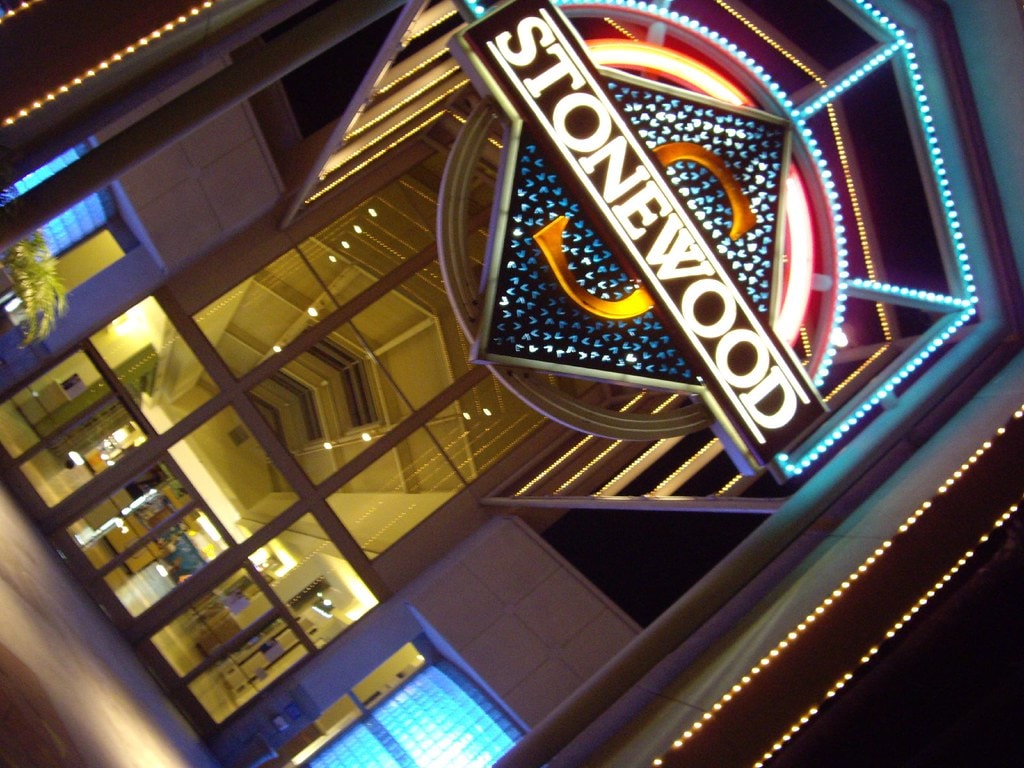
By fall 1990, the remodeled center reopened with a postmodern interior design that included steel-and-glass atriums and a central dome skylight.
The redevelopment added new anchor space and reworked earlier retail uses.
A two-level May Company department store of more than 146,000 square feet was built on the south end, joining The Broadway, J.C. Penney, and Mervyn's as the fourth anchor.
The former supermarket and drug store space was converted into a one-level May Company Home Store of about 30,000 square feet.
A new west-end food court, "The Filling Station," opened with vintage gasoline pumps as part of its interior decor.
After renovation, the mall measured roughly 945,000 square feet and included more than 150 retail spaces.
Logos change: Sears, Macy's, Kohl's
After the 1990 redevelopment, Stonewood Center kept its enclosed layout while the department store lineup changed through rebrandings, closures, and replacements.
On January 31, 1993, May Company was rebranded as Robinsons-May. In 1996, The Broadway chain was dissolved and the Stonewood Broadway store closed, ending its run that began in 1965.
Sears, Roebuck & Co. acquired the former Broadway building and reopened it as a Sears department store on November 2, 1996.
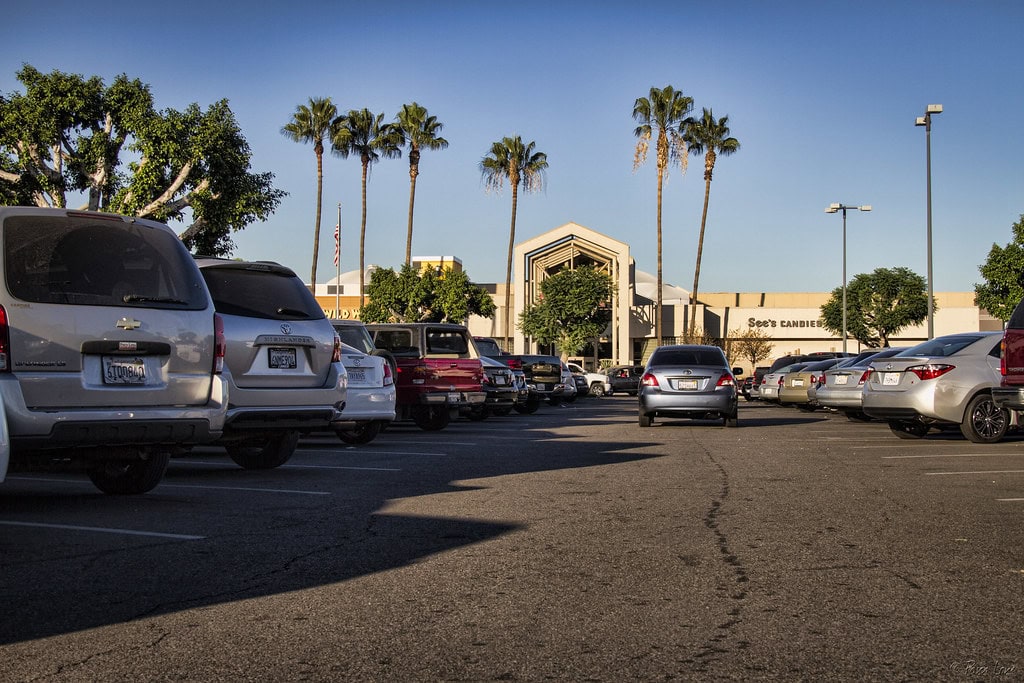
Around the same time, a separate Sears Auto Center was built as a freestanding outparcel in the parking lot.
Ownership changed in August 1997 when Hughes sold Stonewood Center to The Macerich Company, which became the owner and operator.
In September 2006, Robinsons-May became Macy's after Federated Department Stores acquired May Company.
The home furnishings space remained part of the Macy's operation at Stonewood as a dedicated home component adjacent to the main store.
In 2008, Mervyn's went bankrupt and liquidated, leaving its Stonewood Center space vacant.
Kohl's renovated the roughly 83,000-square-foot former Mervyn's site and opened on September 30, 2009. The opening drew large crowds and restored more than 150 jobs.
Two thousand teens, and the Button Hole
Stonewood Center hosted community events over the years alongside its retail operations, including classic car shows, Halloween trick-or-treat activities, local fundraising fairs, and seasonal programs held in shared public areas of the property.
In March 2015, a planned appearance by teenage pro skateboarder Steven Fernandez at the Zumiez store drew more than 2,000 teens.
The crowd outgrew the space and became unruly. Mall management and police shut down the event and temporarily closed the mall for safety. No injuries were reported.
Stonewood Center also retained a small feature from its original era.
In 1958, a gap was left in an exterior wall at the request of a local resident, Wallace Button, who had walked through the area before the mall was built and wanted to continue the route after construction.
The opening became known as "The Button Hole." A plaque was placed there to recognize Button. After the feature was restored, it was rededicated in 2023.
Round1 planned for the former Sears
During the 2010s, Stonewood Center faced online shopping, new ways people liked to shop, and the closing of some well-known stores.
The mall kept a mix of popular clothing and lifestyle brands like H&M, Forever 21, and Hollister.
Dining became a bigger part of the draw.
BJ's Restaurant & Brewhouse opened at Stonewood Center in 2009, and several national chains operate in exterior buildings around the mall, including Olive Garden and Raising Cane's Chicken Fingers.
Stonewood's location continued to help. It was the regional mall in Downey and the nearby areas (13 miles southeast of Los Angeles downtown), which brought back loyal shoppers.
In 2019, the mall and its nearby businesses made up about 10% of the city's total sales tax revenue.
The major shift of the 2020s began with an anchor closing. Sears shut its Stonewood store on November 14, 2021, after 25 years of operation. The replacement concept moved away from traditional retail.
In September 2024, Round One Entertainment submitted conceptual plans to convert the former Sears into a bowling and arcade center expected to include Spo-Cha and a food hall.
In December 2025, the Downey Planning Commission gave Round1 permission to use more than 139,000 square feet over three floors.
The plans include an 8-lane bowling alley, about 400 arcade games, pool tables, karaoke rooms, and a Spo-Cha indoor sports area with things like trampoline courts and batting cages.
Renovations, leasing, and the 2026 lineup
The Round1 plan for the old Sears space included a 44,000-square-foot food hall with Japanese foods, plus a main kitchen to help Round1 locations in the area.
Stonewood also kept updating the rest of the site. On June 19, 2025, Stonewood announced a major renovation for shared spaces and the food court, starting in July and expected to finish by summer 2026.
Alongside the work, Lovisa, Skechers, Miniso, and Basil Thai opened, while Kawaii Klaws, ProImage Kids, and Pitmaster Society BBQ Grill were planned.
As of January 2026, Stonewood Center comprises roughly 926,000 square feet and houses around 140 stores and eateries.
The anchor lineup is Macy's, JCPenney, and Kohl's, with Round1 planned as an entertainment anchor. About 722,000 people lived within five miles.
Occupancy is roughly 95%, with only a few small vacancies, mostly exterior-facing storefronts.