The Bloc opens as Broadway Plaza in 1973
On November 18, 1973, Broadway Plaza opened in Downtown Los Angeles as a large, all-in-one complex that filled an entire city block.
The site was bounded by 7th Street, 8th Street, Hope Street, and Flower Street, with the main address at 700 South Flower Street.
The project was financed with $65 million from the Prudential Insurance Company of America. It was marketed as the first enclosed, suburban-style shopping center built in a major U.S. downtown.
From the sidewalk, the outside looked closed off and solid. Inside, the complex was set up so people could park, shop, eat, stay at the hotel, and work in offices without having to go back out onto the street.
That approach shaped how the block worked for decades.
Later, as Downtown Los Angeles placed more emphasis on walking and active street-level spaces, the property had to change the same features it was originally built around.
A sealed complex of towers, mall, and parking
Broadway Plaza opened as a stacked, connected complex built to function like a small, self-contained district.
Ogden Development led the project, with architect Charles Luckman as the key figure and primary designer. The original setup combined five major pieces.
A 32-story office tower rose over the site. It is now known as the MCI Center. A 23-story Hyatt Regency Los Angeles hotel stood beside it.
Below and between them sat a two-story enclosed shopping mall. The mall was anchored by a three-story flagship store for The Broadway department store chain.
Above that anchor, a six-level parking garage added 1,550 spaces directly on top of the department store. The retail mix also included Oshman's Sporting Goods and a subterranean food court.
The office tower at 700 Flower Street reached 414 feet. It used a steel column and concrete slab frame. The design followed the International Style, built for function and flexible interiors.
The exterior, however, was dominated by a heavy red brick facade that formed a fortress-like barrier between the block's interior and the street life along 7th Street.
The Bloc's site and role in downtown geography
The property sits on a roughly 4.3-acre site in Downtown Los Angeles. The lot area is 186,700 square feet.
The block carries multiple addresses tied to its edges and entrances, including 700 S. Flower Street, 700 W. 7th Street, and 711 S. Hope Street.
The zoning designation is C2-4D under the Central City Community Plan Area.
Over time, the block became a hinge point between several downtown districts, including the Financial, Fashion, Jewelry, and Theater districts.
It also sits where major transit access later concentrated. Its position turned it into a place people pass through as much as a place people choose as a destination.
The complex's identity is still defined by four main components: a 33-story office tower, the 496-room Sheraton Grand Los Angeles hotel, an open-air retail plaza, and a massive parking podium.
Total square footage is listed at approximately 1,895,000 square feet after the residential expansion planned for the site.
In its earliest form, though, the key idea was simple: a downtown block designed to behave like an indoor mall.
Macy's Plaza years bring slow decline
In 1996, the block went through a major branding change. Federated Department Stores acquired The Broadway and renamed the flagship store Macy's.
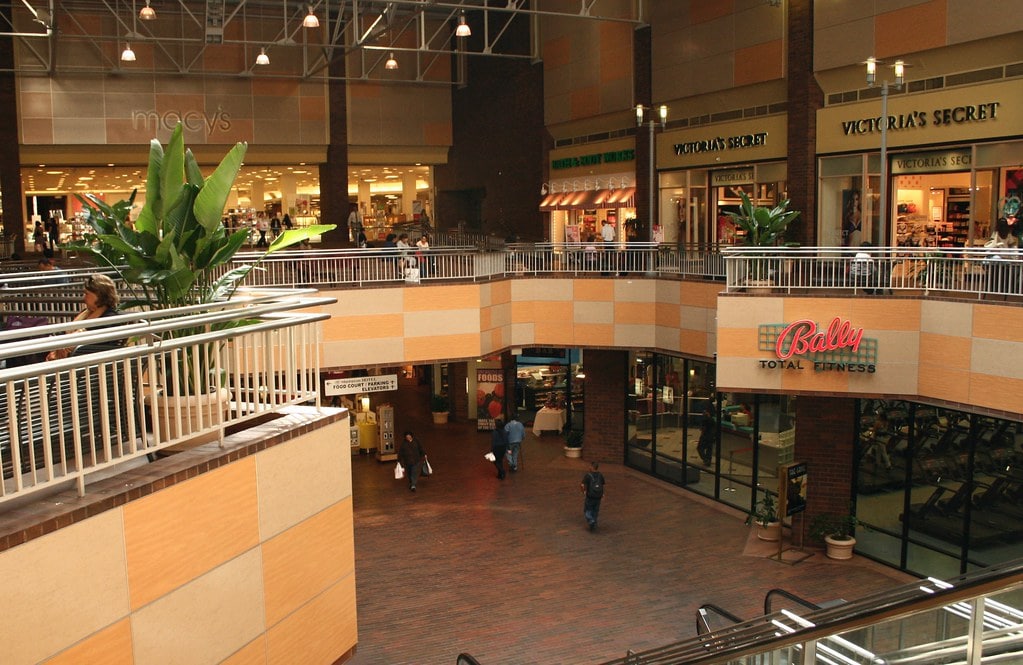
The complex was renamed Macy's Plaza. The basic layout did not change, and it continued operating as an enclosed mall much the way it had since 1973.
Even with the same overall structure, some parts changed over time. In 2005, the Hyatt Regency was rebranded as the Sheraton Los Angeles Downtown.
The former Oshman's space later shifted again as fitness tenants changed. Bally Total Fitness closed in 2012 and reopened as LA Fitness.
The office portion also lost strength. By 2013, office occupancy had dropped to 56% before the property changed hands.
Some of the same features that once made the complex feel self-contained started to work against it. The brick walls and the enclosed atrium that helped keep activity inside also made the property feel cut off.
The block stayed in use, but the design made it harder to connect with the surrounding streets while nearby areas continued to change and develop.
The Bloc rebuild starts with demolition
In June 2013, The Ratkovich Company partnered with National Real Estate Advisors and Blue Vista Capital Management and acquired Macy's Plaza for $241 million.
The new group announced a major renovation budgeted at $160 million to $250 million. The project aimed to break up the block's inward-facing design and reconnect it to the city around it.
The redevelopment rebranded the site as The Bloc, stylized as THE BLOC. Studio One Eleven led the redesign.
The biggest move was removing the retail roof. Crews took out the massive glass roof and the upper brick walls around the central atrium.
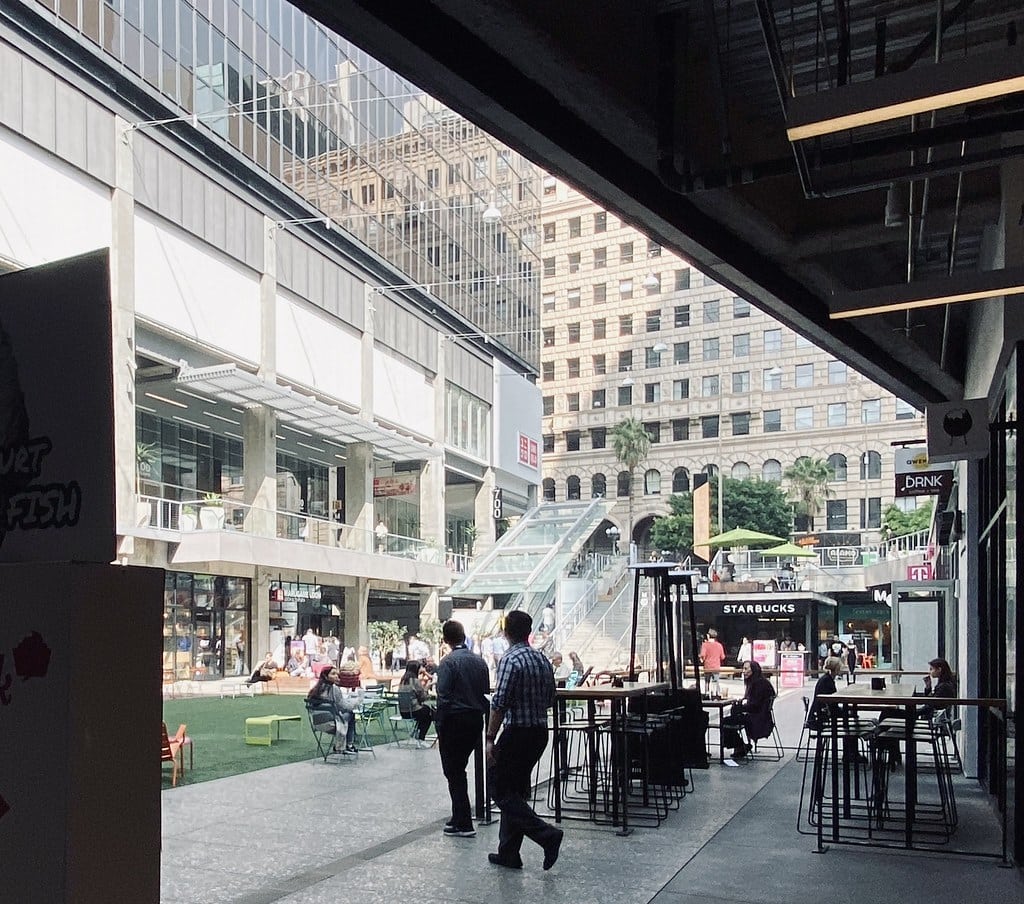
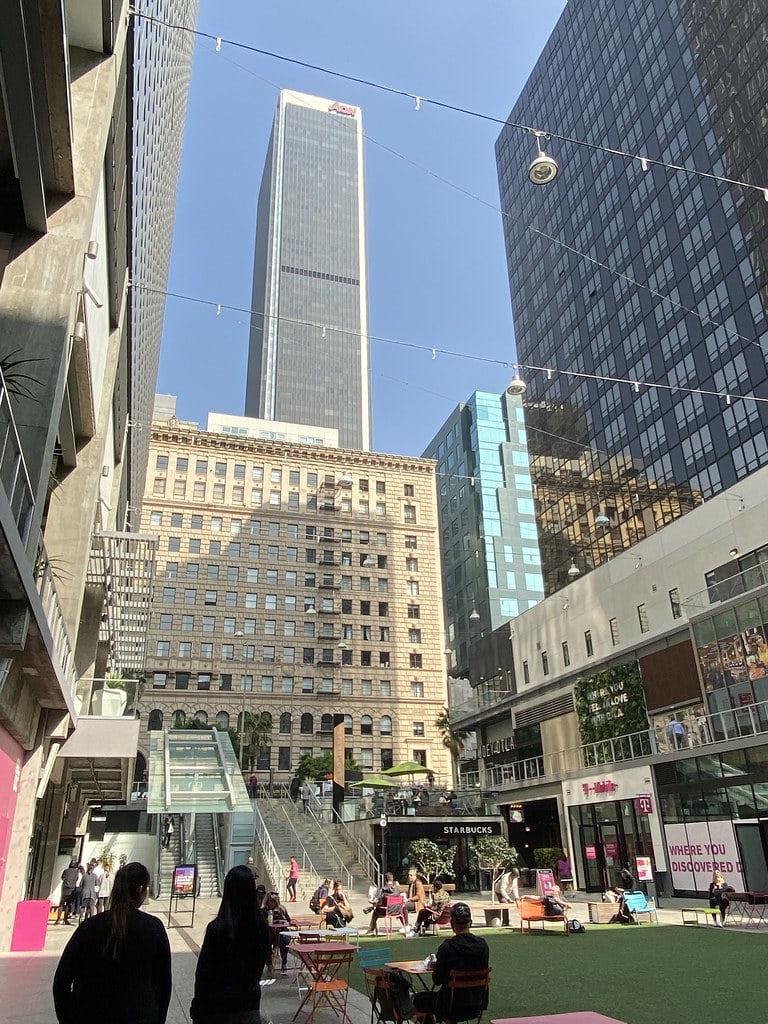
The center of the complex became a multi-level open-air plaza, letting daylight and open air reach the middle of the block.
At street level, large sections of the red brick walls were demolished.
New entrances, colonnades, and mid-block crossings improved access to the site from all four surrounding streets. Balconies, decks, and terraces were added to face outward.
Large openings were cut through the levels to create clearer visual and physical links between retail, the office tower, and the hotel.
Money pressure and a new ownership balance
The renovation was built by Webcor and used a design-build and design-assist approach. The work covered about 1,035,000 square feet of renovated space.
The scale created problems. The project ran over budget and faced delays, and some expected high-profile tenants did not arrive.
To stabilize the finances and complete the work, the ownership group secured a $225 million permanent loan in April 2016 from an institutional balance sheet lender.
That replaced an existing CMBS loan of $121.6 million that came with the property at purchase. The new capital supported completion and leasing costs.
Ownership changed again after the redevelopment was largely in place. In April 2018, The Ratkovich Company sold its interest in The Bloc to its partner, National Real Estate Advisors.
Current ownership lists National Real Estate Advisors as the major owner and Sun Hung Kai Properties as a minority owner.
The block's shift from enclosed mall to open-air plaza had a clear physical result.
The financial structure behind it also changed, moving from a redevelopment partnership into a longer-term ownership and management setup.
Sheraton Grand overhaul resets the hotel
A major part of the larger redevelopment focused on the hotel. A $75 million redesign rebranded it as the Sheraton Grand Los Angeles in April 2016.
The "Grand" label is the top tier within the Sheraton brand and is reserved for properties that meet higher standards for design and service.
Designer Colum McCartan of McCartan Design led the project. The work covered every floor and all 496 rooms and suites. The interior design took cues from local Art Deco, using golden tones and modern luxury materials.
All guest rooms and suites were fully redone, including upgraded features focused on sleep comfort.
The lobby was rebuilt as a main gathering space that operates as a coffee shop during the day and a bar at night, called Hope Street Bar.
The hotel's 10,000-square-foot California Ballroom was built to hold up to 900 guests. Total meeting space reached 30,000 square feet, designed to work across both indoor and outdoor areas.
The hotel also added a signature restaurant, District on the Bloc, centered on locally-sourced, sustainable ingredients.
Outdoor amenities included a rooftop deck with fire features, cabanas, and wide city views. After the renovation, the hotel maintained occupancy near 90%.
Transit access and the next decade of change
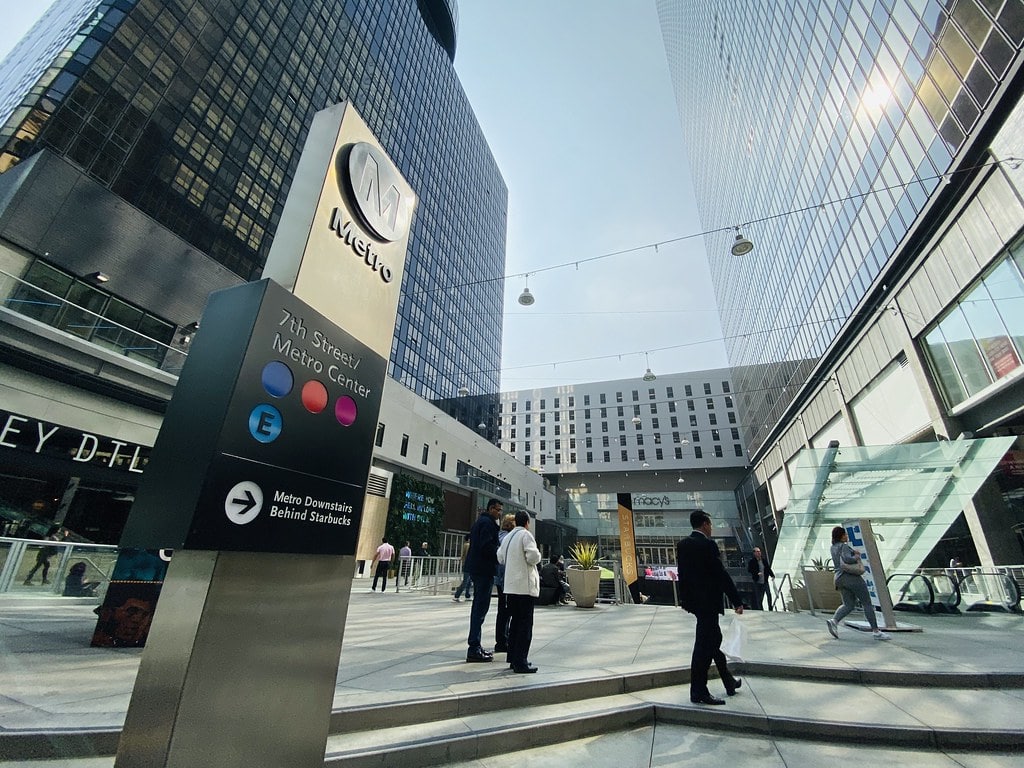
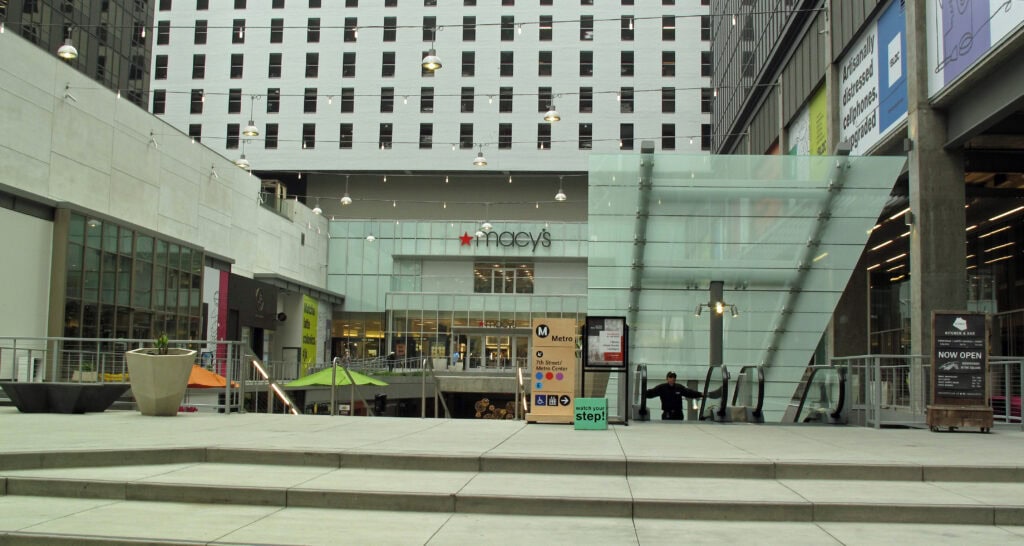
In 2017, The Bloc opened a direct underground walkway to the 7th Street/Metro Center station.
This was the first time a private development created a direct underground portal into a subway station in the Metro system.
The station serves as a convergence point for the A (Blue), B (Red), D (Purple), and E (Expo) Lines.
The new tunnel changed foot traffic patterns by turning the block into a daily commuter pathway.
Leasing improved soon after. By July 2018, over 90% of the 420,000-square-foot open-air retail center was leased.
The office tower was renovated for creative-focused tenants and earned LEED Gold certification. Across 2017 and 2018, it leased about 120,000 square feet of space.
The plaza stayed busy with different activities. Studio One Eleven did a year-long study about how people use the space as part of the Urban Lab projects.
In 2025, the schedule included Dine LA Restaurant Week at places like HATCH from January 24 to February 7.
It also included monthly FitspoLA classes put on by UCLA Health. An American Red Cross blood drive was set for February 17.
Art features included nightly light shows and temporary displays, including mirrored cubes called "The BLOCs," used during events such as CicLAvia.
The post-Macy's pivot and a taller future
In early 2025, Macy's Inc. confirmed the closure of its flagship store at The Bloc as part of its "Bold New Chapter" plan, which involved closing about 150 underperforming stores nationwide.
That ended a 52-year department store presence on the block.
Current tenants listed on The Bloc directory lean heavily toward food, fitness, and service retail.
The lineup includes Alamo Drafthouse Cinema, LA Fitness, UNIQLO, dining spots like Joey DTLA, Marugame Udon, Starbucks, and HATCH, plus service tenants such as UCLA Health, Drybar, USPS, GNC, T-Mobile, Video Vortex, Lámay Nail Spa, and A & M Auto Detailing.
The next anchor is Ballers DTLA, scheduled to open in the late summer of 2026 in about 100,000 square feet inside the former Macy's building.
The concept was founded by veterans of the Equinox brand and is backed by $20 million in Series A funding.
Plans include 18 pickleball courts and the first padel courts in Downtown LA, five golf simulators, two indoor soccer fields, two full-service bars, dining led by Chef Mitch Prensky, and recovery amenities with saunas and cold plunges.
Residential expansion is planned through The Bloc Tower, designed by Handel Architects.
The tower is planned to rise atop the existing 12-level parking podium by adding 41 residential stories, producing a 53-story, 710-foot skyscraper.
The plan calls for 466 apartments and 470,000 square feet of new tower floor area, plus 24,000 square feet of podium commercial space converted to residential lobby and related use.
Total open space is planned at 54,750 square feet, including a Level 12 amenity deck and a Level 51 sky lounge, with a pool, fitness center, lawn, and sculpted glass rooftop.
The Los Angeles City Council approved the project in September 2025. Construction is projected to start in 2027 and be completed in 2030, over 35 months.