
Fewer than a dozen of the Los Angeles area's old giant-donut buildings were left by late 2025, and one of them is in La Puente, California.
The Donut Hole opened on Amar Road in 1968. Two donuts, each 26 feet wide, stand at the ends of a one-story stucco shop. The driveway runs between them.
Its chain closed in 1979. The Lopez family ran this store until 2003, and the shop kept going.
In August 2026 the Donut Hole is open at 15300 Amar Road. Both donuts are intact. Cars go in one side and out the other, and the Conservancy lists the shop as a legacy business.
The 1963 patent for a drive-through donut
On September 30, 1963, three men filed a patent application for a building shaped like the thing it sold.
John H. Tindall of West Covina, with Edward W. McCreary and Jesse C. Hood of Covina, drew a low narrow shop with an enormous circle at each end and a lane running straight through the middle.
A car would go in through one circle and come out the other.
The Patent Office granted the design in October 1964. All three men assigned it to Diamond Donut, Inc., a company in West Covina.
Nothing like it stood in La Puente yet. The drawing came five years before the building did.
The Donut Hole opens on Amar Road in 1968
The Donut Hole opened in 1968 at 15300 Amar Road in La Puente, near Elliott Avenue, in the eastern San Gabriel Valley.
It was the second store in a chain that grew to five.
Two fiberglass donuts, each 26 feet across, are finished in a brown that reads as chocolate glaze.
Between them runs a one-story stucco bakery. From donut to donut, the building measures 46 feet.
On October 22, 1968, McCreary, Tindall, and Hood filed a second design application, and this one matches the Amar Road building closely: two round portals, a low rectangle between them, a lane down the center.
It was granted a year later, again to Diamond Donut.
Giant donuts were already a Los Angeles habit.
The Big Donut Drive-In chain had been putting them on rooftops since the early 1950s, above an ordinary restaurant.
In La Puente they sit on the ground and carry the traffic.
What a driver saw in the lane
A customer never had to get out of the car, and never got a dining room either.
You entered through the first donut into a narrow covered passage with the work areas on both sides. Service and display windows faced the lane.
Pastries sat behind the glass, and donuts were made on the other side. Then you drove out through the second donut.
The lane belongs to the building itself.
Signs pushed drivers into it, including one in a photograph from about 1970 reading "Entrance - Do-Nut Blvd." Later accounts called the passage Donut Avenue, or Donut Lane.
By 1987, the shop was running 24 hours.
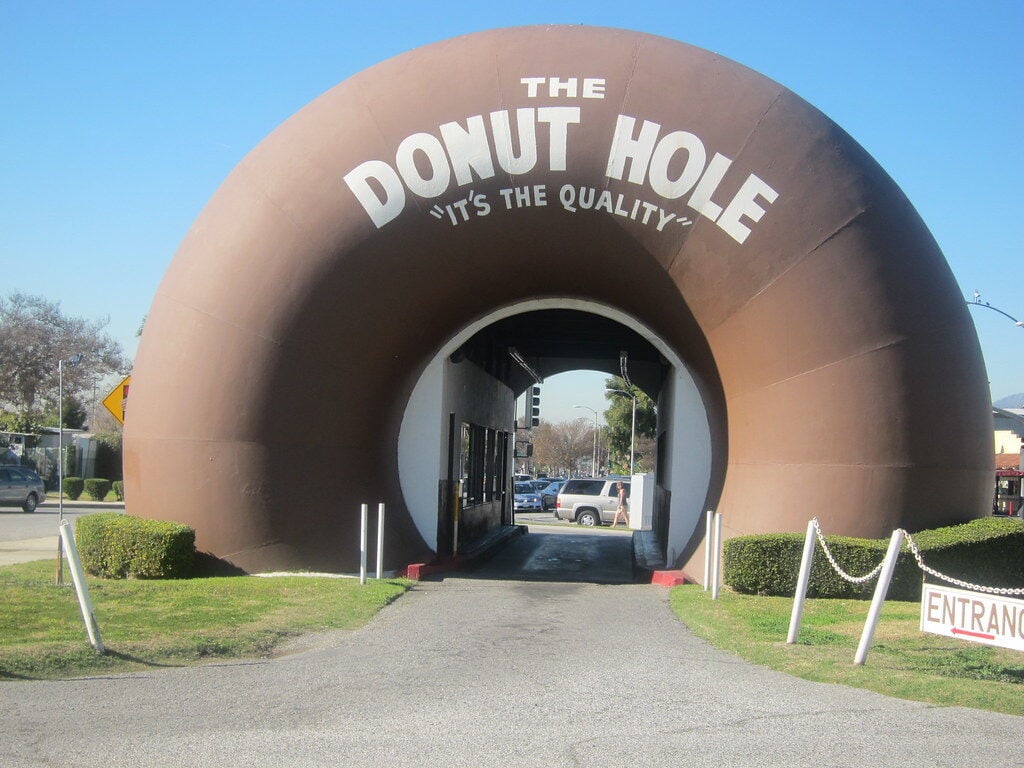
" by pneyu is licensed under CC BY-NC-SA 2.0
The chain ended in 1979, the shop didn't
The Donut Hole reached five stores, including Covina and Long Beach.
La Puente was the only one known to build the full pair of giant donuts into the architecture.
In 1979, the company went out of business. The other stores were demolished, converted to other restaurants, or altered.
La Puente was the only one that survived intact.
The Lopez family bought the Amar Road shop that year and kept making donuts in it.
Gilbert and Lorraine Lopez were still the owners in December 1988, about a decade in. They kept a fact sheet on the place.
Customers came from West Covina, Baldwin Park, and La Verne, plus visitors from Australia, China, England, Germany, and Japan.
The family held the shop until 2003.
Film crews kept coming back
By the 1980s the building was known outside La Puente for its shape. "Moving Violations" staged a police coffee break at the Donut Hole in 1985.
"Dragnet" shows it near the start of the 1987 film. In 1993, "Calendar Girl" used it while its characters crossed Southern California.
The shape is practical on camera. A giant donut identifies the place at a glance, and the passage lets cars and people move through the architecture.
It turned up later in a music video, Oneohtrix Point Never's "On an Axis," and in Ashok Sinha's photographs of Los Angeles car culture, published in 2020.
Hit by a car and repaired in kind
The lane runs vehicles within inches of stucco walls and two big fiberglass shells, and over the years the building has been struck.
In 2004, a driver lost control and went through one of the giant donut facades.
The damaged section was repaired, donut and all, and the shop stayed open. Both portals appear intact in photographs since.
Keeping that shape is why the building shows up on preservation lists.
The Los Angeles Conservancy names the Donut Hole a historic place and a legacy business, and classifies it as programmatic architecture: a building that depicts the product sold inside it.
The listing gives 1968 and continuous donut-shop use.
Travel pages sometimes call the place a National Register site. No federal listing is documented.
The recognition on the record comes from the Conservancy and its architecture.
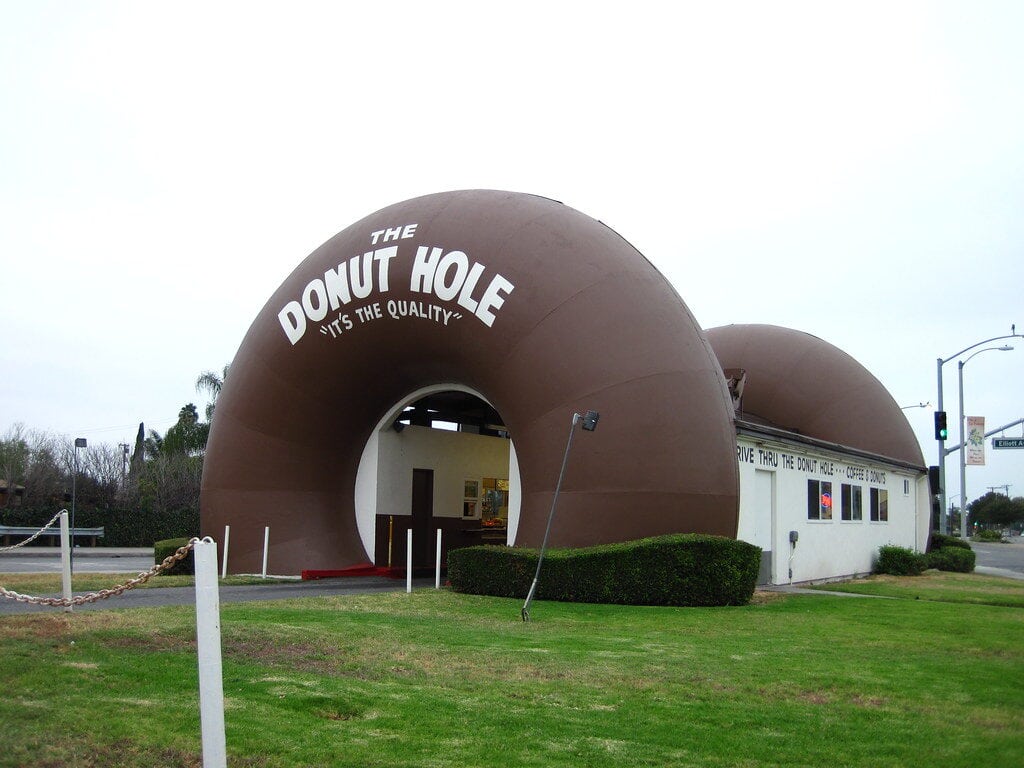
Who drives through the Donut Hole now
Newly married couples drive through it for luck, and some accounts describe the custom as a fertility ritual.
A couple enters through one circle, passes the narrow middle, and comes out the far side.
The rest of the traffic is ordinary. Residents buy donuts here, and architecture buffs, photographers, film crews, and tourists come for the building.
In 2003, a jelly donut cost 70 cents.
The property changed hands after the Lopez family, with a public sale recorded in 2004.
The name, the bakery use, the address, and the route through the middle all carried forward anyway.
Fewer than a dozen of Southern California's old giant-donut buildings were left by late 2025.
In August 2026 this one is open at 15300 Amar Road, both brown donuts standing, cars still passing the service window, and the city still listing the business in its directory.
Independent Publisher Notice
BestAttractions is an independent editorial publisher. We are not affiliated with, endorsed by, or acting on behalf of any location, business, property owner, manager, government agency, or organization described in this article. Comments posted on this page are not forwarded to, reviewed by, or acted upon by any entity mentioned in the article. For official inquiries, complaints, applications, bookings, or other requests, please contact the relevant entity directly through its official website or other verified channels.