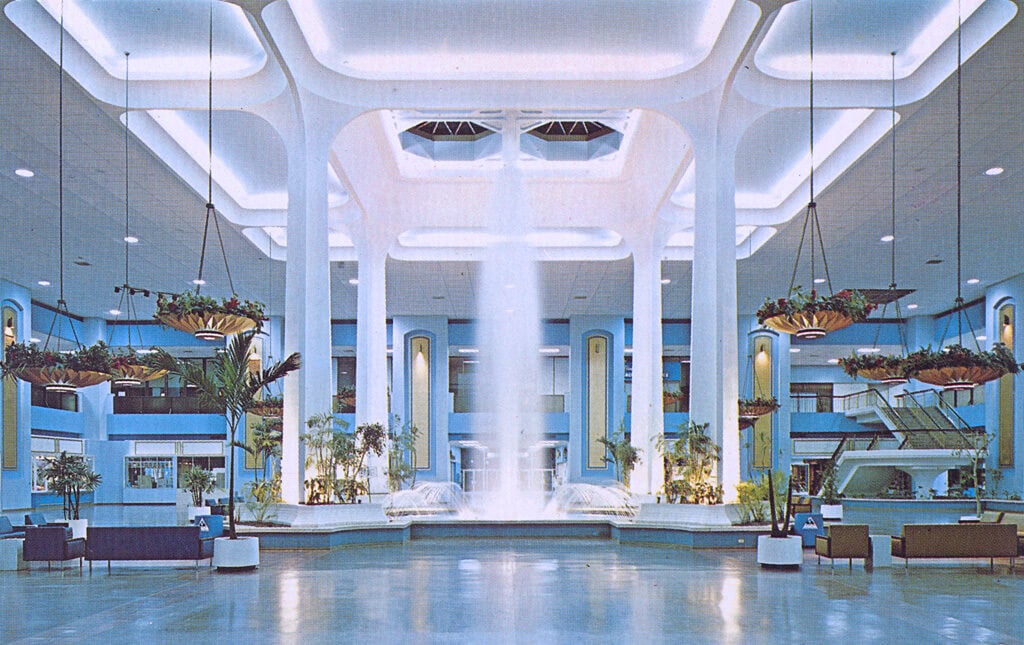
On March 7, 1968, thirty off-duty Denver police officers stood at the entrances. Inside, fountains started running under a glass dome that covered a full acre of indoor plaza space.
The plaza had trees, benches, and statues arranged to make the inside feel more like an outdoor public square than a building.
Only about 100 stores were open that morning, far fewer than the 250 that had been promised. Developer Gerri Von Frellick still moved ahead.
Each month of delay meant about $400,000 in lost rent. The mall opened before construction and leasing were fully complete, and that did not seem to matter to the crowds.
Shoppers filled the color-coded corridors: Blue Mall, Rose Mall, Gold Mall, Shamrock Mall, Sunflower Mall, and the central area called the Blue Room.
The complex ran through about two miles of enclosed walkways and had 7,000 parking spaces.
Its builders told the press it was the largest indoor shopping center in the world. The label people remembered was simpler: the largest mall west of the Mississippi.
How Cinderella City Won Approval in Englewood
The project began eight years before the mall opened. By 1960, Von Frellick was already a well-known Denver developer of large shopping centers.
He came to Englewood with a plan to build on a 55-acre site near City Hall where KLZ radio transmitters had once stood.
People in the surrounding area opposed the project. Residents and city officials objected to the size of the proposed development, and some also objected to the name "Cinderella City."
On November 19, 1962, the city council voted 5 to 2 to approve the zoning change the project needed. That was not enough.
A protest petition signed by more than 20 percent of nearby homeowners raised the number of votes required for approval.
Six votes were needed, so the zoning change failed. At that point, the project looked finished. It was not.
Less than a year later, on September 4, 1963, the council changed course and passed new measures approving the creation of Cinderella City near City Hall in Englewood.
The legal fights did not end, but by then, the project was still moving forward on that site.
Buying the Park and Breaking Ground
On May 21, 1964, Von Frellick signed contracts to buy Englewood's City Park for $1 million. The city planned to use the money for new park sites.
The sale triggered lawsuits, but on July 20, 1965, the Colorado Supreme Court ruled 7-0 to uphold both the park sale and the rezoning of 63 acres.
Von Frellick told reporters that more than 600,000 square feet of retail space had already been leased.
Groundbreaking came on March 31, 1966, with early projections of 1.2 million square feet of retail space, an enclosed air-conditioned mall covering four and a half acres, a one-acre central plaza under a glass dome, and jobs for more than 2,500 people in 125 stores.
The named anchor tenants were Neusteters, Denver Dry Goods, J.C. Penney, and King Soopers.
By early 1968, the numbers had grown to 1.6 million total square feet, 70 acres of land, a projected 40,000 daily customers, a workforce of 3,500, and a total investment topping $50 million.
An Indoor City Designed by Color Codes
Cinderella City was planned to feel less like a regular shopping center and more like a small town inside a building.
At the center was a three-story circular plaza under a glass dome. It held plants and sculptural pieces meant to give the space the feel of an indoor park.
The mall sections that spread out from the center used different colors so shoppers could find their way without relying only on a map.
Battery-powered telephones placed around the complex let visitors call for directions. The enclosed parking areas also used color coding to match the mall sections they served.
Before the mall opened, promotional material highlighted very large refrigerated display cases in the King Soopers grocery store and air-conditioning systems built to keep the huge interior comfortable throughout the year.
A separate ten-story Continental National Bank building stood on the property and was the tallest structure in Englewood at the time.
Promotional material listed 14,000 parking spaces, although earlier figures had given the number as 7,000. A larger grand opening, with all 250 stores in operation, was scheduled for July 1968.
Tax Revenue and the Rocky Mountain Crowds
Cinderella City shaped Englewood's economy for more than ten years. Shoppers came from across the Rocky Mountain West, often making a long drive to spend the day there.
The mall brought in so much tax money that it quickly changed the city's budget in visible ways.
By 1970, revenue from the mall had helped Englewood raise school spending from $670 per student to nearly $825.
By 1978, the mall's 235 merchants had produced more than $45 million in total sales taxes for the city. That same year, Von Frellick sold his share of the mall to New York investors for $35 million.
Families often spent entire afternoons walking through the color-coded halls.
The mall served as a gathering place for the community, a major shopping destination for the region, and the main source of economic support for a small suburban city's budget during the strongest years of the 1970s.
Then the ground beneath it quite literally began to shift.
Dump Soil, New Malls, and Empty Hallways
Cinderella City was built on land that had once served as Englewood's town dump. As the years passed, the ground shifted, and the building developed structural problems.
In the mall's last years, a full section called Cinder Alley was found unsafe and closed.
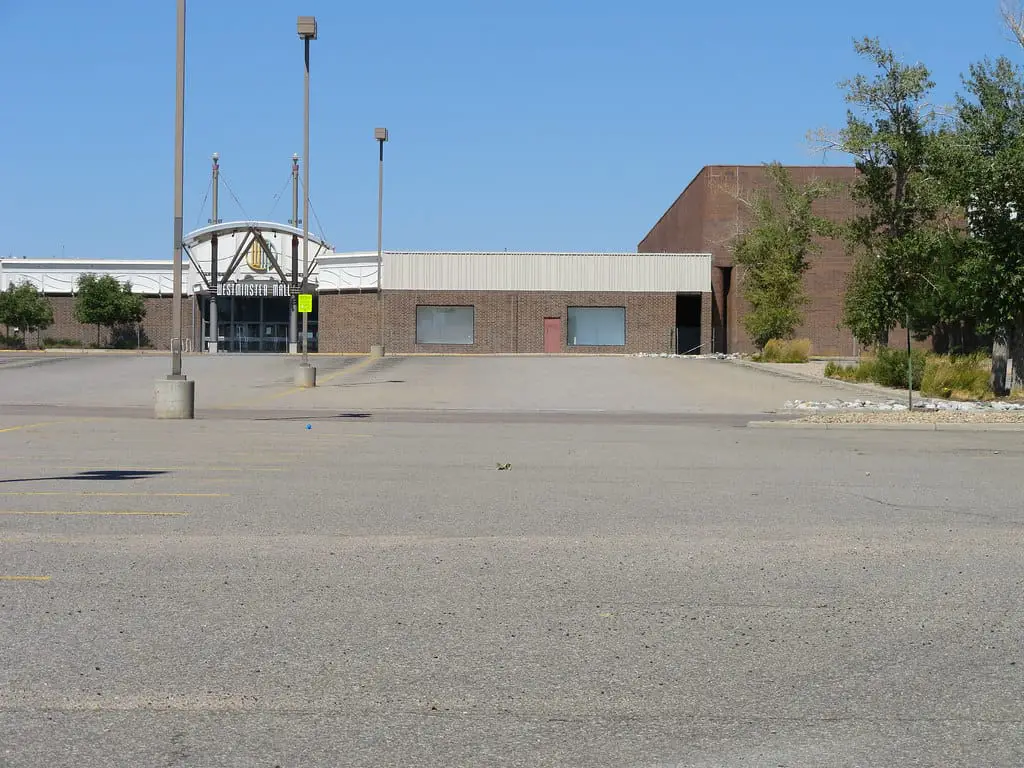
Newer suburban malls made the decline worse. Southwest Plaza, Westminster Mall, and other shopping centers drew away the regional customers who had once driven long distances to shop in Englewood.
By 1991, retail analysts had given up on Cinderella City.
The drop in tax revenue showed how far the mall had fallen. In 1981, it brought in $3 million in tax revenue. By 1992, that number had dropped to $1.85 million.
Security guards dealt with criminal activity in empty parts of the complex where tenants were gone, and vacant storefronts spread through hallways that had once been full on weekend afternoons.
Montgomery Ward, the last major retailer, closed for the final time in 1997. When Cinderella City closed permanently, only about three tenants were still in business there.
Demolition and Redevelopment at Cinderella City
Demolition started on August 18, 1998. Former mayor Elmer Schwab, who had been there during the mall's opening period about thirty years earlier, returned for the first blows.
A wrecking ball struck the old J.C. Penney Auto Center as crowds stood nearby and watched.
One part of the complex remained after the rest was torn down. A former Broadway Southwest department store, added to the site in 1985, was later turned into the Englewood Civic Center and is still standing today.
The redevelopment plan included retail stores, townhomes, a multiscreen theater complex, and a new civic center. By 2000, the site had been rebuilt with a new city hall, a Wal-Mart, and other retail businesses.
The RTD light rail Southwest Corridor opened to the public on July 14, 2000, and Englewood Station was one of five stops on the 8.7-mile extension.
The former mall property became CityCenter Englewood, later identified as Colorado's first transit-oriented development.
CityCenter in Its Second Transformation
CityCenter Englewood covers about 55 acres. The site runs from Cherokee west to Santa Fe and from Hampden north to Floyd Avenue.
Ownership of important parts of the property changed after a 2018 foreclosure by LNR Partners. On December 20, 2024, New Englewood, LLC took over the ground-lease interest for the central sections.
In October 2025, the city council approved a phased transfer of the areas east of Inca Street to New Englewood, LLC.
At the same time, the city took control of the former 24 Hour Fitness building and the nearby plaza retail space.
By February 2026, the first phase of that transfer had been completed, and the city had title to the former fitness building and the western ArtWalk retail spaces.
The city and the Englewood Downtown Development Authority began looking at short-term uses for those properties, including a possible startup-business incubator.
A separate project moved forward in February 2025. Englewood approved a 260-unit apartment development at 401 Englewood Parkway on land that had once been part of Cinderella City.
A later phase could add either a 120-room hotel or more housing units.
What Remains of Cinderella City Mall
The Historic Englewood Museum opened in spring 2024, and its very first exhibit focused on the history of the mall.
History-related murals funded by the city were installed on the second floor of the Civic Center in spring 2025.
A separate effort called the Cinderella City Project built an immersive digital reconstruction of the mall, and its exhibit ran from May 2024 through August 2025.
A restored Cinder Alley sign now hangs in the museum space. Englewood's vision for what sits on the old mall land today looks nothing like a shopping center.
In late 2025 and early 2026, the city described future CityCenter plans that could include housing, restaurants, shops, civic facilities, office space, a hotel, public plazas, and event spaces.
A public open house in January 2026 gathered community input on the next phase.
The ground where Gerri Von Frellick once built his enormous glass-domed retail city is still being figured out, almost sixty years later.