
St. Pete Beach can be a very good retirement choice if you expect the Gulf to shape everyday life.
It has an unusually large older population, direct beach access, city recreation programs that include SilverSneakers options, and transit connections to mainland St. Petersburg.
Florida also does not levy an individual state income tax on natural persons. The trade-off is that this is a coastal, barrier-island retirement.
A home that looks affordable at the asking price can become expensive once property taxes, homeowners or wind coverage, flood insurance, condo reserves, special assessments, and storm repairs are added.
Nearby mainland St. Petersburg and South Pasadena provide the major hospital care you would use. Hurricane evacuation and re-entry belong in the normal household plan from the day you move in.
A useful decision test is:
Can I comfortably afford the specific property, insure it, evacuate from it, maintain it, and reach the care I expect to need while still getting enough value from living at the beach?
If the answer is yes, St. Pete Beach gives you a retirement setting that is hard to duplicate inland.
If those ownership and access issues strain your budget or health plan, nearby mainland St. Petersburg or South Pasadena may give you much of the same regional lifestyle with fewer barrier-island complications.
St. Pete Beach retirement at a glance
| Factor | What it means for a retiree |
|---|---|
| Older population | U.S. Census QuickFacts reports that 44.8% of residents are age 65 or older. St. Pete Beach is a mixed-age city where older adults make up a large share of the population. |
| 2026 housing | Zillow's typical home value was $608,062 as of June 30, 2026, down 7.1% from a year earlier. Its observed average asking rent was $2,775. |
| Taxes | Florida does not levy an individual state income tax on natural persons. Eligible permanent-resident homeowners can also apply for homestead benefits. |
| Flood and storms | Flood zone, evacuation zone, building elevation, construction history, and insurance terms answer different parts of the risk question. |
| Condos | Price the unit together with the association's structural inspection status, reserve study, budget, insurance, assessments, and meeting records. |
| Healthcare | Full hospital and specialist care is available in nearby mainland St. Petersburg and South Pasadena, but you should test the route from the exact home you are considering. |
| Local mobility | PSTA's SunRunner links St. Pete Beach with Pasadena, Central Avenue, and downtown St. Petersburg. Registered city residents can also use the Freebee on-demand shuttle without a per-ride fare. |
| Best fit | Retirees who will use the beach often, can absorb coastal housing costs, and are comfortable with storm planning. |
| Think twice if | You need the lowest predictable housing cost, cannot evacuate easily, rely on frequent complex medical care, or do not want to manage coastal property risk. |
Why retiring here is different from retiring in St. Petersburg
St. Pete Beach and St. Petersburg share a metro area while producing very different retirement routines.
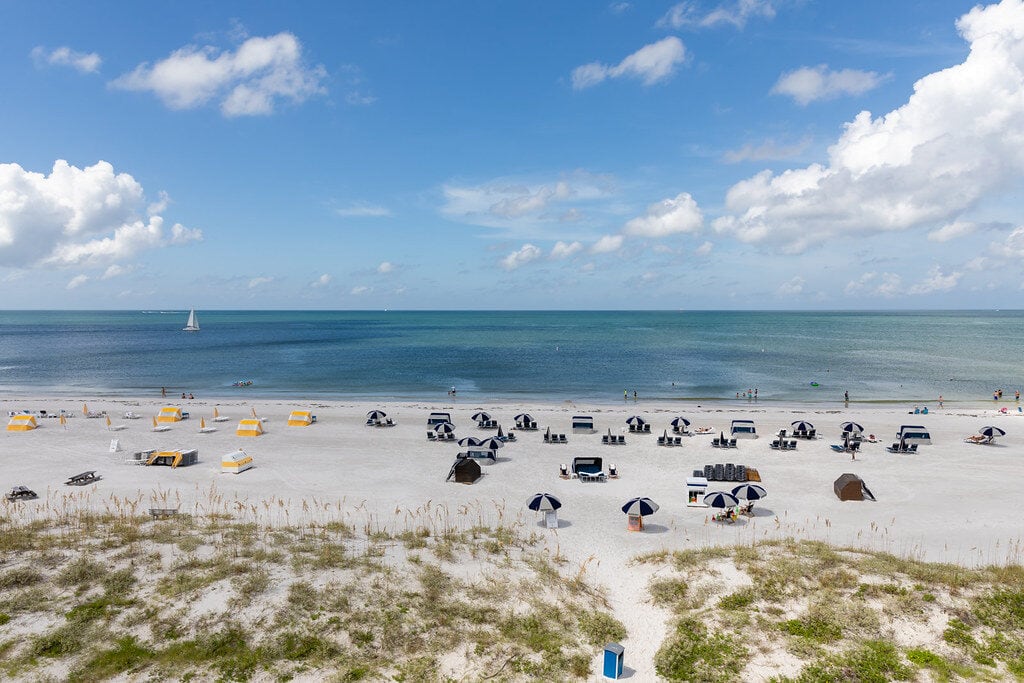
St. Pete Beach puts the Gulf, beach walks, sunsets, boating, and a compact beach-city routine close to home.
It is also a tourist destination, so the same location that gives you restaurants and beach activity can bring seasonal traffic and competition for road space.
Mainland St. Petersburg gives you a much larger choice of neighborhoods, hospitals, medical offices, shopping, cultural venues, and housing types.
From mainland St. Petersburg, the Gulf beaches become a trip you make instead of the setting outside your door.
That distinction matters because St. Pete Beach asks you to pay for proximity to the water in more than one way.
Purchase price is only the first layer.
Flood exposure, wind coverage, evacuation logistics, salt-air maintenance, and association finances can all affect the long-term cost of staying in the home.
A retiree who walks the beach every morning may consider that trade worthwhile.
Someone who plans to visit the beach twice a month may be paying for a benefit they could access from the mainland without assuming as much coastal property risk.
What does it cost to retire in St. Pete Beach in 2026?
There is no single retirement budget for St. Pete Beach because the housing stock ranges from condos to waterfront houses, and property-level insurance costs can differ sharply.
Still, current market data gives a useful starting point.
Zillow reported a typical home value of $608,062 as of June 30, 2026, down 7.1% year over year.
The median sale price was $636,500 in May 2026, while 87.2% of sales in that month closed below list price.
Zillow's observed average asking rent was $2,775 in June 2026.
Those numbers suggest buyers may have more negotiating room than during a hotter market.
They do not tell you whether a particular property is inexpensive to own.
Build the true monthly housing cost
Before comparing two homes, put them on the same monthly basis:
True monthly housing cost = mortgage principal and interest + property tax / 12 + homeowners or unit-owner insurance / 12 + flood insurance / 12 + HOA or condo fee + special assessment payment + a property maintenance allowance
For a condo, add another line for any assessment that has been approved but not yet fully collected.
For a house, pay special attention to roof age, electrical systems, windows and openings, HVAC condition, elevation, and prior storm damage because those items can affect both repairs and insurance.
The practical point is simple: a $450,000 condo with a high monthly fee, a large assessment, and weak reserves may be a worse retirement fit than a more expensive unit in a financially healthier building.
Property taxes can reset after a purchase
Do not use the seller's current property-tax bill as your own forecast.
Florida's homestead system can limit assessment increases for an existing owner. After a sale, the new owner's taxable position can be different.
The Pinellas County Property Appraiser provides a tax estimator specifically for buyers.
Qualifying permanent-resident homeowners can apply for Florida homestead benefits that reduce taxable value and activate Save Our Homes assessment protections.
A separate low-income senior exemption may apply to qualifying owners age 65 or older; local adoption, homestead status, household income, and the taxing authority all matter.
The Florida Department of Revenue lists the 2026 adjusted household income limit at $38,686 for the senior exemption.
If you are moving from another Florida homestead, ask whether you can transfer part of your Save Our Homes assessment difference through portability.
If you are moving from another state, do not assume the previous owner's tax history follows the property for your benefit.
Put the state income-tax benefit beside the coastal costs
Florida law does not impose an individual state income tax on natural persons.
That means Florida itself does not tax a retiree's Social Security benefits, pension income, IRA distributions, or other personal income through a state individual income tax.
Federal tax rules still apply, and property taxes, sales taxes, insurance, HOA fees, and other living costs remain.
For a St. Pete Beach retirement budget, count the tax advantage on the same sheet as coastal ownership costs.
The complete total tells you whether the move saves money.
Flood risk is an address-level question
Address-level data is much more useful than distance from the beach when judging property risk in St. Pete Beach.
Before buying or signing a long lease, check at least four separate things:
- FEMA flood zone
- Pinellas County evacuation zone
- The building's elevation and elevation certificate, when available
- The property's construction, permit, and storm-damage history
A flood zone and an evacuation zone are not the same.
Pinellas County explains that FEMA flood zones are used for flood-risk and insurance purposes, while evacuation zones are based on vulnerability to hurricane storm surge.
A property can therefore have one risk classification for insurance and another for evacuation planning.
That difference is easy to miss when a listing says "not in an evacuation zone" or uses a single flood label as shorthand for the whole risk picture.
Get an insurance quote before the inspection period runs out
Do not wait until closing to learn what insurance will cost.
Ask an insurance agent to quote the exact address using the actual roof, construction, elevation, wind-mitigation, and occupancy information.
If the property is a condo, obtain a unit-owner quote and review what the association's master policy does and does not cover.
If Citizens Property Insurance is your proposed carrier, its flood requirements deserve special attention.
In 2026, Citizens requires flood coverage for covered personal residential policies with wind coverage outside a Special Flood Hazard Area when Coverage A is $400,000 or more.
Homes in a Special Flood Hazard Area with applicable Citizens personal residential wind coverage also require flood insurance.
The threshold expands again in 2027.
Citizens notes that condominium unit-owner policies, tenant contents policies, and policies that exclude windstorm or hail are exempt from that particular Citizens flood-insurance requirement.
That exemption does not mean a condo unit has no flood exposure, and a lender or other policy terms may create separate requirements.
For retirement planning, get the quote first and decide whether you can tolerate the premium and deductible.
Do not buy first and hope the insurance number becomes manageable later.
Understand the 50% substantial improvement and damage rule before buying an older home
St. Pete Beach's floodplain rules can materially change the economics of renovating or restoring an older building.
For a property in a mapped flood hazard area that does not meet current floodplain regulations, the city says a building determined to be substantially damaged or substantially improved must be brought into compliance with current floodplain requirements.
The city's threshold is when the applicable work or damage reaches at least 50% of the market value of the building or structure, excluding land.
That can mean elevation or other major compliance work, depending on the building and project.
The city also states that phasing improvements to avoid the threshold is not permitted.
This matters to a retiree considering a "fixer" or a storm-damaged property.
The lot value can make the purchase look attractive while the structure carries a much harder renovation problem.
Before making an offer on an older or previously damaged home, ask for:
- the city's permit history;
- any substantial-damage or substantial-improvement determination;
- available elevation certificates;
- documentation of post-storm repairs;
- the building value used for any prior 50% calculation;
- a contractor's written scope and cost estimate for your intended work.
If your retirement plan depends on immediately renovating the house, check this issue before treating the renovation budget as settled.
Condo buyers need to investigate the association
St. Pete Beach has many condos, and a condo can make beach retirement easier by shifting exterior maintenance to an association.
It can also concentrate financial risk in the association.
Florida requires milestone inspections and Structural Integrity Reserve Studies, known as SIRS, for qualifying condominium and cooperative buildings.
They serve different purposes.
A milestone inspection examines an aging building for substantial structural deterioration.
A SIRS is a reserve-planning study that examines structural components, existing reserves, and the funding needed for future major repair and replacement work.
For a buyer, completion of the paperwork is only the starting point. Read what the reports found and how the association plans to pay for the work.
Request this condo document package before you buy
At a minimum, review:
- the latest milestone inspection, if the building is subject to one;
- the latest SIRS, if applicable;
- the current annual budget;
- the reserve schedule and current reserve balances;
- all current or approved special assessments;
- board and owner meeting minutes, especially those discussing roofs, concrete, waterproofing, elevators, windows, flood damage, insurance, or major capital work;
- the association's master insurance declarations and deductible information;
- the unit's HO-6 insurance quote;
- pending litigation that could affect the association;
- post-storm engineering reports, permits, and repair status;
- rules on leasing, pets, parking, renovations, and guests if those matter to your retirement plan.
Evaluate a recent special assessment by what it funded and what remains unfunded.
An association that paid for needed work may be in a better position than one that postponed it.
Evaluate a high monthly condo fee by what it covers, including reserve contributions, insurance costs, utilities, amenities, and the condition of the building.
Base the decision on total annual ownership cost plus the financial condition of the association. A monthly fee captures only part of that picture.
Hurricane planning is part of normal retirement planning here
St. Pete Beach is on a barrier island, so storm planning has a practical retirement dimension that does not apply in the same way to many inland communities.
Pinellas County can order evacuations according to storm-surge risk.
After a hurricane, law enforcement may restrict access to barrier islands until conditions are safe, and re-entry can be limited to residents and businesses with an Emergency Access Permit.
That creates several questions worth answering before a move:
- Where will you evacuate to?
- Can you drive yourself if an order is issued?
- What happens if you no longer drive five or ten years from now?
- Can you transport medication, mobility equipment, pets, and medical supplies?
- Is your planned destination outside the evacuation area?
- How will you return if access is restricted?
- Who checks the property if you are away for an extended period?
For residents who need help with daily activities or specialized transportation, Pinellas County operates a Special Needs Evacuation Program.
During evacuation orders, PSTA also operates free buses to shelters.
Those services are useful backups, but they work best when registration and planning are done before a storm.
A retirement plan that works only while both partners can drive should be revised if you intend to age in place.
Major hospital care is on the mainland
Medical care is close in regional terms, and major hospital services require a trip to the mainland.
HCA Florida Pasadena Hospital is at 1501 Pasadena Avenue South in St. Petersburg and operates a 24/7 emergency room.
Orlando Health Bayfront Hospital in St. Petersburg has emergency, trauma, heart, neuroscience, geriatric, surgical, rehabilitation, and other specialist services.
For routine care, you can choose among medical offices throughout the St. Petersburg area.
For more complex care, you should expect to cross to the mainland.
That may be a small issue for a healthy retiree who drives.
It can become more important with frequent specialist appointments, dialysis, rehabilitation, vision loss, cognitive decline, or reduced mobility.
Test the medical trip before choosing the property
Test travel time in person from the exact address. During a scouting visit, drive from the exact home or condo to:
- the primary-care practice you would likely use;
- your preferred hospital or emergency department;
- a pharmacy;
- any specialist you expect to see regularly.
Try the trip at both a busy time and a quiet morning.
If you plan to reduce driving later, check the transit path as well.
PSTA's SunRunner connects St. Pete Beach with Pasadena, the Central Avenue corridor, and downtown St. Petersburg.
It is useful for many routine trips, but it is not a substitute for emergency medical transport.
For short local trips within St. Pete Beach, the city's Freebee service provides on-demand transportation.
Registered residents can ride without a per-ride fare; unregistered riders are charged a fare under the city's current program.
This can help with local errands and dining, but again, it should not be treated as your medical contingency plan.
Daily life can work very well for an active retiree
The lifestyle case grows stronger the more often you expect to use the beach and the city's outdoor setting.
U.S. Census QuickFacts reports that 44.8% of city residents are 65 or older, which gives the city a much older age profile than many ordinary mixed-age communities.
St. Pete Beach is a mixed-age city, so daily life includes visitors, families, workers, tourists, and older residents instead of the planned social structure of a 55+ development.
City recreation offerings also include SilverSneakers and Renew Active eligible fitness classes.
The beach itself makes walking, swimming, paddling, fishing, and boating easy to build into a routine if those activities suit you.
Restaurants, events, tourism, and road congestion make the pace change through the year.
Heat, thunderstorms, and hurricane season also shape the summer and fall routine.
A person who loves a February week on the Gulf may feel differently after living through a hot, humid summer or a storm evacuation.
For that reason, rent before buying if you have never lived on the Pinellas beaches.
A full summer or a multi-month stay tells you more about your fit than a winter vacation.
What type of St. Pete Beach property fits retirement best?
Choose the property type by the job you need it to do.
Gulf-front condo
Best for: someone who wants the beach immediately outside, prefers less exterior maintenance, and accepts shared-building finances.
Main trade-off: association health matters as much as unit condition.
Insurance, reserves, structural work, elevators, waterproofing, and assessments can all affect your cost.
Before buying: read the full condo document package and get an HO-6 quote. Do not rely on the seller's monthly fee as a complete cost picture.
Waterfront single-family home
Best for: someone who values private outdoor space, boating or water access, and control over the property.
Main trade-off: you directly bear more of the roof, structure, flood, wind, landscaping, dock or seawall, and storm-repair burden.
Before buying: get property-specific insurance and flood quotes, inspect waterfront structures separately when applicable, review elevation and permit history, and investigate prior flood or storm damage.
Older beach cottage or renovation property
Best for: someone willing to manage construction and who specifically wants an older, lower-scale beach home.
Main trade-off: the renovation may be constrained by floodplain rules, and hidden storm or structural work can turn a cosmetic project into a much larger one.
Before buying: investigate the city's 50% substantial improvement and damage rules before setting your renovation budget.
Rental first
Best for: anyone unsure how they will respond to summer weather, tourism, storm season, or the island's road access.
Main trade-off: rent can be high, and you do not build equity during the test period.
Why it can still be smart: a year of rent can be cheaper than discovering after a purchase that you dislike the summer, cannot tolerate evacuations, or chose a building with costs you did not understand.
Who is St. Pete Beach best for in retirement?
St. Pete Beach is a strong match if most of these statements sound like you:
- You expect to use the beach several times a week.
- You prefer a mixed-age beach city to a gated 55+ development.
- You can afford coastal insurance and property costs without making your retirement budget fragile.
- You are willing to check flood, elevation, building, and association records before buying.
- You can leave during an evacuation and have somewhere safe to go.
- You are comfortable crossing to the mainland for major medical care.
- You value local dining, water activity, and outdoor routine more than large-lot suburban space.
- You are willing to rent first if you have not experienced a full Gulf Coast summer and storm season.
It is a weaker fit if one or more of these are central to your plan:
- Your housing budget has very little room for insurance, HOA, tax, or assessment changes.
- You want your hospital and specialists within a few minutes without bridge or island traffic.
- You cannot evacuate independently and do not want to make a formal assistance plan.
- You dislike tourism or seasonal traffic enough that it would reduce your daily enjoyment.
- You mainly want Florida tax treatment and warm weather, not the beach itself.
- You want the programmed amenities and age restrictions of a large 55+ community.
In those cases, compare St. Pete Beach with mainland St. Petersburg, South Pasadena, or other Pinellas County locations before committing.
You may keep access to the same regional hospitals, restaurants, and Gulf beaches while changing your exposure to coastal housing costs and storm logistics.
A retirement due-diligence checklist before you buy
Use this list for the exact address, not the city in general.
Housing and carrying cost
- [ ] Obtain a current property-tax estimate for new ownership.
- [ ] Get a homeowners or HO-6 insurance quote before the inspection period ends.
- [ ] Get a flood-insurance quote or document why you are choosing not to carry one.
- [ ] Convert all annual costs to one monthly total.
- [ ] Add HOA or condo fees and every known assessment.
- [ ] Check hurricane and other major deductibles in dollars as well as percentages.
- [ ] Confirm roof age, HVAC age, electrical system, windows or shutters, and other major components.
Flood and storm
- [ ] Look up the FEMA flood zone.
- [ ] Look up the Pinellas evacuation zone separately.
- [ ] Obtain any available elevation certificate.
- [ ] Review prior storm and flood claims or damage disclosures.
- [ ] Review the city permit history.
- [ ] For an older or renovated home, investigate substantial-damage or substantial-improvement status.
- [ ] Get a barrier-island Emergency Access Permit after establishing residency.
- [ ] Decide where you will evacuate and how you will get there.
- [ ] Register for the Special Needs Evacuation Program in advance if you may need assisted transportation or shelter support.
Condo-specific checks
- [ ] Read the latest milestone inspection if applicable.
- [ ] Read the latest SIRS if applicable.
- [ ] Review reserves, budget, insurance, deductibles, and special assessments.
- [ ] Read recent meeting minutes for pending capital work.
- [ ] Ask what major projects are expected during the next several years.
- [ ] Confirm whether the master policy and your HO-6 policy leave coverage gaps you cannot comfortably absorb.
Healthcare and aging in place
- [ ] Choose a likely primary-care practice and hospital.
- [ ] Drive the route from the property at a busy time.
- [ ] Check how you would make the same trip if you stop driving.
- [ ] Test access to groceries, pharmacy, banking, and routine services.
- [ ] Decide whether the home itself can support reduced mobility later.
Lifestyle fit
- [ ] Spend meaningful time in St. Pete Beach outside peak winter season.
- [ ] Experience summer heat, rain, and tourism patterns before buying if possible.
- [ ] Decide how often you will actually use the beach.
- [ ] Compare at least one mainland alternative using the same total-cost worksheet.
Should you retire in St. Pete Beach?
St. Pete Beach is one of those retirement choices where lifestyle fit and property due diligence cannot be separated.
The city has a large older population, direct Gulf access, useful local transportation, nearby mainland healthcare, and Florida's lack of an individual state income tax.
Those advantages matter most when the property itself supports a durable retirement plan.
The strongest St. Pete Beach retirement property is the one whose total carrying cost, flood exposure, insurance, building condition, association finances, evacuation plan, and healthcare access still work when you test them together.
For a beach-first retiree with the budget and willingness to manage those details, St. Pete Beach can justify the extra complexity.
For someone seeking maximum cost predictability or easier aging-in-place logistics, living on the mainland and visiting the beach may be the better long-term decision.
On the map: St. Pete Beach, FL 33706
Sources and useful further reading
- City of St. Pete Beach official website - City of St. Pete Beach.
- QuickFacts: St. Pete Beach city, Florida - U.S. Census Bureau.
- Saint Pete Beach, FL Housing Market - Zillow Home Value Index and Zillow Observed Rent Index data through June 30, 2026. Data Provided by Zillow Group.
- Flood Maps & Zones - Pinellas County.
- Substantial Improvement/Substantial Damage - City of St. Pete Beach.
- Flood Insurance Requirements - Citizens Property Insurance Corporation.
- Condominium Milestone Inspections and SIRS - Florida Department of Business and Professional Regulation.
- Florida Statutes, Section 220.02 - Florida Legislature.
- Two Additional Homestead Exemptions for Persons 65 and Older - Florida Department of Revenue, revised January 2026.
- Florida Property Tax Exemptions and Additional Benefits - Florida Department of Revenue.
- Orlando Health Bayfront Hospital - Orlando Health.
Current information last reviewed: August 9, 2026

Independent Publisher Notice
BestAttractions is an independent editorial publisher. We are not affiliated with, endorsed by, or acting on behalf of any location, business, property owner, manager, government agency, or organization described in this article. Comments posted on this page are not forwarded to, reviewed by, or acted upon by any entity mentioned in the article. For official inquiries, complaints, applications, bookings, or other requests, please contact the relevant entity directly through its official website or other verified channels.