
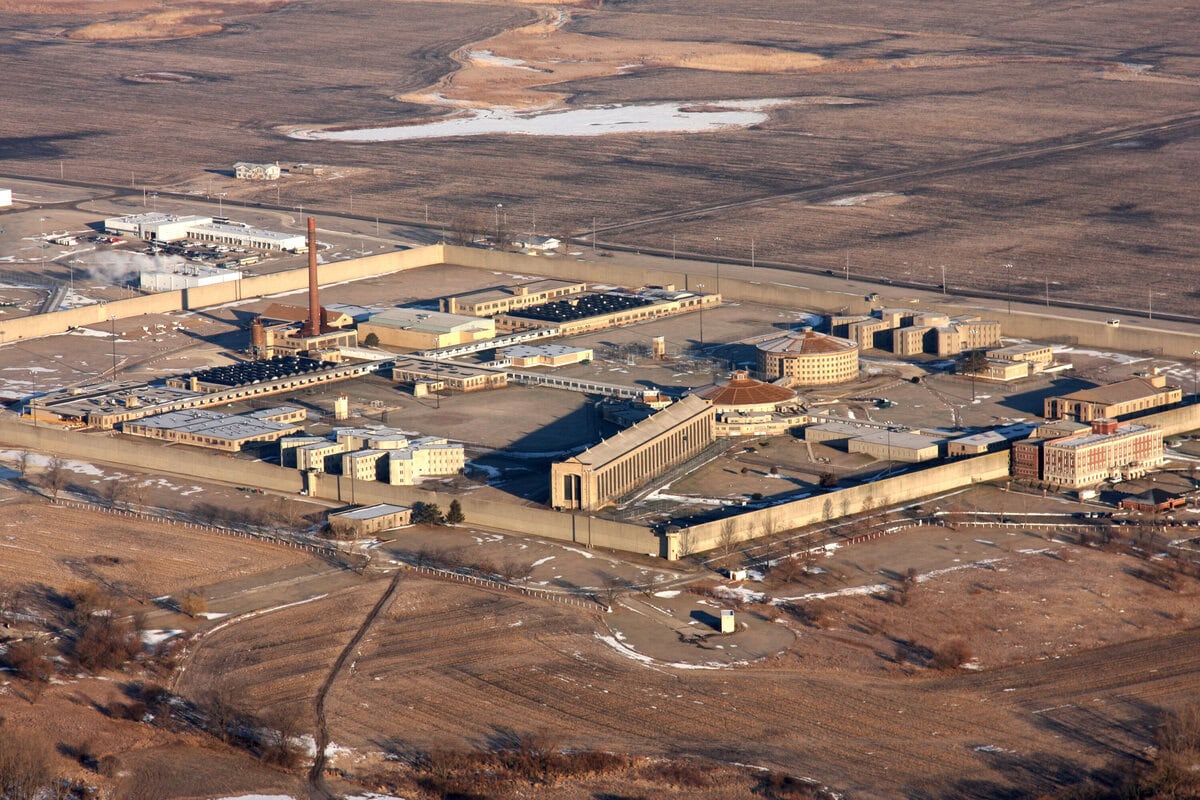
F-House was round. Cells in tiers around the outside, one guard position in the middle, hundreds of men in a single open space.
It sat inside Stateville Correctional Center in Crest Hill, Illinois, a maximum-security prison that opened in 1925 and had four of those roundhouses. By the 1990s it was the last one in the country still holding prisoners.
By December 2016 Illinois had emptied it and avoided $10.3 million in deferred maintenance, then reopened it in 2020 for COVID-19 isolation.
In August 2024 a federal judge ordered most of Stateville cleared out too, because concrete was coming loose, and the last men left in March 2025.
Two new prisons are now planned for the same 2,264 acres. The story starts with a design that promised one officer could watch everybody.
Illinois built Stateville to replace Joliet
In 1909, after investigations into conditions at the old Illinois State Penitentiary at Joliet, the state set aside money to buy land nearby for its replacement.
Construction began in August 1916. The wall took four years: 35 feet high, 6,750 feet of concrete, done in the summer of 1920.
Each cell was drawn for one man, with a toilet and an outside window.
The walls went up faster than the rest of the prison: heat and kitchens were still unfinished in 1920, and prisoners began arriving in December 1924.
Stateville Correctional Center opened on March 9, 1925 in what is now Crest Hill, Illinois, 40 miles southwest of Chicago, a maximum-security prison rated for 1,506 men.
Joliet stayed open until 2002.
Four round cellhouses, one guard at the center
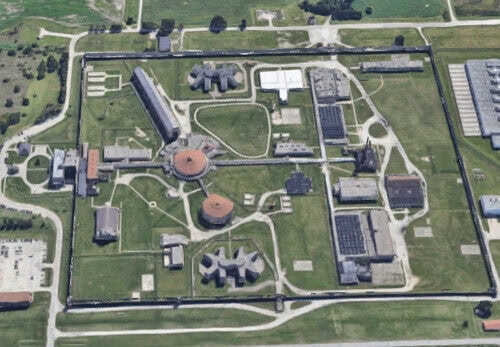
Four circular cellhouses went up inside the wall, cells stacked in tiers around the outer ring, every one facing inward at a single guard position.
Architect W. Carbys Zimmerman worked from Jeremy Bentham's panopticon: one officer, one spot, a view of everybody.
That sight line needed one undivided room, hundreds of men in a single acoustic space.
It aged badly against later standards for cell size and ventilation.
Illinois stopped at four. Cellhouse B came next, a rectangular Auburn-plan block, then decades later H and I houses, both K-plan units.
By the 1990s, F-House was the last panopticon in the country still holding prisoners.
A riot in 1931, an escape in 1942
On March 18, 1931, roughly 1,500 prisoners rose up, and fires went through the machine shop, the kitchen, the laundry, and the shoe shop.
The six-year-old prison had much of its industrial plant to rebuild.
Then October 9, 1942. Roger Touhy, a Chicago gangster, escaped with six other men from an institution the state had promoted as secure.
Federal agents found him in Chicago on December 29. In 1947, James Stewart filmed Call Northside 777 there.
Joseph Ragen ran the place from 1935 to 1941 and again from 1942 to 1961, on strict discipline. Unrest came back anyway.
In September 1979, prisoners in the death-row and isolation unit took over and held eight hostages.
Prisoners infected with malaria for the war effort
In March 1944, a University of Chicago team under physician Alf S. Alving began infecting prisoners with malaria, the first on March 8, through mosquitoes carrying Plasmodium vivax.
Hundreds of men were in that first group, and malaria was disabling American troops in the tropics.
The work ran well past 1945 and fed research on primaquine.
Some subjects had severe hemolytic reactions, and chasing that result led to what we now call G6PD deficiency.
Participation was described as voluntary, and volunteers got benefits.
Whether a man in a cell can consent the way a man outside one can is still argued over.
The state's capital punishment site, 1990 to 1998
Illinois used electrocution before it paused capital punishment, and Stateville had an electric chair of its own.
When the state resumed executions in 1990, it used injection and Stateville, which by then also held Richard Speck.
John Wayne Gacy's sentence was carried out there on May 10, 1994, with heavy press and a crowd outside the wall.
The function moved to Tamms in 1998.
A moratorium followed in January 2000, most of the state's capital sentences were commuted in January 2003, and the repeal was signed on March 9, 2011.
Stateville hadn't used those rooms for an execution in 13 years by then.
College degrees earned inside the walls
Nathan Leopold and Richard Loeb, both serving time for the 1924 Bobby Franks case, helped organize a correspondence school inside the prison.
Classes began in 1933 at high-school level, with lessons men could do from their cells.
Education stuck.
By the 2000s the prison ran adult basic education, GED preparation, vocational instruction, and college courses through outside partners.
Northwestern University and Oakton College started a program at Stateville in 2018.
On November 15, 2023, 16 students accepted Northwestern bachelor's degrees in the prison theater, with another 60 still working toward theirs.
Within a year, nearly all of them were living somewhere else.
Falling concrete emptied the cellhouses
F-House went first. Transfers began on October 26, 2016, and the last 36 men left by December 1.
Closing the roundhouse avoided $10.3 million in maintenance. In May 2020 it reopened for COVID-19 isolation, four years after being shut as unfit.
By 2023, 11 buildings were rated in severe condition and deferred maintenance had reached $286 million.
The governor's administration proposed closing and rebuilding in March 2024.
A federal judge fixed the deadline in August, ordering most of the 430 men still inside out by September 30 because concrete was coming loose in the housing units.
The health care unit held on until March 24, 2025.
What's still open at Stateville now
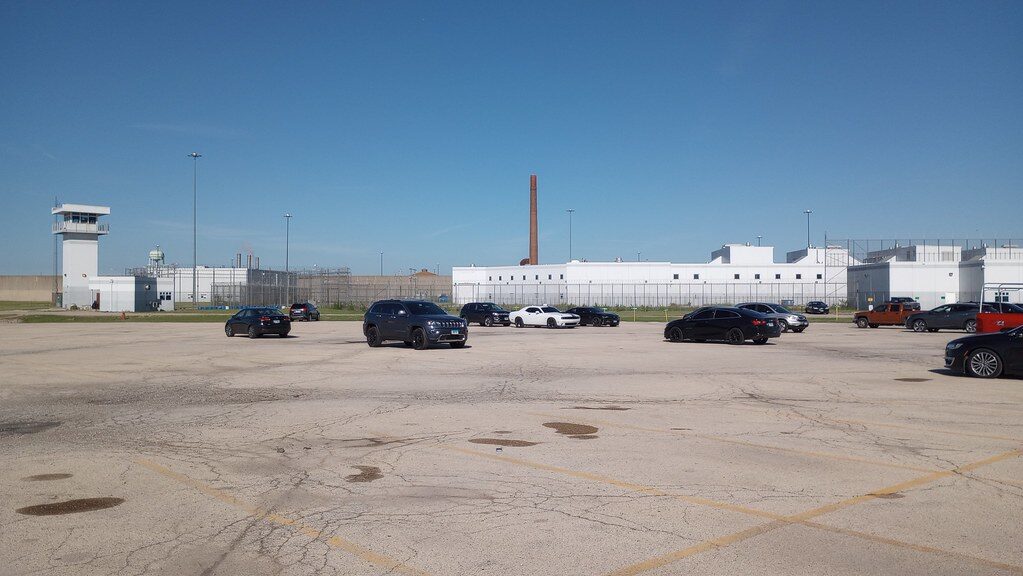
The old maximum-security prison is empty. The campus around it is not.
The Northern Reception and Classification Center, open since 2004 with 1,800 beds, still processes men entering the Illinois system.
The Minimum Security Unit, open since October 2003, holds 192. As of March 31, 2024, Stateville had 939 employees, 676 of them in security.
On June 5, 2026, the state chose this property for both replacement prisons: 1,500 beds for men, 800 for women.
The August 2026 solicitation estimates the design-build contract at $1.1 billion, with completion targeted for May 2032.
Most of the people who worked the cellhouses now work the reception center on the same 2,264 acres, waiting on a prison that doesn't exist yet.

Independent Publisher Notice
BestAttractions is an independent editorial publisher. We are not affiliated with, endorsed by, or acting on behalf of any location, business, property owner, manager, government agency, or organization described in this article. Comments posted on this page are not forwarded to, reviewed by, or acted upon by any entity mentioned in the article. For official inquiries, complaints, applications, bookings, or other requests, please contact the relevant entity directly through its official website or other verified channels.