
A strong first visit to Baton Rouge combines the downtown political-history district with LSU and one nature or family stop farther out.
That matters because downtown is compact enough to explore on foot, while places such as the LSU Rural Life Museum, Bluebonnet Swamp Nature Center, and Baton Rouge Zoo are spread across the metro area.
Trying to bounce between them at random wastes more time than the attractions themselves.
For a first trip, start with the Louisiana State Capitol, Capitol Park Museum, and Louisiana's Old State Capitol. Add LSU if you have half a day more.
Then choose one deeper stop based on your interests: the Rural Life Museum for Louisiana social history, Bluebonnet Swamp for nature, or Knock Knock Children's Museum for younger children.
Quick guide to Baton Rouge attractions
| Attraction | Best for | Planning estimate | Adult admission* |
|---|---|---|---|
| Louisiana State Capitol | Architecture, politics, first-time visits | 45-75 min | Free |
| Capitol Park Museum | Louisiana history and culture | 1.5-2 hrs | $13 nonresident / $11 Louisiana resident |
| Louisiana's Old State Capitol | Architecture, political history | 45-75 min | Free |
| Louisiana Art & Science Museum | Art, science, planetarium, families | 1.5-2.5 hrs | $16 |
| USS KIDD Veterans Museum | Military history | 45-90 min while ship is away | $8 museum-only |
| LSU campus and Mike the Tiger | College culture, sports fans | 45-90 min | Free |
| LSU Rural Life Museum | Rural Louisiana history | 2-3 hrs | $12 |
| Magnolia Mound | Early Louisiana history | 1-1.5 hrs | $12 guided / $5 grounds |
| Bluebonnet Swamp Nature Center | Nature, birding, short trails | 1-2 hrs | $3 |
| Knock Knock Children's Museum | Families with younger children | 2-3 hrs | $15 ages 2+ |
| BREC's Baton Rouge Zoo | Families, animal exhibits | 2-3 hrs | $10 + tax |
*Prices shown are current planning figures and can change. Check the attraction's official page before a trip.
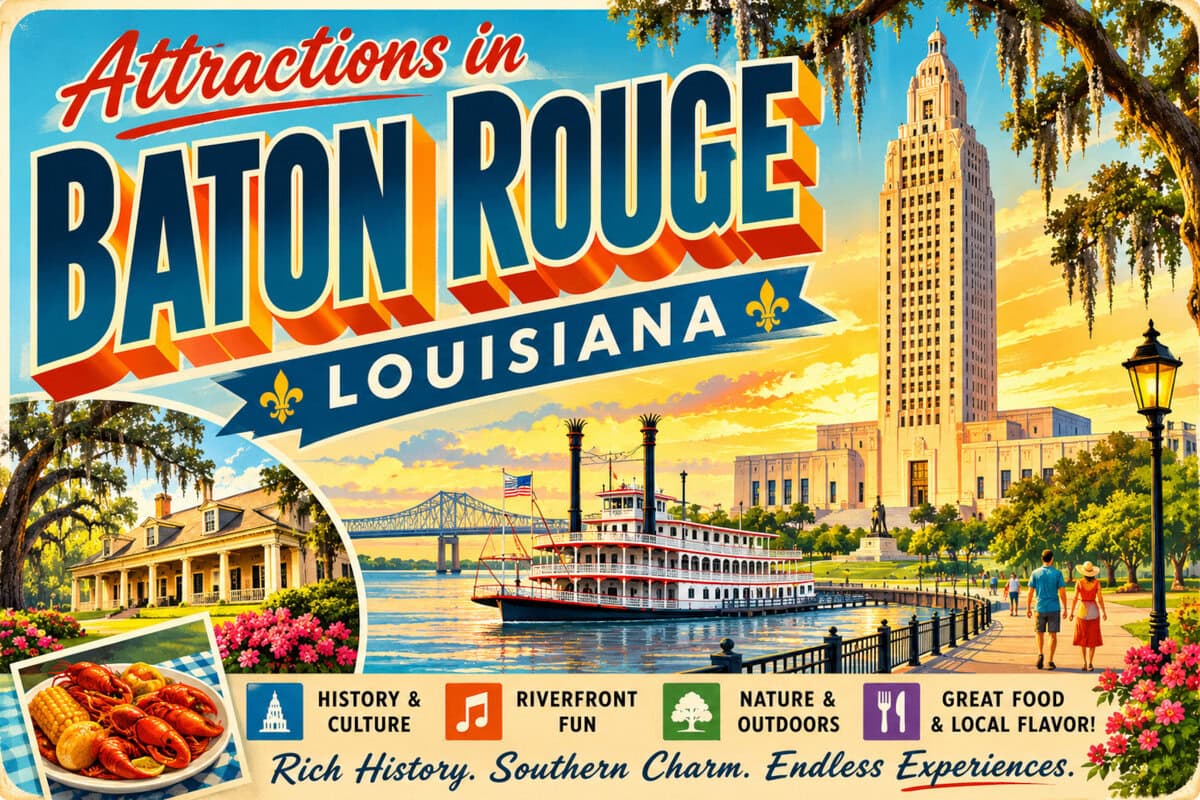
1. Louisiana State Capitol
The Louisiana State Capitol is the best place to start if you want one sight that immediately explains Baton Rouge's role as the state capital.
The 1930s Art Deco tower is the tallest state capitol in the United States, and its grounds sit at the north end of downtown near Capitol Park Museum.
The building remains open to visitors during its renovation, and admission is free.
The main limitation is the observation deck: it is closed for renovation, with state tourism guidance indicating the closure is expected to continue until late 2027.
That removes the skyline view that older guidebooks often treat as part of the standard visit.
The interior and grounds are still worth seeing.
A short visit works well before Capitol Park Museum because the two attractions are only a few blocks apart.
If your main interest is architecture rather than exhibits, pair the Capitol with the Old State Capitol later in the day and compare two very different visions of Louisiana government.
Good to know: use the east breezeway entrance during renovation; the front steps are closed.
2. Capitol Park Museum
If you want one museum that gives you the broadest introduction to Louisiana, choose Capitol Park Museum.
Its permanent galleries cover politics, industry, music, migration, foodways, slavery, civil rights, energy, agriculture, and the state's regional cultures.
The museum is useful precisely because it puts subjects that are often split across separate attractions into one place.
You can move from Cajun and zydeco traditions to oil production, Mississippi River commerce, and the history of race and citizenship without leaving the building.
This makes Capitol Park Museum a better first choice than a more specialized historic site when your time is limited.
It also gives context for places you may visit later, including the Rural Life Museum and Magnolia Mound.
The museum is open Tuesday through Saturday, so do not build a Sunday or Monday itinerary around it.
Budget about two hours for the permanent exhibits if you want a steady, unhurried visit.
3. Louisiana's Old State Capitol
The Old State Capitol looks nothing like the tower a few blocks north.
Its Gothic Revival exterior, cast-iron staircase, and stained-glass dome make the building itself the main attraction even if you are not deeply interested in politics.
Admission is free, which makes it easy to add to a downtown walking route.
Inside, exhibits cover Louisiana political history and the building's own past.
The location also works well as a transition from the government district to the Mississippi River side of downtown.
Choose the Old State Capitol over the new Capitol if ornate interiors and historic architecture matter more to you than modern state government.
Better yet, see both. The contrast is one of the easiest ways to understand how dramatically Baton Rouge changed between the 19th and 20th centuries.
The museum is closed Sunday and Monday, so weekend visitors should plan it for Saturday.
4. Louisiana Art & Science Museum
The Louisiana Art & Science Museum is one of the best indoor choices when you want a break from political history or from Louisiana heat and rain.
It occupies a historic railroad depot beside the Mississippi River and combines changing art exhibitions, science displays, and the Irene W. Pennington Planetarium.
General admission includes regularly scheduled planetarium shows, so the museum gives families more variety than a single-focus gallery.
This is an easy pairing with the Old State Capitol because both sit near the riverfront.
A museum visit can also fill the middle of the day while saving an outdoor river walk for later.
LASM is closed Monday and Tuesday.
If the planetarium is a priority, check the day's show schedule before arriving because shows begin at set times and late entry is not allowed.
5. USS KIDD Veterans Museum
The USS KIDD is one of Baton Rouge's signature attractions, but a current access detail changes what you can actually see.
The World War II destroyer is currently in Houma for a major drydock overhaul. The downtown Louisiana Veterans Museum remains open.
The museum currently charges a reduced museum-only admission and keeps daily hours.
For now, the visit is museum-only, which is a very different experience from the shipboard tour shown in older photos and travel articles.
The museum's overhaul information expects the vessel to return to Baton Rouge during the spring 2027 high-water cycle.
Until then, think of the stop as a compact military museum rather than a destroyer tour.
If boarding the ship is the main reason you would go, verify its return status before making it a priority.
6. Walk the downtown Mississippi Riverfront
The downtown levee and riverfront give you a free way to connect several attractions while seeing the Mississippi River up close.
Use the riverfront as the walking link between the Old State Capitol, Louisiana Art & Science Museum, and USS KIDD Veterans Museum rather than setting aside a separate half day for it.
It also gives you a better sense of why Baton Rouge developed where it did and how the river still defines the city's geography.
If you prefer to save outdoor walking for later in the day, the riverfront fits naturally after the nearby museums.
If the weather is poor, keep the same downtown plan and spend more time inside LASM or the Old State Capitol instead.
7. LSU campus and Mike the Tiger
Louisiana State University is one of the city's major visitor districts, with live oaks, historic buildings, Tiger Stadium, and the habitat of LSU's live tiger mascot.
Seeing Mike the Tiger is free.
LSU says Mike is usually outside between 8 a.m. and 7 p.m., though his schedule can change for care, maintenance, or other reasons.
The habitat sits near Tiger Stadium and the Pete Maravich Assembly Center.
Sports fans will naturally spend longer here, especially during football season.
Outside game days, the campus works well as a short architectural and cultural stop between downtown and attractions farther south.
Do not treat a stadium visit as guaranteed.
Access inside athletic facilities depends on events and operations, while the campus and tiger habitat are much easier to visit casually.
8. LSU Rural Life Museum and Windrush Gardens
For visitors who want more than a quick museum overview, the LSU Rural Life Museum is one of the strongest history stops in Baton Rouge.
The museum spreads 32 historic buildings across roughly 25 acres and interprets working life in Louisiana and the Lower Mississippi River Valley.
Its buildings and exhibits address plantation agriculture, slavery, rural trades, domestic life, vernacular architecture, and the experiences of working people across different regions of the state.
Give the Rural Life Museum at least two hours, as LSU advises, with extra time for Windrush Gardens.
The grounds are self-guided, so your pace depends on how much detail you want.
Choose the Rural Life Museum over Capitol Park Museum if you prefer historic structures and material culture to conventional galleries.
Choose it over Magnolia Mound if you want a wider survey of rural Louisiana rather than one historic property.
9. Magnolia Mound Museum + Historic Site
Magnolia Mound gives you a narrower, place-based look at early Louisiana life.
The main house and grounds preserve French Creole architectural influences and interpret the site's history as a working sugar plantation.
The deeper reason to visit is the site's interpretation of both the people who owned the property and the people who were enslaved there.
That gives the visit a more specific social-history focus than a decorative-house tour alone.
You can take a guided tour or pay a lower fee to explore the grounds.
A guided visit makes more sense if this is your only historic-house stop because the interpretation gives the buildings context that is easy to miss from the exterior.
Magnolia Mound is near LSU, so it fits better with a campus day than with a north Baton Rouge or Bluebonnet Swamp outing.
10. Bluebonnet Swamp Nature Center
Bluebonnet Swamp is the easiest place in the city to trade museums and government buildings for cypress-tupelo swamp, hardwood forest, wildlife, and short trails.
The 103-acre property has more than a mile of gravel paths and boardwalks plus an indoor nature center.
It is especially good for birders, families who want a manageable outdoor stop, and visitors who do not have time for a longer swamp excursion outside Baton Rouge.
Admission is only a few dollars for adults, making it one of the least expensive paid attractions in the area.
One accessibility detail is worth checking before you go: BREC currently says most wheelchairs and strollers cannot use the nature trails because of steep boardwalk inclines and uneven gravel.
The boardwalk from the parking lot to the nature center and the indoor exhibits are accessible.
11. Knock Knock Children's Museum
For families with younger children, Knock Knock is a better use of several hours than asking kids to endure one more history museum.
The museum has 18 hands-on learning zones built around play, making it a reliable indoor choice for hot, wet, or low-energy afternoons.
It sits in City-Brooks Community Park, about a mile from LSU, so it pairs naturally with a short campus visit.
General admission is currently $15 for visitors age 2 and older, while children under 2 enter free.
Adults may enter only when accompanied by a child, so this is specifically a children's museum rather than an all-ages science museum like LASM.
If your children are old enough to prefer animals, trails, or planetarium shows, compare Knock Knock with the zoo, Bluebonnet Swamp, and LASM before committing half a day.
12. BREC's Baton Rouge Zoo
The Baton Rouge Zoo is the farthest major attraction from the downtown cluster, so it deserves its own block of time rather than being tacked onto a museum day.
The zoo now uses a new entrance through Greenwood Community Park in Baker, north of central Baton Rouge.
Official directions describe it as about a 15-minute drive from downtown under normal conditions.
The entrance change is worth noting because old directions may still point visitors toward the former Thomas Road approach.
The zoo is open daily except for several major holidays, and the current adult ticket is $10 plus tax.
Families should allow a few hours rather than trying to combine it with multiple downtown museums.
Choose the zoo when animals are a major interest.
If you mainly want a short nature break, Bluebonnet Swamp is cheaper, closer to many south Baton Rouge stops, and easier to fit into a half-day.
Which Baton Rouge history attraction should you choose?
Baton Rouge has enough history museums that seeing all of them can become repetitive. Pick based on the kind of story you want.
Choose Capitol Park Museum for the broadest overview of Louisiana.
It is the best first stop if you want politics, music, industry, culture, civil rights, and regional identity in one building.
Choose the LSU Rural Life Museum for historic buildings and everyday life.
It takes more time, but the open-air setting lets you see architecture, tools, workplaces, and domestic spaces rather than only objects in cases.
Choose Magnolia Mound for one historic property and a more focused look at French Creole architecture, plantation life, and the people connected to the site.
Choose the Old State Capitol when the building itself is the draw. It is free, compact, and easy to combine with other downtown sights.
If you have a full weekend and history is your main interest, these places complement one another.
If you have only a day, Capitol Park Museum plus the Old State Capitol gives you the most range with the least driving.
How to group Baton Rouge attractions
One day: downtown plus LSU
Start at the Louisiana State Capitol and walk to Capitol Park Museum.
After lunch, head toward the Old State Capitol and the riverfront. Choose LASM or the USS KIDD Veterans Museum for one more indoor stop.
Drive to LSU late in the day for the campus, Tiger Stadium exterior, and Mike the Tiger habitat.
This plan works because most of the morning and afternoon sights are in one compact downtown area, with only one major drive at the end.
Two days: add one deeper south Baton Rouge stop
Use the first day for downtown and LSU.
On day two, choose the LSU Rural Life Museum if history is your priority, or Bluebonnet Swamp if you want nature.
Families with young children can substitute Knock Knock Children's Museum.
Add Magnolia Mound if you still want another historic stop and do not mind a museum-heavy day.
Family day
Pick either the Baton Rouge Zoo or Knock Knock as the main stop. Add Mike the Tiger if you are near LSU.
LASM is the strongest indoor backup because its planetarium and mixed art-science format give children something different from a conventional history museum.
A practical note on getting around
Downtown Baton Rouge is the easiest part of the city to explore on foot.
The State Capitol, Capitol Park Museum, Old State Capitol, riverfront, LASM, and USS KIDD Veterans Museum all sit within the central area.
Outside downtown, a car is much more useful. LSU, the Rural Life Museum, Bluebonnet Swamp, and the zoo form separate driving stops.
If you drive downtown on a weekday, note that city street parking is enforced from 8 a.m. to 6 p.m. and many on-street zones have a two-hour limit.
For a museum-heavy day, a garage can be simpler than moving your car between short street-parking sessions.
Legal street parking is free after enforcement hours and on weekends, but always check posted restrictions.
What is most worth seeing on a first visit?
If you only have time for three attractions, make them the Louisiana State Capitol, Capitol Park Museum, and Louisiana's Old State Capitol.
Together they give you architecture, political history, and a broad introduction to Louisiana without much driving.
With more time, add LSU and Mike the Tiger for a different side of the city, then choose Rural Life Museum or Bluebonnet Swamp depending on whether history or nature matters more to you.
The biggest planning mistake is trying to collect attractions from every part of Baton Rouge in one day.
The city is more rewarding when you finish one area before driving to the next.
Sources and further reading
- Baton Rouge - Explore Louisiana.
- State Capitol - Louisiana Department of Culture, Recreation and Tourism.
- Visit the Old State Capitol - Louisiana's Old State Capitol.
- Capitol Park Museum - Louisiana State Museums.
- Plan Your Visit - Louisiana Art & Science Museum.
- USS KIDD Overhaul - USS KIDD Veterans Museum.
- Hours & Prices - LSU Rural Life Museum.
- Bluebonnet Swamp Nature Center - BREC.
- Admission - Knock Knock Children's Museum.
- Visit the Zoo - BREC's Baton Rouge Zoo.
Independent Publisher Notice
BestAttractions is an independent editorial publisher. We are not affiliated with, endorsed by, or acting on behalf of any location, business, property owner, manager, government agency, or organization described in this article. Comments posted on this page are not forwarded to, reviewed by, or acted upon by any entity mentioned in the article. For official inquiries, complaints, applications, bookings, or other requests, please contact the relevant entity directly through its official website or other verified channels.