Fair Lane - Where Henry Ford Went Home
The driveway at Fair Lane does something unusual. It hides the house from you. Landscape architect Jens Jensen planted the entrance path through dense woodland and curved it just enough that you see nothing but trees until the last moment.
Then the house breaks open in front of you. It is a long gray limestone face sitting above the Rouge River. Henry Ford, the man who ran one of the largest industrial operations in human history, chose to live here.
Not in Detroit, not in some grand lakefront neighborhood. A few miles from the farm where he was born in 1863, back in Dearborn, where he started.
He and his wife, Clara, moved into Fair Lane around 1916 and never really left. Henry died here in April 1947 - during a storm, with the power knocked out - and Clara followed three years later.
They had spent over thirty years in these rooms, walking these lands, listening to the river. The powerhouse made a steady noise down by the water.
About 500 birdhouses were scattered around the property. Clara's rose garden covered two and a half acres.
What they built here tells you something about who they actually were, past the headlines and the history books.
Henry Ford builds his estate near Dearborn
Henry Ford was born in 1863 in Dearborn, just a few miles from where Fair Lane is today.
By 1913, the Model T had already transformed life in the United States. Around the same time, Ford was assembling land along the Rouge River for what would become Fair Lane.
His factories were making 250,000 cars a year and earning more than $30 million in profit. He could have lived anywhere, but chose to return home.
The land he bought was regular Midwest farmland. It had small open fields, patches of untouched forest, and the Rouge River winding across the property on its way to the Detroit River.
As the years went on, Ford kept adding to the property until it totaled more than 2,000 acres. He wanted a house that fit what he had achieved, but that did not draw attention.
Next to the big, showy estates other industrialists built at the time, Fair Lane was designed to be noticeably modest.
The name came from his family history. Ford's adoptive grandfather, Patrick Ahern, came from a place called Fair Lane in County Cork, Ireland. That family connection gave the estate its name before any building began.
Construction began in 1913 and finished in 1915. The Fords moved in by 1916. From then on, Fair Lane was their permanent home.
Ford used it as a quiet place to work on engines, watch birds, and walk through the woods, with the fields where he grew up still in sight.
A Mansion Shaped by Four Architects
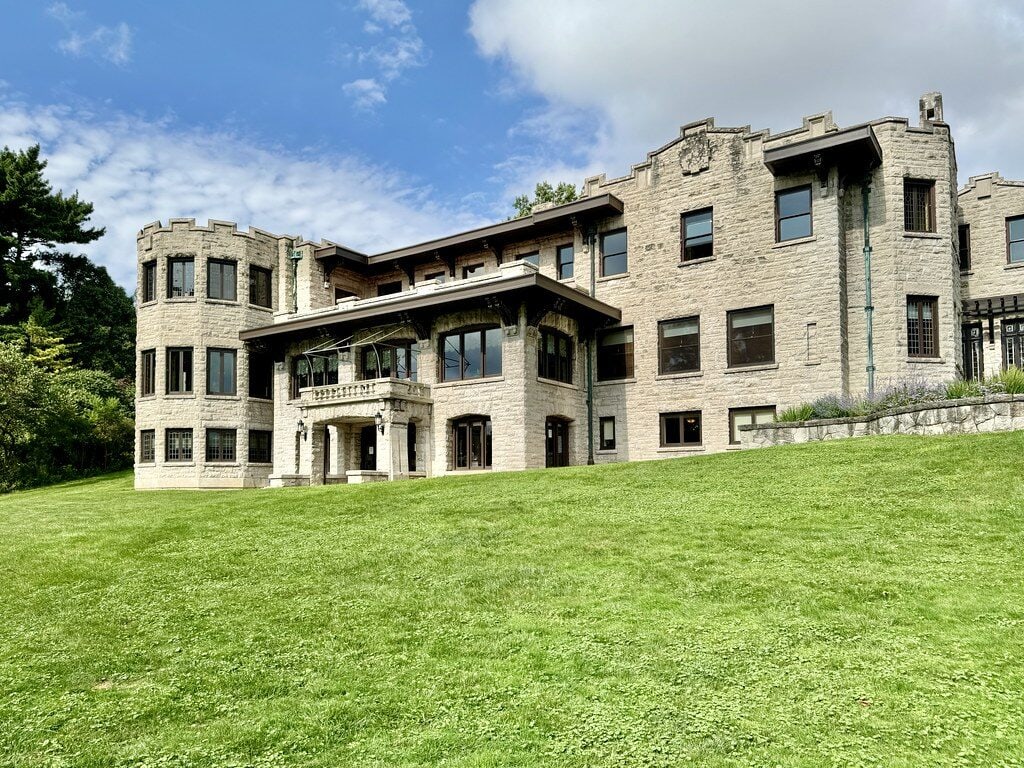
The mansion at Fair Lane was not designed all at once. Four architects worked on it over several years, and the building shows the results of that step-by-step process.
Frank Lloyd Wright is sometimes credited with the earliest Prairie-style plans. His associate Marion Mahony Griffin then revised them.
After the Fords returned from a trip to Europe, they wanted something closer to an English Manor.
William Van Tine was brought in to add those details, and Joseph Nathaniel French was also involved in the project.
The finished house stretches 200 feet long, covers nearly 31,770 square feet, and is built from Indiana limestone with walls up to 24 inches thick on the outside.
It contains 56 rooms, 15 baths, and 8 fireplaces spread across two stories above a lower level.
Inside, the library was paneled in hazel brown oak with a Tudor-style plaster ceiling and once held more than 4,000 books.
The dining room was lined with roseleaf mahogany, with French doors looking out over the gardens and the river.
The music room's marble and walnut fireplace was carved with lines from a Robert Herrick poem. A carved oak Elizabethan staircase rose from the entrance hall to the second floor.
The lower level held a passageway to the power plant, while Ford's personal workshop was in the powerhouse.

The grounds, the river, and Edison's power
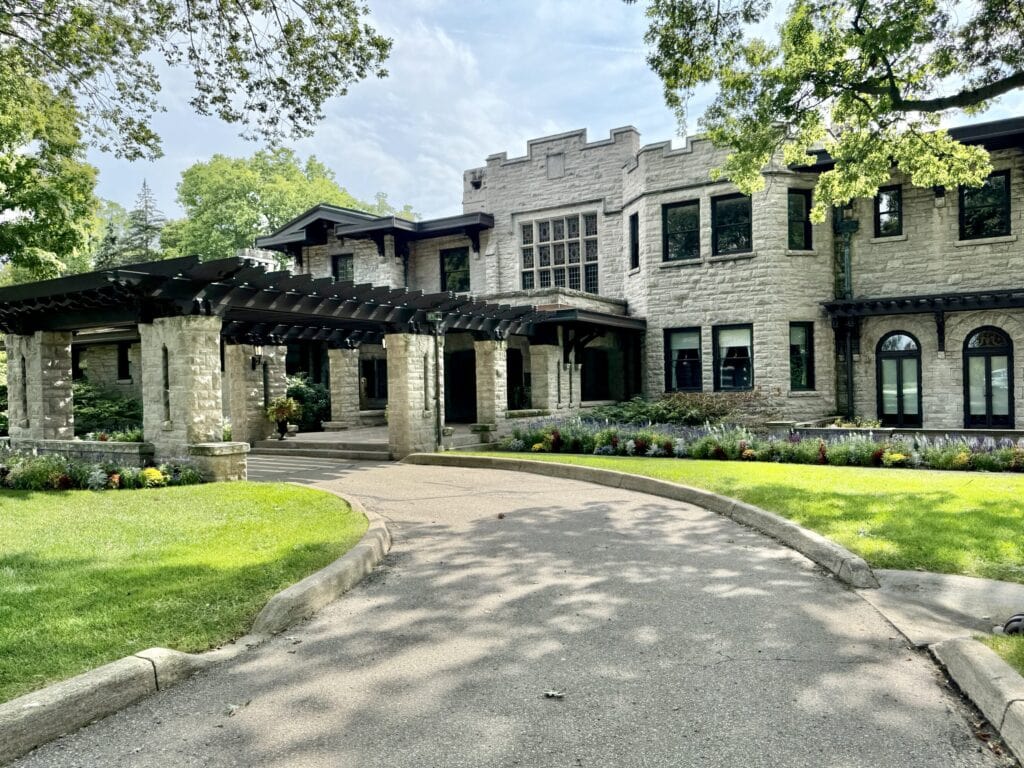
Jensen planned the landscape at Fair Lane using an idea he called a "delayed view." Visitors arrived by driving on a road that wound through dense woods.
The trees blocked wide views until the road reached a point where the woods opened up and the house came into view.
One large meadow, called the "Path of the Setting Sun," was laid out so that the sunset on the summer solstice lines up with a specific opening in the trees.
Jensen also designed the boathouse and its stone cliffs. From there, Ford could travel on the Rouge River in an electric boat.
The powerhouse was built in 1915 from Indiana limestone. It cost $244,000. It was important enough that Thomas Edison laid the cornerstone. Inside were two 55-kilowatt generators powered by water and one steam generator.
They supplied electricity to the estate and to parts of Dearborn. Ford used the top level as a private laboratory for engine work.
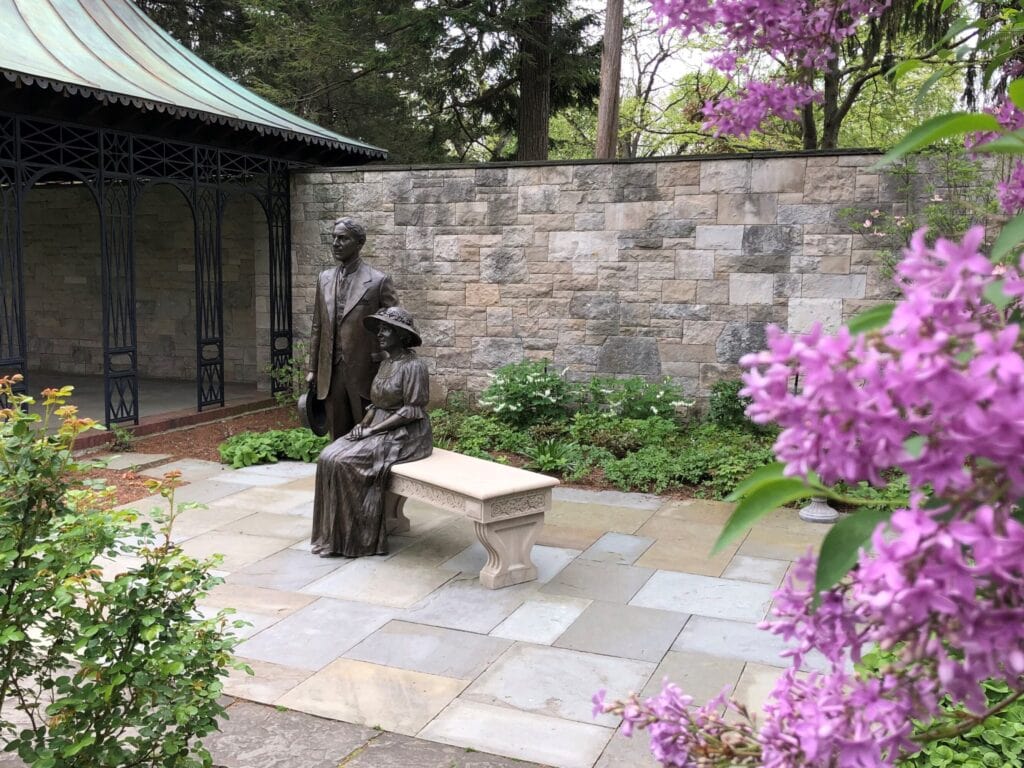
Clara Ford wanted formal gardens, even though Jensen preferred a more natural look.
She ordered a 2.5-acre Rose Garden with space for up to 12,000 rose plants in 350 varieties. The garden included a pergola, a gazebo, and a tea pavilion.
Ford's interest in birds guided the rest of the property. About 500 birdhouses were placed around the grounds, and the planting plan included plants that supported bird habitat through every season.
The estate after the Fords were gone
Henry Ford died at Fair Lane in April 1947, during a storm that cut power to the property. Clara died in 1950.
They had lived there together for more than thirty years. After they were gone, the future of the estate was unclear.
The Ford Motor Company bought the property from the heirs in 1952.
In 1956 and 1957, the company gave the mansion, the powerhouse, 210 acres of land, and $6.5 million to the University of Michigan to help start a new campus in Dearborn.
The gift kept the property from passing into private ownership and put it to educational use.
Fair Lane became a National Historic Landmark on November 13, 1966, and it was also placed on the National Register of Historic Places.
For decades, it operated as a house museum. Visitors toured the rooms where the Fords had lived. That ended in 2010, when the University closed the museum because it could no longer carry the financial burden.
In 2013, care of the estate passed to the non-profit organization Henry Ford Estate, Inc. With support from the Ford family, the new managers began a major restoration program and started planning the work needed to restore Fair Lane.


A Multimillion-Dollar Push to Restore Fair Lane
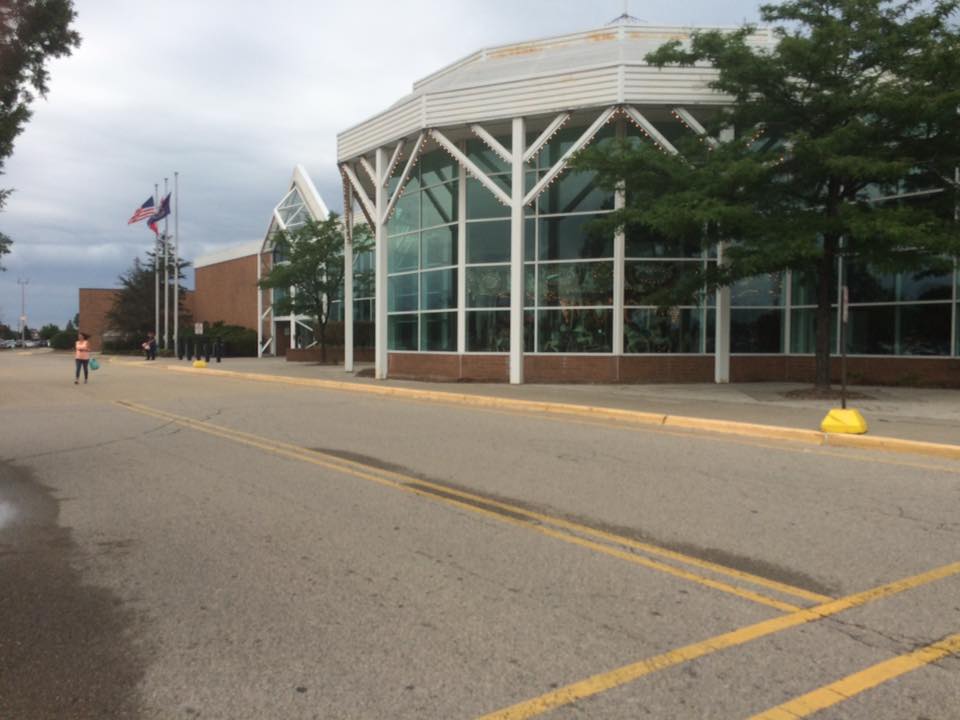
A major restoration is underway at Fair Lane. It is the biggest project at the estate since Henry Ford built it. The main house is closed to visitors while crews work to bring it back to how it looked in 1919.
They are preserving the original woodwork, recreating furnishings from that time using historical records, and fixing roof and foundation issues that developed over decades.
Work is also happening across the grounds. Crews have rebuilt part of the Rouge River bank and restored the porte-cochere, the covered entryway at the main entrance.
They have finished repairs to the courtyards, balconies, and roof terraces. The basic structural work on the powerhouse is complete.
As each section finishes, construction fencing along the pathways is being taken down bit by bit.
Money for the project comes from memberships, public events, and sweepstakes. In 2023, a Restoration Showcase brought visitors to see the progress on the main floor in person.
Sweepstakes prizes have included a 2024 Ford F-150 Raptor R and a 2023 Ford Bronco Raptor, linking the estate to the Ford company founded by the person who built it.
As of early 2026, construction is expected to continue through the summer. A full reopening is planned for early 2027.
Until then, visitors can still access some of the property, including the walking paths and parts of the gardens.
When Fair Lane reopens, it will show much of what Henry and Clara Ford built, including the setting tied to American industrial history.
Fair Lane: Home of Clara and Henry Ford
Historical landmark in Dearborn, Michigan
Address: 1 Fair Ln Dr, Dearborn, MI 48128
Architects: Jens Jensen, William Van Tine, Marion Mahony Griffin, Joseph Nathaniel French, Frank Lloyd Wright
Architectural styles: Prairie School, Scottish baronial architecture
Area: 350 acres
Built: 1913-1915