
Great Northern Mall began as a patchwork of farm deeds
Wilmorite Properties began assembling the Great Northern Mall site in the mid-1970s, buying farmland in Clay, New York, in a series of small transactions. In 1975-76, family farmers sold parcels to Wilmorite.
Walter Farnholtz sold 2.5 acres. Lillian Gaylord sold 5.2 acres. Lois and Helen Bettinger sold 1 acre. In 1977, June Hullin sold 5.6 acres, then sold an additional 20.2 acres in 1985.
The largest and most important acquisition was the Higgs property, which was planned as the center of the mall complex.
After Robert and Diana Higgs' purchase option expired, Wilmorite acquired nearly 60 acres of Higgs family property in December 1984.
Charles Delong Sr. added 31 acres from his family farm on Ver Plank Road, creating what would become the mall's back-door access. From 1975 to 1985, Wilmorite spent $956,000 to assemble 188 acres.
Clay was growing quickly during the same period. The town's population tripled between 1960 and 1980, but many residents still used Liverpool for their mailing address.
Market studies projected that at least 30 percent of customers would come from Oswego County.
Oswego, with about 19,000 residents, and Fulton, with about 13,000 residents, were treated as both a customer base and a competitive pull for local merchants.
When sewer capacity and highway access slowed the project
In May 1986, the Town of Clay imposed a moratorium on new construction after the sewage treatment plant at Wetzel Road became overloaded.
The development could not move forward until the capacity problem was addressed. Upgrades were required at the Wetzel Road plant, and the pump station at Gaskin Road also needed improvements to handle additional demand.
Highway access was adjusted at the same time. A $900,000 off-ramp project at Caughdenoy Road and Maple Road was built to let commuters exit the highway without being directed into mall traffic at Route 31.
The goal was to keep through-traffic from mixing with vehicles heading to the mall site and to reduce congestion on the approach roads.
The sewer work and the off-ramp project added time to the schedule, but they removed major constraints on the project.
With the utility upgrades and the access changes in place, construction planning could proceed on firmer terms.
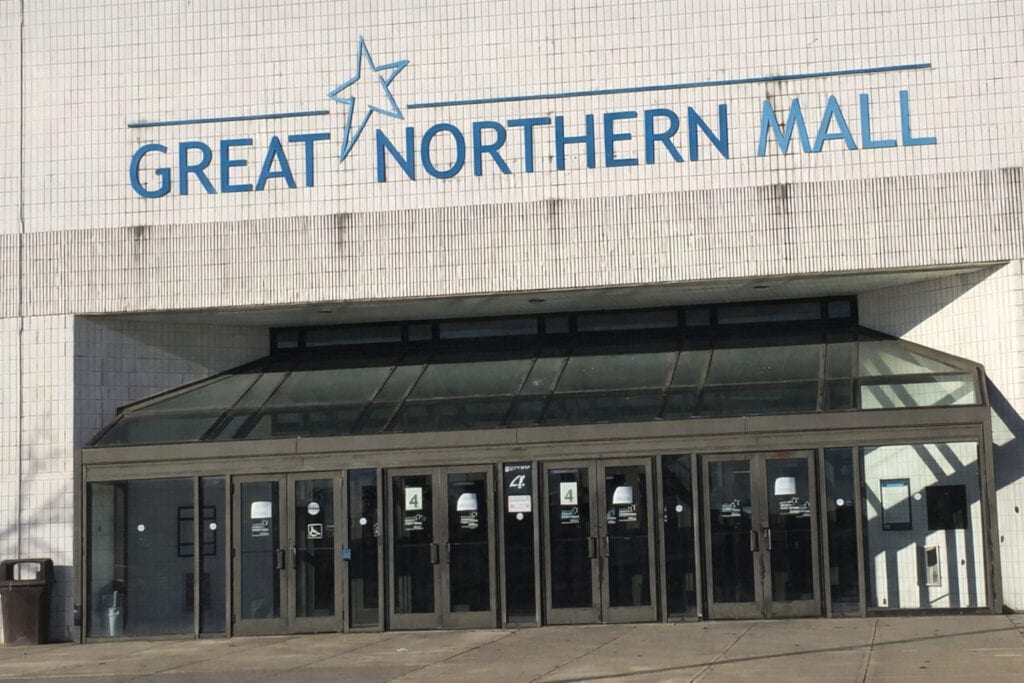
October 1988 opens with crowds and clowns
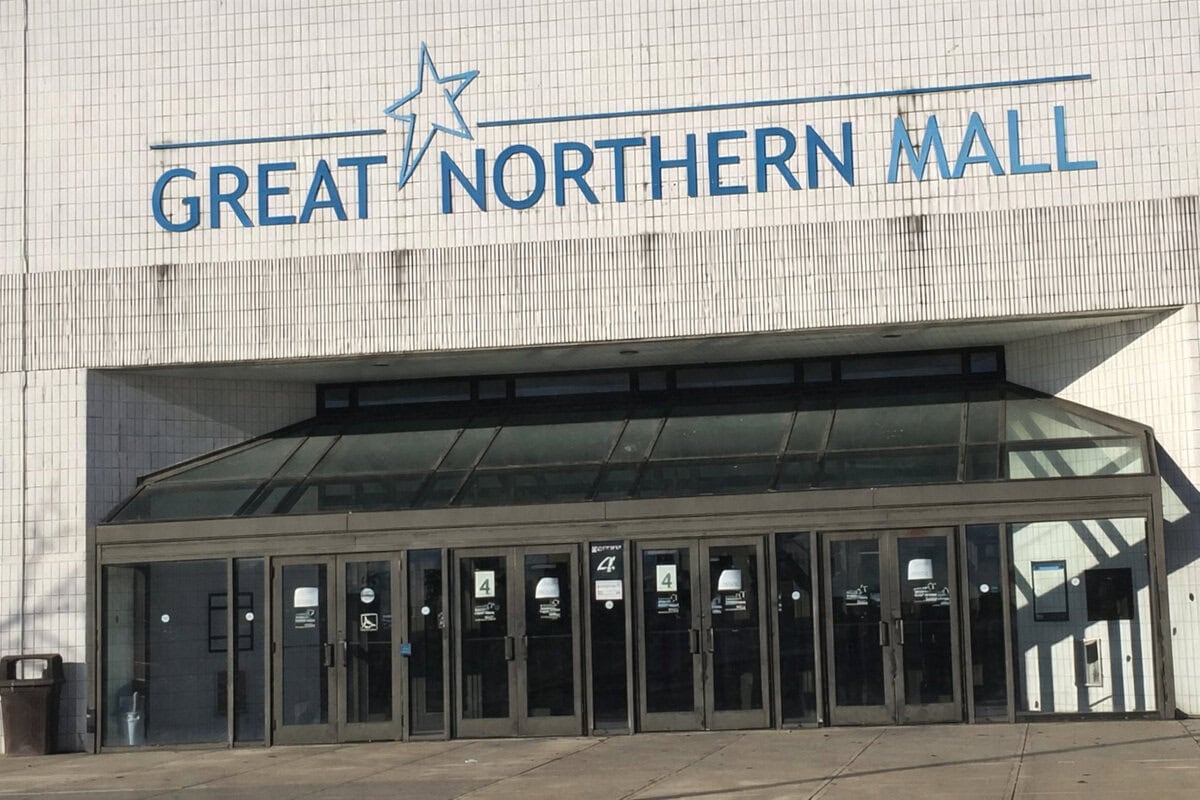
Great Northern Mall opened on October 5, 1988, and the first day drew a crowd large enough to make the new building feel immediately in use.
About 100,000 people came through on opening day. Wilmorite Properties marked the opening with a private party that featured singer Andy Williams.
During the opening week, Scoopy the Clown greeted shoppers as they entered and walked through the interior, which still had the look and smell of a newly finished mall.
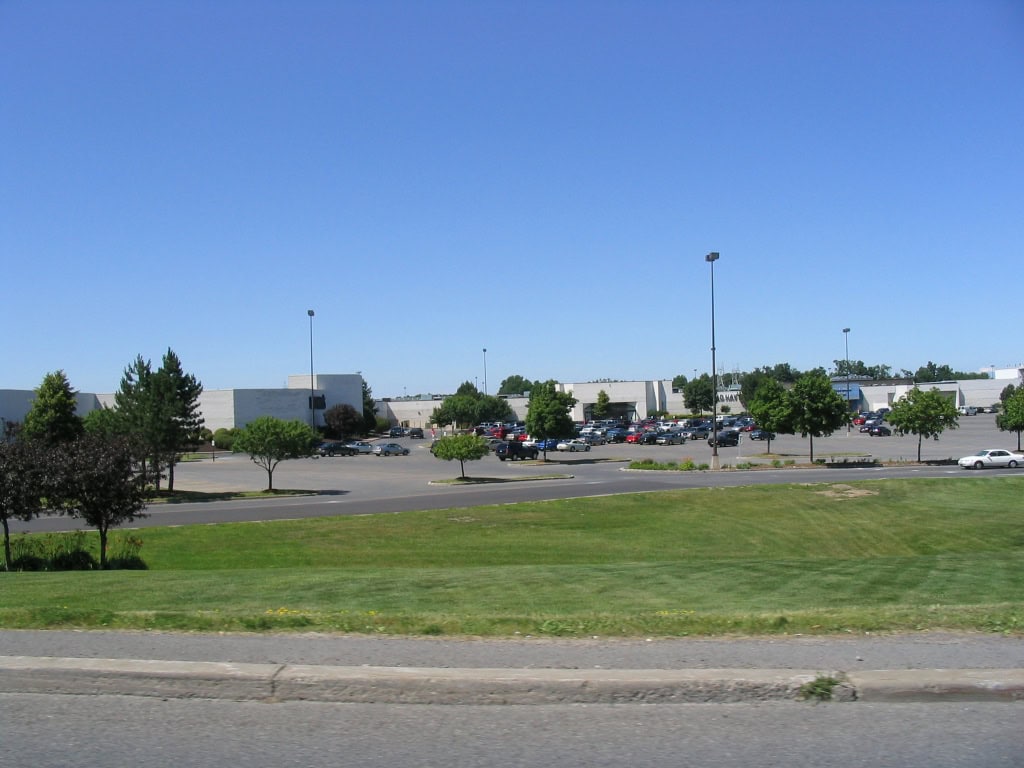
The mall opened at roughly 895,000 square feet at 4155 State Route 31 in Clay, New York.
It sat at the intersection of Routes 31 and 481 in the northern suburbs of Syracuse, with highway access that made it easy to reach from multiple directions.
At opening in October 1988, Great Northern Mall's anchor stores were Sears and Hess's. Sibley's and Addis & Dey Brothers opened the following year (1989), and later rebrandings brought in Chappell's.
Around those large stores, about 90 additional stores and services filled the corridors and common areas.
From the start, the mix of size, anchors, and location positioned Great Northern Mall as a regional shopping destination for the northern suburbs and the broader central New York area.
A food court and a six-screen cinema (later a Regal 10)
Great Northern Mall opened with a six-screen Loews cinema, which was among the mall's first entertainment tenants.
Operated by Loews Theatres, it later expanded to ten screens in the 1990s and eventually came under the Regal Cinemas brand.
The multiplex kept activity on the property into the evening and drew visitors beyond daytime shopping hours.
The mall had a food court, which is frequently mentioned in local recollections of the mall.
The space followed a typical food-court layout, with quick-service counters along the edges and a central seating area spread through the court.
Entertainment and family-oriented tenants filled in the interior mix.
Timeout operated as the mall arcade and included games such as the sit-down moving cockpit version of Afterburner. Friendly's operated as a sit-down restaurant on the property.
Kay-Bee Toys drew families and younger shoppers, and Electronics Boutique served customers focused on video games and electronics.
Through the 1990s and into the early 2000s, the mall's placement helped it function as a routine shopping destination for much of Onondaga County.
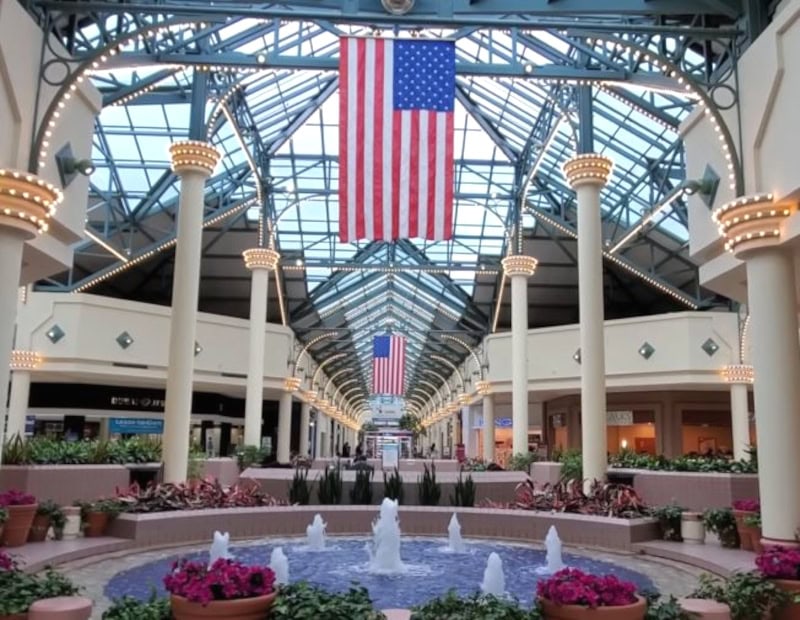
Macerich buys Wilmorite, then walks away
The mall's ownership shifted in the mid-2000s, when Wilmorite became part of a larger national deal.
On December 23, 2004, The Macerich Company announced it would acquire Wilmorite Properties and Wilmorite Holdings for about $2.33 billion.
The package included 11 regional malls and two open-air centers totaling 13.4 million square feet across New York, Connecticut, New Jersey, Virginia, and Kentucky.
Macerich offered $1.13 billion in cash, $320 million in convertible preferred and common units, and assumed about $882 million in debt.
The acquisition was completed in April 2005.
In 2015, the company defaulted on a $34 million payment and abandoned the mall, after indicating in SEC filings dating back to February 2015 that it intended to divest from struggling assets.
Anchors fall: Bon-Ton to Sears to Dick's
Anchor changes began after the mall opened and continued through the next two decades. Dey Brothers closed, and Chappell's opened after 1989 in that space.
In 1994, The Bon-Ton acquired former Chappell's stores, and the space was moved into Bon-Ton's chain.
Sibley's was rebranded to Kaufmann's in 1990. That Kaufmann's store became Macy's in 2006. Dick's Sporting Goods was added in the 2000s.
Closures followed in the years after those shifts. The Bon-Ton closed in 2006. Macy's closed in 2017. Sears, an original anchor from opening day, closed in September 2018.
Dick's Sporting Goods, in space formerly held by Hess's, closed on July 10, 2021, and relocated to another shopping center less than a mile away.
In October 2020, Regal Cinemas was closed as part of Regal's broader closure strategy during the pandemic. Great Northern Mall officially closed on November 20, 2022.
Kohan's era ends with 9 million sale
After Macerich abandoned the mall in 2015, the property moved into lender-controlled management. C-III Asset Management, a Texas-based loan servicer, was appointed to manage the foreclosed site.
Kohan Retail Investment Group, based in Great Neck, New York, later acquired Great Northern Mall as part of its portfolio of struggling malls in small to midsize markets.
Under that ownership, the mall continued to lose tenants and accumulated deferred maintenance, with fewer remaining spaces left to lease as conditions deteriorated.
After the mall closed, the next step was a change in ownership rather than an internal recovery. In July 2023, Kohan sold the property to Hart Lyman Companies for $9 million, the equivalent of about $13 per square foot.
SRS Real Estate Partners brokered the transaction. The sale later received a 2024 CoStar Impact Award in Syracuse for the sale or acquisition of the year.
A $1 billion town center hits the docket
Hart Lyman Companies, based in Syracuse, moved from purchase to redevelopment planning soon after taking control of the former Great Northern Mall property.
In March 2024, Hart Lyman, with Conifer Realty, announced a $1 billion mixed-use redevelopment, described as a plan to "radically redevelop, rename, and redefine" the site into a new town center.
On March 14, 2024, the developers submitted a site application and redevelopment plans to the Town of Clay.
At that point, they said they wanted approvals to move quickly and described a target of starting construction in Q4 2024.
The plan covered a 215-acre redevelopment area bordered by Routes 481 and 31, Morgan Road, and Verplank Road.
The proposal called for more than 600,000 square feet of retail, community, grocery, restaurant, and entertainment space.
It also included over 790,000 square feet of medical and office space. Hotels were part of the plan, with more than 750 rooms across about six hotels.
Housing was organized into several mixed-use clusters described at 300 to 500 units each, totaling about 1,700 apartments and condos.
The redevelopment was tied to expected growth in Clay following Micron Technology's semiconductor plans, including a commitment of up to $100 billion over more than 20 years and up to 9,000 jobs.
Historic Euclid Restaurant, with origins traced to 1817, was planned to be incorporated into the project while preserving its operating heritage.
Town approvals and SUNY Upstate interest
By September 2024, the Town of Clay Town Board had approved the Hart Lyman-Conifer multi-use town center concept, including apartments, hotels, medical hubs, and shops.
Planning board review still remained before the project could reach final approval, so the work continued in stages through the local process.
Healthcare was set up as a central piece of the redevelopment.
After a request for proposals issued in 2023, SUNY Upstate Medical University selected Hart Lyman in July 2024 to develop a multi-clinic site for healthcare services at the former mall property.
The selection matched the broader plan's mix of medical, office, retail, and community uses on the site.
As of July 2025, the contract between Upstate and Hart Lyman was still under review by New York State and had not been formally executed.
Lawsuit, partner breakup, and no ground
In January 2025, an investor who contributed $2.25 million toward the 2023 purchase filed a breach-of-contract lawsuit.
He alleged Hart Lyman overextended itself and disrupted timely payments, demanded about $226,000 in unpaid funds, and sought financial records from several project entities.
The partnership shifted again in July 2025. Hart Lyman and Conifer parted ways, with Conifer deciding to focus on housing and retaining about 11 acres north of Verplank Road near the mall for its own housing projects.
Hart Lyman bought out Conifer's shares and took 100 percent ownership of the mall property, then began reviewing proposals from national companies with "billion-dollar-type financial means."
A July 14, 2025, report described the structure changing, with a major medical center concept tied to SUNY Upstate explored as a potential anchor and a stated goal to break ground in spring 2026, pending approvals.
Environmental review began with earlier expectations that construction could start by the end of 2025.
As of January 2026, no construction has commenced, and the old mall site remains a cleared stage waiting for the first set to arrive.
unless Clay has a large stadium, I doubt that the six hotels that will be built will have much business and the apartment will be so costly that only the financially well to do will be able to rent them. Perhaps they can get a few celebrities into their "entertainment" area but I doubt that it will have the draw to make this plan a viable and profitable one.. I hope I'm wrong .
I appreciate your perspective. It’s definitely a bold plan, and I hope it works out positively. Thanks for sharing your thoughts!
So many high end apts are going up and who can afford them.Micron is not going to help the people that lived here all their lives. You can’t afford a house ,now you can’t even afford an apt
I share your concerns about the affordability of new apartments. It's important for the community to push for a range of housing options to ensure that everyone can benefit from the economic growth. Thanks for your comment!
Another example of smoke being b.own up the community's butt by a lager company with the help of county government. Spring-fed ponds filled and a close-knit small hamlet destroyed and for another pipe dream that didn't work out. Each "next best" shopping center robs tenants from the previous malls, causing them to close while the new best thing is busy until the "new" wears off, which prompts another developer to design another
The part about the ponds and the hamlet matters. People often talk about projects like this as if they start on empty land, but they do not. There was something there before, and your comment makes that clear.