
Wilmington is coastal North Carolina, but living there is not the same as living in a beach town.
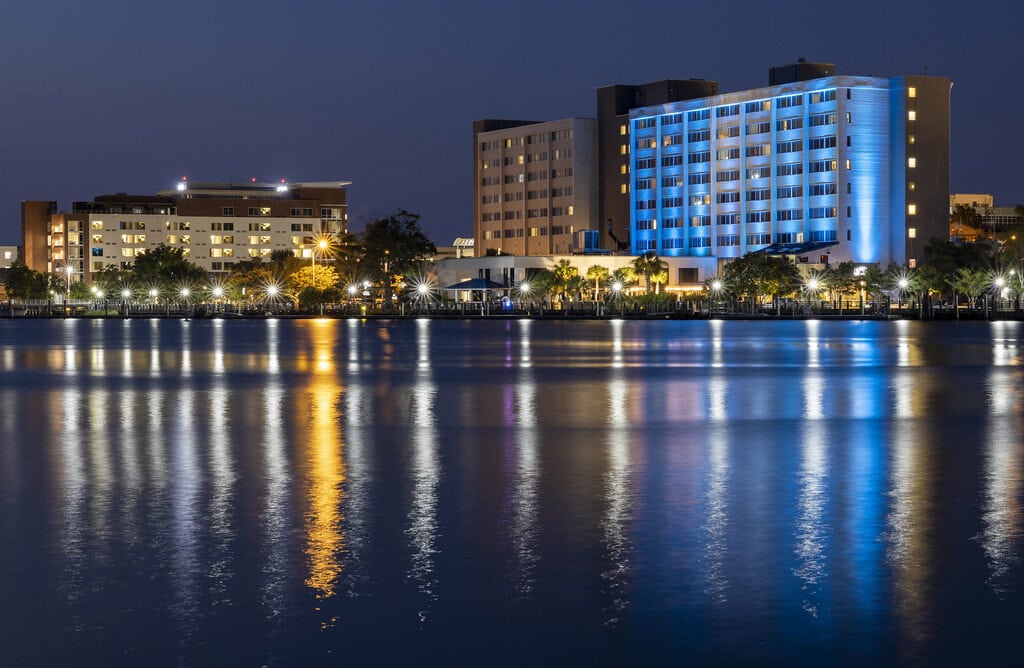
Wilmington is built around the Cape Fear River, with a historic downtown on the riverfront and Atlantic beach communities outside the city itself.
The beach can be part of life several times a week, but for most Wilmington addresses it is still a trip rather than the place outside the front door.
The better moving question is: do you want a functioning city with regular beach access, or do you need the beach to organize everyday life?
Downtown Wilmington gives you a river-city routine
Wilmington has something many coastal relocation markets lack: a genuine historic urban core.
The National Park Service notes that most of downtown Wilmington was listed in the National Register of Historic Places by 1974.
The USS North Carolina sits across the Cape Fear River and was designated a National Historic Landmark in 1986.
Downtown is not simply a tourism strip attached to the ocean.
It is its own riverfront district, with older buildings and a street pattern that can support a more urban routine than much of the surrounding city.
If you live nearby, the river may become the water you see most often.
Dinner, a walk, or an evening out can happen without first driving toward the Atlantic.
Beach access depends heavily on which side of Wilmington you choose
Wilmington covers 51.41 square miles of land. That is large enough for "living in Wilmington" to hide very different beach routines.
An address on the eastern side of the city reduces the first part of a trip toward the ocean.
A downtown or more western address strengthens riverfront and central-city access instead.
A southern routine may point more naturally toward Carolina Beach.
Do not reduce those choices to one citywide "minutes to the beach" claim. Travel time changes with the exact street, destination, traffic, and season.
Test frequency instead. If you expect one beach morning every weekend, many Wilmington addresses can support that lifestyle.
If you expect to surf before work or go back and forth several times a week, the coast-bound side of the city matters much more.
Wilmington gives you beach access. It does not make every neighborhood beach-adjacent.
The housing numbers show what immediate beach location can cost
The citywide Census figures help explain why some buyers accept that separation.
For 2020-2024, the median value of owner-occupied housing units was $383,800 in Wilmington.
In Carolina Beach, an incorporated Atlantic-side town south of Wilmington, the comparable figure was $566,200.
That is a $182,400 difference, with Carolina Beach's median about 48% higher.
These are broad Census estimates, not current listing prices or a matched-home comparison.
They show the scale of the trade that can exist between a larger inland coastal city and direct beach-community living.
Wilmington also has a more mixed housing pattern. Its owner-occupied housing rate was 47.6% in 2020-2024, while median gross rent was $1,395.
That makes the city relevant to renters and buyers in a way that smaller beach communities may not be.
The useful question is what you are buying with the distance from the ocean: a different house, a different neighborhood, lower housing cost, or easier access to work and services.
Wilmington can support a full weekday without leaving town
Beach access gets attention, but Wilmington's strongest practical advantage is that it functions as a regional city.
The Census Bureau recorded about $5.31 billion in retail sales in Wilmington in 2022, about $3.20 billion in health care and social assistance receipts or revenue, and $816 million in accommodation and food-service sales.
Those totals include spending by nonresidents, so they are not a household spending profile. They do show a substantial local service base.
For many households, groceries, healthcare, restaurants, shopping, and ordinary appointments can stay inside Wilmington.
The mean travel time to work was 18.5 minutes for Wilmington workers age 16 and older in 2020-2024.
That is a citywide average, not a promised commute from any neighborhood, but it reinforces Wilmington's role as a place where a local workweek is possible.
The job market is real, but it is not a Raleigh or Charlotte labor market
Wilmington's economy has its own shape.
In May 2025, the Bureau of Labor Statistics reported an average hourly wage of $28.12 across the Wilmington metropolitan area, compared with $33.54 nationally.
Food preparation and serving jobs accounted for 13.8% of metro employment, office and administrative support 10.9%, and sales 10.8%.
Management, computer and mathematical, and healthcare practitioner occupations paid more on average, but those fields make up a smaller share of the market.
That matters for remote workers and specialized professionals.
A household arriving with a remote salary can judge Wilmington mainly on housing and lifestyle.
Someone in a narrow corporate or technology specialty should research the employer base before moving.
Summer makes the coast attractive and the routine more demanding
Wilmington's climate is part of the lifestyle, not just a reason to visit.
National Weather Service 1991-2020 normals put Wilmington's July average maximum at 90.0°F and average minimum at 73.0°F. July normally brings 6.86 inches of precipitation.
July 2026 ran hotter: the average maximum was 92.3°F, and 23 days reached at least 90°F.
That changes when outdoor life feels easiest.
Beach trips, yard work, dog walks, and long downtown walks often make more sense earlier or later in the day during summer.
Rain is also part of the pattern. NWS says Wilmington's 1991-2020 normal annual rainfall exceeds 60 inches, with summer the wettest season.
The practical consequence is that outdoor life here includes heat, humidity, thunderstorms, and weather planning along with the water.
Flood risk belongs in the address check, not the city stereotype
Wilmington's coastal setting also means a buyer should treat flood exposure as property-specific due diligence.
FEMA's Flood Map Service Center is designed for checking the flood-map information tied to a particular location.
A citywide statement that Wilmington "floods" or "doesn't flood" is too crude to be useful.
Two homes a short distance apart can have different mapped flood conditions.
The right question is what FEMA shows for the exact property, what the insurer quotes for that property, and what the inspection reveals about drainage and previous damage.
Storm history explains why this deserves attention.
The National Weather Service's Wilmington climate overview records 23.02 inches of rainfall from Hurricane Florence in September 2018.
That does not predict a future property's outcome, but it explains why coastal-weather preparation belongs in the homeownership decision.
Who is Wilmington actually right for?
Wilmington works best for someone who wants both a real city and regular access to the Atlantic, but does not require those two experiences to occupy the same block.
It is a strong fit for people who value a historic downtown, local services, a modest-size metro job market, and beaches that can fit into weekends or selected weekdays.
It is less convincing for someone whose image of coastal life depends on walking to the ocean every day.
Before choosing a home, build a seven-day map.
Mark work, groceries, healthcare, downtown evenings, and the beach trips you genuinely expect to make.
Then compare two or three addresses on different sides of the city.
If the beach remains easy enough while the rest of your week becomes simpler, Wilmington's trade works.
If you keep wishing the Atlantic were outside your door, you may not be choosing between Wilmington neighborhoods at all.
You may be choosing between city life near the coast and beach life itself.
Sources and further reading
- U.S. Census Bureau QuickFacts: Wilmington city, North Carolina
- U.S. Census Bureau QuickFacts: Carolina Beach town, North Carolina
- U.S. Bureau of Labor Statistics: Occupational Employment and Wages in Wilmington, May 2025
- National Weather Service Wilmington: July 2026 Climate Summary
- National Weather Service Wilmington: 1991-2020 Climate Normals
- National Weather Service Wilmington: Climate Overview
- National Park Service: Wilmington, North Carolina
- FEMA Flood Map Service Center
Independent Publisher Notice
BestAttractions is an independent editorial publisher. We are not affiliated with, endorsed by, or acting on behalf of any location, business, property owner, manager, government agency, or organization described in this article.
Comments posted on this page are not forwarded to, reviewed by, or acted upon by any entity mentioned in the article.
For official inquiries, complaints, applications, bookings, or other requests, please contact the relevant entity directly through its official website or other verified channels.