Tryon Palace begins as a brick promise
New Bern sits where the Neuse River and the Trent River meet, with streets close to the water. In the mid-1760s, North Carolina's colonial government wanted to settle its work in one place after years of holding Assembly meetings in different coastal towns.
William Tryon arrived in North Carolina in 1764 as lieutenant governor. Governor Arthur Dobbs died on March 28, 1765, and Tryon became governor.
He wanted a permanent capitol that could function both as the governor's home and as the day-to-day center of colonial administration. He chose New Bern for its location between Charleston, SC, and Williamsburg, VA.
Tryon brought in English architect John Hawks in 1764. Hawks was born in Shipston-on-Stour, Warwickshire.
He learned building skills early from his father, a joiner, and later trained under English architect Stiff Leadbeater.
In North Carolina, Hawks designed the project and served as the "master builder," handling the plans, lining up suppliers, hiring workers, and supervising the quality of the work.
The Assembly met in New Bern on November 8, 1766. Tryon asked for funding for a "grand building" to serve as the Government House and the governor's residence.
By early December 1766, the Assembly approved 5,000 pounds, borrowed from public school funds, to be repaid through a poll tax and a liquor levy.
Taxes rise as the palace plan locks in
The design took its final shape between late 1766 and early 1767. Drawings from before December 1766 showed a main block about 78 by 34 feet.
It was planned as a three-story building with a Palladian-style entrance and a central window.
A plan dated December 29, 1766, changed that to a main building about 83 by 59 feet, with two 44 by 26-foot wings connected by colonnades.
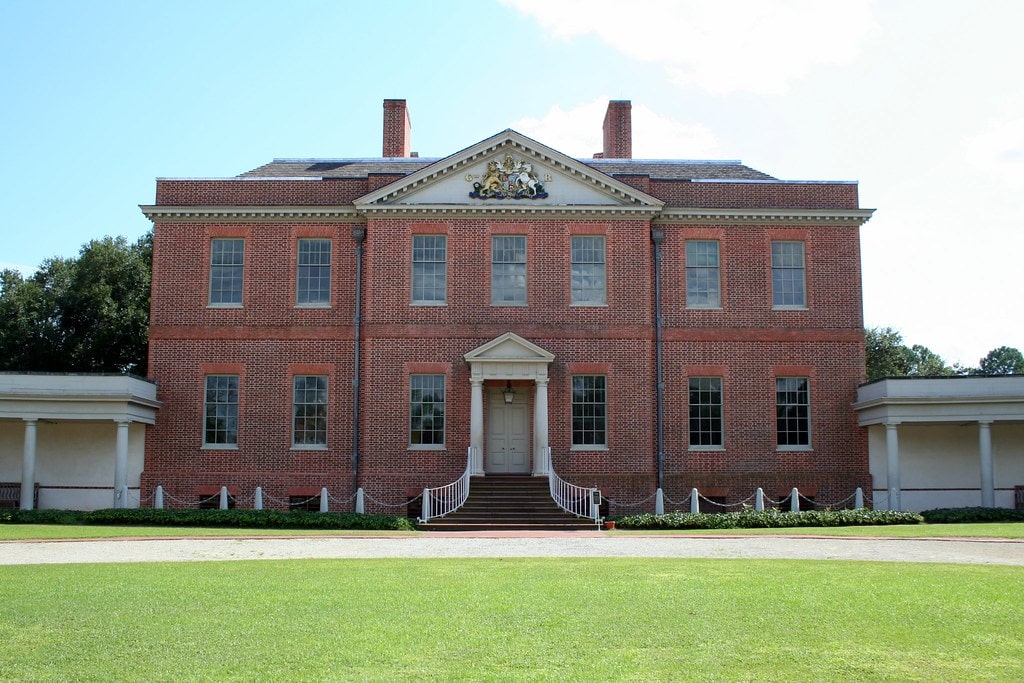
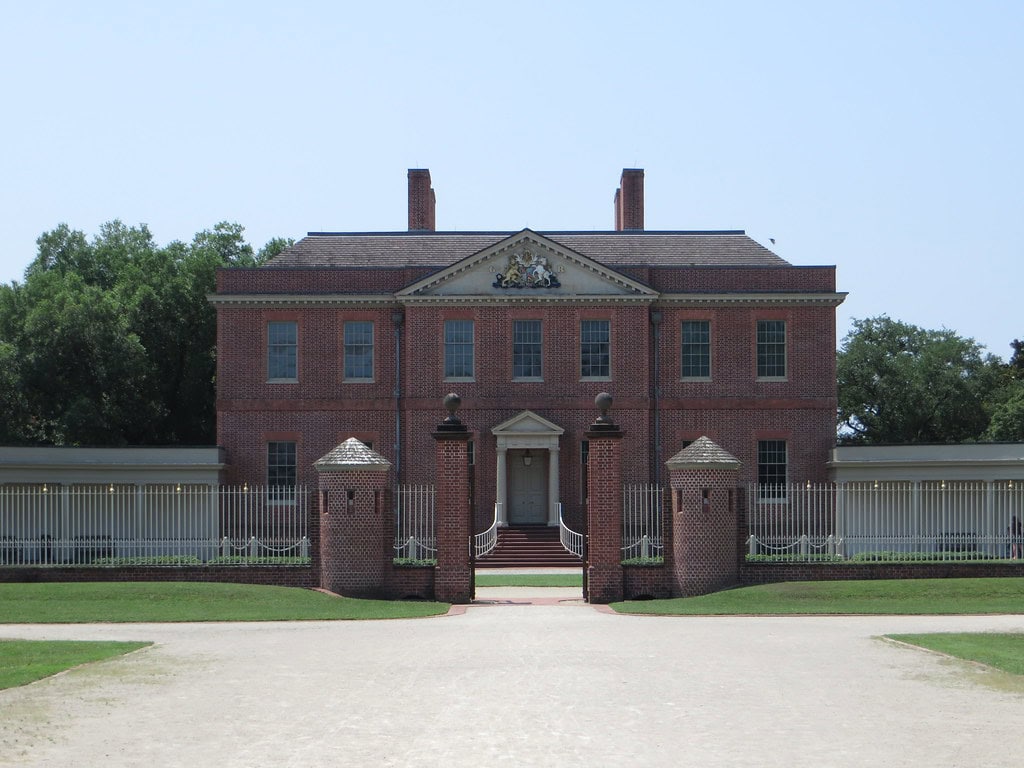
The final plan, dated February 23, 1767, set the main block at about 82 by 59 feet. It was two stories tall, with 49 by 39-foot wings and curved colonnades that formed a forecourt.
Hawks based the design on English country houses and the pattern books of James Gibbs and Abraham Swan.
The two wings had specific uses: the Kitchen Office and the Stable Office. Hawks considered adding a second row of columns and groin arches to the colonnades.
He dropped the idea because it would have tripled the cost and added little practical value.
Tryon and Hawks signed a contract on January 9, 1767. The taxes used to pay for the project angered many backcountry settlers and helped fuel the Regulator Movement.
In 1768, the Assembly approved another 10,000 pounds. The total cost rose past 15,000 pounds.
Bricks, labor, and a storm in New Bern
Construction began on August 26, 1767, when the first brick was laid. Hawks supervised the build and the recruiting. Skilled local labor was limited, so artisans were brought in from Philadelphia.
Tryon sent Hawks to Philadelphia in February 1767 to hire workers, with 2,500 pounds in proclamation money set aside for labor and specialty supplies beyond the brick and timber already under contract.
The palace used local materials for its body and imported finishes.
Window sashes and decorative mantels were ordered from overseas to keep "pure English taste." A metalworker came from England to install a lead plumbing system, including drains and "sesspools" for the complex.
By March 1768, the main building had been raised up to the plates. By January 1769, the main building and wings were roofed with wood shingles.
In September 1769, a hurricane destroyed much of New Bern. The palace, already under roof, survived.
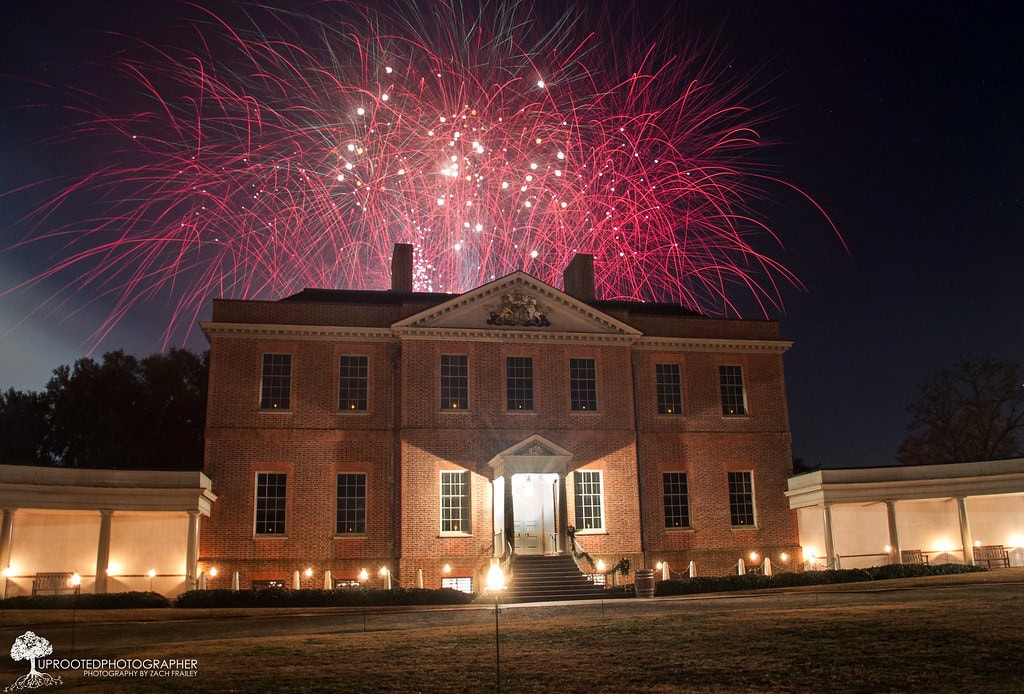
Work finished in 1770. On December 5, 1770, the opening was marked with a grand gala, fireworks, and public festivities.
Royal governors arrive, then power slips away
Tryon, his wife Margaret Wake Tryon, and their daughter Margaret lived in the palace for about thirteen months. Tryon left North Carolina on June 30, 1771, after his appointment to lead New York.
Josiah Martin arrived in New Bern on August 11, 1771, as Tryon's successor. He became the second and last royal governor to live at Tryon Palace.
He furnished it lavishly as tensions rose across the colony, and the palace's high cost remained tied to anger over taxes and unequal political power.
Unrest connected to the Regulator Movement grew into the War of the Regulation and ended at the Battle of Alamance in 1771.
On May 24, 1775, Martin fled as Patriot forces moved in. He went to Cape Fear for refuge and later returned to England.
The Patriot militia took control of the palace in 1775. Martin's furnishings were sold at auction to fund the new state government.
That was the end of royal control over the colony's government house, which had been built to show British rule.
A state capitol until Raleigh takes the job
Under Patriot control, Tryon Palace served as North Carolina's capitol.
Richard Caswell was inaugurated as the first state governor on January 16, 1777, in the Council Chambers. He obtained funds to restore the buildings.
Abner Nash followed and used the palace in 1780 and 1781, when British threats pushed close. Lead from the roof was taken and melted for musket balls. Alexander Martin later served as governor there.
After the 1783 Treaty of Paris, the palace hosted early post-war General Assembly sessions as lawmakers designed the new state's laws and systems.
On April 21, 1791, New Bern held a dinner and dance at the palace honoring President George Washington during his Southern Tour.
Richard Dobbs Spaight took office on December 14, 1792, and became the last governor to reside there. The final legislative session met in July 1794.
The capital moved to Raleigh, where construction of a new North Carolina State House began in 1792.
Fire in 1798 and a long, messy afterlife
After 1794, the palace stopped being used regularly. The state rented it out as a private school, a dancing academy, a boarding house, and the local St. John's Masonic lodge to help cover upkeep costs.
Vandals took anything valuable, and vagrants moved into parts of the property.
On February 27, 1798, hay stored in the cellar caught fire, and the main building burned. The central palace was destroyed.
Only the west wing, the Stable Office, survived. The Kitchen Office was torn down in the early 19th century.
The Stable Office lasted for more than 150 years. It was used as a warehouse, a dwelling, a stable, a school, a chapel, and, by 1931, an apartment building.
As New Bern grew, George Street was built over the palace foundations to connect to a bridge over the Trent River.
Houses and businesses soon filled the old palace grounds. The palace lived on in local memory, mostly through the surviving wing and local stories.
From rediscovered drawings to reconstruction
Interest in restoring the palace grew in the 1920s, including work by the Daughters of the American Revolution. The Great Depression slowed the effort.
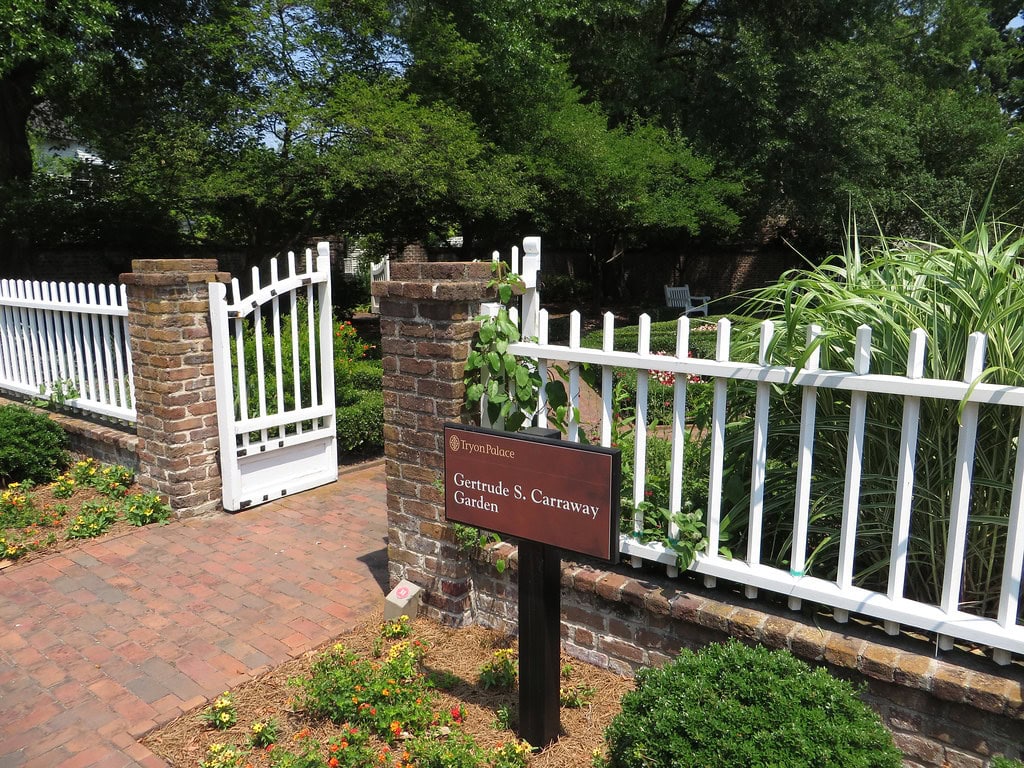
In the 1930s, volunteers, including Gertrude Carraway and architectural historian Fiske Kimball, found John Hawks' original drawings in the New-York Historical Society and the British Public Record Office in London.
Governor Clyde Hoey approved excavations in 1939.
In January 1944, New Bern native Maude Moore Latham moved the project ahead by starting a trust fund with an initial gift of $100,000.
The legislature created the Tryon Palace Commission in 1945. It had 25 members appointed by the governor, and the state agreed to maintain the site over time.
Latham chaired the commission until she died in 1951. She provided $250,000 in trust funds, $125,000 in antiques, and a bequest of about $1.12 million.
Her daughter, Mae Gordon Kellenberger, and her son-in-law, John A. Kellenberger, carried the work forward.
The site was bought for $227,000. Crews removed 54 buildings, rerouted U.S. Highway 70, and built a new bridge over the Trent River.
Archaeological work under George Street uncovered the original foundations and artifacts, including marble, brass, molding, and glass.
1959 reopening and the restored gardens
Excavations confirmed the original basement layout, supporting piers, and remnant bricks. Later, stucco was removed from the Stable Office to reveal older brickwork.
Architect William G. Perry, from the firm that restored Colonial Williamsburg, was appointed in 1951. Craftspeople from the United States and abroad rebuilt the palace through the 1950s using Hawks' plans.
Tryon's detailed inventory, made after his New York home was later burned, guided the search for matching English furnishings.
The overall reconstruction cost reached $3.5 million. Tryon Palace reopened on April 8, 1959, as North Carolina's first major public history project.
The rebuilt site operated as a house museum with period guides. The cellar was reinterpreted using Hawks' letters.
The complex included the restored Stable Office and a reconstructed Kitchen Office. A 1769 map by Claude Sauthier showed that the gardens had straight, geometric designs.
In 1991, a separate 1783 plan was found in Venezuela that Hawks had given to traveler Francisco de Miranda, showing French-style parterres, paths, and lawns toward the Trent River.
During the 1955 to 1961 reconstruction period, landscape architect Morley Jeffers Williams designed the restored 16-acre gardens, presenting three centuries of styles and hosting events like weddings.
Houses and schools around the palace grounds
Tryon Palace is owned by the state and managed by the North Carolina Department of Natural and Cultural Resources, with support from the Tryon Palace Foundation.
The John Wright Stanly House, built in the 1780s for merchant and privateer John Wright Stanly, was built from hand-hewn longleaf pine and laid out with a center-hall plan and a two-story stairwell.
George Washington stayed there in 1791 and praised the "exceeding good lodgings." In 1802, John Stanly Jr. killed Governor Richard Dobbs Spaight in a duel behind St. John's Masonic lodge, leading to the first gubernatorial pardon in the state.
During the Civil War, it served as Union General Ambrose Burnside's first headquarters and later as a convent for the Sisters of Mercy.
Other site buildings include the George W. Dixon House (1830s), which later served as a hospital for the 9th Vermont Infantry.
They also include the Robert Hay House (about 1804), restored in the 1990s using an 1843 inventory and hand-made reproductions, with double piazzas to catch breezes from the Trent River.
Another is the Jones House (about 1809), a Civil War jail that held Confederate spy Emeline Pigott, who hid messages and supplies in her large skirts, and is now used as office space for the costume shop and education staff.
The New Bern Academy was incorporated in 1766, making it the first incorporated school in North Carolina. Its Federal-style building replaced an earlier academy building that burned.
The present New Bern Academy building was completed in 1810. It later served as a Union hospital and remained a public school until 1971.
History Center, exhibits, and winter events
In October 2010, the 60,000-square-foot North Carolina History Center opened on a remediated Superfund site.
It includes the Pepsi Family Center, Regional History Museum, classrooms, a 200-seat performing arts hall, a waterfront cafe, and green features such as LEED Certification, permeable parking, restored wetlands, and riparian gardens.
The Pepsi Family Center's "time machine" puts visitors in 1835 for Snapdragon sailing, turpentine distilling, and a quilting bee.
Exhibits cover five centuries, including Pepsi-Cola's creation by Caleb Bradham, and the Guion Gallery's "Treasures from the Attic" from Maude Moore Latham.
The Z. Smith Reynolds-funded "Inclusive Public Art Initiative" highlights Black craftsmen in New Bern's 1770 to 1830 "Golden Age": Donum Montford (plasterer and brick mason, emancipated in 1804, apprenticed and freed others), Amelia Green (weaver who bought her daughters' freedom), and John Carruthers Stanly (businessman and barber, major landowner and large slaveholder in Craven County).
The site keeps the tradition of Jonkonnu alive with annual performances and workshops. It celebrated its 250th anniversary in 2020 and, as of 2026, is still one of North Carolina's most popular historic sites.
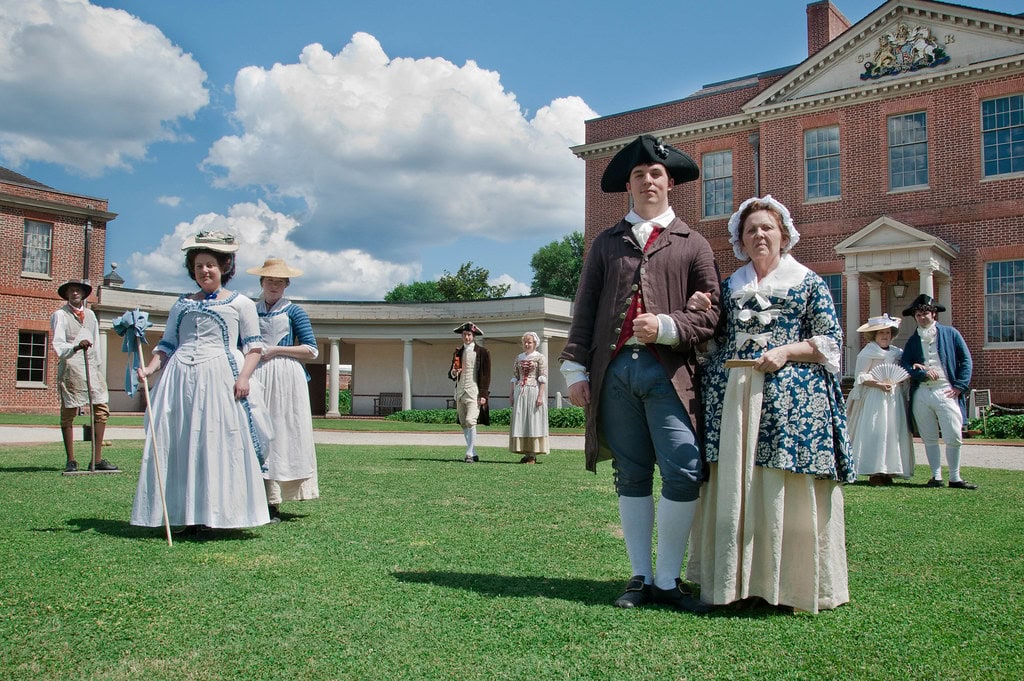
Each December, the 'Candlelight' celebration takes place on select Saturdays, featuring timed tours, period decorations, costumed interpreters, entertainment, food trucks, drinks at Mistletoe Corner, and a black powder fireworks show behind the palace.