
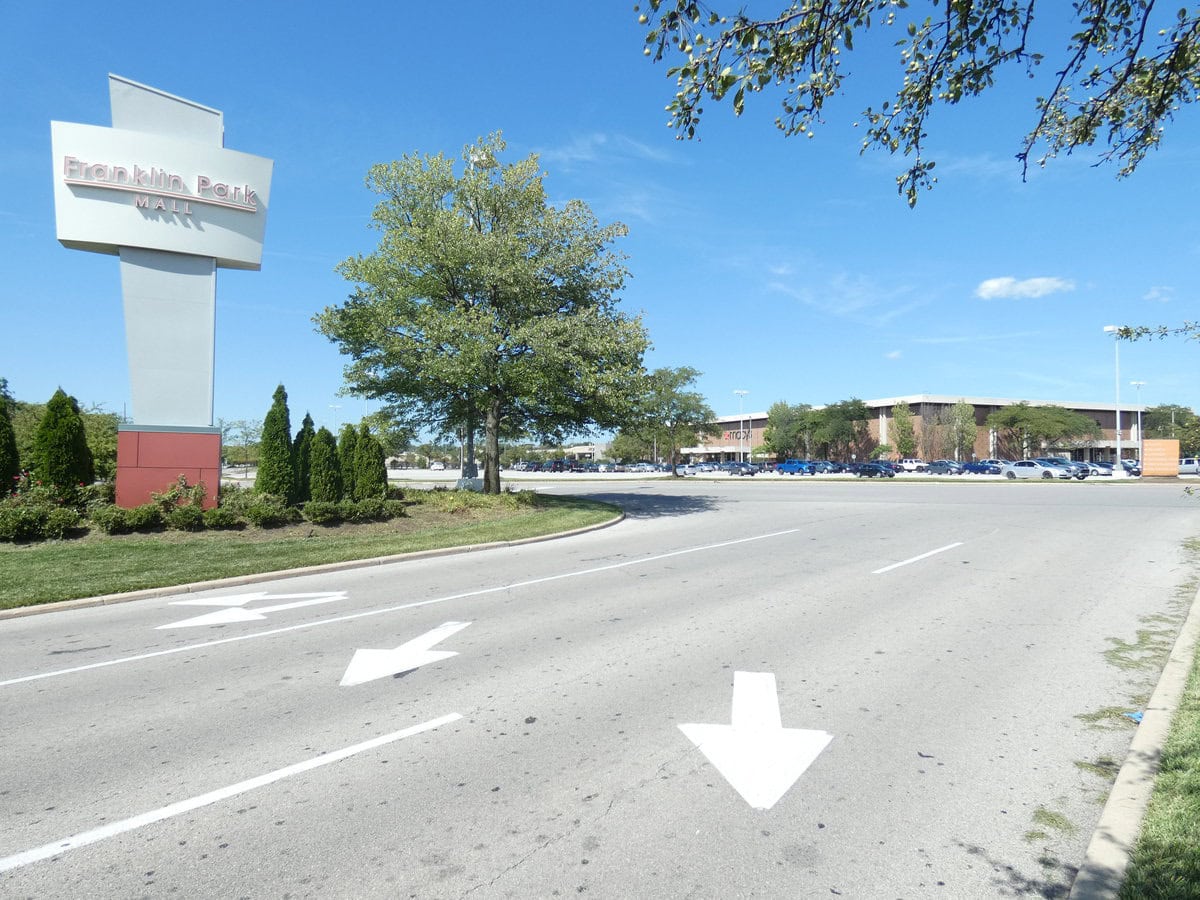
Franklin Park Mall rises from runway grass
Franklin Park Mall sits on Monroe Street about 7 miles northwest of Toledo. Before that, the site operated as Franklin Airport. The private airfield opened in 1939 and used grass landing strips for small aircraft.
The field carried local aviation through the 1940s and early 1950s. In 1952, the airport's closure was announced and operations moved to National Airport on Telegraph Road, putting the land up for redevelopment.
What followed was a long planning period. For roughly two decades, proposals were discussed without construction moving forward on the site.
The tract covered about 66 acres and remained undeveloped while suburban commercial patterns in the area shifted toward large retail projects built around surface parking and automobile access.
When the mall was eventually developed, the property’s function changed from aviation to retail. The site was built out as an enclosed, climate-controlled shopping center designed for extended indoor visits.
A $5 million dream, then a long pause
On August 27, 1952, Irving C. Reynolds - president of the Franklin Ice Cream Company and owner of the property - announced plans for a $5 million regional shopping center.
He described it as "something of a super-shopping center." The proposal was an open-air strip center. It was planned at 300,000 square feet, with space for 35 to 45 businesses.
Reynolds also projected 6,000 parking spaces, a total described as exceeding all combined private and public parking spaces in downtown Toledo's central business district.
Reynolds met with area residents near the Washington Township and Sylvania Township boundary around Talmadge Road. The plan did not move forward.
Westgate Village developers carried out a similar concept first, and the Reynolds proposal went dormant as enclosed mall formats became dominant.
In 1963, Edward J. DeBartolo Corporation proposed a $46 million mixed-use project for the site, combining a shopping center with high-rise apartments, an office building, and a motel.
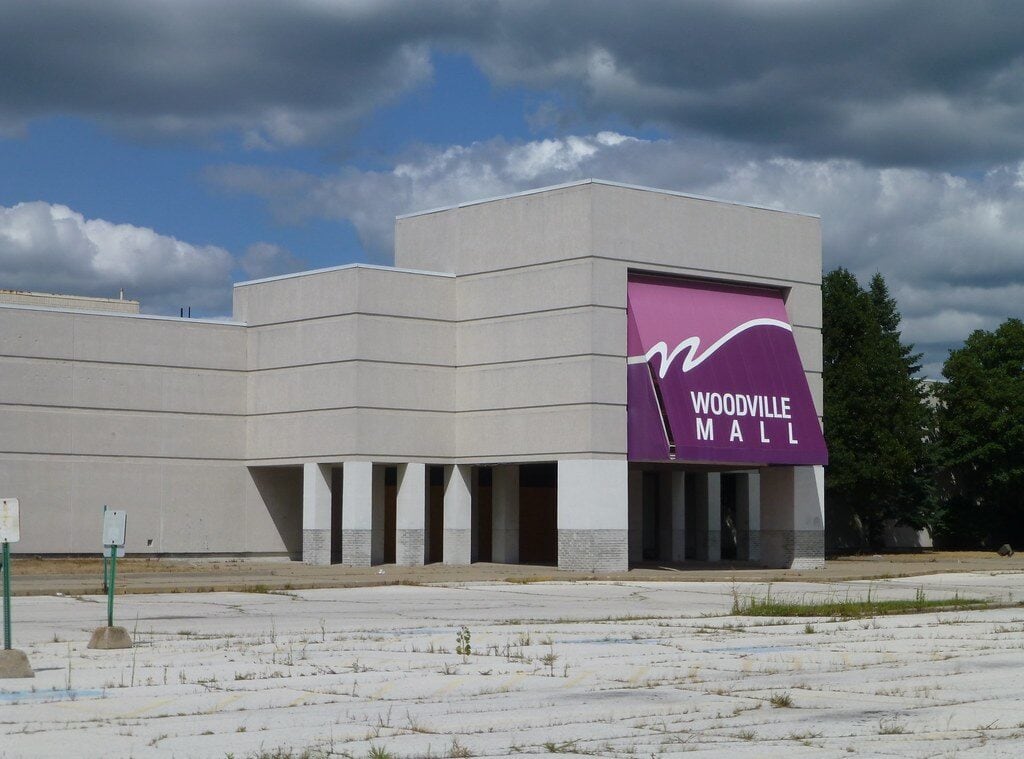
That plan was also not executed. DeBartolo later built Woodville Mall instead, and the property remained in limbo.
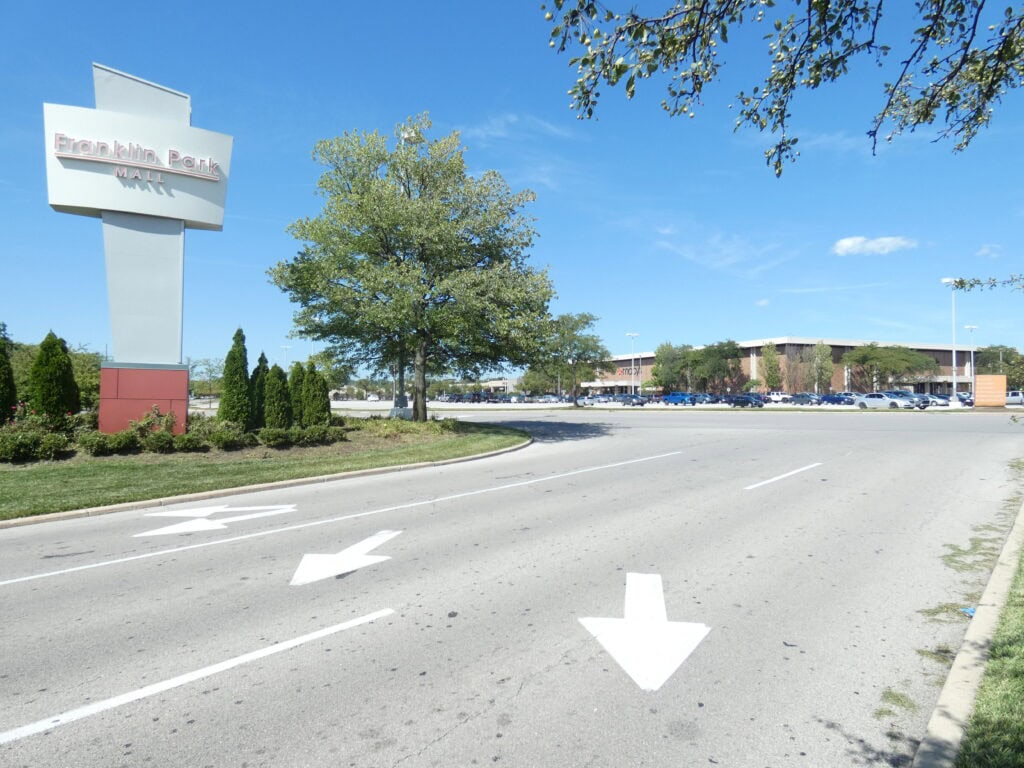
Penney forces the issue in the 1960s
By the mid-1960s, the former airport property had been talked about for years without anything being built. In 1966, the plan finally became real.
J.C. Penney announced a 650,000-square-foot "Franklin Park Shopping Center" and put its name on it as the main store, which turned the site from repeated ideas into a real project, moving forward with design and getting the needed permissions.
The anchor package came together by 1968. Hudson's, the Detroit-based J.L. Hudson Company, committed as a co-anchor. Lamson Brothers, the long-established Toledo department store, signed on as the third anchor.
With three department stores in place, the project fit the super-regional model of the period, with the inline shops designed to fill in the space between the big boxes and lean on their traffic.
Development responsibility went to The Rouse Company of Baltimore.
At that point, Rouse was operating eleven enclosed shopping malls nationwide, and Franklin Park was placed inside that development and management framework.
Rouse getting involved showed that the project was now a large indoor mall, not just a local idea. The three-anchor configuration was described as a $30 million investment.
This was a big increase from the $5 million amount in Irving Reynolds' 1952 proposal and showed how much bigger the planned center had gotten by the late 1960s.
1971 opening day was built like an event
Groundbreaking took place in 1969. Franklin Park Mall opened on July 22, 1971, on 66 acres of land.
The project was developed by The Rouse Company of Baltimore and designed by Daverman & Associates of Grand Rapids, Michigan.
The layout was primarily single-level, with the department store anchors built as two-level buildings.
The mall opened with about 940,000 square feet of leasable space and roughly 75 retailers. The interior was divided into four court areas.
Skylights lined the hallways and let sunlight into the main walkways.
Some of the courts were set lower than the rest of the floor, in front of main entrances, to make clear gathering spots and break up the long hallways.
The opening week was staged. Hudson's and Lamson Brothers opened on July 20, 1971. J.C. Penney opened on July 22.
The mall's debut included formal opening ceremonies attended by representatives of the developer, the city, and the three anchor retailers.
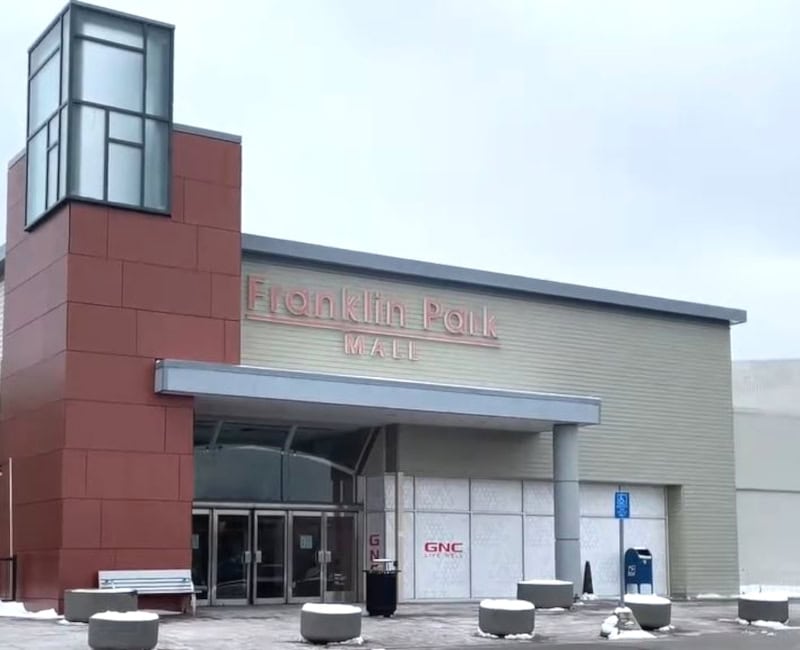
The anchors and the original tenant mix
The mall opened with three department store anchors, and they were built to do most of the heavy lifting. J.C. Penney operated in a two-level building with 294,300 square feet and included a first-floor restaurant.
Hudson's ran 186,000 square feet across two levels and returned the J.L. Hudson Company to the Ohio market after a long absence since its earlier Toledo presence in the late 1800s and early 1900s.
An abstract "stabile" by Alexander Calder was installed at the Hudson's entrance, placed as a public art feature at one of the main interior thresholds.
Lamson Brothers filled a 100,000-square-foot anchor space and brought a Toledo department store name into the original lineup.
Around those three stores, the mall opened with an inline mix that covered food, clothing, and basic services.
Arthur Treacher's Fish & Chips and Farrell's Ice Cream Parlour both opened as the first Ohio locations for their chains.
Gray Drug provided the pharmacy. B. Dalton Bookseller opened as a bookstore.
Apparel tenants included Lane Bryant, The Limited, Lerner Shops, Young Ages, and J. Riggings, giving the early mall a fashion core beyond the department store floors.
Outside the enclosed building, a freestanding Kroger supermarket sat in the north parking area.
The store measured 29,400 square feet and added grocery shopping to the complex, tying the mall to regular weekly trips as well as the larger department store visits.
Lamson collapses, Jacobson takes over
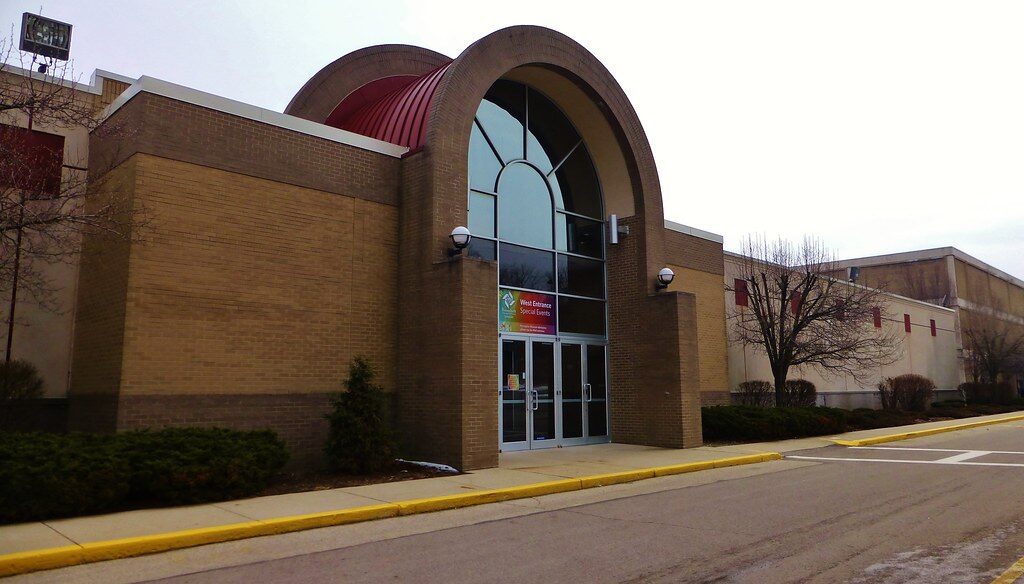
In 1974, Lamson Brothers declared bankruptcy. The closure left the 100,000-square-foot Lamson space removed the Toledo-based department store from the mall's original three-anchor configuration.
A replacement was secured when Jacobson's, a department store chain based in Jackson, Michigan, acquired the former Lamson building and began operating in the space.
The Franklin Park location became Jacobson's 14th store. With the change, the mall retained a third department store anchor and kept the same basic layout and traffic patterns that had been established at opening.
In 1986, the Jacobson's building was expanded. The anchor space increased from its original 100,000 square feet to 120,000 square feet.
Movies, arcades, and surviving rivals nearby
By the late 1970s and through the 1980s, Franklin Park became the region's main indoor destination for northwest Ohio and nearby Michigan communities.
People came for shopping and for the routine of spending time indoors during long winters and wet stretches.
Movie theaters operated close to the mall. National Amusements Cinema 1 & 2 was 1.1 miles southeast and operated beginning December 17, 1964, later expanding to a Cinema 1-3 configuration.
National Amusements Franklin Park Cinemas 4 & 5 opened October 22, 1971, about 0.7 miles northwest.
In 1985, a vacant Kroger in the north parking lot was converted into a theater. AMC Franklin Park Mall 6 opened there on October 4, 1985.
Inside the mall, the Red Baron arcade operated into the 2000s and closed in 2003. Stores and restaurants that fit the period included National Record Mart, RecordTown, York Steakhouse, Hickory Farms, and Olga's Kitchen.
Competing malls opened and later closed. Southwyck Center opened in 1972 and was demolished in 2009.
North Towne Square opened in 1981, was renamed Lakeside Centre in 2003, and closed in 2005. Franklin Park remained open.
The 1990s North Wing changes scale
In the early 1990s, Franklin Park Mall expanded with the construction of a North Wing. The addition was designed by Zeidler Roberts Partnership of Toronto.
Local approval was obtained in September 1991, and construction continued through 1992 and 1993.
The project added 192,100 square feet in a two-level wing.
The expansion was anchored by Lion Store, a Toledo-based department store. The new wing also added 20 inline tenants.
New stores and restaurants included Gap Kids, Bombay Company, Recordtown, Babbage's, Waldenbooks, Cache', and Ruby Tuesday.
The North Wing was dedicated on August 4, 1993. After the expansion, the mall's gross leasable area increased to 1.1 million square feet, and the property counted 125 stores and services.
The project included an overall facelift of existing areas of the mall, carried out alongside the new construction.
Lion Store later changed brands as department store ownership consolidated nationally, but during the 1993 expansion, it functioned as the primary anchor draw for the new wing.
Westfield buys in, then rebuilds everything
In January 2002, Westfield Group acquired Franklin Park Mall through a multi-company deal that included Simon Property Group and the Rouse Company, tied to the division of Rodamco N.V. assets.
Westfield brought a global branding habit with it. In June 2002, the mall became "Westfield Shoppingtown Franklin Park." In June 2005, it was shortened to "Westfield Franklin Park."
Around the same time, the anchor lineup kept changing with the national consolidation wave. Hudson's transitioned into Marshall Field's.
Lion Store had already been rebranded as Dillard's in June 1999 after Dillard's acquired Mercantile Stores in August 1998, turning the Lion location into the last functioning descendant of that chain.
Jacobson's closed in March 2002 after bankruptcy. The building was sold to Dillard's, and a planned "Dillard's For The Home" never opened, leaving the former Jacobson's box vacant.
Westfield's signature move was the massive 2004-2005 renovation and expansion, priced at $113 million, though some reporting later cited $100 million.
The Cardinal Deck parking garage was completed in October 2004. The Orchid Deck followed as the work progressed. The re-dedication came on May 6, 2005, and the mall's old interior was about to look very different.
A new South Wing and a changed Center Court
The 2004-2005 renovation and expansion replaced a major portion of the original mall footprint.
As part of the project, the vacant Lamson Brothers-Jacobson's building from the 1971 era was demolished. A new South Wing was constructed in its place.
The addition measured 238,000 square feet, was built on two levels, and created 27 new store and dining locations.
The South Wing introduced new major tenants. Dick's Sporting Goods opened as a key draw. Borders Books opened in the new wing and later closed when the chain ended national operations in 2011.
Other tenants added with the expansion included Williams-Sonoma, Pottery Barn, Aldo, Perfumania, Charlotte Russe, Mimi Maternity, and Bravo! Cucina Italiana.
Dining and entertainment were reorganized with the new construction. The Terrace Food Court opened as a 12-bay food court and consolidated food service into one primary hub.
National Amusements Franklin Park 16 Cinema De Luxe opened as a 16-screen multiplex on the second level of the South Wing, integrating a large theater into the mall and replacing the nearby freestanding theaters as the primary cinema destination.
The renovation also changed the interior's central feature. In Center Court, the original 35-foot fountain and the suspended "sky cube" were removed and replaced with a pyramid skylight.
Several established tenants were relocated during the renovation, including Victoria's Secret, Select Comfort, Yankee Candle Company, Brookstone, Hollister, and Olga's Kitchen.
After the re-dedication on May 6, 2005, the mall measured about 1.2 million square feet and contained roughly 150 stores and services.
Pads, new owners, and the 2025 gut punch
In 2008, Westfield added a southeastern pad: 49,000 square feet in an outdoor promenade with DSW, Old Navy, and Ulta Beauty, opening November 1, 2008.
In November 2013, Westfield sold the mall to Starwood Retail Partners, and the name reverted to Franklin Park Mall, the old label with the strongest local muscle memory.
In 2016, the southeast pad expanded again for Dave & Buster's Grand Sports Cafe, 32,000 square feet, opening October 31, 2016.
By December 2020, the mall was sold to Pacific Capital Retail Partners, with Golden East Investors assuming management.
The property carried into the mid-2020s with Dillard's, Macy's, JCPenney, Dick's Sporting Goods, and Cinemark Theatres as key anchors, plus a modern tenant list that still drew traffic, including Toledo's only Apple Store, Build-A-Bear Workshop, Sephora, and H&M.
Then 2025 took two big bites. Macy's - the former Marshall Field's, formerly Hudson's - announced its closure in January 2025 and closed in March 2025, leaving the anchor box listed and its future unclear.
Forever 21, which had moved into a larger space in 2011 after Borders vacated, closed March 30, 2025, amid a March 2025 bankruptcy filing.
Smaller beats continued anyway. KixCon took place at the mall on August 17, 2024. Miniso opened at the mall, with a ribbon-cutting held March 22, 2025.
The mall received a Gold MAXI Award tied to an NIL athlete partnership campaign, and Franklin Perk Cafe was a finalist in a visual merchandising category, reported May 19, 2025.
A local food truck, The Saucy Slamwich, opened a permanent food court location on June 30, 2025.
Looking into early 2026, Dollar Tree is scheduled to open, and additional local food trucks have been announced for permanent spots.

The management team is spectacular. The fact that Toledo has an attractive mall when so many other cities have lost theirs is because of their creativity and hard work.
Thank you for this thoughtful comment. It is good to see someone point out the work behind the scenes. People notice stores and crowds, but strong management is often the reason a mall stays active.