
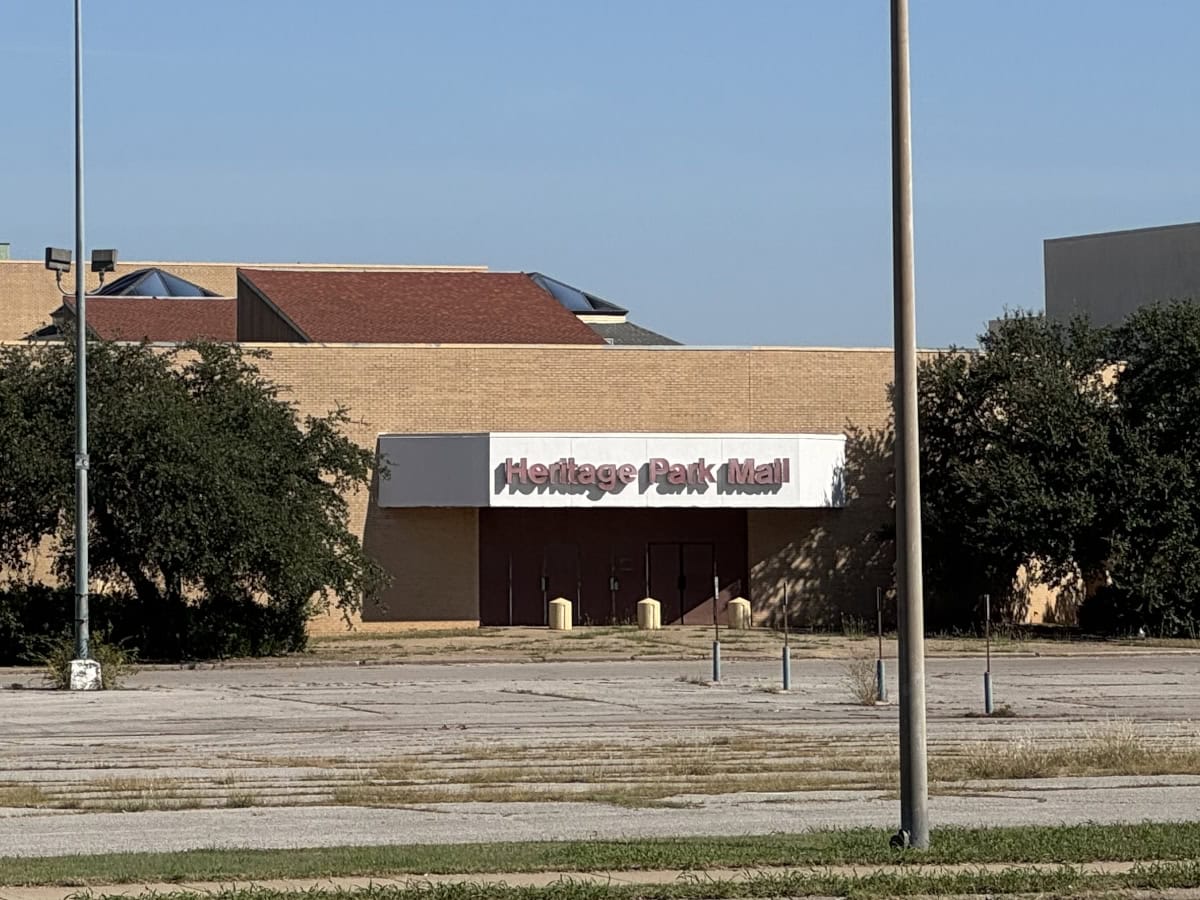
Heritage Park Mall stopped operating as a mall in 2010.
It took Midwest City nearly sixteen years, several redevelopment attempts, and a court order to gain control of what came next.
It opened in 1978 and once generated more than $1 million a year in property taxes; by the 2017 redevelopment study, the mall generated only about $70,000 a year in fiscal impact.
The enclosed space filled with the wrong things: tire storage, oils, old engine parts, bathroom fixtures, appliances, and diagnostic machines.
People kept breaking in for the copper. The glass kept breaking.
In early 2026, a judge cleared the way, the city took possession, and the former owner had until late May to remove whatever he wanted to keep.
The 39 acres at Reno and Air Depot are now waiting to come down.
Heritage Park Mall opened in 1978 with a TV star at the door
In October 1978, Henry Winkler appeared at a new enclosed mall in Midwest City, Oklahoma, while Happy Days was riding near the top of American television.
His visit drew a crowd.
The grand opening of Heritage Park Mall ran across two days, October 8 and 9, with store promotions, ceremonies, and a charity relay tied to Special Olympics fundraising.
What opened that week was a 650,000-square-foot enclosed shopping center, apparently the city's only enclosed mall.
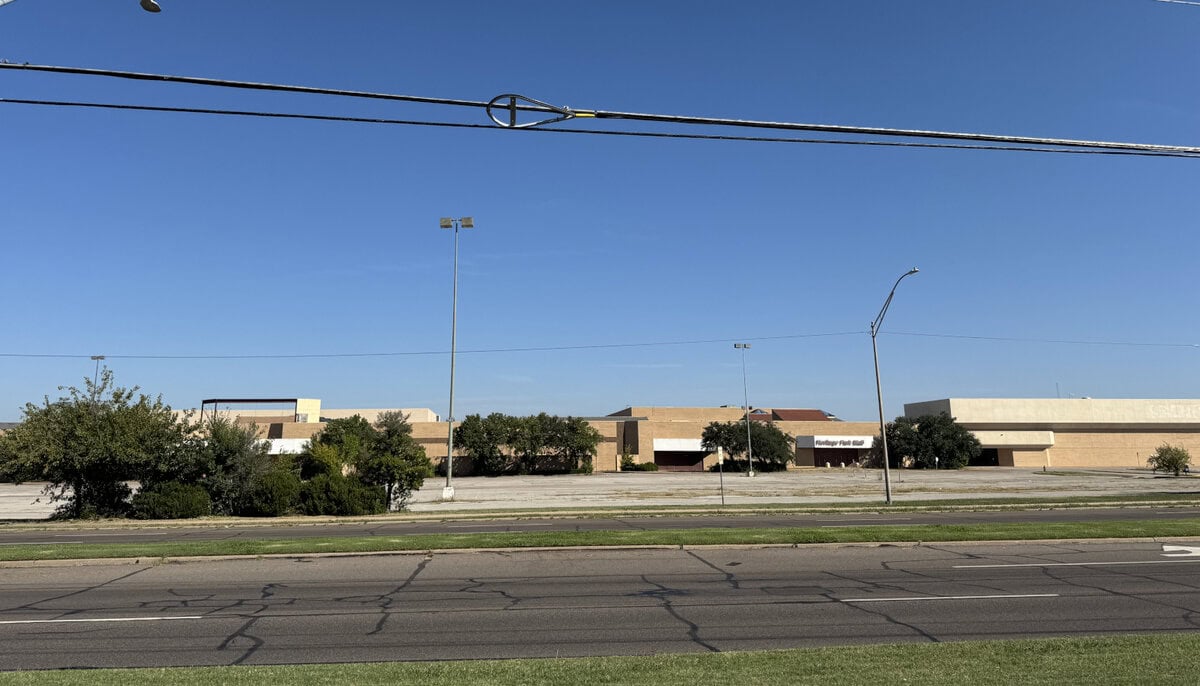
It sat at the northwest corner of East Reno Avenue and North Air Depot Boulevard: a one-story mall with four major anchors and an enclosed concourse.
For eastern Oklahoma County and the families tied to Tinker Air Force Base, it became the place you went without needing a reason.
How Tinker Air Force Base helped build the Midwest City mall
Melvin Simon & Associates, the Indianapolis mall developer that later became Simon Property Group, announced the project in 1976.
The plan was reported as a 750,000-square-foot center.
When the mall opened in 1978, later city and Simon records put it nearer 650,000 square feet, still large enough to serve as a major east-side retail draw.
The location was the point.
Midwest City grew up during World War II alongside what became Tinker Air Force Base, and the base stayed one of the region's largest employers.
A department-store mall at Reno and Air Depot meant many east-county shoppers no longer had to make every department-store trip into Oklahoma City.
It gave that side of the county its own center, built on the familiar 1970s pattern: department-store anchors, smaller national and local shops along the enclosed concourse, and broad surface parking wrapped around the complex.
Simon kept Heritage Park in its regional-mall holdings beyond the late 1990s, selling it as a non-core property in December 2004.
The cinema, the record stores, and a full mall by 1982
The first anchors were Sears, Dillard's, Montgomery Ward, and Wilson's.
Between them, they covered appliances, clothing, jewelry, and general goods.
The smaller stores filled in the rest: Spencer's Gifts, Musicland, Disc Jockey, Hickory Farms, Olga's Kitchen, Jeans West.
The mall opened without a theater and gained one within two years.
Heritage Park Mall Cinema 3 opened on June 13, 1980, in the northwest part of the building, with three auditoriums with 400 seats each, for a total of 1,200 seats.
It passed through several operators over the years, from Oklahoma's Cinema Theatres circuit to Commonwealth, United Artists, and finally Hollywood Theaters, and closed in July 1999.
A second nearby theater, Heritage Plaza 5, opened in a strip center behind the mall in 1986 and closed in 2006, later becoming a church.
By 1982, the mall had reached full occupancy and ranked among the strongest retail centers in the Oklahoma City market.
For a while, it looked permanent.
Newer malls pulled shoppers away from Heritage Park
The competition arrived almost as soon as the mall did.
Quail Springs Mall opened in north Oklahoma City in 1980, Penn Square was upgraded, and Shawnee Mall opened to the east in 1989.
Each gave shoppers and retailers another option.
In 2005, Midwest City Town Center Plaza was built about three miles south and helped pull retail toward the Interstate 40 corridor.
Then the anchors started going.
Service Merchandise left in May 1999 as the catalog-showroom chain restructured, and the mall's three-screen cinema closed that summer.
Montgomery Ward lasted longer, still operating at Heritage Park when the chain announced its national shutdown in December 2000.
Dillard's left by the mid-2000s, and in 2007 its former building was first sold for $900,000.
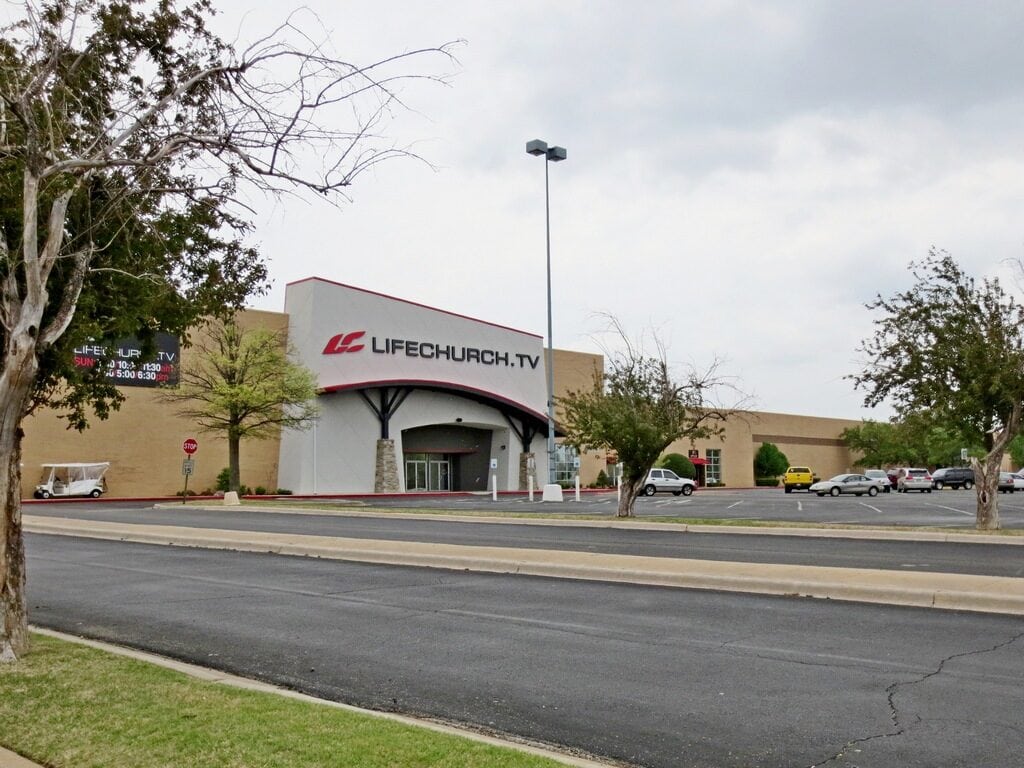
LifeChurch bought it from previous owners that same year for $1.5 million, then renovated the roughly 100,000-square-foot space in 2011 for a church campus and regional distribution center.
An enclosed mall runs on its anchors, and Heritage Park was losing them one at a time.
By 2009, the slide showed up in the numbers.
Oklahoma City's retail vacancy rose to 14.8 percent that year, and Heritage Park Mall and the failing Crossroads Mall together accounted for 31 percent of all the empty retail space in the market.
The 2010 closing and the Sears that would not leave
A private buyer had taken over the declining mall after Simon sold it at the end of 2004.
By January 2010, the owner said rent from the few remaining tenants no longer covered the cost of keeping the building open, and the mall was listed at $3.8 million with no takers.
Heritage Park Mall closed as an enclosed mall on February 15, 2010, and the last inline tenants cleared out.
Sears stayed.
Its store sat on a separately owned corner parcel and ran almost as a standalone store, which let it keep its doors open after the rest of the mall closed.
It held on until 2017, when Sears closed the location during the chain's national contraction.
By then, the property that once generated more than $1 million a year in taxes brought the city roughly $70,000 a year.
A decade of stored parts, code notices, and broken glass
A new owner bought the 232,000-square-foot inline section in 2011 for $1.3 million.
It never reopened as a real shopping center.
Over the next decade, the enclosed space filled with the wrong things: oils, paint, engine parts, appliances, old diagnostic machines, cherry pickers, shower stalls.
City fire and building officials kept finding the same problems.
Inspections and city records flagged active roof leaks, rodents, certificate-of-occupancy problems, and combustible material stacked in spaces built for retail.
By 2020, the city had issued formal citations.
The building had quietly shifted from a mall into an unpermitted warehouse, and nobody had approved the change.
The owner said the city stood in his way, pointing to water-service and certificate-of-occupancy problems he blamed for stalling his work.
The city called the property unsafe and a drag on everything around it.
Copper wiring was stolen or removed, and electrical boxes were damaged.
The glass kept breaking.
The plans that came and went for the old mall
Midwest City started studying what to do with the site in 2016, hiring a Dallas firm to study the options and interview the owners of the mall, the Sears parcel, and the LifeChurch building.
At a community workshop in February 2017, more than 75 residents, business owners, and city staff threw out ideas: a skating rink, a small theater, a specialty grocery, senior housing, food trucks, more restaurants, parks.
One scenario kept LifeChurch and Sears and replaced the dead mall core with junior-anchor spaces, pad sites along Reno, and a fitness use on the north end.
None of it got built.
In 2024, the owner floated his own plan to remake the site with apartments, an aquaponics farm, a biomass plant, and a solar field.
The city reviewed it, found too little detail behind it, and rejected the zoning request.
Midwest City declared the mall blighted and went to court
The city declared the mall area blighted in August 2022.
An urban renewal plan followed, approved by the City Council in April 2023, covering the former mall, the old Sears, the former Montgomery Ward, and a few nearby parcels.
LifeChurch, Pelican's Restaurant, and Becker's Auto Service were left out.
When negotiations failed, the Urban Renewal Authority moved to condemn the property.
The owner had turned down an offer of close to $6 million.
Court-appointed commissioners valued it at $6.7 million, plus $200,000 for moving costs and $12,000 for the commissioners' fees.
The authority placed $6.9 million in escrow and set aside another $2.3 million for hazardous-material removal and possible demolition.
In early 2026, an Oklahoma County district judge ruled that the city had followed urban-renewal law in finding the property blighted.
The authority claimed possession and gave the owner 90 days to take out his personal property.
What comes down, and what stays on the corner
On February 27, 2026, the Urban Renewal Authority voted to demolish the mall and to study whether the parking lot should come down with it.
The former owner had until May 28, 2026, to remove any personal property he wanted to keep.
The authority also moved on one piece separately: the empty former Whataburger and its leaning pylon sign at 6525 East Reno Avenue, where an asbestos survey found no asbestos in the sampled materials.
The job covered permits, capping the sewer, pulling out the slab and footings, hauling off the debris, and keeping the dust down for the businesses still open next door.
Whether the main mall buildings are down yet isn't confirmed.
What's certain is that the corner is no longer the owner's to hold.
The old Dillard's still stands as a church.
The Sears parcel belongs to the city's Economic Development Authority.
Around the 39-acre Reno and Air Depot site, where a TV star once helped open the old mall, the dead mall pieces are being cleared for whatever Midwest City builds next.
The mall that once generated more than $1 million a year in taxes ended as a property the city had to take to court to be rid of.
Independent Publisher Notice
BestAttractions is an independent editorial publisher. We are not affiliated with, endorsed by, or acting on behalf of any location, business, property owner, manager, government agency, or organization described in this article. Comments posted on this page are not forwarded to, reviewed by, or acted upon by any entity mentioned in the article. For official inquiries, complaints, applications, bookings, or other requests, please contact the relevant entity directly through its official website or other verified channels.