
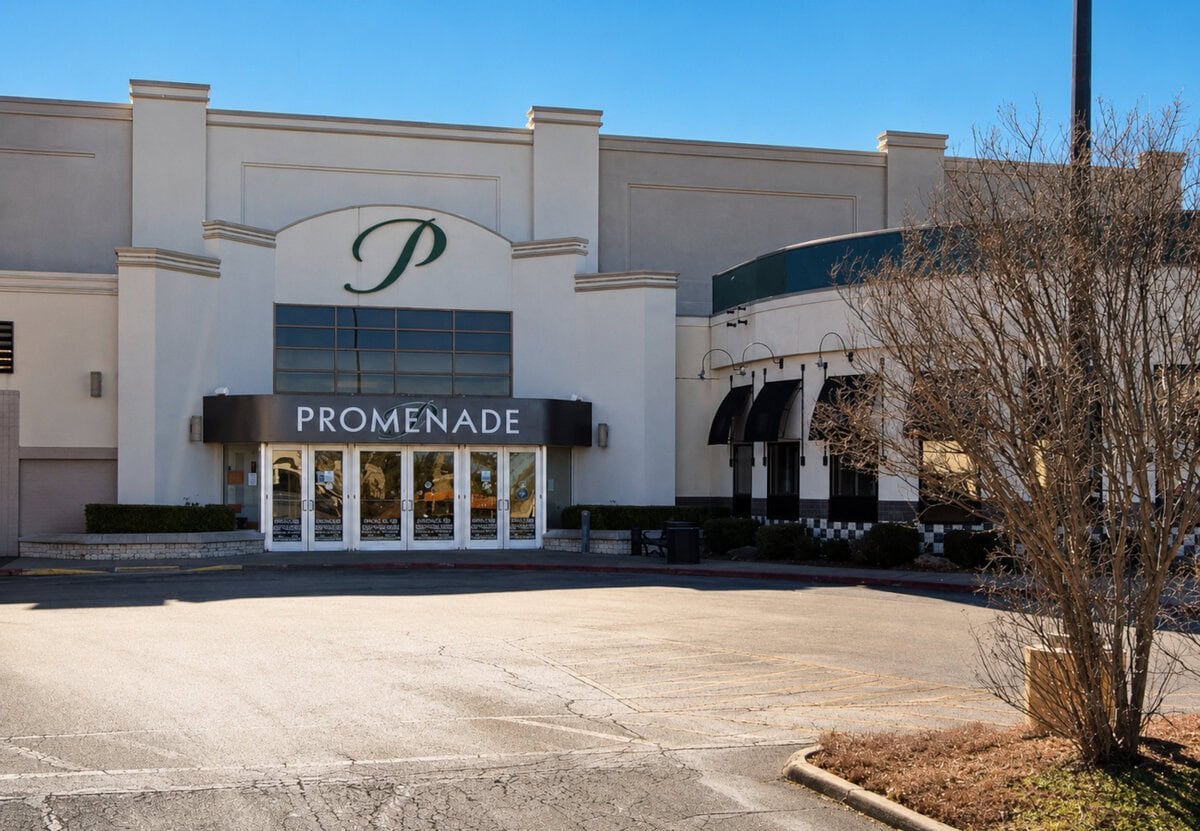
Tulsa Promenade is an enclosed shopping mall at the corner of 41st Street and Yale Avenue in Midtown Tulsa. It began in 1965 as Southland Shopping Center, an outdoor row of department stores and smaller shops.
The mall most Tulsans remember opened in the mid-1980s, when an older outdoor shopping center was sealed up, given a second floor, and renamed Tulsa Promenade.
Fountains and planters lined the interior concourse. A food court became a lunchtime and after-school destination for years. A cinema extended the mall into evenings and weekends. For about twenty years, the two-level building made Oklahoma weather irrelevant.
What stands out about Promenade today is its current condition. The main enclosed mall has been closed to the public since 2023 because of fire-code issues, and it was later declared unfit for use. Its doors are welded shut, and the inside has suffered from water damage and vandalism.
A few former anchor buildings around it, including a converted Macy's that is now a two-rink ice center, are still open and active.
The site contains both a significant adaptive reuse success and a significant unresolved problem, occupying the same place.
Southland Shopping Center: Open Air at 41st and Yale
Max Campbell and the Campbell Company chose land at what would become 4107 South Yale Avenue years before Southland opened in the early 1960s for a major suburban shopping center.
The site had been farmland.
The architect was Malcolm McCune, who also designed Utica Square, and Southland followed a related suburban-retail model: broad middle-class suburban retail, reached by car, open to the weather.
When Southland opened in 1965, the intersection was near the edge of Tulsa's suburban expansion.
The new shopping center gave the developing corridor its first major planned retail concentration. The property covered 400,000 square feet across four main buildings.
Brown-Dunkin anchored one end. J.C. Penney anchored another. Froug's added a third department-store presence.
Smaller tenants included Safeway, T.G.&Y., Walgreen Drug Store, Borden's Cafeteria, Hickory Farms of Ohio, Jenkins Music Company, Peacock's Jewelers, Baker's Shoe Store, Norton Luggage, Tulsa Greenhouse, and Lerner Shops, among others.
That lineup made Southland a full-service suburban shopping center: groceries, shoes, music, jewelry, gifts, food, and apparel in one open-air complex.
Competition Arrives: Southland Falls Behind Enclosed Malls
Southland's outdoor format was under pressure almost immediately. Southroads opened nearby in 1967 as an enclosed, air-conditioned mall, offering climate-controlled shopping at the same intersection.
The contrast was direct: one center was open to heat and cold; the other was not.
Both helped establish 41st and Yale as one of Tulsa's primary retail intersections, even as that position would come under further pressure from the south.
As residential development pushed farther along Tulsa's expanding edge, newer shopping destinations pulled retailers and shoppers with them.
Woodland Hills Mall, which opened in the 1970s, became a dominant enclosed regional competitor.
Southland held its original anchors and its established location, but its physical format no longer matched the direction of regional retail.
The decision to enclose and rebuild came in the early to mid-1980s.
The 1980s Conversion: Southland Becomes Tulsa Promenade
Investor and developer Robert B. Aikens led the reconstruction.
The project enclosed the older open-air buildings, added a second level through most of the complex, and created the interior-concourse format that later generations would know as Tulsa Promenade.
The mall was operating in its enclosed form by 1986, and the name came with the building.
Dillard's and J.C. Penney stayed as major anchors. Mervyn's joined at the west end in a two-level space, giving the property a third department-store draw.
The enclosed concourse connected all three anchors through a shared interior circulation system.
For Midtown shoppers who had walked between buildings in the open air for two decades, the conversion meant stepping inside a fully climate-controlled two-story mall.
The outdoor center was gone.
Regional Mall in Full: The 1990s Expansion
Foley's arrived as a fourth anchor during a major 1990s expansion and later became Macy's as national department-store brands consolidated.
A food court was added, creating a central dining space. Hollywood Theaters Palace 12 opened in 1998, adding 12 screens and extending the mall's draw into evenings.
Dillard's expanded its footprint. Structured parking grew on the north and south sides.
By the early 2000s, the mall covered 927,000 square feet, held more than 100 stores, drew 4.5 million visitors a year, and generated over $100 million in annual tenant sales.
Small-shop sales ran $295 to $305 per square foot. Renovations added new carpeting, updated restrooms and fixtures, a children's soft-play area, a glass elevator, and exterior corner improvements.
The property was still being actively maintained and competed for shoppers.
Tulsa Promenade's Anchor Stores: Arrivals and Departures
Brown-Dunkin was there on opening day in 1965, became Dillard's, and remained through the entire arc of the property's history.
J.C. Penney opened with Southland in 1965 and stayed for 55 years.
Mervyn's joined during the 1980s enclosure, anchored the west end for roughly two decades, and departed by the mid-2000s as the chain failed nationally.
Foley's came with the 1990s expansion and became Macy's in 2006. Macy's announced its departure in January 2017 and closed on March 26, 2017.
J.C. Penney announced it would close in January 2020 and shut in July 2020, delayed by the COVID-19 pandemic.
Hollywood Theaters Palace 12 closed in January 2019 without reopening.
Each departure left a large space to refill.
The former Mervyn's became a fitness and health-care cluster: Sky Fitness took most of the first floor by 2011, and Genesis Health Clubs, CREOKS, and TruHealth later occupied or were associated with the space.
CREOKS renovated 40,000 square feet there in the early 2020s. The former J.C. Penney became Extra Space Storage.
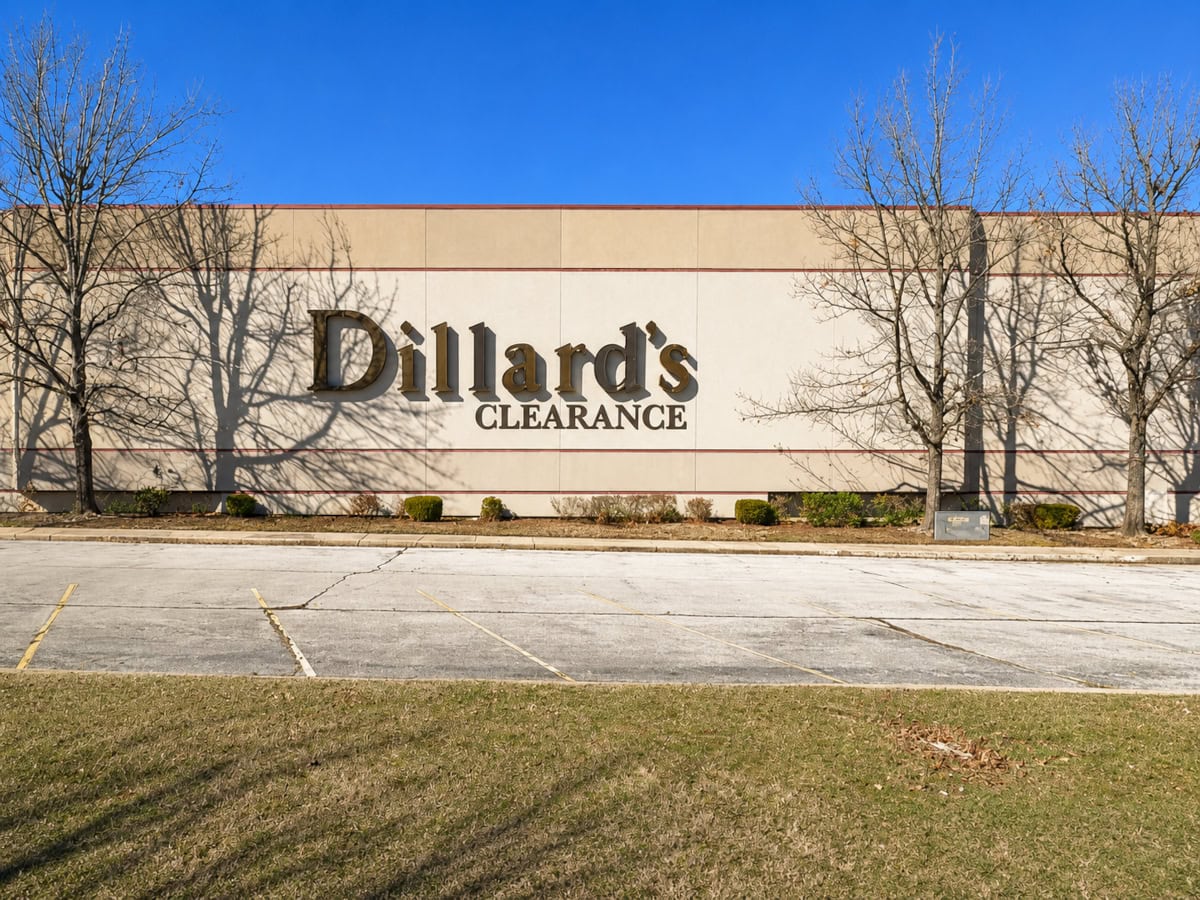
Dillard's outlasted every other original anchor and remained open even after the enclosed mall core closed in 2023.
Ownership Turnover and a Decade of Financial Decline
Connecticut General Life Insurance held the property before Coyote Tulsa Mall LLC paid $30.5 million for it in May 2004.
Coyote renovated the property before selling it to Glimcher Realty Trust, which paid $58.3 million in January 2006. Glimcher held the property in a joint venture with Oxford, owning 52 percent to Oxford's 48 percent.
In 2013, the Glimcher-Oxford group sold to Tulsa Promenade Realty Management LLC for $12.3 million, less than a quarter of the 2006 price.
The sale was associated with a retail-property network operating out of Rochester, New York.
Deferred maintenance accumulated in the years that followed. Parking-garage concerns became public by 2016, including cracked supports and incomplete repairs.
Nonfunctioning escalators, elevator problems, inactive fountains, and HVAC failures in storefronts all piled up.
Tulsa Crime Stoppers moved out after a pipe burst caused water damage and electrical problems. By the early 2020s, the mall's second level had become largely vacant or inaccessible in normal operations.
The financial crisis became public in 2019. Ready Capital Corp. pursued foreclosure after the owner defaulted on loan obligations. A Tulsa County judge appointed a receiver to manage the property.
The ownership entity owed $6 million; the property's estimated value had fallen from a cited $25.9 million in 2016 to $4.5 million in a later evaluation.
The receivership placed day-to-day control with an outside manager for a period. The property eventually returned to the same ownership network, but the physical problems remained.
Closure, Damage, and the Building Left Behind
Interior mall tenants received notice on September 11, 2023.
Six days later, the enclosed mall core closed to the public because of unresolved fire-code and life-safety violations: fire suppression, fire alarms, fire extinguishers, and fire-watch requirements.
A temporary fire watch had allowed the building to remain open; management ended that arrangement.
Roughly 20 businesses and organizations were still inside, including Against Global Hunger. They had a short window to remove inventory and move.
The building deteriorated after closure. By April 2025, city inspectors found the main entrance unsecured, the interior showing overturned tables, leftover merchandise, trash, vandalism, and standing water.
On April 28, code enforcement deemed the structure unlawful and unfit for human occupancy, and the city began daily monitoring with code enforcement, Tulsa Police, and the Tulsa Fire Department.
Doors were welded shut or boarded. Arrests for copper theft continued into 2026. A June 2025 storm damaged the closed Hollywood theater facade, exposing steel beams and insulation.
Tax delinquency added separate pressure. In May 2025, taxes owed for 2021 through 2024 totaled $800,000.
A June 2025 payment covering the 2021 balance removed the property from immediate auction but left $575,000 unpaid. By March 2026, the minimum payment needed to avoid auction was $252,800, due by June.
WeStreet Ice Center and an Unresolved Future
The most concrete reinvestment on the property opened in March 2024.
WeStreet Ice Center, built inside the former Macy's building, cost $25 million to $26.8 million and required major structural work: the old department-store column grid was not suited for open rink spans.
Interior columns and portions of the second floor were removed, and long-span inverted bowstring trusses created the clear-span areas needed for ice.
The completed complex holds two NHL-sized rinks, one with stadium seating, plus locker rooms, party and community rooms, a pro shop, arcade, sport simulators, offices, and Puck's Sports Bar and Grill.
It serves as the official practice facility for the Tulsa Oilers, hosts Oklahoma State University collegiate hockey and Tulsa Jr Oilers teams, and offers public skating, figure skating, curling, lessons, leagues, and events.
The enclosed mall core had no confirmed plan as of March 2026.
Public discussion pointed to concepts involving entertainment and housing, but no transaction had closed, no redevelopment plan had been adopted, and no demolition schedule had been announced.
City officials stated change was coming without saying what it would be. Delinquent taxes still created auction risk.
The active parts of the property are the former anchors that went their own way: Dillard's Clearance Center, WeStreet Ice Center, Genesis Health Clubs, CREOKS, TruHealth, and Extra Space Storage.
The closed part is the interior concourse that once connected them, along with the food court and the glass elevator that hasn't moved in years.
Brown-Dunkin opened at 41st and Yale in 1965. Six decades later, Dillard's is still selling there. In what used to be the Macy's next door, people are skating on ice.
Independent Publisher Notice
BestAttractions is an independent editorial publisher. We are not affiliated with, endorsed by, or acting on behalf of any location, business, property owner, manager, government agency, or organization described in this article. Comments posted on this page are not forwarded to, reviewed by, or acted upon by any entity mentioned in the article. For official inquiries, complaints, applications, bookings, or other requests, please contact the relevant entity directly through its official website or other verified channels.