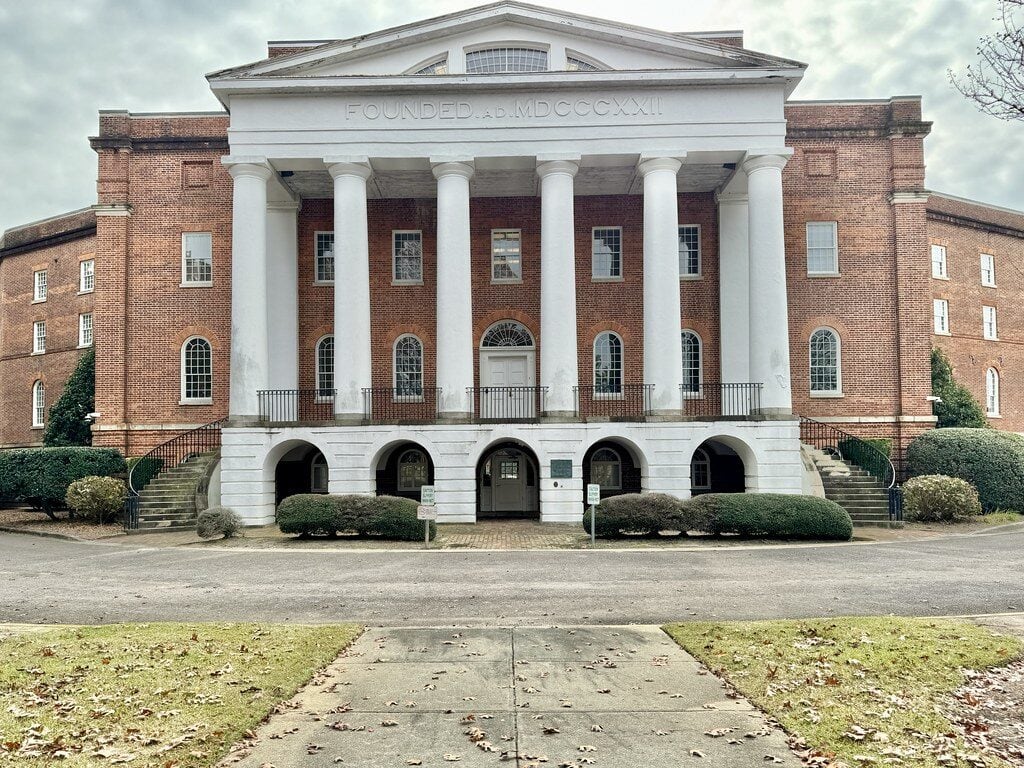
Inside the oldest surviving state mental hospital building in America, one detail stands out right away: the locks are hidden. Robert Mills made that a deliberate choice.
When the building was completed on December 18, 1827, at 2100 Bull Street in Columbia, it looked nothing like the jails and poorhouses where many people with mental illness in South Carolina were still confined.
Rooms were oriented to the south to bring in sunlight. Hinges were built into the woodwork so they would not be visible. The ceilings were fireproof. A garden sat on the roof. Heat circulated through the walls.
All of these features followed the same reasoning: the surroundings could play a role in healing the mind. Hidden ironwork was meant to reduce a sense of confinement. Southern light exposure was chosen for health, not appearance.
The South Carolina General Assembly authorized the hospital on December 21, 1821, with an initial budget of $30,000. By completion, costs had risen to nearly $100,000.
The building was designed for about 120 patients and became one of the first three publicly funded mental hospitals completed in the United States.
The first patient entered in 1828. Eliza Fanning, age 20, from Barnwell District, was admitted on December 12 and discharged on February 7, 1829.
Her record noted she was uncured. During her stay, her mother worked at the hospital as a matron.
The South Carolina State Hospital from the 1850s to the 1880s
The hospital relied on paying patients to help keep its finances in balance. During the 1850s, the standard rate was about $250 per year.
A private room with its own dining space cost an extra $100. Pauper patients were charged $135 a year, and their home districts were billed.
The system did not work as expected, and the state ended up covering more and more of the costs.
Before 1860, the number of patients stayed under 200. Nearly all were white.
A small number of Black patients, mostly enslaved people, had been admitted in the first two decades, but formal approval for their admission came in 1848.
By 1860, the asylum was full with 192 patients. Even at that point, many families in South Carolina chose not to send relatives to Columbia. They kept them at home or placed them in local jails or workhouses.
The original building became overcrowded by the early 1850s. By the early 1850s, the Board of Regents concluded that a second building was necessary.
An 1856 report stated plainly that patients were sleeping in the corridors of the Mills building.
Construction on a new building began in 1857.
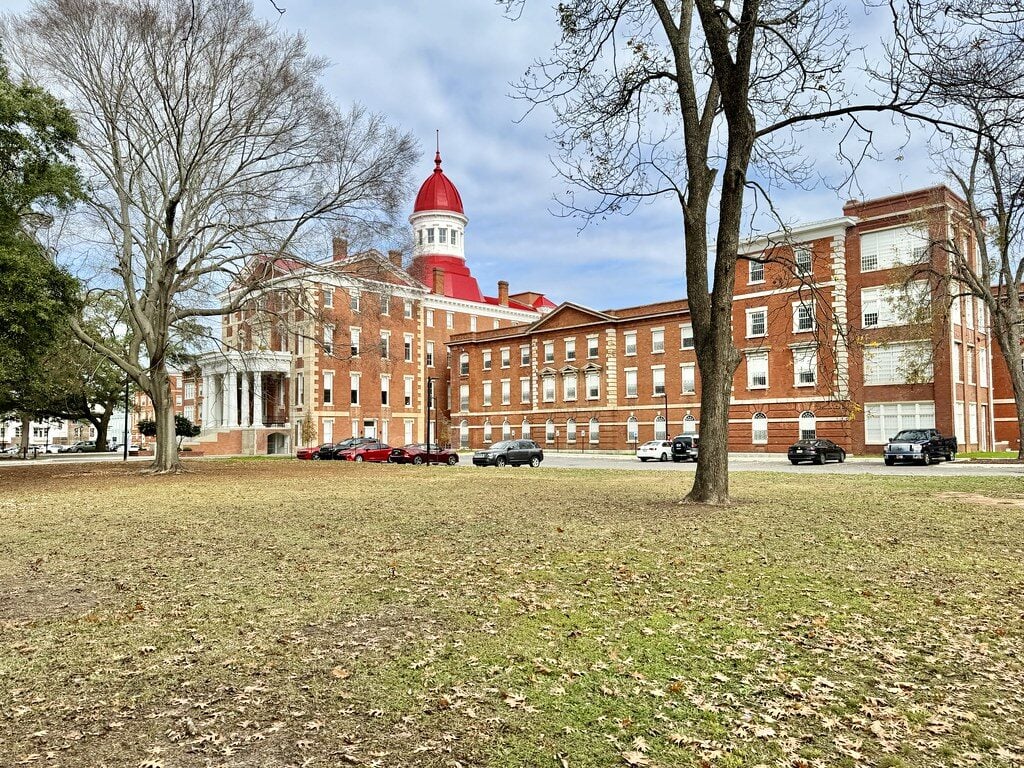
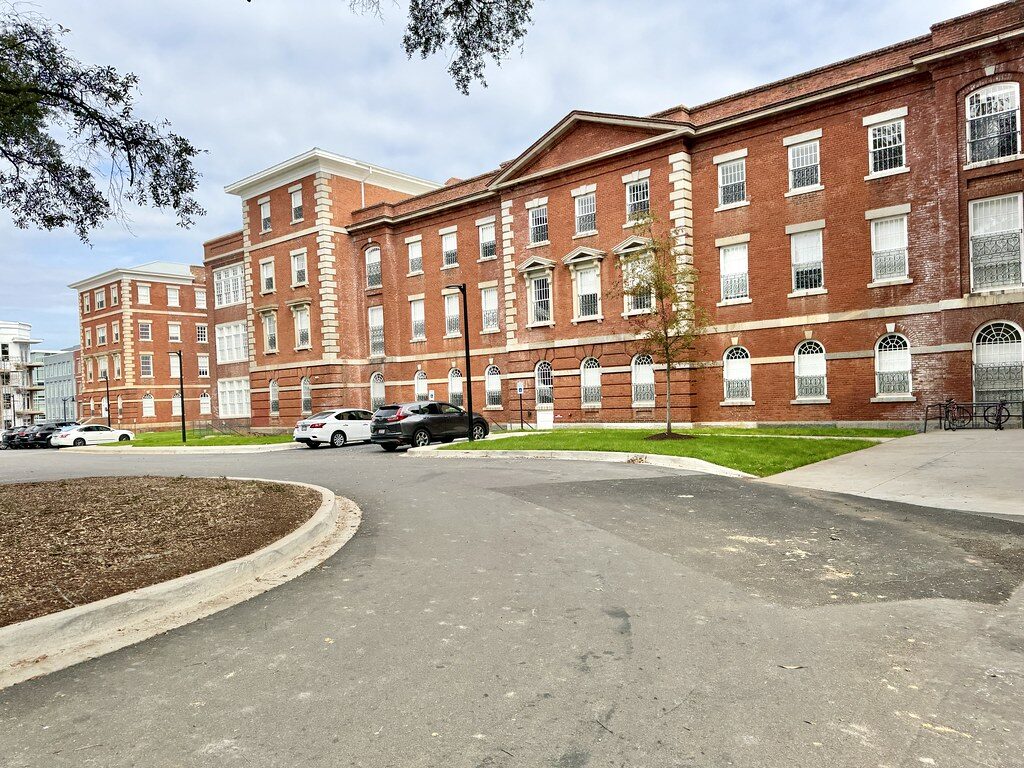
Building continued on the Bull Street grounds over the next thirty years in four phases: 1857 to 1858, 1870 to 1876, 1880 to 1882, and 1883 to 1885.
Three architects shaped the project. George E. Walker designed the first phase. Gustavus T. Berg designed the north wing. Samuel Sloan completed the central section that connected the buildings.
The final complex covered about 300,000 square feet and followed the Kirkbride system, using the building's layout and setting as part of treatment.
A superintendent's report from the 1880s described it as comparable to the best hospitals in the country in terms of beauty, strength, sanitation, and patient comfort.
Camp Asylum and Bull Street's Postwar Overcrowding
The Civil War reached the hospital grounds, even though the buildings themselves were never taken over.
The Confederate Army used the land from October 1864 to February 1865 as a prison camp for captured Union officers. The site was called Camp Asylum.
In February 1865, when William Tecumseh Sherman burned much of Columbia, people from the city came to the hospital grounds looking for shelter.
In 2014, excavations uncovered physical evidence of the prison camp in the southeast corner of the property.
Archaeologists found nine small pits that prisoners had dug and used as simple shelters, known as shebangs.
In 1871, the state took over responsibility for the cost of caring for the mentally ill, removing that burden from the counties.
Counties and jails quickly transferred patients they had been holding. As a result, the number of patients at Bull Street grew faster than the buildings and staff could handle.
In the years after the war, the hospital shifted away from the founders' goal of curing patients and toward housing large numbers of poor and long-term residents.
By 1900, the patient population had reached 1,040.
A City Within a City
By 1920, more than 2,000 patients lived at the Bull Street campus, and the site operated much like a small town.
It included a dairy, ice cream factory, mattress factory, bakery, lock shop, welding shop, greenhouses, a newspaper printing setup, a pig farm, and a milk pasteurization plant.
Doctors and nurses lived there as well. The hospital supplied its own food, clothing, and maintenance.
A 1909 legislative review had already pointed out major problems: poor sanitation, worn-out buildings, unclean living conditions, and overcrowding.
Even so, the number of patients kept increasing. Black patients faced especially high death rates.
In the 1910s, pellagra - caused by a lack of niacin in the diet - became the leading cause of death among African American patients.
Several service buildings from this period still remain.
These include a laundry from the late 1880s, separate dining halls for men and women from the 1910s, a bakery dating to around 1900, the Parker Annex from about 1919, a mattress factory, the LaBorde Building from around 1920, the Williams Building from 1938, the Ensor Building from 1939, and a group of buildings from around 1955 such as Benet Auditorium, Horger Library, and the Chapel of Hope.
Bungalows built for employees in the 1920s and 1930s still line sections of the grounds. By the 1950s, the patient count had risen to nearly 4,000.
Dr. Babcock, Pellagra, Psychiatric Nursing, and Research at Bull Street
James Woods Babcock became superintendent in 1891. The next year, in 1892, he started a nursing school at the hospital that operated until 1950.
It was one of the earliest programs in the United States focused on psychiatric nursing.
In 1895, three years after he took the role, Sarah Allen joined the staff as a psychiatrist. She was the first licensed female physician in South Carolina and worked at the hospital until 1907.
Babcock's most important work was in medicine. He was one of the first physicians in the United States to recognize an outbreak of pellagra by studying cases among his own patients.
In 1909, he and J. J. Watson presented their findings to the New York Medical Society.
Pellagra was affecting large numbers of people across the rural South, and Babcock was among the early physicians in the United States to identify it in patients in Columbia.
The hospital later became a center for federal research. In 1931, the U.S. Public Health Service set up a Division of Field Investigation of Malaria on the grounds.
Construction of a research laboratory began in 1938, and it opened in 1939.
The Ensor Research Foundation was established in 1945. In 1946, the hospital started the first Clinical Pastoral Training Program in the Southeast.
Dorothea Dix had visited the hospital in 1852 and again in 1859 to discuss methods of care.
Despite ongoing overcrowding, the institution she saw had developed into a place where scientific research was actively carried out.
Segregation, State Park, and Palmetto State Hospital
A few Black patients were admitted to the Bull Street Asylum from its earliest years, most of them enslaved people brought by their owners.
The state formally approved Black admissions in 1848, but care remained unequal.
After the Civil War, Black admissions increased, and conditions worsened. Pellagra killed Black patients at far higher rates than white patients.
By the 1910s, it was the leading cause of death among them at the hospital.
In 1910, a legislative investigation found the hospital too small to function. Lawmakers funded a separate campus north of Columbia for African American patients.
Land was acquired, the first permanent building was completed in 1913, and patients began moving there in 1914.
Palmetto State Hospital opened in 1922. By 1930, all Black patients had been removed from Bull Street. They remained segregated from white patients for another three and a half decades.
In the mid-1960s, segregation formally ended, and the State Park campus shifted to geriatric care.
The facility was renamed Palmetto State Hospital in 1963 and Crafts-Farrow State Hospital in 1966, for William Crafts and Samuel Farrow, who had supported the creation of the asylum in 1821.
While segregation remained in place, outpatient services expanded for white patients. A permanent clinic opened in Columbia in 1923.
By the end of the decade, clinics were also operating in Florence, Orangeburg, Anderson, Charleston, and Greenville.
By 1924, Ethel Sharpe was conducting pre-discharge and post-discharge home visits and compiling social histories.
Federal Pressure, Decline, and a $15 Million Sale
In 1985, the U.S. Justice Department found the hospital's conditions unconstitutional.
A year later, in 1986, South Carolina entered a four-year consent decree with the federal government that required expanded services.
By then, deinstitutionalization had already been lowering the inpatient population for about twenty years.
Psychotropic medications introduced in the 1950s, federal mental health policies in the 1960s, and the expansion of Medicaid all contributed to that shift.
The 17 community mental health centers were used to screen patients before admission and reduce the number sent to the main campus.
By 1996, the two hospital campuses had been reduced to 410 beds. By 2003, the average number of patients was under 200, and plans to close were announced.
On December 16, 2010, the Department of Mental Health signed a contract with Hughes Development Corporation to sell the Bull Street property in phases over seven years for $15 million.
The proceeds went into a trust for the care and treatment of people with mental illness. The first payment from a parcel sale came in October 2014.
In December 2015, all patients and staff from the William S. Hall Psychiatric Institute were relocated, ending all Department of Mental Health operations on the Bull Street campus.
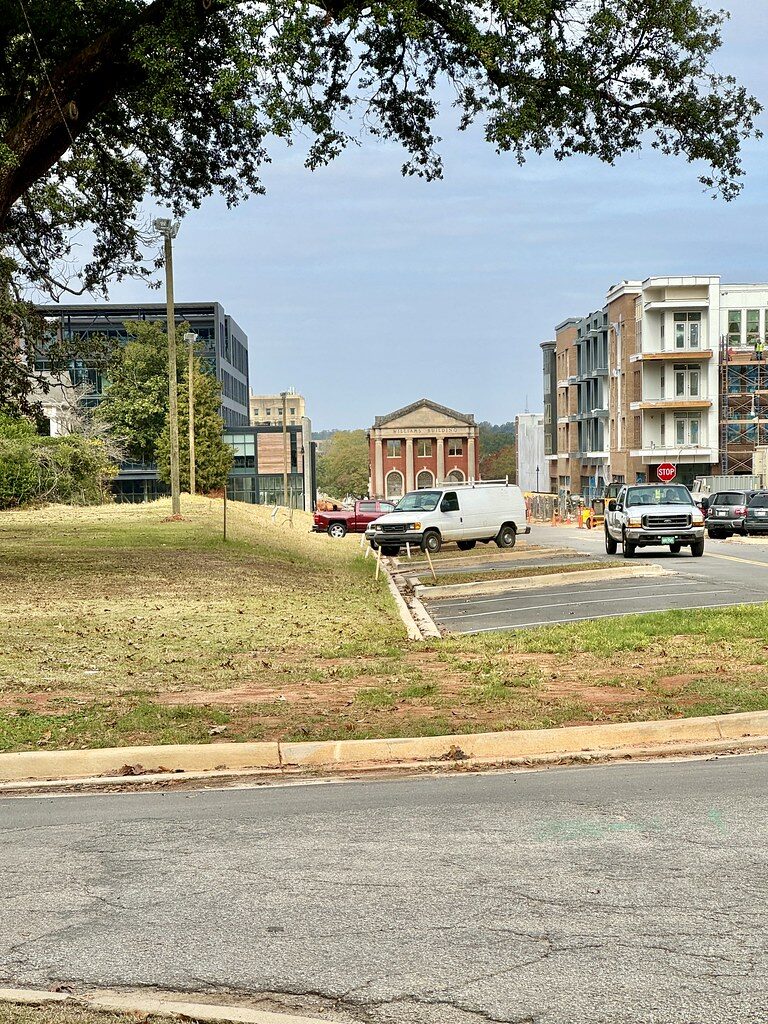
The Cupola Comes Back, and a District Takes Shape
The Babcock Building lost its cupola in a three-alarm fire in September 2020. A new one was put back in place in August 2023.
By 2024, the rehabilitation was finished. The building now has 208 apartments, backed by $39 million in HUD loans, historic tax credits, and a 20-year tax abatement.
The BullStreet District now covers 181 acres, up from 165 after the 16-acre Hall Institute parcel was added in 2015.
The release event was held at The Laundry, a restored former service building that opened as an event venue on April 9, 2025, with nearly 8,000 square feet of indoor space.
By early 2026, private investment had passed $250 million. More than 600 workers were active on site, and hundreds of housing units were either occupied or under construction.
The University of South Carolina started work on its new School of Medicine Columbia facility in February 2025 and held a topping-out ceremony in December 2025.
The 300,000-square-foot building is expected to be completed by August 2027. A 50,325-square-foot Publix is planned for Bull Street and Colonial Drive, with construction set for summer 2026.
A seven-story, 136-room Grand Willow Hotel is planned at 1571 Freed Street, with completion expected in late 2027.
On March 24, 2026, Able South Carolina and Historic Columbia released "People, Not Patients," a 74-page history based on the experiences of people who lived and worked at the hospital.
The Mills building at 2100 Bull Street, the oldest surviving state mental hospital building in the country, now houses the South Carolina Office of Resilience.