City Creek Center and the Downtown That Was
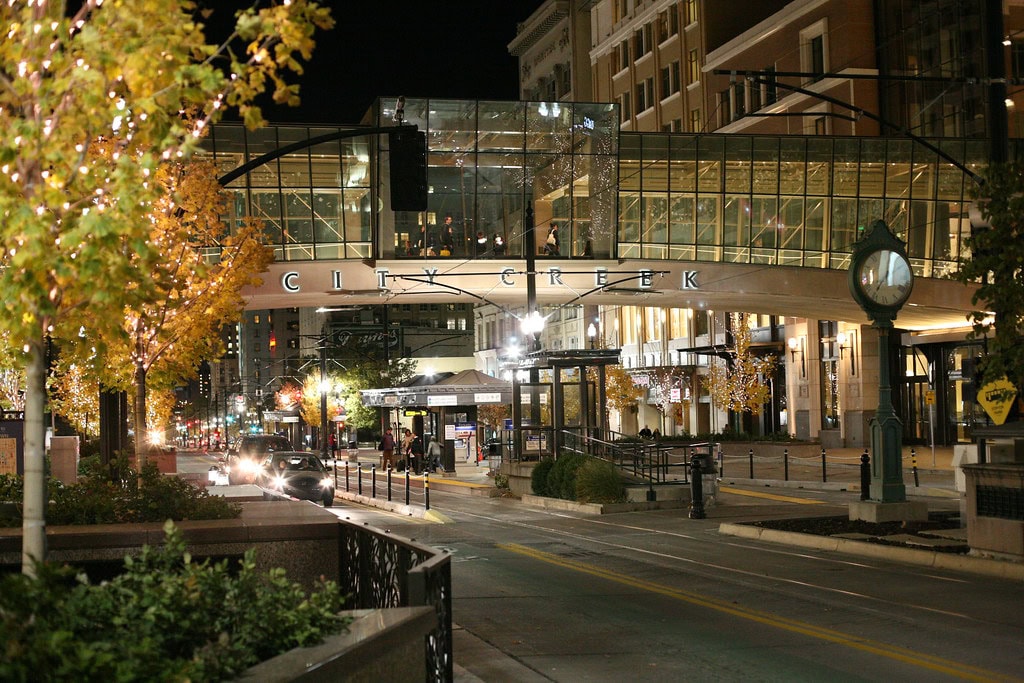
City Creek Center sits on three downtown blocks in Salt Lake City, two of which once hosted two malls and, earlier still, the original Zions Co-operative Mercantile Institution.
April 1, 1876, was opening day for ZCMI, a store that is often spoken of as one of the nation's first department stores. When the 1970s demanded an enclosed retail future, the original building was demolished.
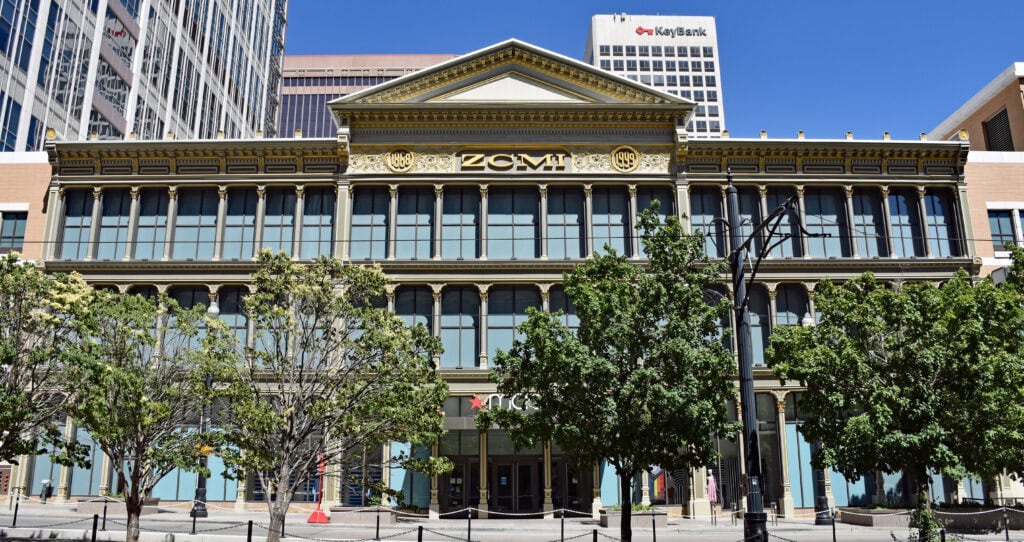
History kept one artifact intact, the ZCMI Cast Iron Front, a three-story front in cast iron and pressed metal, built from 1876 to 1901 for the store.
Saved and moved, it was later added to the new buildings on Main Street, showing that history could be moved from place to place.
From the beginning, the site has been a lesson in downtown continuity: what gets erased, what gets saved, and what gets rebuilt to look inevitable.
When ZCMI and Crossroads Ruled Main Street
The ZCMI Center Mall opened in 1975 and promptly earned a bragging right: it was the largest indoor downtown shopping mall in the country at the time.
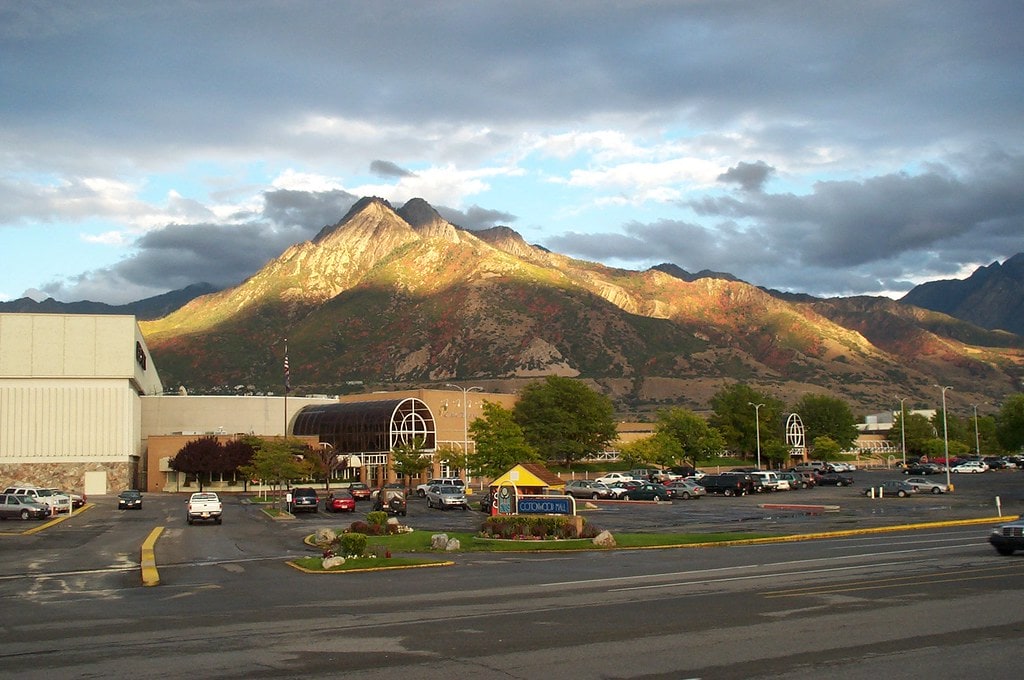
Crossroads Plaza arrived in 1980, directly opposite the site: a four-level shopping center that condensed downtown into a focused retail center.
For decades, the two malls did what downtown malls are meant to do: bring people together, give shoppers shelter from the weather, and keep Main Street busy.
By the early 2000s, both malls were having trouble with fewer sales and more empty stores. Their problems did not happen all at once but slowly, making the area feel emptier over time.
The stores still had their lights on, but the excitement moved away, one store after another.
The Gateway Opens and Nordstrom Threatens to Leave
In November 2001, The Gateway opened four blocks west: a $375-million open-air complex built in the shadow of the 2002 Winter Olympics.
It arrived with trendy retailers like Abercrombie & Fitch and Anthropologie, plus a Children's Museum, a 12-screen movie theater, offices, and apartments.
The pitch was not "mall" so much as "neighborhood," with shopping as the entry fee.
Traffic followed. What made the shift clear was Nordstrom's flirtation with The Gateway - widely sought, loudly discussed, but ultimately blocked, with no Nordstrom store opening there.
Even without the relocation, the gravitational pull was real: newer construction, shinier tenants, and a westward drift of attention that left Main Street's old malls suddenly seemed even more outdated.
Saving the center of the city was no longer just about looks, but became something that needed to be done, with Temple Square close enough to be affected.
Buying Crossroads, Sketching a Downtown Cure
The Church of Jesus Christ of Latter-day Saints had reasons to care about more than just shopping.
Temple Square was close, and when downtown areas lose businesses, that emptiness can spread to places that are still doing well.
The church purchased Crossroads Plaza through Property Reserve, Inc., and began treating the blocks as civic infrastructure.
In October 2003, soon after the purchase, preliminary plans were presented to significantly remodel Crossroads Plaza and the neighboring ZCMI Center.
The first idea was to keep and fix up the buildings that were already there. Then planning dragged on for three years, and it became clear that small fixes would not be enough.
By the time the plans were finished, the project needed more than just a few changes - it needed a whole new look. In a way, it was an emergency fix.
October 2006, a Decision to Start Over
On October 3, 2006, the church announced revised plans: instead of remodeling two failing malls, it would demolish them and build a single mixed-use development called City Creek Center.
Taubman Centers, Inc., headquartered in Bloomfield Hills, Michigan, was brought in early as a consultant to Property Reserve, Inc. and then became responsible for retail leasing and operations.
What made Taubman's plan, at the announcement, feel real was that significant money had been spent on it; speculation had been paid for, and inevitability moved in.
The idea extended past a new shopping district toward a downtown reset, meant to keep commerce and street life near Temple Square, so the city's middle could feel, again, like its middle and stay there still.
Implosions, Empty Blocks, and Recycled Dust
Demolition began in November 2006 with the Inn at Temple Square and moved across the site from west to east.
Businesses kept operating until shortly before their scheduled ends, a kind of retail version of "please exit in an orderly fashion." In January 2007, the Crossroads Plaza parking structure was demolished.
In August 2007, the Key Bank Tower - the last major piece of Crossroads - was brought down by controlled implosion.
Demolition of the ZCMI Center block began in the summer of 2007. Roughly 23 acres across three city blocks were cleared, and nearly 1,100 construction workers labored on the site.
More than half of the demolition debris was recycled, an environmental footnote to an otherwise blunt act: erase two malls to make room for one idea.
Brick, Subcontractors, and a Recession Build
With planning approvals in place, subsurface work began in early 2008.
The first concrete pour came in March 2008 for 99 West on South Temple, a 30-story, 375-foot condominium tower with 185 units, later LEED Gold, and clad in a brick facade.
Richards Court, two 10-story towers, began move-ins in April 2010. Altogether, City Creek Center accounts for roughly 700 housing units.
Retail progress had its own milestones: the skybridge steel was placed overnight on March 21, 2010; Harmons construction began in July 2010; and that same month brought a topping-out ceremony for the retail center's last steel beam.
The project was privately funded, estimated at $1.5 to $2 billion with no public subsidy, and kept more than 2,000 subcontractors working from 2006 through 2012.
Interstate Brick later counted 5.5 million modular brick equivalents used in construction.
Not every plan survived contact with the street grid.
A proposed Dillard's anchor fell out after concerns over Regent Street alignment, and the space helped produce The Regent, a 20-story, 150-unit LEED Gold condominium tower (opened October 2011, first known as "Tower 5").
City Creek Landing Apartments added 108 rentals above the west block shops in 2011, stacked over seven stories with a fitness center, spa, pool, clubhouse, controlled access, and in-unit conveniences.
Cascade Tower was started too, but only its foundation and first three floors were built, waiting for a better market.
The Whalebone Roof and the Quiet Machines
City Creek Center's defining compromise is structural: it can be a streetscape or a mall, depending on the sky. The church preferred open air; Taubman preferred a covered, all-weather environment.
Recommendations from Magnusson Klemencic Associates helped produce the hybrid approach nicknamed the "whalebone" structure.
Above the galleria sits a 30,000-square-foot retractable glass roof more than 500 feet long, designed to close in about five minutes.
Panels ride on steel rail girders and part in the middle when opening; at the time, only one comparable retractable roof was noted worldwide, in Dubai.
Glumac's mechanical design makes the hybrid practical. Open side walls allow natural ventilation, so the main gallerias need no air handlers about 84 percent of the year, cutting energy use by 25 to 50 percent.
A central plant includes 34 high-efficiency condensing boilers (68 million BTU per hour) and five magnetic bearing chillers (1,400 tons).
It heats nearly 20 acres of snow-melt, supports space heating, and keeps the water features from freezing so native fish can keep living their improbable lives.
Creek Water, Trout, and Fountains in Concert
The development stages its own origin myth in water.
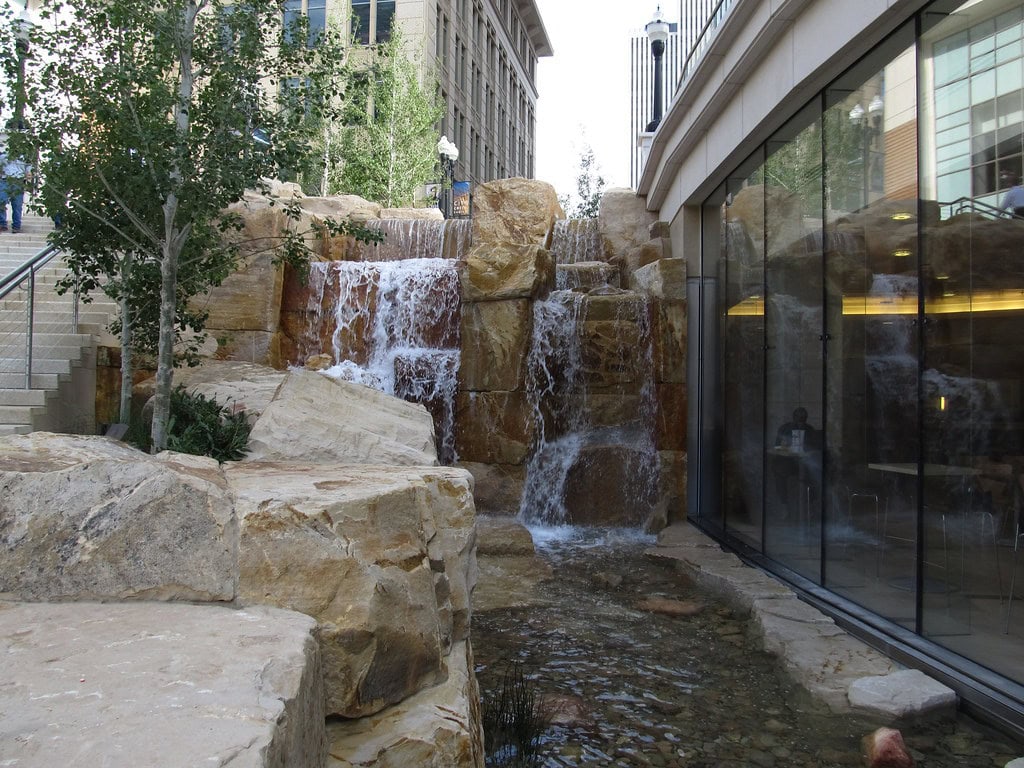
A 1,225-foot-long recreation of City Creek winds through the project in an S-shape, dropping more than 40 feet over boulders and waterfalls meant to echo the Wasatch Range.
The original creek was piped underground more than a century ago; this version uses recirculated tap water.
The creek's water portion covers about 19,000 square feet.
With courtyards, paving, plantings, and roof gardens, the overstructure green space reaches roughly 90,000 square feet, described as the largest flowing on-structure watercourse of its kind in the United States.
It is stocked with 300 live trout.
The biggest drop is the Regent Court Cascade: about 2,500 gallons per minute spill through a 17-foot waterfall over native Utah sandstone boulders weighing up to 14 tons.
The cascades took more than three years and logged over 15,000 production hours, with mock-ups and hand-carving.
WET Design created three fountains - "Flutter," "Transcend," and "Engage" - with music and choreographed water-and-fire jets reaching 50 feet.
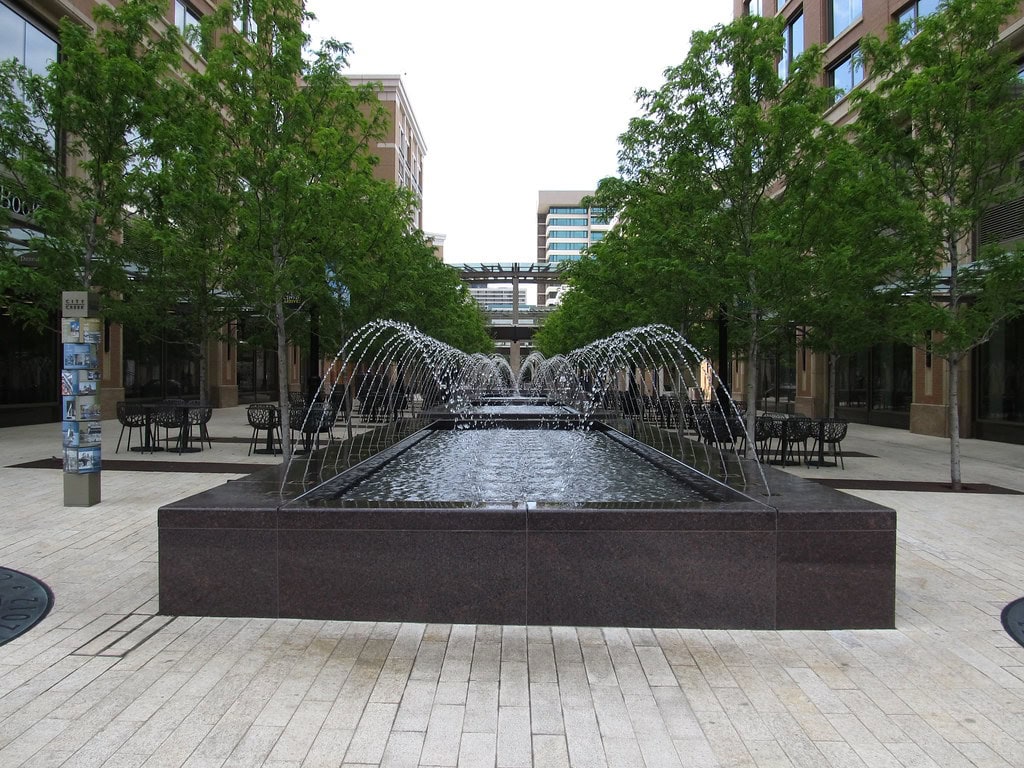
CMS Collaborative added three rectangular fountains leading toward Central Plaza to complement nearby civic water features.
Trees, Waterproofing, and Preserved Faces
SWA Group kept City Creek Center aligned to the street grid and spread about six acres of green space across multi-level plazas and walkways.
When the design was finalized, 627 trees were preselected a year and a half early from five nurseries in Oregon and Idaho.
The dominant species - aspen, native birch, chokecherry - were planted in engineered structural soil, with depths ranging from three to five feet.
All that greenery depends on waterproofing. A fluid-applied membrane was topped with rigid foam insulation, a dimple drain and root barrier, and up to five feet of growing medium.
American Hydrotech supplied roughly 300,000 square feet of waterproofing and Garden Roof components, including intensive green roof sections built to bear soil, continuous water flow, and boulders up to 14 tons.
Two older faces were kept visible: the ZCMI Cast Iron Front reattached to the project along Main Street, and the preserved facade of the Amussen Jewelry Building integrated into the new streetscape.
Rollout Milestones and Daily Mechanics
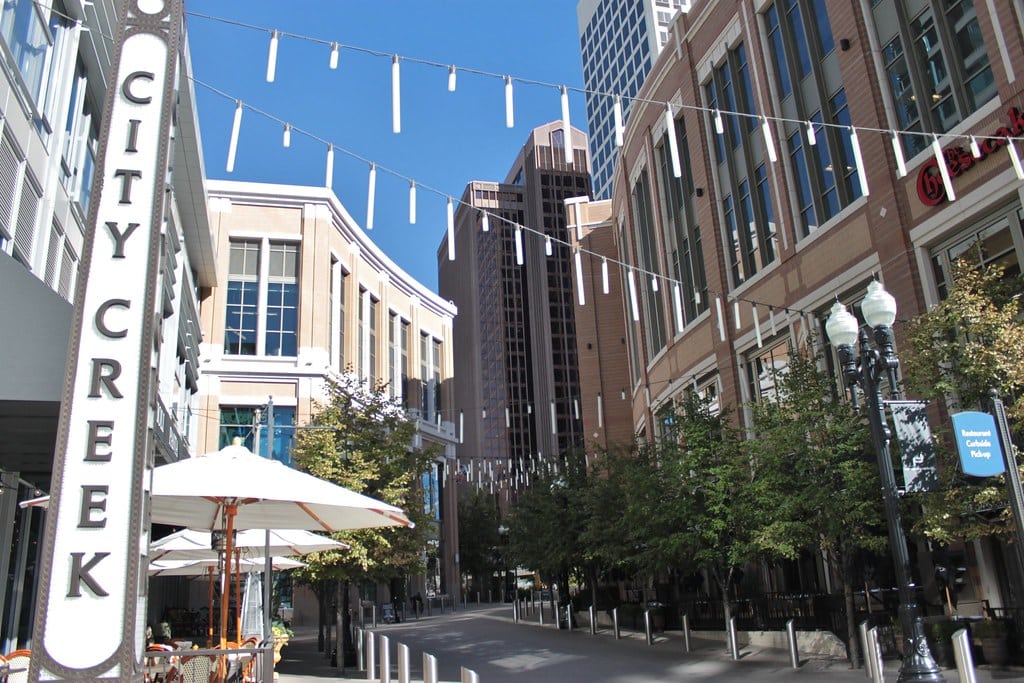
City Creek Center opened in phases.
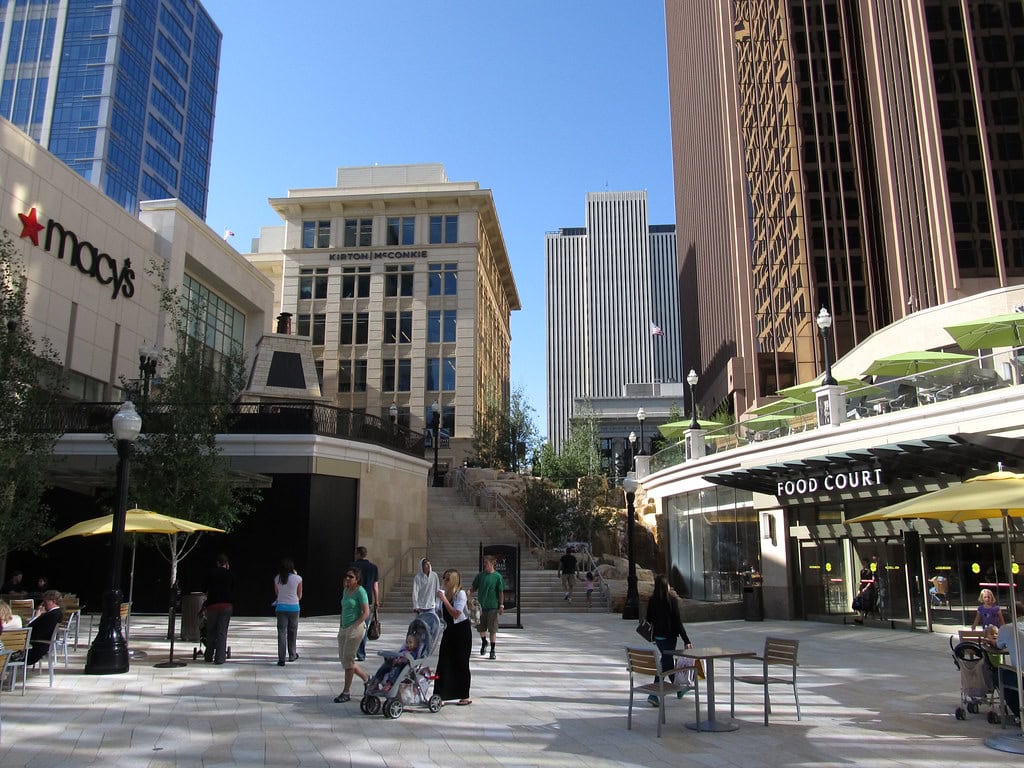
The food court's first phase opened June 10, 2009, with two kitchen tenants, a children's play court, a 40-foot atrium, and outdoor seating; the plan called for about 13 food tenants, 1,050 seats, and 32,000 gross square feet.
Deseret Book opened its flagship store on March 25, 2010. The first underground public garage opened in June 2011. Harmons opened in February 2012.
The official opening arrived on March 22, 2012, with 17 leaders addressing the crowd, as nearly $5 billion in downtown revitalization projects gathered around it.
The retail center totals about 890,000 square feet, anchored by Nordstrom (125,000 square feet over two levels on West Temple) and Macy's (155,000 square feet over three levels east of Main), plus about 300,000 square feet for specialty stores.
Early headliners included The Disney Store, Tiffany & Co., H&M, Porsche Design, and The Cheesecake Factory.
Beneath it all are about 5,000 underground parking spaces across five levels, entered from West Temple, 100 South, South Temple, and State Street.
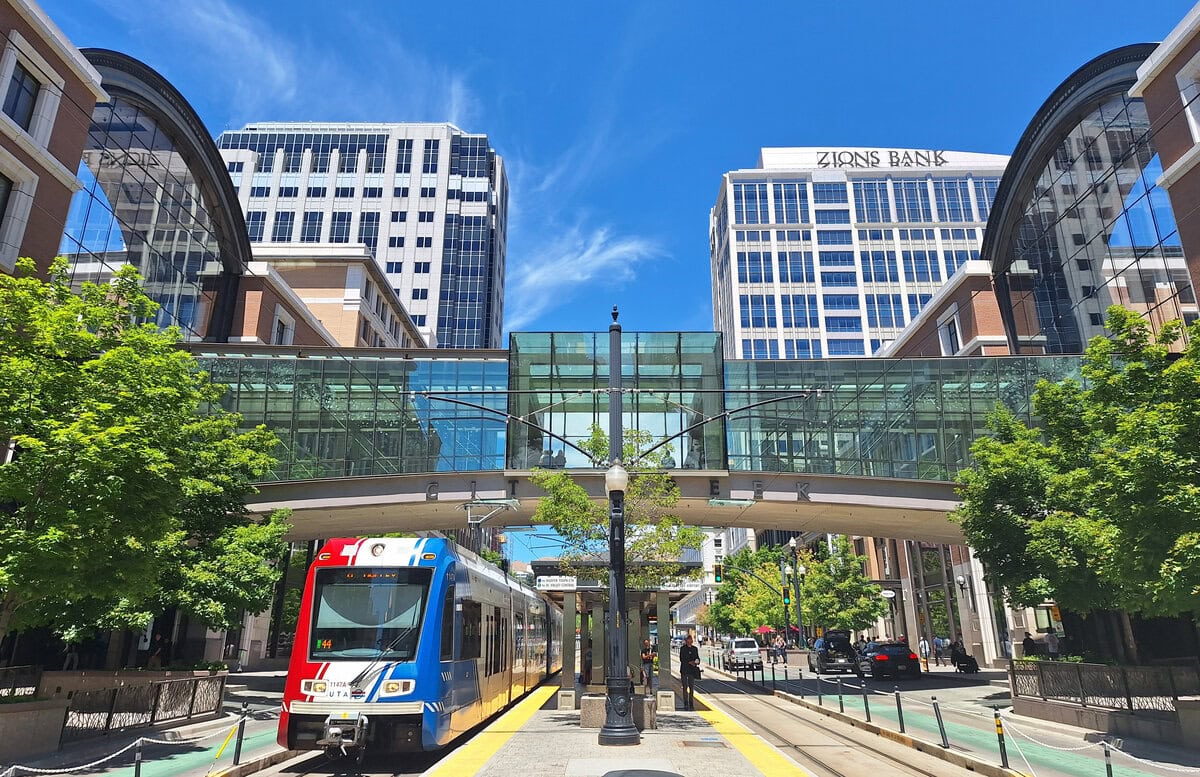
TRAX serves City Center Station, and Jacobsen Construction's 320,000-pound skybridge spans Main Street with etched glass walls, benches, and roof panels that can open.
"The Link at City Creek" runs beneath State Street at the former Social Hall site.
Offices, Awards, Controversy, and Pandemic Shocks
Office and hotel space were stitched in around retail: the Kirton McConkie Building was the only new office building in the initial phase, later joined by 111 Main and 95 State, while existing buildings (First Security Bank Building, Gateway Tower West, KeyBank Tower formerly Beneficial Life, World Trade Center formerly Eagle Gate) were integrated.
The Salt Lake Marriott Downtown at City Creek, opened October 15, 1981, stayed operating through renovation and renaming.
The center won the 2013 ICSC Gold awards for design and sustainable design and earned LEED-ND Silver as a pilot, with multiple LEED Gold buildings.
A Sierra Club report cited the development among 60 LEED-ND pilot projects tied to faith-community environmental action.
Funding remained contentious: a 2019 whistleblower alleged $1.4 billion from funds set aside for charitable causes had been transferred during the 2008 crisis, but a unanimous 9th Circuit ruling sided with the church, finding no misrepresentation and concluding funding came from interest on invested reserve funds.
The mall closed from March 12 to May 6, 2020, during COVID-19 restrictions; late May brought George Floyd protests, smashed windows, looting, and Utah Army National Guard protection.
Some early tenants later departed - The Disney Store, Forever 21, The GYM, and the Microsoft Store. But as of 2025, it still operated with more than 75 stores and 25-plus food options, anchored by Macy's and Nordstrom.