
Peabody is where Black students in Petersburg, Virginia, went to high school. The core campus runs between Wesley, Jones, and Federal streets.
The Peabody-Williams School opened on Jones Street in 1920. A larger Peabody High School opened at 725 Wesley Street in 1951. It took in 524 students. In 1960, 20 Black students, most from Peabody, sat down at a segregated lunch counter downtown.
The last high school class graduated in June 1970. The 1951 building ran as Peabody Middle School until the School Board closed it on June 30, 2017.
The school buildings sit empty and city-owned today. Alumni want a museum and a tutoring center in it. The city hasn't decided.
Peabody started in a church on Harrison Street
In 1868, Petersburg, Virginia, opened public schools for African American children with help from the Freedmen's Bureau and the Peabody Education Fund.
The state had no system of its own until 1870, and its law separated schools by race.
One of them, Elementary School No. 1 on Harrison Street, is identified as Virginia's first public school for Black children.
High-school work started in January 1870 in the old African Baptist church on the same street; the congregation's newer sanctuary had burned in an 1866 run of arson attacks on Black churches.
The city called it the Colored High School.
By 1873 the rooms were too small, and the board bought a lot at Harrison and Fillmore streets.
$18,270 and 12 rooms of brick
The school that went up there in 1874 cost $18,270: 12 rooms across three stories.
It took the name Peabody School, for the financier George Peabody, whose education fund paid for Southern schools after the war.
Elementary and high-school pupils shared it.
R. E. Hardaway ran it with four teachers. He and the four principals after him were white.
That held until December 1882, when Alfred Pryor became acting principal, the first African American to lead a Black public school in the city.
It followed years of pressure from Black Petersburg for African American teachers.
William H. Hamlin, a Petersburg native and Peabody graduate, took over in 1884. High-school enrollment climbed from 25 students in 1883 to 43 in 1886.
46 years under one principal
James Shields became principal in 1889 and stayed 46 years. When he started, the high school had about 50 pupils and one room of the 12.
When he retired after the 1934-1935 session, enrollment was 409 and the teaching staff had gone from one to 43.
The old building was already coming apart, and by the 1910s the city was planning a replacement.
Once Peabody left, the 1874 school was demolished.
By 1926 the Harrison and Fillmore site was being cleared for Anna P. Bolling Junior High School, which opened the next year.
Nothing of the 12-room building survives there.
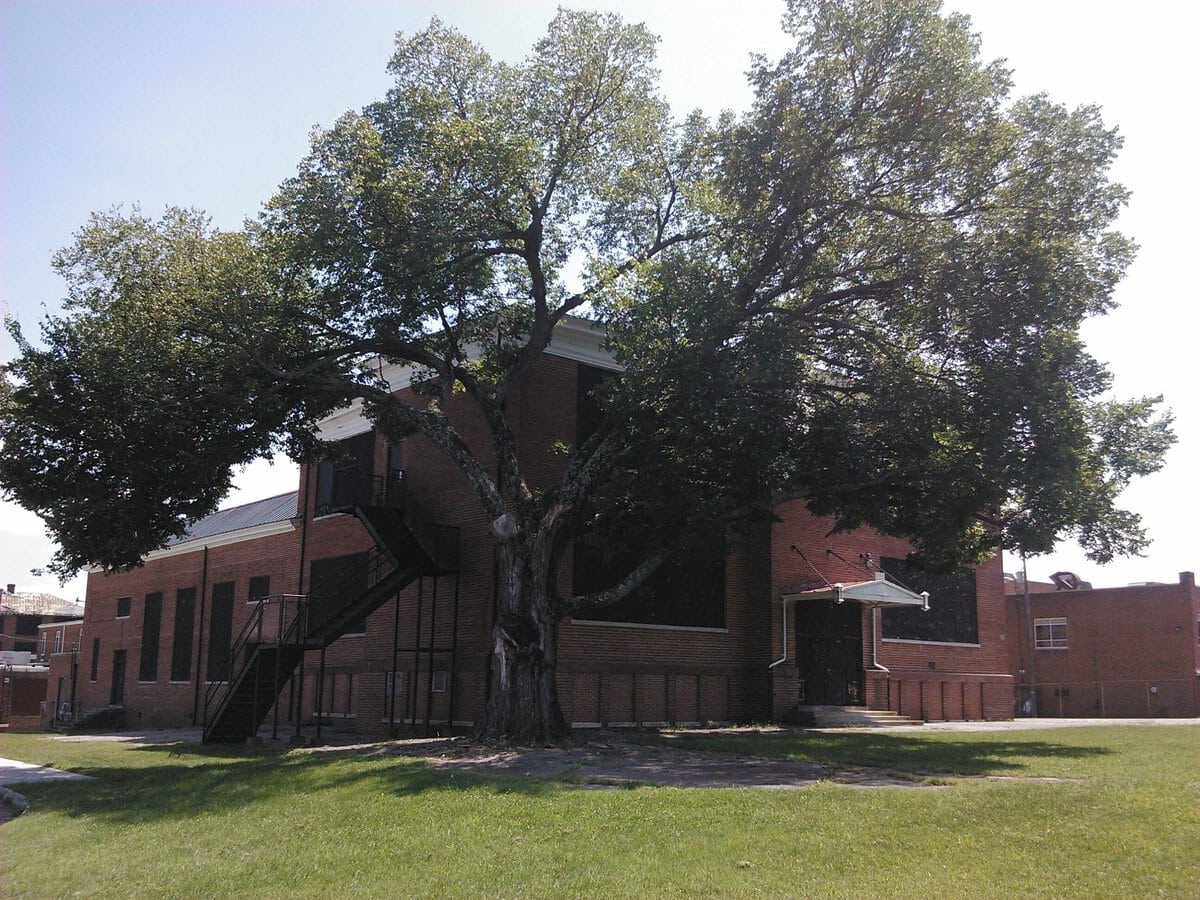
Peabody and Williams, joined by an arcade
An October 1915 proposal put the new school on the Bulifint property on Jones Street.
Charles M. Robinson finished the plans in 1917, and the war stalled the job.
The Peabody-Williams School opened in 1920: two stories of red brick, joined by an arcade and a cloistered walkway.
The Peabody side held the senior high school and an auditorium; Williams took the younger grades.
The Williams name honored the Reverend Henry Williams of Gillfield Baptist Church, who had pushed the city to let African Americans run its Black schools.
Peabody was the first Petersburg building put up solely as a high school for Black students, and it won accredited four-year status for 1921-1922.
Fire took the Williams half in 1967.
524 students walked into Wesley Street
Petersburg bought three parcels in 1948 and 1950 between Wesley, Jones, and Federal streets.
The new Peabody High School opened at 725 Wesley Street in September 1951 with 524 students, 29 teachers, and grades eight through eleven.
Enrollment under principal Abraham M. Walker had climbed from 281 in 1941 to 595 by 1952, and his tenure ended that September.
The school ran past the daytime timetable: an adult night school gave credit courses, and summer school started in June 1952.
Brown v. Board of Education came down on May 17, 1954. Peabody stayed segregated.
State officials spent years delaying integration, and Petersburg's dual system held.
Sit-ins downtown, then the last class
On February 23, 1960, 20 African American students, most from Peabody, sat down at the S. S. Kresge lunch counter and asked for service.
Smaller groups did the same at McLellan's and W. T. Grant. The counters closed.
Four days later, about 140 protesters, many from Peabody and Virginia State College, walked into the public library through the whites-only entrance and took the seats.
The library closed for four days, City Council passed an anti-trespass ordinance, and 11 who returned a week later went to jail.
On March 9, more than 1,400 people packed Zion Baptist Church, and six bomb threats came in during the meeting.
A few Peabody students entered all-white Petersburg High in 1963-1964.
The last Peabody High class graduated in June 1970, and the 1951 building became Peabody Junior High that fall.
Why the school closed, and what's left standing
The 1920 building joined the Virginia Landmarks Register in June 2000 and the National Register that August.
It is the oldest surviving Petersburg school building put up for the education of Black children.
By early 2017, bringing the complex up to current standards was priced at $40 million to $50 million, and Vernon Johns could take Peabody's students.
The School Board voted in February to move the students there, and Peabody Middle School closed on June 30, 2017.
Copper wiring was stripped out, and fire broke out on Christmas Eve 2020.
In 2023 Preservation Virginia named Peabody-Williams one of Virginia's most endangered historic places, citing deferred maintenance.
Alumni keep showing up at Council meetings.
Through May 2026 they and the Peabody Academic Learning and Development Center were still asking for custodial control, with plans for tutoring, job training, and a museum.
No transfer has been approved. The 1920 building is still standing, photographed in 2026.
Independent Publisher Notice
BestAttractions is an independent editorial publisher. We are not affiliated with, endorsed by, or acting on behalf of any location, business, property owner, manager, government agency, or organization described in this article. Comments posted on this page are not forwarded to, reviewed by, or acted upon by any entity mentioned in the article. For official inquiries, complaints, applications, bookings, or other requests, please contact the relevant entity directly through its official website or other verified channels.