
Spokane Valley Mall is a large enclosed shopping center on the north side of Interstate 90 in Spokane Valley, Washington. It opened in 1997 with three department stores anchoring a two-level concourse with about 75 shops and restaurants at opening, a food court, and a 12-screen cinema.
What makes it unusual is the gap between how long it took to build and how quickly it reshaped the retail geography around it. The site was under negotiation for nearly 20 years before a single wall went up.
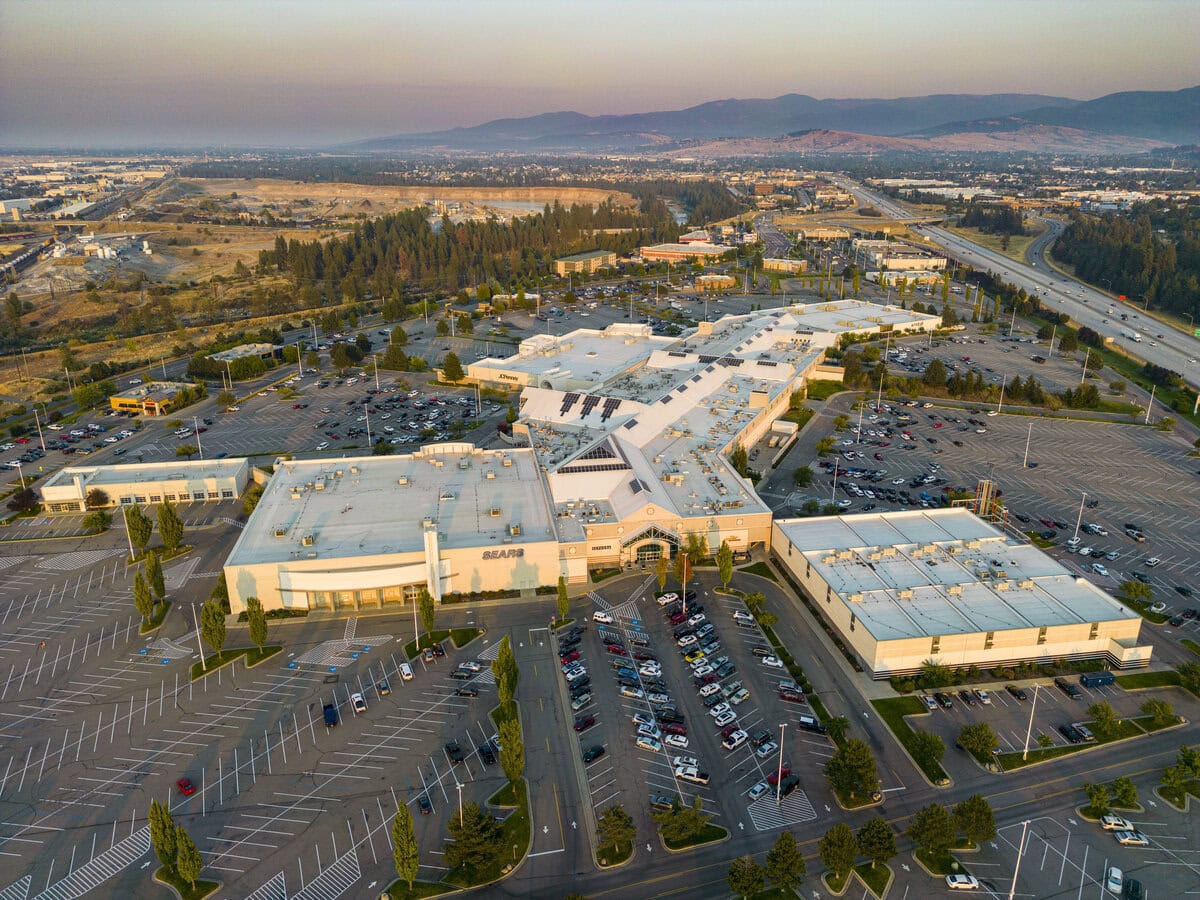
Two of its original three department stores are still operating. The third, Sears, closed in 2020 and left a 132,400-square-foot building sitting at the west end of the mall.
The mall is 28 years old. The question of what fills that west end is still open.
More Than 3,000 People Waiting at 9:45 a.m.
On August 13, 1997, the doors of Spokane Valley Mall opened, and more than 3,000 people walked in.
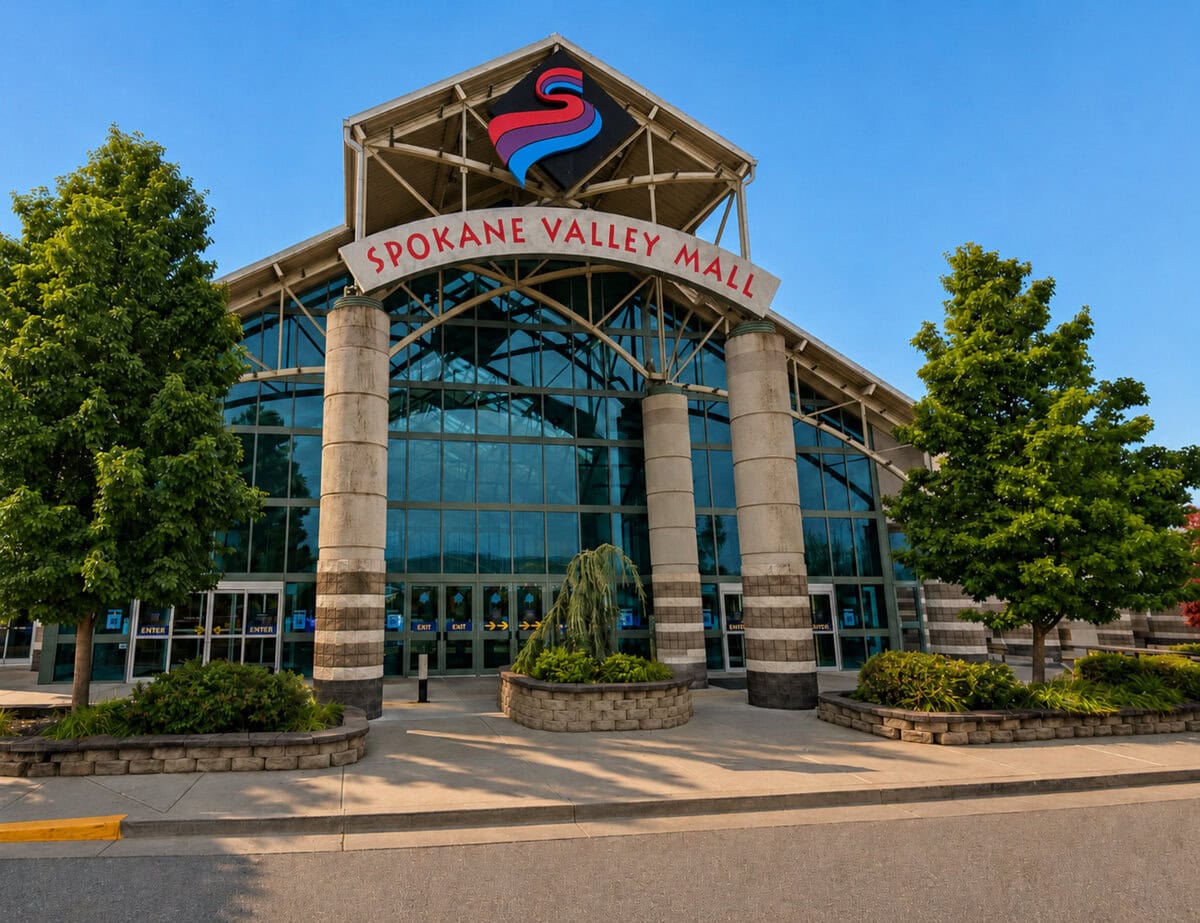
They entered through glass walls that reached to the ceiling, past indoor plantings and 13 preserved palm trees, into a two-level concourse lit by skylights and clerestory windows.
A central fountain area anchored the interior. Steel trusses framed the skylit corridors. Glass-block bridges crossed the concourse.
Three department stores, dozens of specialty shops, a 12-screen cinema, and a 500-seat food court waited inside.
The mall had been delayed for years. The morning it opened, the Valley showed up.
Twenty Years in the Making: The Long Road to Groundbreaking
The idea for a regional mall in the Spokane Valley was already nearly two decades old by the time that crowd arrived.
JP Realty Inc. of Salt Lake City had been in conversations with Valley landowner R.A. Hanson since the late 1970s.
The company secured an option on the 85-acre site in 1984 and bought the land in 1990 for $7.9 million. Then it waited.
Three separate starts were announced and postponed. An early anchor lineup built around Frederick & Nelson, Mervyn's, and Target fell apart when Frederick & Nelson entered bankruptcy, and Mervyn's withdrew.
Target opened separately on East Sprague Avenue. The real estate market of the late 1980s and early 1990s made financing difficult.
The site had a practical limitation: freeway access was not capable of handling the traffic a major regional mall would generate.
JP Realty became publicly traded in the mid-1990s and gained the capital that had been missing. Ground broke on April 18, 1996.
The shell construction contract, handled by Garco Construction and valued at $16 million, was expected to involve about 150 workers through Garco and its subcontractors, while overall mall construction was projected to create 250 jobs.
Projections anticipated 1,000 permanent jobs, $100 million or more in annual retail sales, and more than $1 million in annual sales-tax revenue.
Construction also became a public-policy pilot.
JP Realty worked with the Washington Department of Ecology and the REBAR Council to recycle or reuse construction materials, including gypsum board, metals, cardboard, and lumber.
The Centennial Trail ran near the site; debris accumulated along it was cleared, and contractors were directed to reduce construction impacts near the trail and river corridor.
The Anchors That Opened a Region
The Bon Marche opened first, beginning business on July 25, 1997, in a 120,000-square-foot space at the mall's east end.
JCPenney opened its 125,000-square-foot store on August 1. Sears opened during the August 13 program in a 134,000-square-foot space at the west end, the largest of the three anchors.
The ACT III cinema opened as a 12-screen theater during the same period.
The JCPenney move carried a direct consequence. The store transferred workers and customers from its former University City Shopping Center location, which closed shortly before the Valley Mall opened.
JCPenney had been one of University City's key anchors for years.
Its departure accelerated a decline at University City that continued for nearly two more decades; by 2015, demolition had begun on parts of the old complex, including the former JCPenney building, the arcade, and the parking ramp.
The specialty-store mix filled out a late-1990s regional roster: The Buckle, Gap, GapKids, Victoria's Secret, Wet Seal, Journeys, Foot Locker, Zumiez, Ben Bridge, Kay Jewelers, Bath & Body Works, Hot Topic, Spencer Gifts, and Waldenbooks, among others.
The food court opened with Cinnabon, Auntie Anne's, Orange Julius, and Taco Time. Thomas Hammer Coffee operated inside. Tilt provided the arcade.
Department stores, food, cinema, and arcade together made the mall a retail and entertainment destination, not just a shopping center.
60 percent of specialty space was occupied on opening day; 109,000 square feet sat behind temporary decorative barricades.
JP Realty expected to reach 90 percent occupancy by the holiday season. Occupancy reached 80 percent by the first anniversary.
Indiana Avenue and the Interchange Standoff
The Sullivan Road interchange served the mall at opening, but the scale of development planned nearby quickly overloaded it.
Spokane County imposed a moratorium on additional large-scale retail near the mall while a funding plan for a new Evergreen Road interchange remained unresolved.
The proposed interchange was estimated at $23.4 million, requiring state and county money plus private developer contributions.
JP Realty was expected to contribute $2.4 million; Inland Empire Paper $2.1 million.
R.A. Hanson had already spent $5 million extending Indiana Avenue from Pines Road to Sullivan Road to serve the mall and nearby projects.
A tentative funding deal emerged in October 1998. The Evergreen Road interchange opened on May 4, 2001, as Exit 291A at Interstate 90. The second access point unlocked additional development.
Spokane Valley Plaza, built in 2001, added 138,000 square feet of mixed-use retail just outside the mall and later included Nordstrom Rack, DICK'S Sporting Goods, TJ Maxx, Old Navy, and Buffalo Wild Wings.
Evergreen Crossing and other commercial projects followed along the same corridor.
JP Realty, General Growth, and the Consolidation of Spokane's Mall Market
After Spokane Valley Mall opened, JP Realty bought NorthTown Mall in north Spokane for $128 million, giving it control of both major enclosed regional malls in the metropolitan area.
It also owned Silver Lake Mall in Coeur d'Alene.
During the first year after Spokane Valley Mall opened, taxable sales at common retailers at NorthTown declined, a pattern that reinforced JP Realty's decision to acquire both properties and manage Spokane's enclosed-mall market from both sides.
General Growth Properties acquired JP Realty in July 2002 in a transaction valued at $1.1 billion, covering 18 regional malls, 26 community shopping centers, and associated properties.
During the financial crisis of the late 2000s, General Growth entered Chapter 11. Brookfield Asset Management became a major investor as part of the company's 2010 bankruptcy exit.
Brookfield Property Partners agreed to acquire General Growth's remaining shares in 2018.
The mall now operates under GGP Retail LLC branding.
NorthTown Mall followed a different path: sold to Kohan Retail Investment Group in 2022, while Spokane Valley Mall remained with the Brookfield-affiliated GGP structure.
Store Names Change, Retail Categories Shrink
In 2003, the Bon Marche name was replaced by Bon-Macy's. By March 2005, the store became Macy's.
The same east-end building, the same entrance, a different sign. Macy's continues to operate at 14740 E. Indiana Avenue.
Waldenbooks closed by January 31, 2010, as part of a national bookstore contraction.
Music stores, electronics retailers, and some youth apparel chains from the original tenant mix also disappeared during the 2000s and 2010s.
H&M opened its first Spokane-area store at the mall in 2012, after five smaller lower-level stores near Sears were relocated to create a larger contiguous space.
Vans opened near Sears in June 2012. DICK'S Sporting Goods opened at 14014 E. Indiana Avenue in November 2012. A restaurant space near the Regal theater, formerly an arcade and coffee-shop space, became Hops n Drops.
In May 2017, Spokane County Library District opened The BookEnd, a 2,200-square-foot library outlet in a second-floor space near Macy's, after plans for a full Valley library branch had not been funded.
The Sears Closing and the West End Question
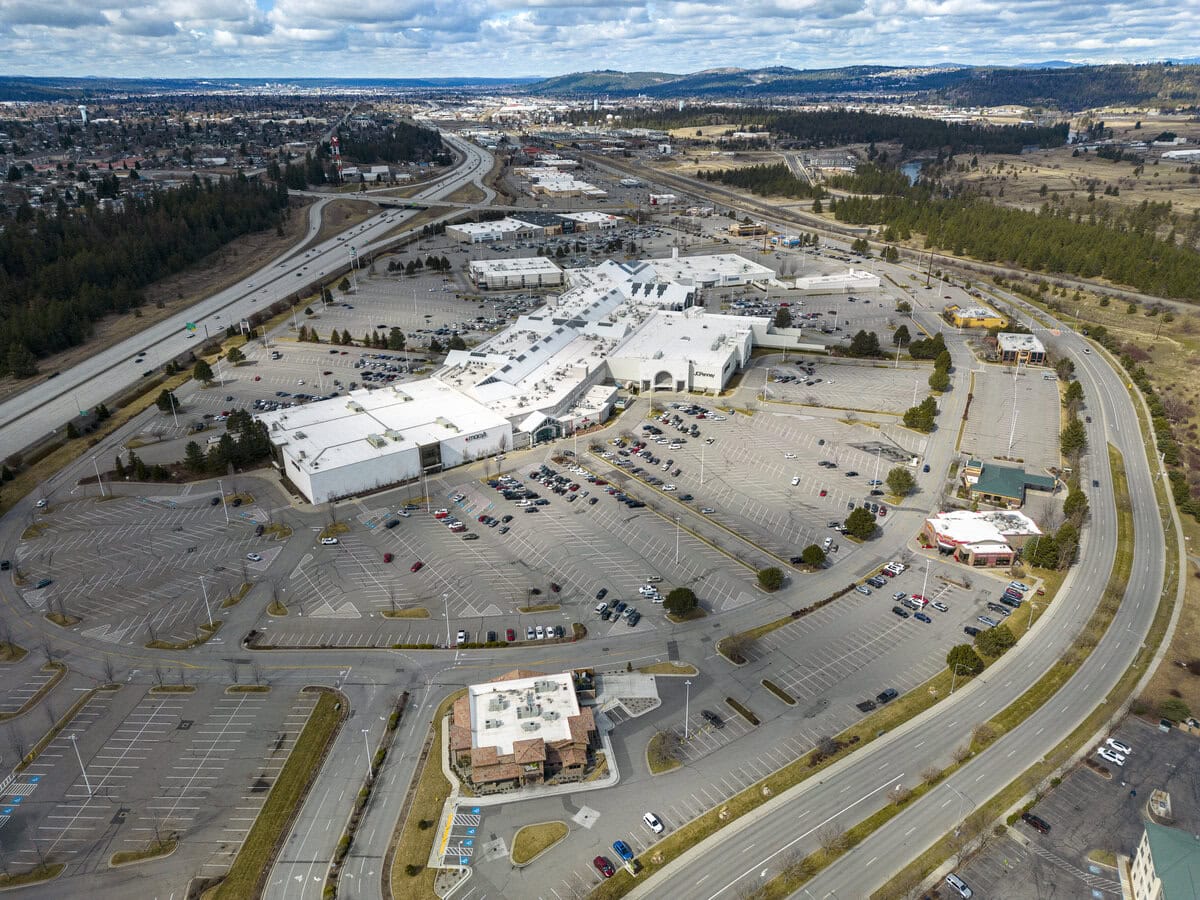
Sears had been the mall's largest original anchor. In November 2019, the company announced that the Spokane Valley Mall store would close as part of a national round of Sears and Kmart closures.
It closed in early 2020, removing the anchor that had held the west end since opening day.
The building left behind is the mall's most significant unresolved question.
At 135,000 square feet on about 9 acres, it is large enough for a single replacement anchor, multiple smaller tenants, entertainment conversion, or a hybrid approach.
Marketing materials describe it as a two-level former anchor box with freeway visibility from Interstate 90. No full redevelopment plan had been publicly approved as of spring 2026.
Commercial development continued in the surrounding district in 2024, including a Dave & Buster's project near the interstate and Evergreen Road interchange.
What Remains at 14700 E. Indiana Avenue
Spokane Valley Mall opened before Spokane Valley was a city. The city was incorporated in 2003; the mall had been open for six years.
It is still there, and still the commercial anchor of the valley's busiest retail corridor.
Macy's and JCPenney hold the east and central anchor positions they have occupied since 1997. Regal runs the cinema.
The food court serves customers on the upper level. More than 100 specialty stores, restaurants, and service businesses occupy the concourse.
Mall walkers are admitted before 11 a.m. A children's play area sits on the concourse. Electric-vehicle charging stations stand in the parking lot. Bike racks are at the entrances. Transit routes stop nearby.
The west end, where Sears stood for 22 years, is available. What replaces it will define the next chapter of a building that took 20 years to open and is approaching 30 years standing.
Independent Publisher Notice
BestAttractions is an independent editorial publisher. We are not affiliated with, endorsed by, or acting on behalf of any location, business, property owner, manager, government agency, or organization described in this article. Comments posted on this page are not forwarded to, reviewed by, or acted upon by any entity mentioned in the article. For official inquiries, complaints, applications, bookings, or other requests, please contact the relevant entity directly through its official website or other verified channels.