
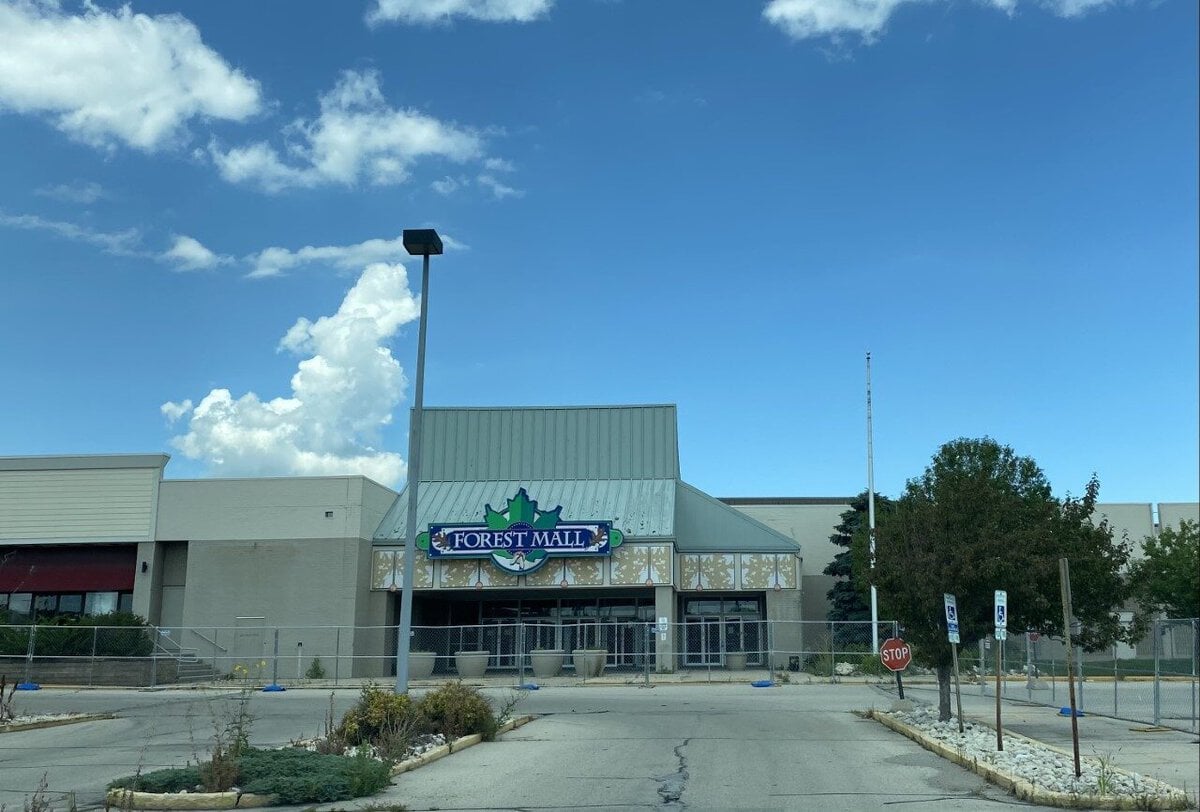
Forest Mall was Fond du Lac's indoor regional shopping center, a place where you could go from a department store, a discount store, a variety store, to a two-screen movie theater without going outside.
It opened in 1973 as the area's first mall like this.
At its busiest, it had a Wisconsin department-store chain, two national department stores, a discount store, a variety store, and many specialty shops, all linked by a covered walkway on West Johnson Street.
What made Forest Mall different was how much it changed the city's shopping areas.
The big stores that used to be downtown moved to West Johnson Street, and downtown never got that shopping role back.
The mall itself closed in 2020, and what replaced the building is not what anyone planned.
The Mall That Gave Fond du Lac an Indoor Shopping Street
When Forest Mall opened in September 1973, it was the first enclosed shopping center in the Fond du Lac area.
The mall's covered concourse connected J.C. Penney, H.C. Prange Co., Montgomery Ward, Prange Way, and G.C. Murphy under a single roof on West Johnson Street, giving shoppers a way to move between department stores and smaller shops without stepping outside.
In Wisconsin, that mattered. The mall held about 52 merchants at opening.
It was designed around the standard enclosed regional-mall formula of its era: anchors at either end, smaller tenants along the concourse between them, exterior entrances for each major store, and surface parking surrounding the building.
Several of the anchors had histories tied to downtown Fond du Lac or represented relocations from older city-center retail patterns, which meant Forest Mall did not simply add new retail space.
It shifted where Fond du Lac did most of its shopping.
How Forest Mall Took Nine Years to Open on West Johnson Street
Melvin Simon & Associates first announced plans for Forest Mall in 1964.
The mall did not open until September 1973, nine years later.
That gap reflected the scale of the project; enclosed suburban malls were still becoming the standard format for regional shopping in mid-sized American cities when Simon made the announcement.
The West Johnson Street location placed the mall near the Interstate 41 Johnson Street interchange, giving it access to local traffic and regional shoppers arriving from the highway.
Downtown had foot traffic and established shopping habits.
Forest Mall had parking, highway visibility, and a building designed entirely for car-oriented retail.
Prange's, Penney's, and the Wisconsin Department-Store Era
H.C. Prange Co. was a Sheboygan-based department store with a significant Wisconsin retail presence, and its Forest Mall location was paired with Prange Way, the same company's discount-store format.
Together, they gave the mall both traditional department-store shopping and discount retail under adjacent roofs.
J.C. Penney and Montgomery Ward provided national department-store anchors.
G.C. Murphy supplied the variety-store format common to shopping centers of that period.
A Copps Department Store was also part of the early commercial environment near the mall.
Those five primary anchors established Forest Mall as a serious regional shopping destination from its first year.
The mall was not just a row of smaller shops.
It was a collection of the same stores families had previously driven downtown to reach.
When those anchors appeared on West Johnson Street, downtown Fond du Lac lost its position as the primary place for department-store shopping.
That transfer was gradual and lasting.
The 1980s brought the first major anchor change.
Montgomery Ward left, and Kohl's eventually occupied the space.
In 1992, H.C. Prange Co. was sold to Younkers, which meant the Prange department-store name disappeared from the mall after nearly two decades, while Prange Way continued for several more years.
The anchor box stayed open and operating, but the store became part of the broader consolidation of Wisconsin and Midwest department-store chains rather than a local retail institution.
Prange Way, the discount format, filed for Chapter 11 bankruptcy protection in 1995 and was later replaced by Sears, which began operating at Forest Mall in 1997.
Each anchor replacement kept a large retail space active, but the original names that had defined the mall were fading.
Simon, Skylights, and the 1998 Renovation
Simon renovated Forest Mall in 1998, adding skylights and new flooring to the interior.
That work was typical of what 1970s enclosed malls were doing: refreshing the interior to stay competitive against newer power centers and big-box retailers that had begun drawing shoppers away from enclosed formats.
The renovation did not change the one-story layout or the basic anchor-concourse structure, but it modernized the interior environment and extended the property's competitive life.
At the end of 1996, Forest Mall carried a $12.8 million mortgage at a 6.74% rate, with annual debt service of $863,000 and a maturity date of December 15, 2003.
By the early 2000s, the property measured 501,400 square feet, wholly owned by Simon.
The anchors were operating, the ownership was stable, and the enclosed format still generated enough traffic to fill the concourse with specialty stores.
From National Chains to Local Fill: Forest Mall's Slow Decline
In 2006, new stores opened at Forest Mall, but most additions came from local operators rather than national chains.
By 2009, the mall had reduced rents and shortened lease terms to attract smaller businesses and keep space filled.
That approach worked well enough to maintain occupancy but showed that the property could no longer command the kind of lease demand that had characterized it in earlier decades.
National tenants that had built their retail presence partly inside enclosed malls, including American Eagle, Aeropostale, PacSun, and Victoria's Secret, eventually left Forest Mall.
Each departure made the enclosed concourse harder to sustain for the stores that remained.
Forest Mall Cinema I & II, the two-screen theater associated with Frank family theater operations since 1987, was still running.
Younkers and Sears were still in their anchor boxes, and Kohl's continued on the west side.
But the middle of the mall had already shifted toward a different and smaller kind of retail, and the national chains that had once lined the concourse were mostly gone.
2014: The Year Four Major Tenants Left
No single year did more damage to Forest Mall than 2014.
JCPenney announced early that year it would close 33 underperforming stores nationwide.
The Fond du Lac location was on that list, and the store closed by May, ending more than 40 years as one of the mall's original anchors and the last original anchor still operating under its original name.
Sears followed. Liquidation sales began on August 15.
The store and its Sears Auto Center, which employed 42 workers, closed by early November.
The cinema also shut down that year.
Three major traffic generators and one entertainment use were gone within months of each other.
Simon separated Forest Mall from its core portfolio that same year, moving it into the Washington Prime Group and later WP Glimcher collection of lower-performing properties.
The mall lost two anchors and its primary owner's direct investment interest simultaneously.
Younkers Falls and the Last Interior Tenants Leave
In early 2016, Forest Mall had been sold as part of a two-property transaction involving Northlake Mall in the Atlanta area, with a combined price of $30 million for both properties.
That price, for two properties together, signaled how far Forest Mall's market value had fallen from its Simon-era peak.
ATR Corinth Partners, a Dallas-based real estate investment firm, became the owner.
Younkers, operating in the former H.C. Prange Co. space on the east side of the mall, closed in 2018 as part of the Bon-Ton store-closing process, which eliminated Younkers locations across the Midwest.
The Fond du Lac store had 59 employees at the time.
Store-closing sales began February 1, 2018, and the closure removed the last traditional full-line department-store anchor still operating inside the enclosed structure.
By December 2019, the mall retained limited interior access, but Kohl's and Staples operated entirely from exterior entrances, unreachable from inside.
The concourse held only a small number of remaining businesses.
The mall closed as an indoor public space in January 2020.
Demolition, a Stalled Supercenter, and What Was Built Instead
Safety fencing and demolition equipment arrived in July 2020.
The enclosed mall structure came down along with the former anchor buildings on the east side, including the space that had housed Prange's and later Younkers.
Kohl's remained as a freestanding store at 913 W. Johnson Street.
Staples did not renew its lease and closed during the redevelopment process.
ATR Corinth Partners planned a Meijer supercenter of about 160,000 square feet for part of the former mall property.
That project targeted a build within 18 to 24 months.
By June 2021, Meijer owned the site but had set no construction date.
By January 2022, the Fond du Lac project was still not on Meijer's corporate build schedule.
Other parts of the redevelopment moved forward.
Fond du Lac approved a development agreement with ATR Corinth in December 2020 that provided $3.5 million in tax increment financing, with $1.5 million designated for Johnson Street improvements.
TJ Maxx relocated into the former Staples building in November 2021, keeping a major retail tenant at 835 W. Johnson Street.
Caliber Collision also received approval during this period to operate on the former Sears Tire property.
Work on a new property entrance began in 2022, temporarily restricting traffic lanes on West Johnson Street.
ThedaCare and Froedtert Health broke ground on a new medical campus at 755 W. Johnson Street in February 2024.
The 25,000-square-foot facility, built on land cleared after the mall's east side was demolished, represented a $35 million investment and opened April 16, 2025, as ThedaCare's ninth hospital.
It includes an emergency department, 10 inpatient beds, 24-hour physician coverage, and imaging and specialty services.
In its first year of operation, the facility recorded nearly 15,000 medical services, with 95% of patients treated onsite in Fond du Lac.
Forest Mall Redevelopment: What the Site Holds in 2026
The address 835 W. Johnson Street still appears on retail listings, but it no longer marks an enclosed mall.
TJ Maxx operates there. Kohl's is at 913.
ThedaCare is at 755.
The interior concourse, the cinema, the Prange/Younkers east anchor, and the former J.C. Penney and Sears spaces are all gone.
A 6-acre parcel and 61,100 square feet of space remain available for lease or sale as of late 2025.
Meijer still owns part of the property with no confirmed construction timeline.
The site continues to be marketed as Forest Mall Redevelopment, with Interstate 41 access and the surrounding Johnson Street commercial corridor listed as its primary advantages.
Those advantages reflect the site's continuing role in the west-side retail corridor.
The enclosed mall is gone. The location's commercial logic is not.
Independent Publisher Notice
BestAttractions is an independent editorial publisher. We are not affiliated with, endorsed by, or acting on behalf of any location, business, property owner, manager, government agency, or organization described in this article. Comments posted on this page are not forwarded to, reviewed by, or acted upon by any entity mentioned in the article. For official inquiries, complaints, applications, bookings, or other requests, please contact the relevant entity directly through its official website or other verified channels.