
Maricopa begins its working day by pointing north.
Before schools, stores, and recreation facilities settle into their daytime routines, traffic is already moving toward State Route 347, the main connection to Interstate 10 and the Phoenix metropolitan area.
The city offers space that many households can no longer afford closer to Phoenix, but it asks them to measure that space in hours as well as dollars.
That exchange defines ordinary life here.
Maricopa is a fast-growing Pinal County city of subdivisions, parks, schools, and shopping corridors, with an estimated 78,362 residents in 2025 - 34.8 percent more than its 2020 population base.
It feels roomy at home and compressed on the road.
Tuesday Morning Belongs to SR 347
A normal weekday depends heavily on where the adults work.
The mean commute is 36.6 minutes, and Maricopa's 2025 housing assessment found that 92.3 percent of employed residents left the city for work in 2022.
For a household sending one or two people toward Phoenix, Tempe, Chandler, or Mesa, the drive is not an occasional inconvenience.
It determines wake-up times, school-drop-off plans, and how much flexibility remains at the end of the day.
The corridor is also in the middle of a major change.
Initial paving on the 14-mile SR 347 improvement project began June 29, 2026, and work is expected to continue through the end of 2029.
The full project is designed to add a lane in each direction, build grade-separated interchanges at Riggs Road and Mammoth Way, and improve other intersections.
Residents may eventually gain capacity, but during construction they must plan around lane restrictions on the same road that already carries much of the commuter load.
Remote and hybrid work alter the calculation.
Census data shows that 97.2 percent of households have a broadband subscription, although that figure says nothing about the speed or reliability at a particular address.
A worker who stays home three days a week can use Maricopa as a quiet base and treat the northbound drive as a scheduled task.
Two daily commuters experience the city through a much narrower timetable.
Daily Life Is a Chain of Destinations
Maricopa does not operate like a compact town where one central block handles groceries, school, exercise, and dinner.
Its ordinary geography is a chain of destinations reached mainly by car.
John Wayne Parkway carries much of the commercial routine, while Copper Sky, Pacana Park, the Maricopa Library & Cultural Center, schools, and neighborhood shopping areas distribute family life across the city.
The municipal transit route shows both what is available and what is missing.
Its hourly weekday loop links Copper Sky with Walmart, Pacana Park, Central Arizona College, the library, the community center, Planet Fitness, and Bashas'.
Service runs from 8 a.m. to 4 p.m., so it can support daytime errands but not a typical Phoenix commute or evening shift.
For most households, the car remains the unit of daily flexibility.
The Housing Discount Changes Life at Home
The reason many households accept that arrangement is visible behind subdivision walls.
Zillow's typical home value for Maricopa was $345,384 in June 2026, compared with $410,222 in Phoenix.
The gap does not guarantee that every house is affordable, but it can move an extra bedroom, a yard, or a home office into reach for a household priced out farther north.
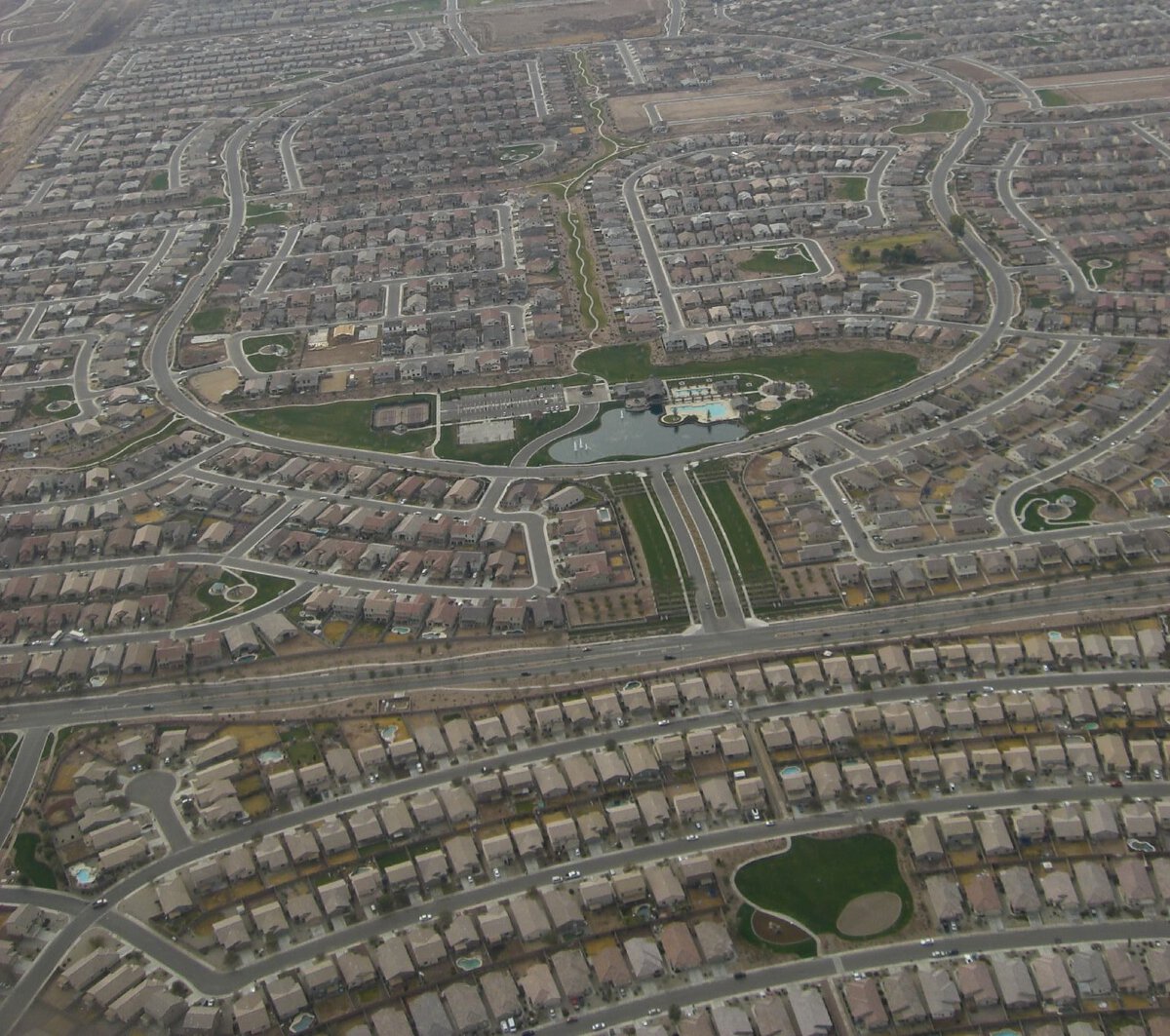
Detached houses dominate the physical and social landscape.
The city's housing assessment, using 2023 Census estimates, found that 96.4 percent of the housing stock was single-family detached.
Apartment construction has expanded since 2022, yet attached ownership and small-unit choices remain limited.
Maricopa therefore suits households that want private indoor and outdoor space better than people seeking a large supply of compact homes near walkable services.
The benefit is not merely square footage.
A spare room can make remote work practical, while a yard can absorb children's play or a dog.
The same low-density pattern also spreads destinations apart and makes spontaneous walking less useful.
Renters do not automatically escape the trade-off.
The Census Bureau places median gross rent at $1,998, and the housing assessment found that 50.8 percent of renter households were spending more than 30 percent of income on rent.
Maricopa can be less expensive than some Phoenix-area choices without functioning as a low-cost refuge for a single-income renter.
Community Happens on a Schedule
Maricopa's social center is not a dense restaurant district.
It is a network of schools, recreation facilities, library rooms, sports fields, and planned events.
That pattern matters in a city where 27 percent of residents are under 18, and the public school district serves more than 9,950 students across 11 schools.
Copper Sky carries much of the load.
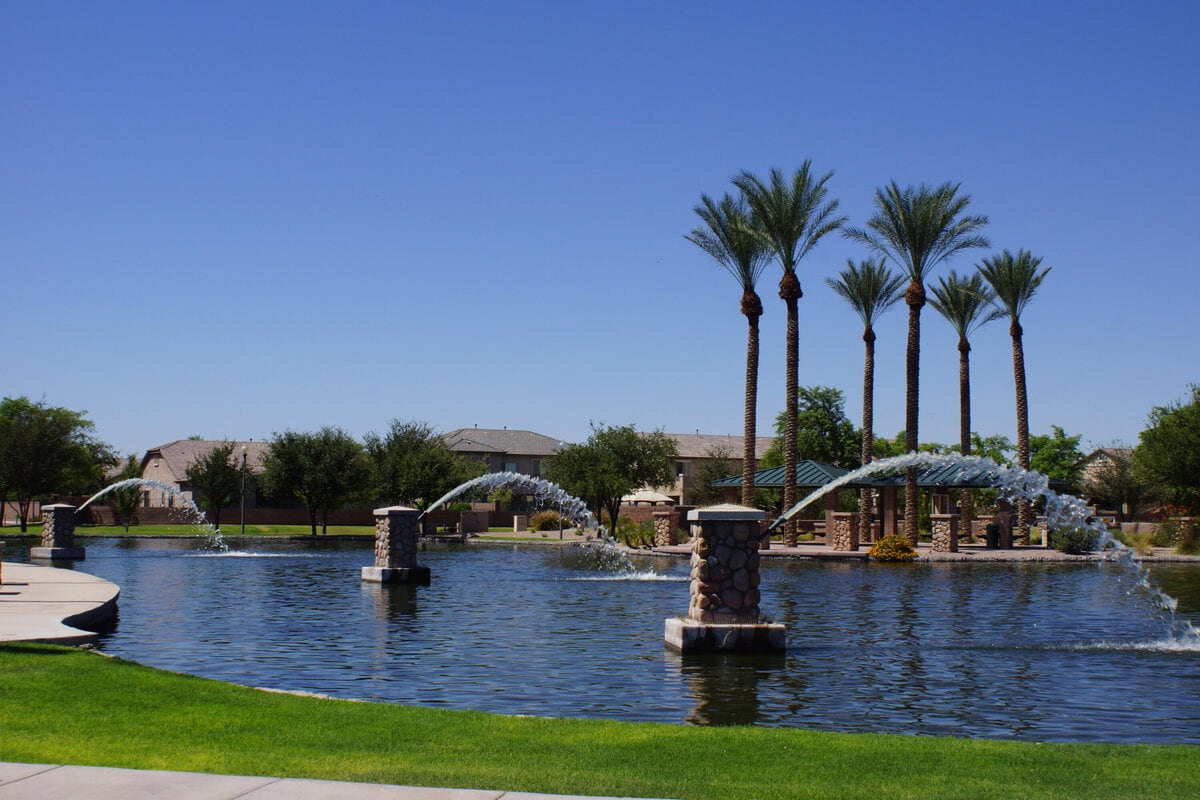
Its recreation complex combines an aquatic center, fitness facilities, indoor programs, sports fields, playgrounds, a lake, courts, and event space.
Pacana Park adds about 28 acres with fields, a fishing lake, a walking path, a dog park, a playground, and picnic ramadas.
These are not decorative amenities at the edge of daily life; they are places where exercise, youth sports, birthday gatherings, and after-school time can happen without leaving town.
The Library & Cultural Center serves a different routine.
Beyond books and digital resources, it has study rooms, community programs, and a contract postal unit.
Municipal celebrations and recreation programs add larger moments to the calendar, but much of the community texture comes from repeated, organized participation rather than casual street life.
That distinction helps explain why some newcomers settle quickly and others do not.
A family ready to enroll in sports, attend library programs, or use the recreation center has obvious entry points.
Someone expecting to meet neighbors simply by walking to cafés and small shops may find the city socially thinner than its population suggests.
A Saturday Can Stay Local
A realistic Saturday does not need to become a day trip to Phoenix.
It can begin at Copper Sky, continue through a library visit or grocery run, and end at Pacana Park or a scheduled community event.
The day will usually be assembled by driving between those stops.
Sports fields, playgrounds, aquatic facilities, and reservable gathering spaces support family routines that can repeat every week.
The Fieldhouse at Copper Sky is scheduled to add indoor basketball, volleyball, and pickleball space in late summer 2026, addressing the limits that severe heat places on outdoor play.
Adults looking for a more urban weekend face a different choice.
Maricopa can cover exercise, errands, children's activities, and a casual meal, but a broader evening built around walkable dining, live entertainment, or several venues close together generally requires a drive elsewhere.
The limitation comes from the city's form, not from an absence of residents.
Summer Moves the Clock
Heat changes when ordinary tasks feel reasonable.
National Weather Service guidance treats 100-degree days as a recurring feature of the lower desert warm season.
Outdoor exercise, dog walking, playground time, and yard work shift toward early morning or later evening, while parked cars and cooling costs become part of the household routine.
Monsoon conditions add a less predictable layer.
Strong outflow winds, blowing dust, lightning, and brief heavy rain can disrupt driving even when rainfall at the house is limited.
The useful response is practical rather than dramatic: residents need weather alerts, shaded or indoor alternatives, and enough schedule flexibility to avoid treating every outdoor plan as fixed.
Winter repays some of that adaptation as parks and patios become comfortable for longer stretches of the day.
People who value mild winters may accept months of heat more readily than those who resent early-morning summer scheduling.
What Starts to Wear After the Move
The commute is the most obvious long-term friction, but its effects spread.
Fuel, maintenance, and the need to coordinate vehicles sit beside the mortgage or rent.
A late meeting in Phoenix can erase an evening at home, and current SR 347 construction adds uncertainty until the widening project is complete.
Rapid growth creates another form of friction.
Some commercial areas and services still feel distributed rather than complete.
School quality and assignment should be checked by address, while citywide public-safety data cannot answer whether a particular street or subdivision will suit an individual household.
Maricopa also asks residents to be honest about what they routinely need outside the city.
Frequent specialist appointments, work in the central metro, or a strong preference for varied nightlife and walkable cultural venues can turn the location into repeated travel.
An occasional trip is easy to dismiss during a home tour; a weekly obligation becomes part of life.
Who Fits Maricopa, and Who Does Not
Maricopa works best for households that will use the space they gain.
Families who want a detached home, parks, youth activities, and a quieter subdivision routine have clear reasons to stay local.
Remote and hybrid workers are especially well positioned because they can keep the housing advantage while reducing exposure to SR 347.
The fit weakens for a daily Phoenix commuter who already resents driving, a single renter seeking genuinely low housing costs, or anyone who wants errands and entertainment to unfold on foot.
It is also a difficult match for people who need frequent access to specialized metropolitan services and do not want those appointments to consume half a day.
Maricopa is not simply a cheaper version of Phoenix.
It offers a different routine: more private space, strong family recreation infrastructure, and an organized community life, balanced against car dependence, desert heat, and a commuter road that governs the week.
The move makes sense when the house and local routine are valuable enough to justify the time between them and the rest of the metro.
Housing data source: Zillow Home Value Index, June 2026.
Data Provided by Zillow Group.
On the map: Maricopa, AZ 85138
References
U.S. Census Bureau QuickFacts for Maricopa, Arizona - https://www.census.gov/quickfacts/fact/table/maricopacityarizona/PST040225
City of Maricopa 2025 Housing Needs Assessment - https://www.maricopa-az.gov/files/assets/city/v/1/development-services/documents/adopted-maricopa-housing-needs-assessment.pdf
Zillow Home Value Index for Maricopa - https://www.zillow.com/home-values/32697/maricopa-az/
Zillow Home Value Index for Phoenix - https://www.zillow.com/home-values/40326/phoenix-az/
Arizona Department of Transportation SR 347 Improvement Project - https://azdot.gov/sr-347-improvement-project
City of Maricopa transit route and schedule - https://www.maricopa-az.gov/Departments/Transit
City of Maricopa parks and facilities - https://www.maricopa-az.gov/Departments/Parks-Recreation/Parks
City of Maricopa Copper Sky Recreation Complex - https://www.maricopa-az.gov/Departments/Parks-Recreation/Copper-Sky
Maricopa Library & Cultural Center - https://www.maricopa-az.gov/Departments/Maricopa-Library-Cultural-Center
Maricopa Unified School District - https://www.musd20.org/
National Weather Service Phoenix heat guidance - https://www.weather.gov/psr/heat
Independent Publisher Notice
BestAttractions is an independent editorial publisher. We are not affiliated with, endorsed by, or acting on behalf of any location, business, property owner, manager, government agency, or organization described in this article. Comments posted on this page are not forwarded to, reviewed by, or acted upon by any entity mentioned in the article. For official inquiries, complaints, applications, bookings, or other requests, please contact the relevant entity directly through its official website or other verified channels.