
Superstition Springs Center is an enclosed two-level shopping mall in east Mesa, Arizona, the largest in the city when it opened in 1990.
It was built the standard way: department stores at the corners, smaller shops strung along the corridors between them, a food court and a theater in the middle.
The unusual part is what's there now.
Arcades, claw-machine rooms, a blacklight miniature-golf course, and a sporting-goods clearance store sit where full-line department stores used to be.
Two of the original anchors still operate.
Others are gone. The mall stays open by leaning on the pieces it was never built to depend on.
Superstition Springs Center's Carousel Almost Left for Good
For years, a double-decker carousel turned inside Superstition Springs Center, 26 feet tall and built on two levels.
In December 2025, word spread that it was leaving.
It half left.
The original operator planned to run the tall version through February 2026, and a smaller single-level carousel would open in its place that spring.
The ride lost a level. It kept its spot.
That's more than the mall's two biggest department stores managed.
The carousel belonged to a mall that opened in 1990 as the largest in Mesa.
The owners meant it to be more than a row of stores.
Kids' play areas, an outdoor amphitheater, and a fountain gave families and teenagers a reason to come on weekends.
A food court and a theater carried the social hours.
A decade earlier, far east Mesa had been mostly open land and suburban fringe.
Now it had the closest thing to a gathering place under one roof.
Why East Mesa's Population Boom Built Superstition Springs
Between 1980 and 1990, Mesa nearly doubled.
The city grew from 152,000 residents to 288,000, up 89 percent, and most of that growth pushed east.
A mall this size needed a wide trade area to survive, and the East Valley finally had the households to fill one.
The freeway arrived in pieces.
The Superstition Freeway reached Dobson Road in July 1977, but it didn't connect to U.S. 60 near Apache Junction until 1991, a year after the mall opened.
So the center opened into a half-finished road network, ahead of the traffic it was built to capture.
It pulled shoppers from east Mesa, Gilbert, Apache Junction, and other communities to the southeast.
It wasn't Mesa's first enclosed mall, either.
Tri-City Mall opened in 1968, Fiesta Mall in 1979.
Superstition Springs Center pushed large-scale indoor retail farther east than either, following the new rooftops.
A Valley Metro connection later tied the mall to the light-rail station at Sycamore and Main Street, though the place was always built for cars.
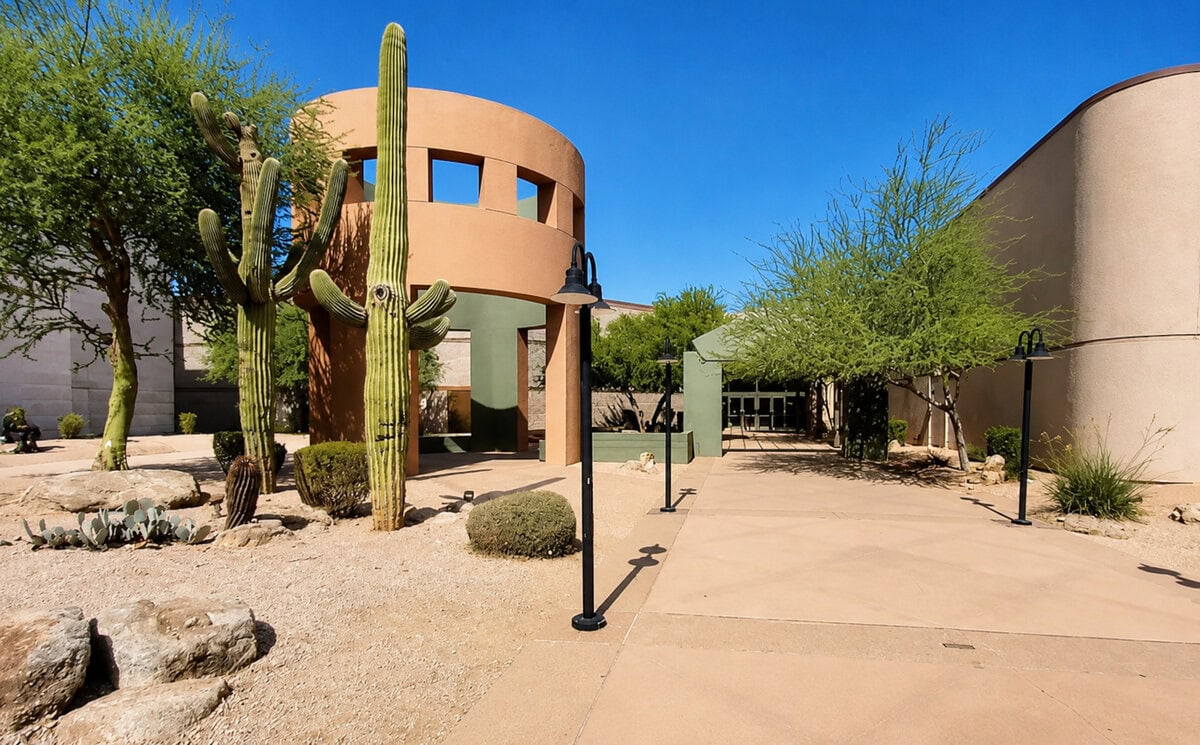
Building Superstition Springs Center as a Two-Level Mall
Westcor and General Growth Properties developed the center as a ground-up regional mall covering 1,285,800 square feet.
Rafique Islam designed it. The Weitz Company built it.
The design was conventional for its moment: two levels, department stores around the perimeter, specialty shops strung along the enclosed corridors between them.
That layout had a logic.
Shoppers heading for a department store had to pass the smaller stores and the food tenants on the way, so the anchors fed traffic to everyone else.
The whole building ran on it.
Years later, when the big stores closed, that traffic flow was the first thing to break.
The Department-Store Years: Sears, Macy's, Dillard's
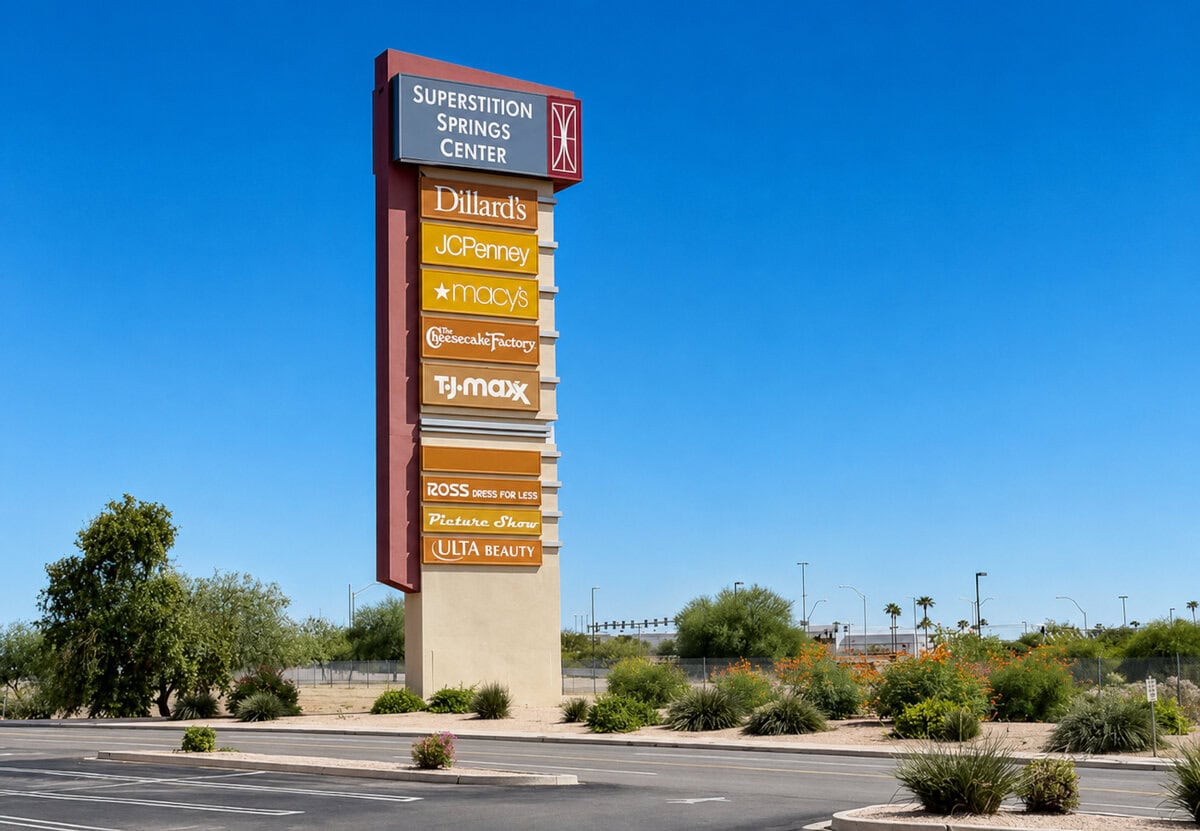
The anchor lineup once read like a directory of American retail: Dillard's, JCPenney, Sears, and the department-store box that later operated as Macy's.
In 2012, the mall still had six large stores, adding Best Buy and Burlington Coat Factory to the four department stores, across 1,207,000 square feet with 92.3 percent leased.
The Macy's name arrived through a corporate reshuffle, not a new store.
Federated Department Stores bought May Department Stores in 2005 and converted most May Company locations to the Macy's nameplate in fall 2006.
The sign changed. The box stayed.
Dillard's and JCPenney held their spots, and JCPenney added an optical shop, a portrait studio, and a salon.
For most of the mall's first two decades, the full department-store roster stayed intact, and that was the stretch when an enclosed mall like this one sat at the top of the regional shopping order.
Who Owned the Mall: Westcor, Macerich, and a 2011 Swap
Superstition Springs Center started as a Westcor property, and Westcor was one of Arizona's most important mall developers.
That made its portfolio a target.
On July 26, 2002, Macerich bought Westcor Realty Limited Partnership and its affiliates for $1.48 billion, a deal that brought nine regional malls in Arizona and Colorado into Macerich's hands.
Superstition Springs Center came with them.
Ownership shifted again in 2011. Macerich and General Growth Properties traded assets.
Macerich took General Growth's one-third interest in the mall and a larger share of the land beneath it.
General Growth received six big-box locations in several states plus $75 million in cash.
When the swap closed, Macerich owned two-thirds of the mall and all of the land under it.
Full ownership followed. By the end of 2024, Macerich owned all of it.
Controlling the land mattered more than it sounds.
An owner that holds the parking fields and the dirt under an anchor can tear that anchor down and build something else.
That redevelopment flexibility would matter later.
In a related move, Macerich sold the separate Superstition Springs Power Center, a 204,000-square-foot center nearby, in July 2023 for $5.6 million and used the money to pay down debt.
Losing Sears and Macy's: Two Anchors, Two Closures
Sears went first.
In October 2018, during the Sears bankruptcy, the Superstition Springs store landed on the closure list, and it closed by the end of that year.
Four years later, the space still sat empty.
A large vacant anchor is a problem for an enclosed mall.
It occupies prime real estate, drags down the foot traffic that once flowed past it, and leaves a dark corner where a busy store used to be.
In 2022, Seritage Growth Properties, which had taken control of much of Sears' real estate in a 2015 transaction, submitted preliminary plans to the Mesa Planning Department to demolish the old Sears and build a 254-unit apartment complex.
They designed it as a separate building so the mall could keep operating around it.
As of June 1, 2026, the public record shows the proposal but no finished apartments and no confirmed demolition.
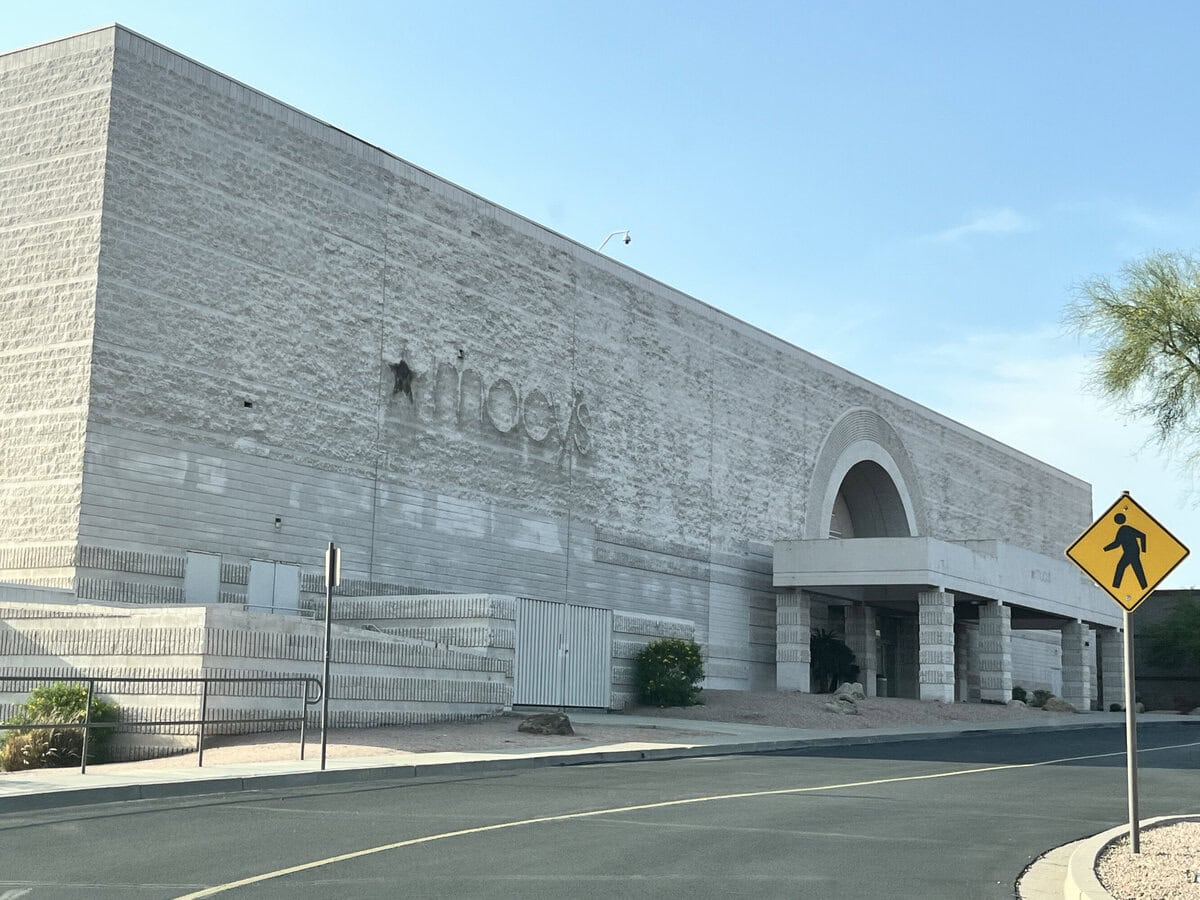
Macy's was second to go.
On January 9, 2025, the chain named the Superstition Springs store among 66 closures in a plan to shut 150 stores over three years.
By later that year, Mesa dropped off the Macy's Arizona store list entirely.
The loss showed up in the mall's own numbers.
Total leasable space fell from 954,000 square feet at the end of 2024 to 794,000 a year later, almost all of the drop tied to Macy's leaving the anchor roster.
Claw Machines and Off-Price Stores Fill the Old Mall
What replaced the department stores isn't a department store.
By the end of 2025, the company-owned anchor was Going, Going, Gone!
by Dick's Sporting Goods, a clearance-format store on the upper level near Ulta Beauty.
Ross Dress for Less, T.J. Maxx, and Ulta filled out the large-format mix with off-price clothing and beauty.
The leased rate actually rose, from 87.7 percent at the end of 2024 to 90.2 percent a year later, even as the building got smaller.
The rest of the space went to uses a department store never imagined.
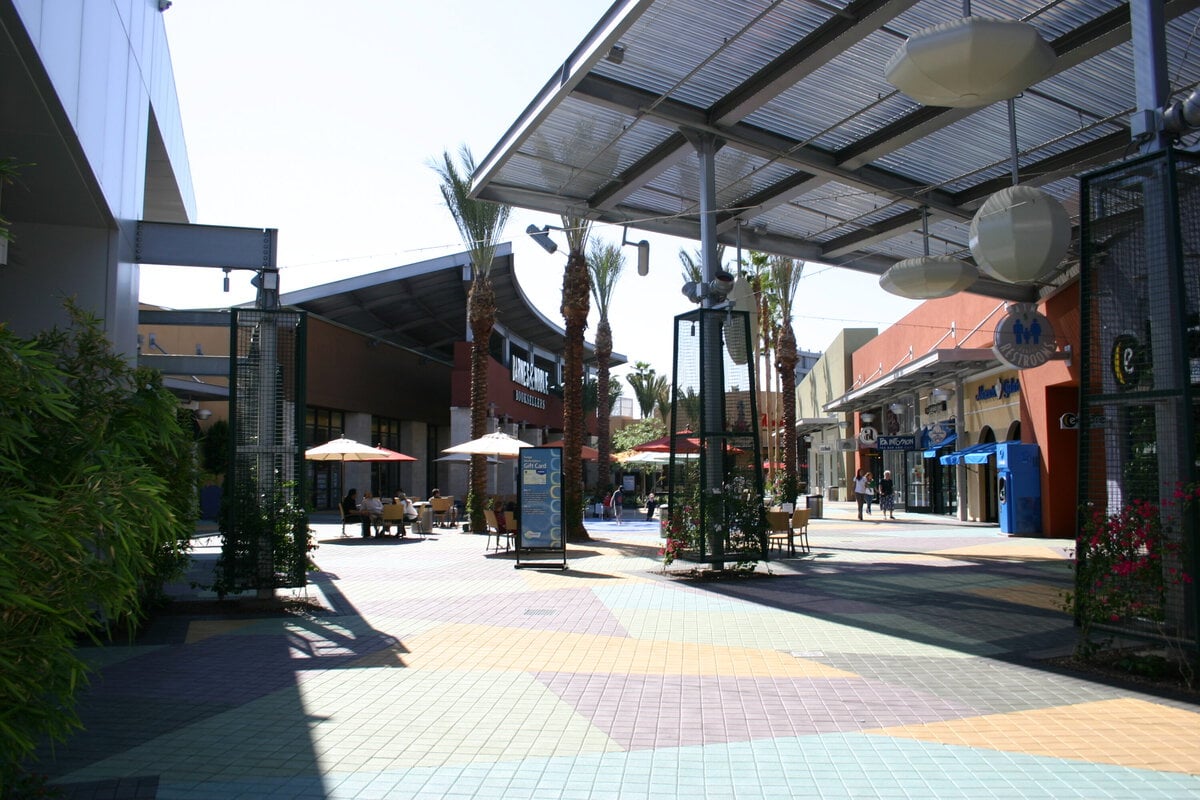
The mall now holds arcades, a blacklight miniature-golf course, claw-machine rooms, toy shops, and game stores, all beside familiar mall names like Hollister, Victoria's Secret, and Hot Topic.
Picture Show runs an eight-screen theater, remodeled with new seats and upgraded projection and sound.
These are the tenants that give you a reason to come over in person, the kind of trip online shopping has a hard time replacing.
What Superstition Springs Center Is Today
The mall is open Monday through Saturday from 10 to 8 and Sunday from 11 to 6.
Two of the original department stores, Dillard's and JCPenney, still hold their two-level boxes.
The Cheesecake Factory still operates as an exterior restaurant.
The food court still sits at the center of the building, the management office tucked behind it past the restrooms.
Macerich counts the property among the centers it plans to keep.
It's also visibly thinner than it was.
Seventeen spaces sat available for lease as of June 1, 2026: eleven storefronts and six small storage units.
Total leasable area has fallen by more than 400,000 square feet since 2012.
Sears is vacant with an apartment plan attached to it.
Macy's is gone.
What remains is the part that was never really about the stores.
The carousel still turns, shorter by a level.
The eight-screen theater still fills its seats.
Families still come for the games, the food court, and the movies, the same kind of trip people made in 1990, when the building was new, and the freeway out front hadn't yet reached Apache Junction.
The anchors that were supposed to be the whole point turned out to be the part the mall could lose and still do its job.
Independent Publisher Notice
BestAttractions is an independent editorial publisher. We are not affiliated with, endorsed by, or acting on behalf of any location, business, property owner, manager, government agency, or organization described in this article.
Comments posted on this page are not forwarded to, reviewed by, or acted upon by any entity mentioned in the article.
For official inquiries, complaints, applications, bookings, or other requests, please contact the relevant entity directly through its official website or other verified channels.