
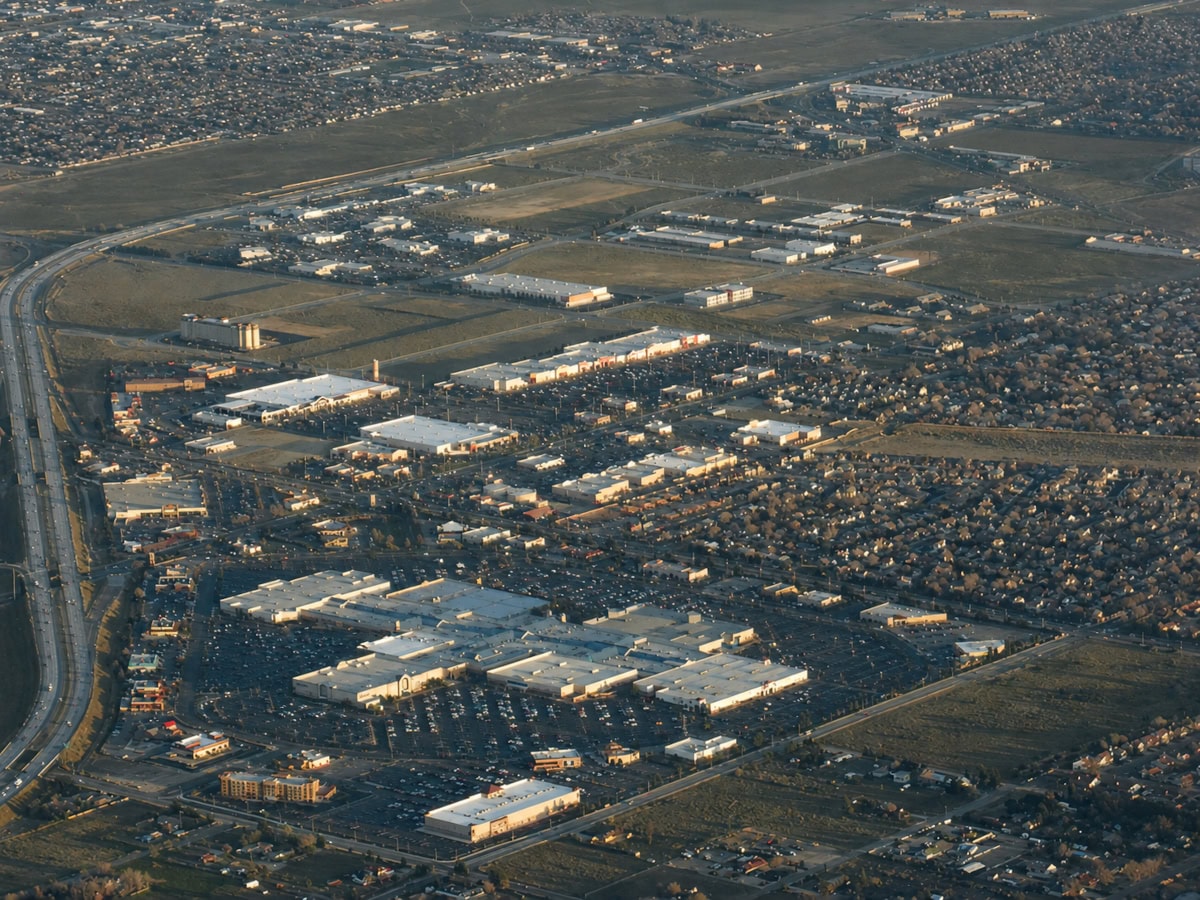
Drive the Antelope Valley, and you'll pass it off State Route 14: Mershops Antelope Valley Mall, the only enclosed regional mall Palmdale, California, has ever had.
It opened in September 1990, on scrubland that held Joshua trees a few years earlier.
Four anchors, a food court, more than 100 shop spaces. The 10-screen theater followed in 1991.
The first time the valley's nearly 200,000 residents didn't have to drive 40 miles to shop.
Anchors have come and gone since: Gottschalks, Mervyn's, and Sears out; Macy's, Dillard's, and Dick's in.
A 16-screen Cinemark opened outside the mall after the original theater closed.
35 years on, it's still the center of gravity for a region that works at Edwards, Lockheed, and NASA.
Antelope Valley Mall opens in 1990
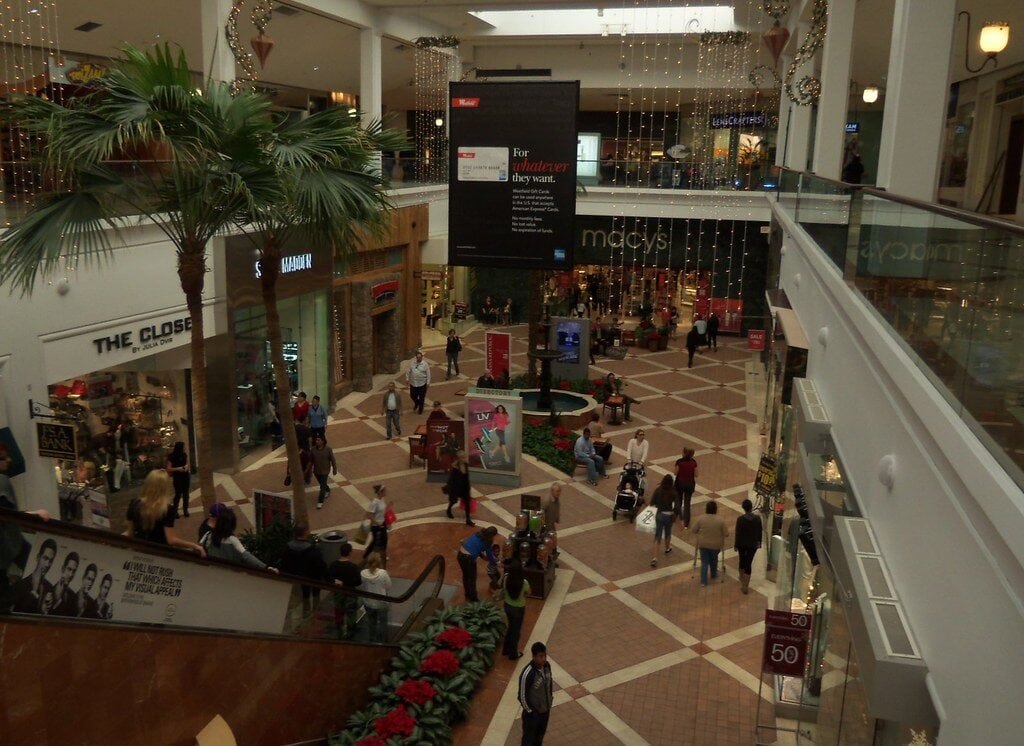
When the doors opened on September 24, 1990, the inside was pale pink. Green steel columns rose beneath the skylights.
Five fountains ran, and at least 100 trees grew indoors, with clerestory windows overhead.
Outside: tan stucco and brick, one story, surface parking in every direction.
This was Antelope Valley Mall, at what is now 1233 Rancho Vista Boulevard in Palmdale, California, just off State Route 14 in the high desert north of Los Angeles.
It was the first enclosed regional mall the Antelope Valley had ever had.
The design was a high-desert take on Mediterranean style: warm stucco and brick, natural light, and indoor planting to soften long single-level corridors.
Many bigger Southern California malls stacked two or more retail levels. This one spread out flat across 82 acres of former scrubland.
A few years earlier, the site was Joshua trees and scrub brush.
By opening day, it held 750,000 square feet, four department stores, a food court, and roughly 120 shop spaces, about 78% of them leased before the public walked in.
The 10-screen theater followed in 1991. The later anchors and second-phase additions would push it toward 1 million square feet over the next decade.
The desert had its mall. The fight to put it there had been the real story.
Why Palmdale fought Lancaster for the project
Palmdale and Lancaster sit about 10 miles apart, and in the late 1980s they were chasing the same prize: a regional mall and the sales tax attached to it.
Lancaster was bigger and had the older retail base. Its taxable sales ran $390 million in 1984 and $648 million by 1988.
Palmdale was smaller but climbing faster, from $91 million to $196 million over the same four years.
What Palmdale had was land. Open, freeway-accessible high desert, the kind department-store chains wanted.
The valley held nearly 200,000 residents and no real regional center, so people drove 40 miles to shop in the San Fernando Valley, or farther out toward Victorville.
The chains favored the Palmdale site. The city committed street and infrastructure money to seal it.
Officials expected $2 million a year in sales tax, a large figure for Palmdale then.
Forest City Commercial Development took the lead and budgeted $75 million.
The anchors that moved in from Lancaster
Two of the four opening anchors weren't new stores. They were defections.
Sears had been in Lancaster more than 30 years and was one of that city's biggest sales-tax producers.
It moved into a 132,000-square-foot box at the new mall.
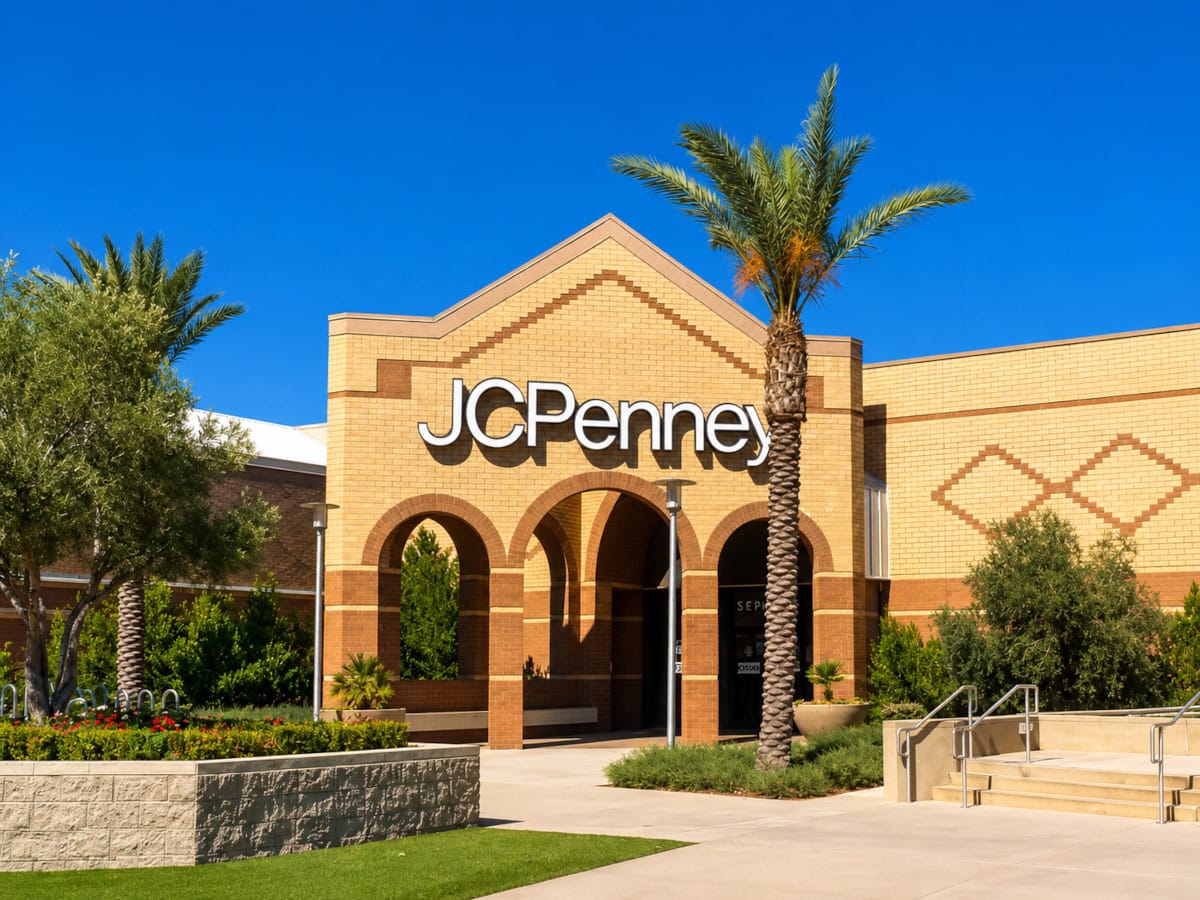
JCPenney had been in Lancaster more than three decades and also ran an older Palmdale store at Palmdale Plaza that dated to 1958.
It folded everything into a 115,000-square-foot store at the mall and opened early, on August 30, 1990, weeks ahead of the rest of the building.
The other two anchors, Harris and Gottschalks, were new to local shoppers.
JCPenney's exit left a hole at Palmdale Plaza, the old downtown center on Sierra Highway. That hole would matter.
What the move did to old downtown
Palmdale Plaza had opened in the late 1950s and once held a strong spot on Sierra Highway.
After JCPenney left for the freeway, the foot traffic followed.
Lancaster lost legacy anchors it had counted on for decades. Palmdale gained a high-visibility center and a bigger slice of regional sales tax.
By late 1991, the strip north of downtown and south of Avenue P was the strongest commercial district in the city.
By early 1992, the mall was the single largest generator of Palmdale's sales tax.
Its rents started higher. Palmdale's existing shopping centers had been collecting 85 cents to $1.40 a square foot a month.
Mall space was set to start near $1.40 and climb from there.
A Palmdale Auto Mall went up nearby at the same time, and more shopping centers filled in along the freeway.
The Antelope Valley Freeway had already been draining traffic off Sierra Highway for years.
The mall sped it up, moving big retailers and shoppers west all at once.
The eight-anchor plan that never arrived
Forest City always wanted more.
Before opening day, the developer was describing a second phase that could nearly double the place to 1.5 million square feet and run eight department stores.
An earlier sketch had called for six. Some of it happened.
In January 1992, the city council cleared a 75,000-square-foot Mervyn's on six acres next door, the first of the planned second-phase anchors, set to open that October.
The biggest later addition came at the end of the decade.
Dillard's picked the mall for its first store anywhere in Southern California, a 150,000-square-foot, two-story building that broke the property's single-level pattern.
By the time construction started in 1998, the mall was about 90% occupied, with Sears, JCPenney, Mervyn's, Gottschalks, and Harris all in place.
Dillard's opened in November 1999, with nine other retailers planned around it.
Eight anchors never arrived. Six did, and that turned out to be the high-water mark.
When Gottschalks and Mervyn's collapsed
The late-2000s downturn took two anchors at once.
Gottschalks had an odd footprint by then, running two large spaces at the mall.
In September 2008, it sold its wholly owned 105,000-square-foot store to Forest City for $12 million and planned to consolidate into a second 92,000-square-foot space.
Then the chain collapsed in 2009, and both spaces went dark. Mervyn's had already started liquidating in 2008.
Two giant boxes empty, in a mall built around anchors. Macy's took one.
In fall 2010, it opened a 110,000-square-foot store in a former Gottschalks space, its first location in the Antelope Valley, with the city's redevelopment agency putting up $5 million to land it.
A few years later, Dick's Sporting Goods moved into part of a 95,000-square-foot free-standing building that had also been Gottschalks.
The original 10-screen theater gave way to a 16-screen Cinemark with stadium seating, and the vacated interior cinema became restaurant space, including a Claim Jumper.
Mervyn's old box became a Forever 21. For a while, every empty anchor found a tenant.
Sold, then sold again for $60 million
Forest City stayed with the mall for nearly its whole life, then sold its remaining stake in a portfolio deal.
In October 2017, it agreed to sell its ownership interest in 10 regional malls to QIC in a transaction valued at $3.18 billion.
The Palmdale property changed hands on January 22, 2018.
QIC kept it for almost five years. The city's long-running deputy arrangement at the mall, in place since 1995, carried on under its ownership.
Then, on December 8, 2022, Bridge Group Investments and Steerpoint Capital bought the mall for $60 million, with Centennial brought in to manage and lease it.
The sale numbers tell you what they bought.
$60 million worked out to roughly $111 per square foot of leasable space, against retail sales running $531 per square foot inside.
Shoppers were spending. The building had lost value anyway, with two of the anchor spots sitting empty.
In May 2025, Bridge Group renamed its platform Mershops, tied to the family behind Shoe Palace, and the property became part of the Mershops portfolio while still operating under its own name.
Going big on bowling and food
The new owners bought a specific problem: large empty boxes and a tired food court. Their plan went straight at it.
The former Forever 21 space, once Mervyn's, at 1305 W Rancho Vista Boulevard, is set to hold Round1 Bowling & Entertainment: more than 75,000 square feet of bowling lanes, arcades, and games, plus a YUU Japanese Food Hall in the same package.
A redesigned food court is part of the same package.
The city agreed to $5 million in funding, paid out against milestones rather than handed over at once, after a unanimous council vote in 2025.
One big box stays outside the plan.
The former Sears, 132,000 square feet on 12 acres at 1345 W Avenue P, sits outside the mall owner's package and is marketed on its own by Transformco for lease or sale.
Whatever lands there will shape the mall's freeway-facing edge.
What Antelope Valley Mall is now
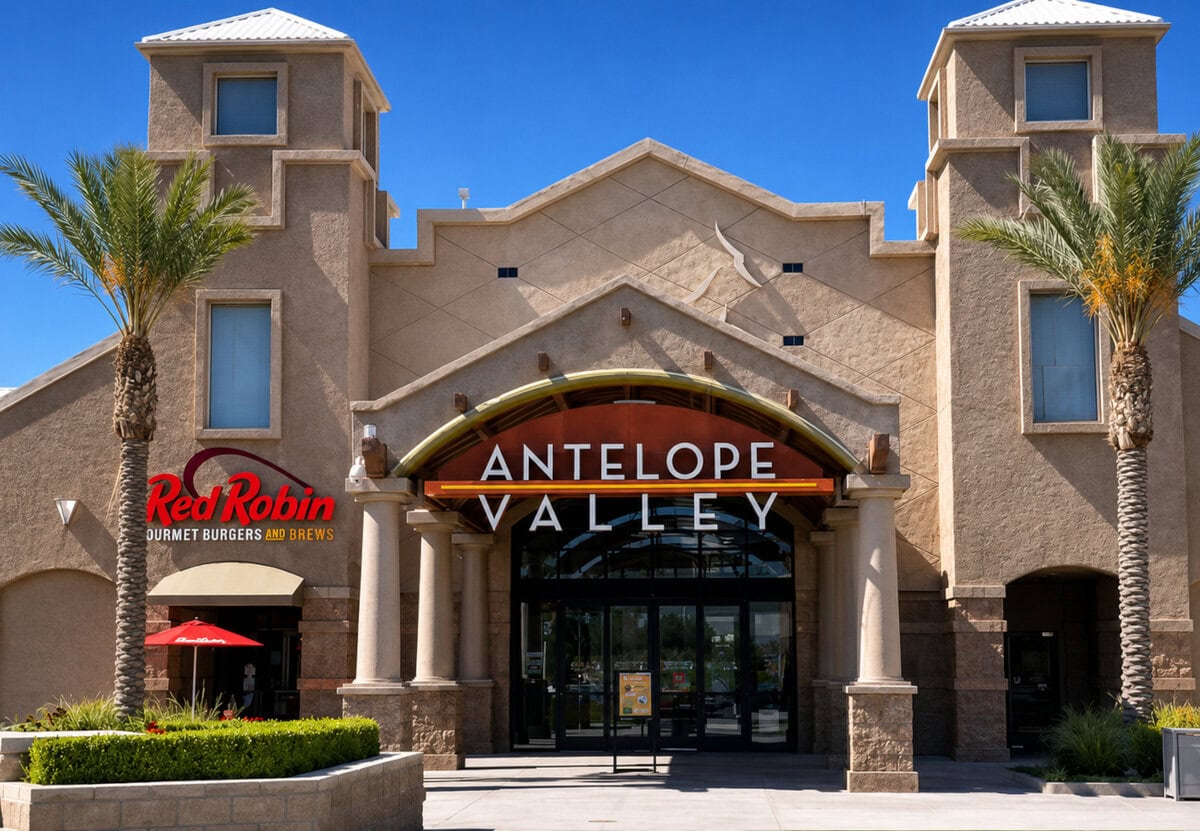
Mershops Antelope Valley Mall is open and busy enough. Hours run 11 to 7 on Sundays, 11 to 8 on weeknights, and 10 to 9 on Fridays and Saturdays.
About 1 million square feet, more than 100 retailers, four big anchors: Macy's, JCPenney, Dillard's, and Dick's.
The food runs from Yard House and Red Robin to Blaze Pizza and Cinnabon, with Dog Haus on a pad out front.
Cinemark still runs showtimes, with Rockin' Jump, Club Pilates, Claw Daddy, and Nowhere filling out the entertainment list. Who comes?
A region that works at Edwards Air Force Base, Lockheed Martin, Northrop Grumman, Boeing, NASA, and Antelope Valley College, much of it tied to aerospace and defense, a lot of it commuting long distances.
For them, the mall is still the closest thing the valley has to a regional center, the reason nobody has to drive 40 miles for a department store anymore.
The bowling alley and the food hall are the bet on the next 30 years.
Independent Publisher Notice
BestAttractions is an independent editorial publisher. We are not affiliated with, endorsed by, or acting on behalf of any location, business, property owner, manager, government agency, or organization described in this article. Comments posted on this page are not forwarded to, reviewed by, or acted upon by any entity mentioned in the article. For official inquiries, complaints, applications, bookings, or other requests, please contact the relevant entity directly through its official website or other verified channels.