
Palm Desert Town Center opened in the California desert in 1983 with an indoor ice rink, which was fitting in a place where summer temperatures go above 110 degrees.
It's had a few names: Palm Desert Town Center, then Westfield Shoppingtown Palm Desert, then Westfield Palm Desert, now The Shops at Palm Desert.
Same enclosed mall in Palm Desert, and still the only indoor one in the Coachella Valley.
Today, the ice rink is gone. So are Sears, the theater, and most of the original anchors.
What's coming might be housing. A 2022 study floated 194 apartments by 2031.
The city is seeking offers for the old Sears, and the owner is planning a 72-acre mixed-use redo with homes in the mix.
The mall built to pull shoppers into the cool is now being planned as a place to live.
Palm Desert Town Center opened with an ice rink
The desert summer clears 110 degrees. The mall that opened on Highway 111 in 1983 put an ice rink inside it anyway.
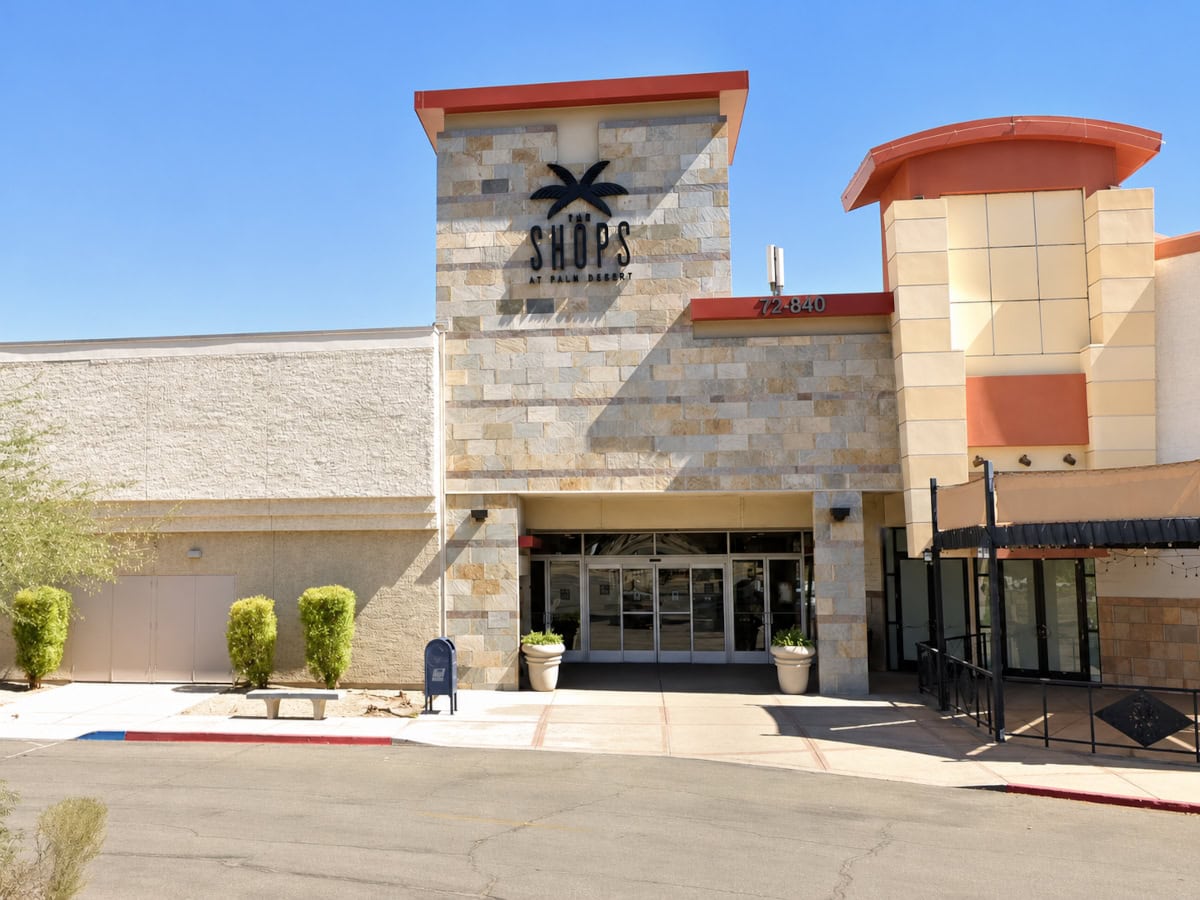
That was Palm Desert Town Center, the enclosed mall at 72840 Highway 111 in Palm Desert, California, the place known today as The Shops at Palm Desert.
It's still the only indoor mall in the Coachella Valley, and the largest.
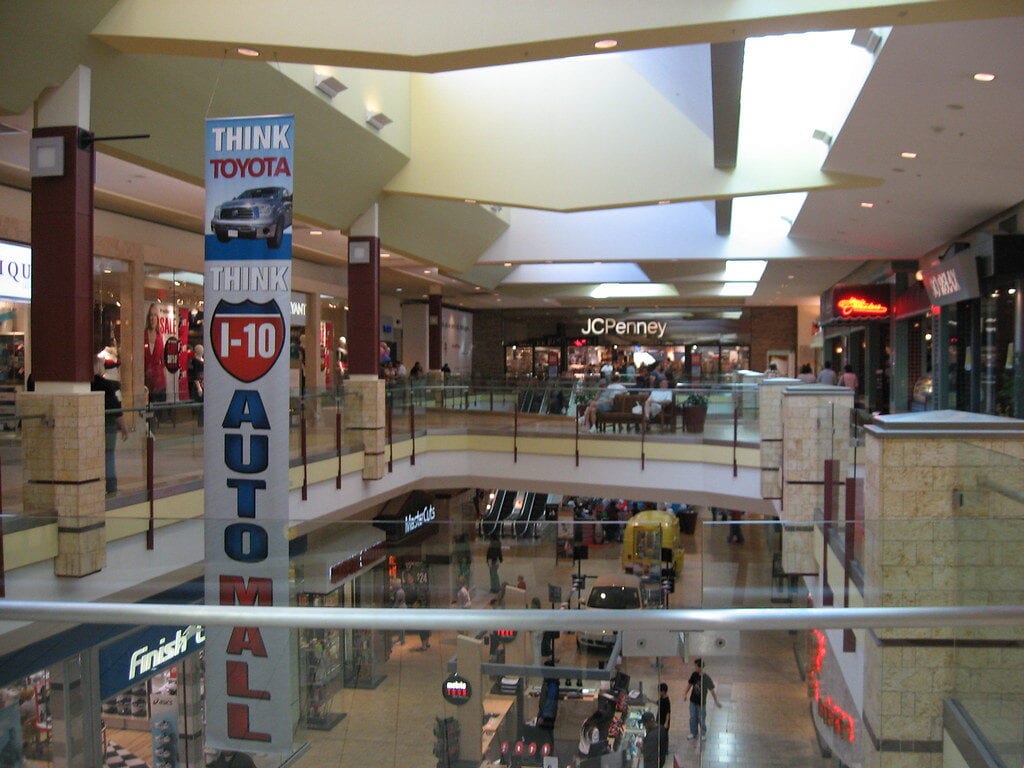
When it opened, it had the works: four department stores, around 130 specialty shops, a food court, a seven-screen movie theater, and the rink, which sat near the food court with the Yellow Brick Road arcade above it.
Kids had What's Up and Balboa Beach Company.
Adults had somewhere to shop in air conditioning while it baked outside.
By 1984, the building pulled 8 million shoppers a year. It even sold the desert to itself.
In 1985, a 3,300 sq ft exhibit called Open House at the Desert was set to open inside the mall, putting Coachella Valley home and resort communities in front of the crowds already walking the corridors.
How the mall pulled shoppers east from Palm Springs
The mall came from Ernest W. Hahn, a developer who built big enclosed centers across Southern California.
Hahn founded his company in 1958 and put up La Cumbre Plaza in Santa Barbara in 1967 before moving into larger malls.
He sold the company to Trizec in 1980 for $267 million, and Palm Desert Town Center came out of that late stretch of his work.
It was reported as a $75 million project on a 62-acre site. And it changed where the valley shopped.
Palm Springs had the old downtown retail name in the 1980s.
The new mall handed Palm Desert department-store scale and parking built for the freeway age, and the money followed fast.
In 1984, Palm Desert's taxable retail sales hit $211.1 million, up 45% from the year before.
Palm Springs, still bigger at $364.7 million, grew 7.6% over the same stretch.
Palm Desert was behind and closing the gap, and the mall was the clearest new reason.
The first anchors, and the names that kept changing
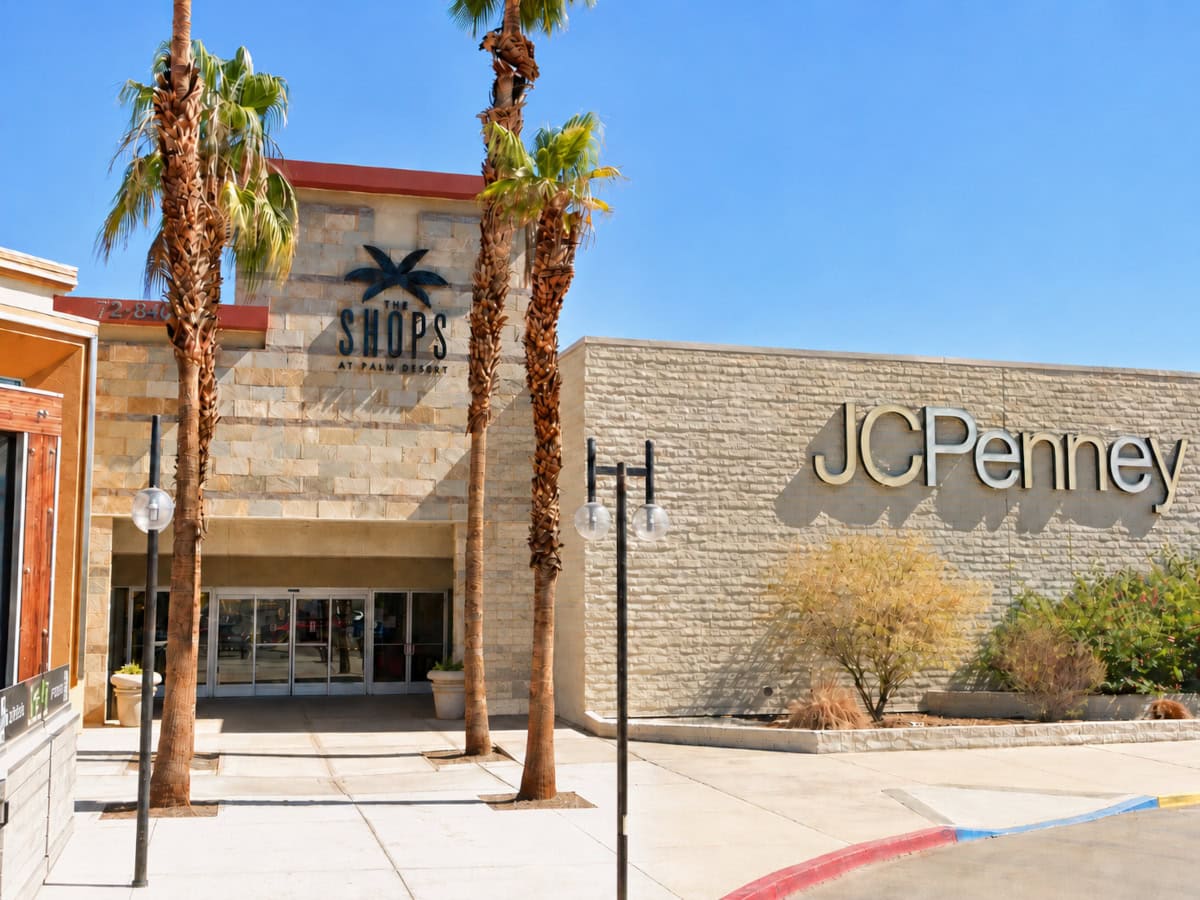
The original lineup was May Company, Bonwit Teller, JCPenney, and Bullock's.
That gave Palm Desert a deeper department-store bench than any other mall in the valley.
Then the names started moving. Bonwit Teller left California in 1987, and Bullocks Wilshire took the space.
For a stretch, the mall had both Bullock's and Bullocks Wilshire under one roof, the same name split into two formats inside one mall.
That same year, J.W. Robinson's opened as a fifth anchor.
The 1990s rewrote the map again. May Company and J.W. Robinson's folded into Robinsons-May in 1993.
Bullock's became Macy's in 1996. The signs changed. The buildings stayed.
Westfield buys in for $82 million
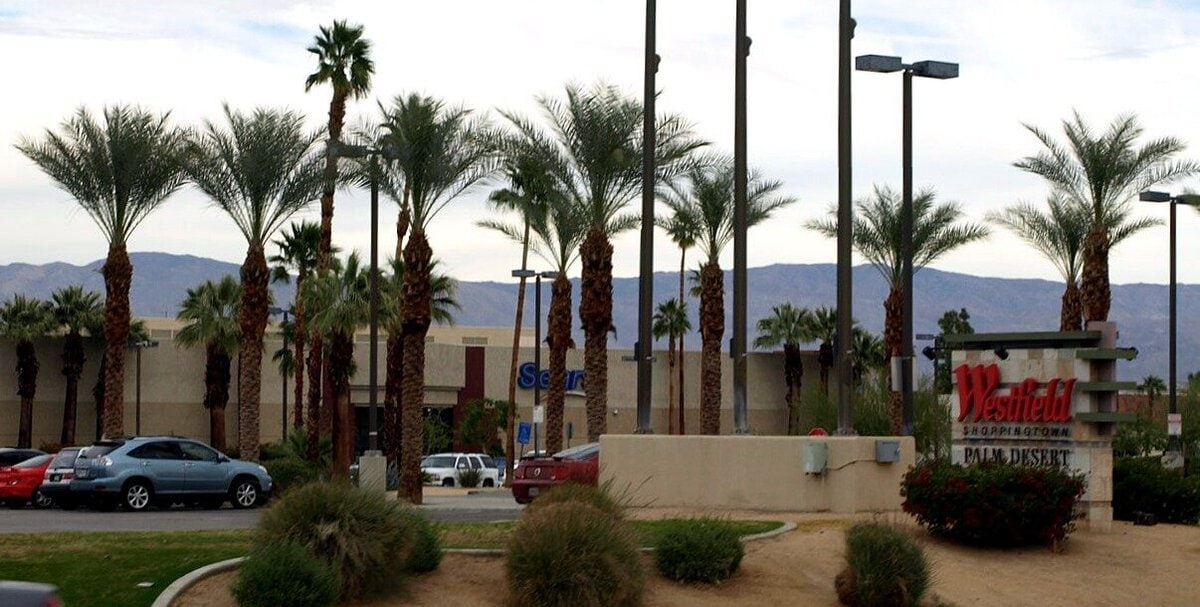
Westfield America bought the mall from TrizecHahn in 1999 for $82 million and renamed it Westfield Shoppingtown Palm Desert, later shortened to Westfield Palm Desert.
The mall was now one node in a national chain run from a single company.
The anchor shuffle kept going. Barnes & Noble opened in 2003.
Sears moved into the former J.W. Robinson's box in 2004.
After Federated bought May Department Stores, Robinsons-May converted to Macy's in 2006, and Macy's slid into the bigger former Robinsons-May building, leaving its older space behind.
While all that happened inside, the competition outside got sharper.
The Gardens on El Paseo opened less than a mile away, a 200,000 sq ft open-air center with Saks Fifth Avenue.
Palm Desert now had an enclosed mall and a luxury strip less than a mile apart.
The Nordstrom that never arrived
Westfield had a bigger idea.
A full-line Nordstrom was attached to a mid-2000s redevelopment, first pitched at 149,000 sq ft and later listed at 138,000, with the opening sliding into the early 2010s.
It would have brought an upscale anchor back to the mall.
Then the economy turned. Nordstrom pulled out in June 2009, and the full-line anchor never came.
What arrived a few years later looked nothing like that Nordstrom plan.
A new entrance and a sporting-goods anchor
What arrived was Dick's Sporting Goods.
The 2013 redevelopment built a new Grand Entrance facing Highway 111, redid the dining court, and added restaurant space including Stuft Pizza Bar & Grill.
Dick's took over a vacant north anchor box, with World Gym filling another chunk of the same structure.
H&M opened in 2014. The mall had turned a corner, at least on paper.
By early 2015, it was 95.6% occupied, with 132 tenants across 977,900 sq ft.
A sporting-goods store, a gym, and fast fashion now sat where the department-store thinking the place was built on used to be.
How a $125 million loan came undone
Underneath the new entrance, the money was getting heavier.
In February 2015, the owners put a $125 million loan against 572,700 sq ft of the mall, interest-only, due in March 2025.
On paper, the building could carry it.
Inline stores under 10,000 sq ft were selling $357 per sq ft in 2014, and occupancy sat above 95%.
The owner later became a European mall company that absorbed Westfield in 2018, then started trying to shrink its American holdings.
Then 2020 arrived. The loan made its last payment in April 2020 and went into default.
By the next year, a receiver was running the property.
The value dropped fast. The collateral behind the loan was worth $212 million at the end of 2014.
By July 2021, it was worth $55.2 million.
Occupancy slid from 95.9% at the start to 80.8% by January 2023.
Somewhere in there, the mall got a new name, The Shops at Palm Desert, while it sat in receivership waiting for a buyer.
Sears goes, the theater goes, a new owner comes
The closures came at the edges.
Sears, in the building that had been J.W. Robinson's and Robinsons-May before it, shut in February 2020 after the announcement that prior November.
The 10-screen theater closed in February 2023 after Tristone's run ended.
That left two big empty boxes on a mall that was still, mostly, open.
In late November 2023, Pacific Retail Capital Partners bought The Shops at Palm Desert and took on the existing debt.
The price was never disclosed.
The buyer came in with a record of taking over enclosed malls with the same basic ingredients: vacant or underused retail, big sites, and room to build something else.
Where The Shops at Palm Desert stands now
The strangest part of the property now is who owns what.
The City of Palm Desert bought the former Sears, so that roughly 7-acre parcel now sits outside the current mall owner's control.
So the valley's only indoor mall has a city-owned hole in it.
In April 2026, the city put the former Sears site up for redevelopment and gave developers until May 7 to make offers.
A 2022 study had floated demand for 194 apartments on the mall site by 2031, plus condos, a hotel, and more retail.
Nothing's approved yet.
The current owner is drawing up its own plan for the wider 72-acre property, with housing, green space, and entertainment in the mix.
Meanwhile, the mall keeps running.
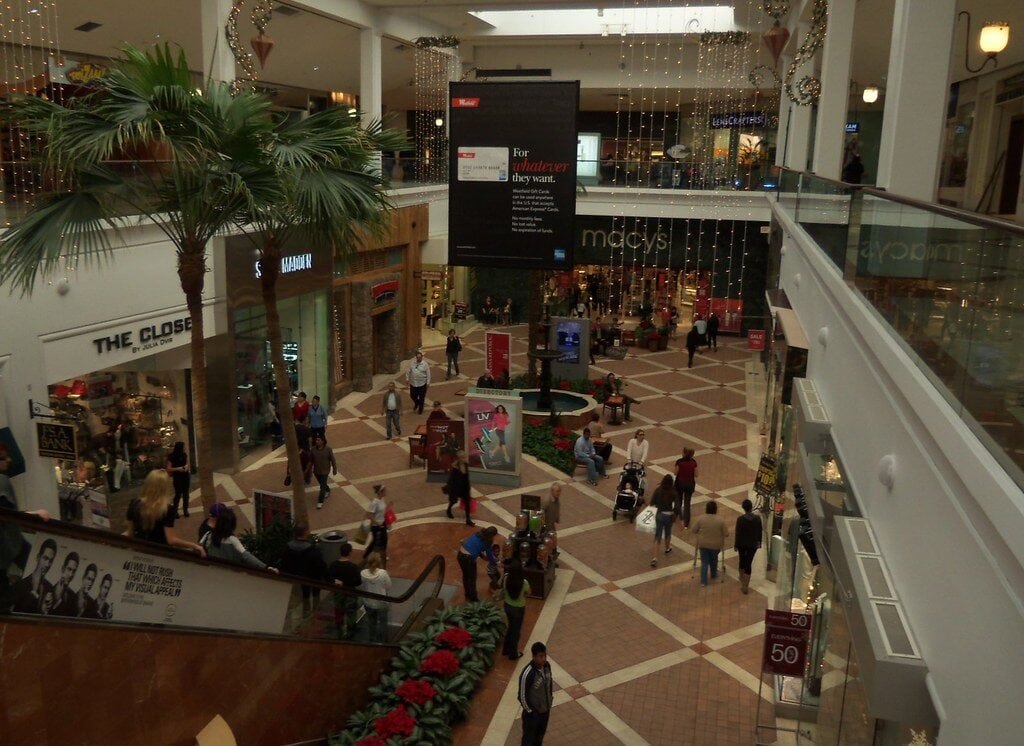
At 984,700 square feet, it's still the biggest indoor center in the valley, with 4,250 parking spaces around it and about 4.7 million visits a year.
The doors open at 10 a.m. for walkers who use the cool corridors before the stores wake up.
Macy's, JCPenney, Dick's, Barnes & Noble, H&M, and about 100 shops and restaurants are still trading, even as Forever 21 and Claire's joined the closing lists in 2025 and vacancy reached 9% by the end of the year.
The ice rink is long gone. The walkers still come at 10.
Independent Publisher Notice
BestAttractions is an independent editorial publisher. We are not affiliated with, endorsed by, or acting on behalf of any location, business, property owner, manager, government agency, or organization described in this article. Comments posted on this page are not forwarded to, reviewed by, or acted upon by any entity mentioned in the article. For official inquiries, complaints, applications, bookings, or other requests, please contact the relevant entity directly through its official website or other verified channels.