
On February 22, 1879, a steam engine running a new pump exploded in Stockton and killed 18 people. Victims of the explosion went into the same ground on Cemetery Lane.
Stockton Rural Cemetery opened in 1861 on 75 acres that Captain Charles M. Weber, the man who founded the city, helped acquire, and still covers 75 acres today at 2350 Cemetery Lane in Stockton, California.
A California governor is here, and so is the founder of Stockton's African Baptist Church. So is the industrialist whose company helped form Caterpillar, and a monument to a man who auctioned the same sack of flour across the West for the Union war effort.
For 165 years this has been where Stockton put its disasters and its founders. The hard part now is keeping 75 acres of it legible.
Livestock walked over Stockton's graves in 1851
The block Charles M. Weber gave Stockton for burials in 1851 had no fence and no survey.
Livestock crossed it, damaged graves, and worked coffins loose.
The City Council spent $1,500 fencing it in 1852 and hired a sexton that July to tend the ground and dig graves.
Weber kept handing out land for the purpose.
Stockton's Jewish community got a lot near the future state asylum in 1851, which became Temple Israel Cemetery.
The Odd Fellows got the block beside it in 1854. The city's first burying ground was a block on Channel Street.
By the early 1860s Stockton wanted something larger and better planned.
Six trustees and 60 acres from Captain Weber
A public meeting in March 1860 appointed six trustees: B. W. Owens, B. W. Bours, E. S. Holden, Samuel Fisher, V. M. Peyton, and William Biven.
Weber supplied the ground. He had bought the tract from his own clerk, E. M. Howison, and deeded it over.
The founding gift was 60 acres. The cemetery covers 75 today, and the record doesn't explain when the rest arrived.
California had passed a law in 1859 letting rural cemetery associations incorporate and hold land, so the place started as a private association with a board, and it has been run that way ever since.
What Stockton Rural Cemetery opened with in 1861
In November 1860 the trustees hired James R. Lowe of Santa Clara, and he ignored the city grid.
Lowe drew serpentine avenues 30 feet wide, lined them with shade and ornamental trees, and named them after forest trees.
He platted 1,560 lots, each built to take as many as 12 burials, room for 18,720 people, plus lots held back for citizens the trustees wanted to honor.
A chapel site sat near the center, a morgue on the east side.
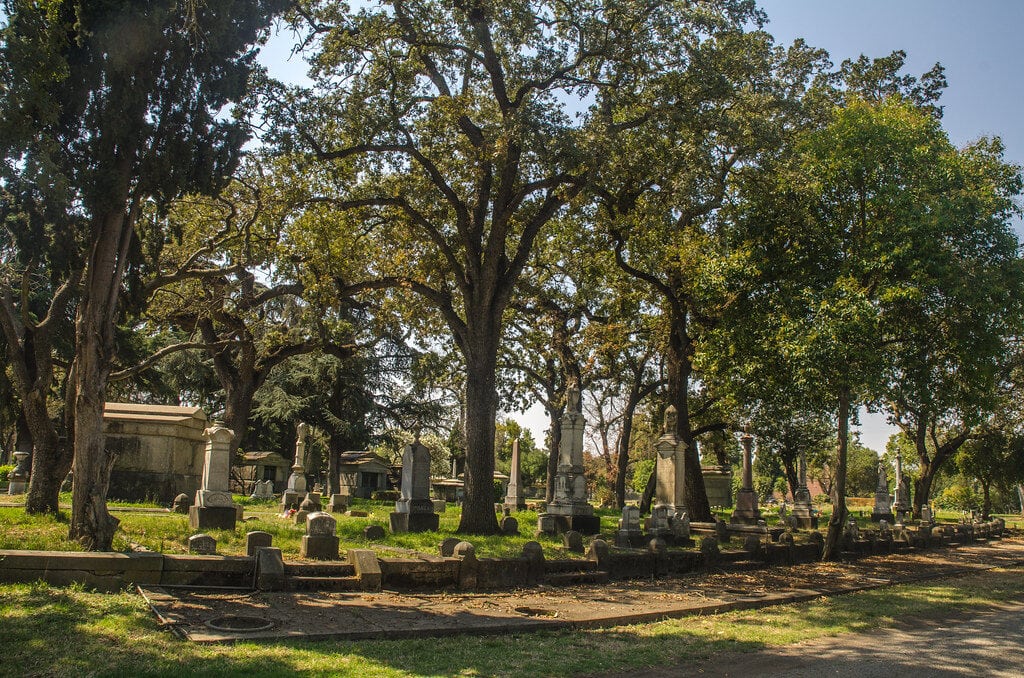
Stockton Rural Cemetery opened in 1861 at 2350 Cemetery Lane in Stockton, California, and visitors came in through hand-wrought iron gates.
Weber worked on the grounds himself. Hundreds of trees still shade the grounds.
Jeremiah King's petition and Block 27
Jeremiah King was born enslaved in Georgia and came to California in the Gold Rush years.
In the 1850s he founded the African Baptist Church in Stockton.
During the Civil War he asked the trustees for burial ground for Black residents and members of his congregation, and he got it.
The area was known as the colored section. King was buried there in 1883.
That ground is associated with Block 27, though the match isn't exact: later grave-by-grave research found white burials in the same numbered block.
Block 27 also sat outside endowed care, so no endowment fund was set aside to maintain it.
A flour sack that raised $275,000
On February 22, 1879, a steam engine running a new pump exploded in Stockton and killed 18 people. All 18 were buried here.
Reuel Colt Gridley got there by a stranger route.
During the Civil War he auctioned a sack of flour for the United States Sanitary Commission, then auctioned the same sack again, and again, town after town, raising a reported $275,000.
He returned to California and was buried here in 1870 under a plain marker.
In 1887 Rawlins Post of the Grand Army of the Republic and local residents paid for a monument showing Gridley with his sack, on a knoll above the Union graves.
Budd, Louttit, and the Caterpillar mausoleum
James Herbert Budd, governor of California from 1895 to 1899, was buried here in 1908.
James Alexander Louttit, who sat in the U.S. House from 1885 to 1887, was interred in 1906.
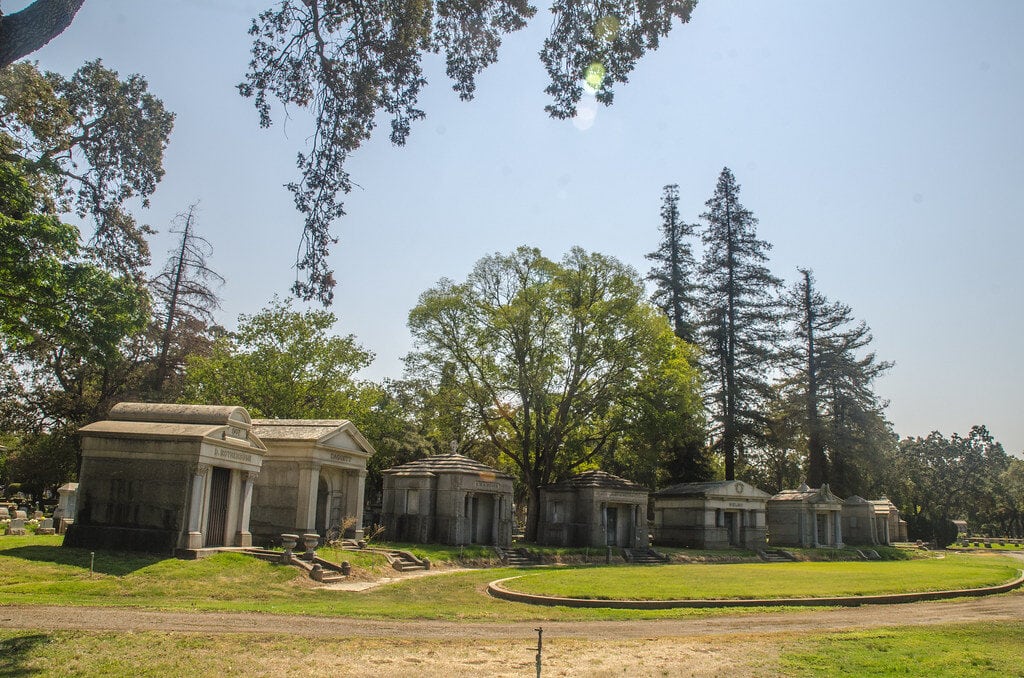
Benjamin Holt, who built the track-type tractor in Stockton and whose company helped form Caterpillar, lies in a family mausoleum fitted with heavy metal doors.
In 1958 the Daughters of the American Revolution put a marker for pioneers and veterans near the entrance.
During the centennial in 1961 the association asked the federal government to consider the Gridley site as a national monument.
The National Park Service declined. California listed the monument as Historical Landmark No. 801 in 1965.
Thieves took a 300-pound gate in 2012
In April 2012 someone hauled a 300-pound iron gate off the Barnhart family vault.
The Holt mausoleum was damaged in the same run, and another stolen door left the Hyatt family coffins exposed.
Staff checked a local recycling yard, and management planned night patrols.
In 2015 descendants and other residents went into Block 27 and took an hour to find King's own marker under the growth. They pushed for regular care.
The problem went back to the section's non-endowment status: those old plots came with no endowment money to mow them in 2015.
Still selling graves at 2350 Cemetery Lane
In October 2018 the cemetery advertised a Halloween festival and evening tour.
Families objected to the horror-themed wording and to crowds among fragile markers. Two days later the cemetery canceled both.
The cremation wall behind the publicity went in anyway, with use up 68 percent.
That work is now the Garden of Memories: benches for as many as four people, a columbarium of 200 niches.
In October 2024 families found flat markers under dirt and mud, and staff cited a small nonprofit crew on 75 acres.
The license runs to January 1, 2027.
Ground burial and cremation spaces are still for sale among the oaks, where people come looking for one name out of 165 years of them.
Independent Publisher Notice
BestAttractions is an independent editorial publisher. We are not affiliated with, endorsed by, or acting on behalf of any location, business, property owner, manager, government agency, or organization described in this article. Comments posted on this page are not forwarded to, reviewed by, or acted upon by any entity mentioned in the article. For official inquiries, complaints, applications, bookings, or other requests, please contact the relevant entity directly through its official website or other verified channels.