The global showman who served as mayor
In 1875, P. T. Barnum stepped into office at Bridgeport City Hall, bringing his larger-than-life reputation into a very different role.
Known widely as a traveling showman, he had already built experience in public service through his time in the Connecticut legislature.
As mayor, he focused on practical city matters. He pushed to lower utility rates, worked to improve the water supply, and took action to shut down houses of prostitution.
His attention stayed on everyday conditions that shaped life in the city.
Barnum's role did not end with elected office. His influence can still be seen in places like Seaside Park, Bridgeport Hospital, and the Barnum Museum, all tied to his efforts to shape the city.
While his name is often linked to the circus, elephants, and the rise of popular entertainment, in Bridgeport he also helped guide city government, strengthen infrastructure, and support the city's growth.
Bridgeport's Iranistan, where traffic passes
Before it burned down, Iranistan was one of the most noticeable buildings in nineteenth-century Connecticut.
Barnum planned the Moorish-style mansion as an "oriental villa," and it became one of Bridgeport's best-known landmarks.
The house had indoor plumbing, which was uncommon at the time, and the property also included a water tower.
In 1857, the mansion caught fire, and almost all of it was destroyed. Very little remains at the site.
Today, cars pass through the area near the Klein Memorial Auditorium, where one of the city's most unusual buildings once stood.
The area seems ordinary now, but it is the former site of a mansion built to catch attention from a distance and make a strong impression at close range.
The shoreline that was made public on purpose
After the Civil War, Bridgeport's shoreline did not automatically become public land. Large areas were hard to access, and much of the waterfront was controlled by private owners.
P. T. Barnum argued for a different plan. He wanted a waterfront that ordinary residents could use, not one closed off by private control. Seaside Park grew out of that idea.
The park was designed by Frederick Law Olmsted and Calvert Vaux, linking Bridgeport to two leading figures in American landscape design.
Today, Seaside Park covers 325 acres and stretches along about three miles of shoreline. Barnum described it as a marine "rural" park, meaning a public coastal space rather than a private waterfront.
What now feels like a natural part of Bridgeport had to be debated first and then deliberately created.
312 sandwiches started a global chain
In August 1965, a small sandwich shop opened in Bridgeport. Its purpose was simple from the start: to help a teenager cover the cost of college.
Fred DeLuca was 17 when he started "Pete's Super Submarines" with money from Dr. Peter Buck, a friend of the family.
On its first day, the shop sold 312 sandwiches. They cost between 49 and 69 cents. From that one location, Subway eventually grew into a chain with tens of thousands of stores around the world.
Bridgeport was more than the first shop's address. It was the place where the first version of a global fast-food chain got its start.
A pie company gave a flying toy its name
In 1871, William Frisbie started the Frisbie Pie Company in Bridgeport. That local business later became part of the history of a toy that would show up on beaches, lawns, and college campuses.
The bakery's pie tins became part of a throwing game that students helped make popular.
One later version of the story says students yelled "Frisbie!" when they threw the tins, but that detail has never been proven. The connection to the business itself is much clearer.
In 1957, Wham-O renamed its plastic disc from "Pluto Platters" to "Frisbee" after adopting the story tied to the Bridgeport pie company.
Connecticut's only zoo stands in Bridgeport
It started in 1922 with just eighteen birds. That small gift slowly grew into the only zoo in the state.
Beardsley Zoo was built inside Beardsley Park, a park designed using Olmsted's approach to landscape planning. Over time, some retired animals from Barnum's circus were also brought there.
More than one hundred years later, the zoo cares for over one hundred species. It is now the only zoo in Connecticut accredited by the AZA.
That makes it unusual for a city more often known for industry or politics.
Right in the center of Bridgeport sits the state's only zoo. It began very small, with just a few birds, and grew into a lasting institution that serves the entire state.
A major art collection inside a college
Downtown Bridgeport hides a serious art collection inside CT State Housatonic, a setting most people would never guess.
The Housatonic Museum of Art holds nearly 7,000 works, making it one of the largest art collections at any community college in the United States.
Pablo Picasso, Andy Warhol, Romare Bearden, Cindy Sherman, and Jenny Holzer all appear in the collection.
The setup is unusual even before the first painting comes into view. Much of the art is spread across the campus instead of sealed inside one traditional gallery building.
Students and visitors move through hallways and common spaces where major works are part of everyday traffic. Bridgeport ends up with a substantial art institution in a place that looks too ordinary to hold one.
Bridgeport built toy trains for American homes
By 1901, mechanical trains made by the Ives Manufacturing Company were leaving Bridgeport and ending up on tracks in American homes.
The company grew from a maker of mechanical toys into one of the important names in model railroading. In 1907, it operated a factory on Holland Avenue in the West End.
It later introduced electric trains and promoted them with the slogan "Ives Toys Make Happy Boys."
That line sounds old-fashioned now, but the trains brought exactly that kind of joy to a generation of children gathered around Christmas floors and living-room rugs.
Ives shut down in 1932, yet its surviving trains still draw collectors.
A machine from Bridgeport became a world standard
The name "Bridgeport" became known around the world through industry, not tourism.
In 1938, Rudolph Bannow and Magnus Wahlstrom founded the Bridgeport milling machine company in Bridgeport, and its Series I turret mill grew into one of the best-known machine tools in modern manufacturing.
Industrial histories describe the machine as a standard piece of equipment in machine shops across the United States and other countries.
The American Precision Museum says more than a quarter-million were built, and that the design became the base for thousands of tool-and-die shops.
That is a striking kind of place branding. For generations of machinists, "Bridgeport" did not mainly mean a city in Connecticut. It meant a specific type of milling machine that became the standard in industry.
A wartime plant rose like its own city
In 1915, only five months were needed to build a factory complex on Boston Avenue that looked like a separate industrial city set down on the east side of Bridgeport.
Remington constructed thirteen parallel five-story buildings and linked them with a corridor about half a mile long.
The entire plant stretched across about 1.5 million square feet and 76.6 acres. At the time, it ranked as the largest manufacturing facility under one roof in the world.
By April 1916, the workforce had reached about 16,000 people. It's easier to grasp the scale when the numbers sit side by side - acreage, corridor length, building count, payroll, and wartime demand.
The site later became General Electric's Bridgeport plant, but its first life was as a vast factory built for World War I production.
A tower that made a shot by dropping lead
Bridgeport built a tower in 1908 and 1909 for a process that depended entirely on height, heat, gravity, and cold water waiting below.
At the Remington Shot Tower, molten lead dropped about 133 feet into vats of cold water. On the way down, gravity and surface tension pulled the metal into spherical shot.
The structure rose about 190 feet to the flagpole. For years, it was the tallest building in Connecticut.
Fewer than a dozen shot towers still survive worldwide.
Bridgeport's tower was both a piece of factory equipment and a skyline landmark, a tall industrial structure built for a process that still sounds strange even once you know how it worked.
The city was doing ammunition work in a building designed around physics, and you could almost see the method in action.
A beach resort became a ghost town refuge
After Bridgeport annexed the former borough of West Stratford in 1889, Pleasure Beach began one chapter of its history and then kept changing.
An amusement park opened within a few years. The city bought the property in 1919. A bridge finished in 1927 brought both pedestrians and cars directly to the beach.
Its Maple Dancing Pavilion contained the largest ballroom in New England, and Glenn Miller, Gene Krupa, and Artie Shaw all performed there.
Then fires and decline reduced the place to much less. When the access bridge burned in 1996, Pleasure Beach took on a new role as Connecticut's largest ghost town.
At the same time, piping plovers and eastern prickly pear cactus found space there.
Memories of the dance hall and a quiet natural habitat ended up sharing the same stretch of sand.
A Barnum-era ferry still crosses the Sound
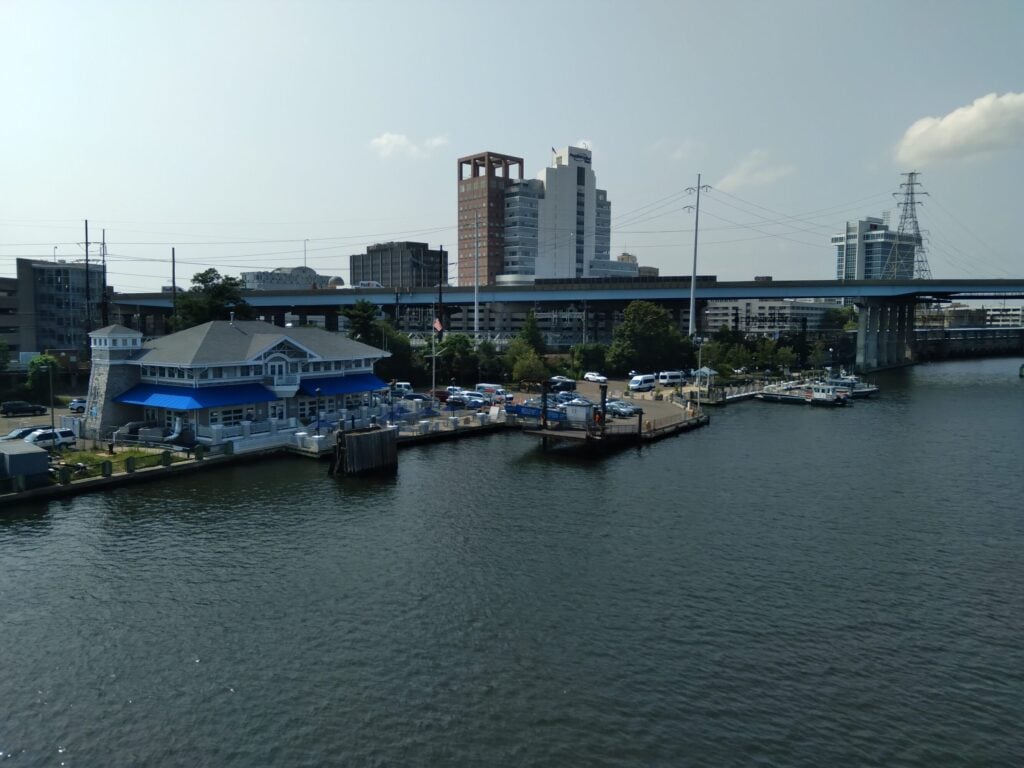
The Bridgeport and Port Jefferson Ferry is old enough to come out of the city's nineteenth-century commercial world, but it still operates as active transportation infrastructure.
Company and historical sources date its founding to 1883 and identify it as one of the oldest continuously operating ferry companies in the United States.
P.T. Barnum was one of the original backers and served as the company's first president. The first vessel, Nonowantuc, entered service in 1884.
More than a century later, the fleet included a vessel named P.T. Barnum, launched in 1999 to recognize that connection.
What stands out is the continuity. Many old transportation ventures survive only in stories. In Bridgeport, a cross-Sound route linked to Barnum still carries people and vehicles along the same regional corridor.
Bridgeport kept a Socialist mayor for 24 years
Bridgeport elected Jasper McLevy mayor in 1933. Then it kept him there for 24 years. This was not a one-term protest vote or some short political novelty.
It was a long run of Socialist leadership in a major Connecticut city, from the Depression into the years after World War II.
McLevy built a reputation for frugality and clean government. Even so, the simplest fact is still the one that stands out most: for almost 25 years, Bridgeport had a mayor who openly identified as a socialist.
A lot of people think of the city in terms of factories, Barnum, or economic decline. Fewer expect to find this in its political history.
A rail wreck turned ballplayers into rescuers
On July 11, 1911, the Federal Express derailed in Bridgeport and split apart on an embankment near Fairfield Avenue.
Fourteen people were killed, and 47 more were seriously injured. The unusual part came from the last two Pullman cars, which stayed upright. The St. Louis Cardinals were in those cars.
Manager Roger Bresnahan put 22 players to work in the rescue effort. The team pulled victims from the wreckage, carried injured passengers, and helped manage the scene.
Professional baseball rarely meets rail disaster history in such a direct way. Bridgeport was the place where that happened.