
Standing on the Double Branch peninsula in Tampa, Florida, sits a 596-acre county park with 1.25 miles of named trail in it. The rest is marsh, mangrove, hammock, and pine flatwoods.
Hillsborough County founded Upper Tampa Bay Park in 1982. The plan was a classroom, boardwalks, trails and observation points, and the built part stayed small.
Two picnic shelters burned on May 30, 2024, when a prescribed burn crossed into the wrong part of the park. More than 100 acres went with them.
The gate is open 8 to 6 at $2 per vehicle. By July 2026, the Otter Trail boardwalk had been entirely replaced.
The 3,000 acres proposed next door
In the late 1960s a private plan called Bay Port Colony covered about 3,000 acres of Upper Tampa Bay.
Roughly half of that tract was wetland, and turning it into waterfront lots meant dredging and filling it first.
Hillsborough County's park board had been looking for public waterfront on the same bay since the early 1960s and had failed every time it tried to pay for any.
The county applied for a federal Open Space Grant in 1968.
Public opposition to the dredging and filling grew over the same period, and the original Bay Port Colony plan was dropped.
The county bought 409 acres from the Tampa Bay Port Authority in 1969, out on the Double Branch peninsula, with Double Branch Creek along one side and Old Tampa Bay to the west.
It added 187 acres in 1976. That made 596 acres of shoreline, mangrove, salt marsh and pine flatwoods.
A fifth of what Bay Port Colony would have covered, with the wetlands still there.
How Upper Tampa Bay Park lost its marinas
The county now had the land and a plan for it.
The first concept was a waterfront recreation area: marinas, beach facilities, camping areas and picnic grounds, with developed access to the bay.
A citizen group pushed the county toward preservation instead, and the plan was rewritten.
What came out of the rewrite was a classroom, boardwalks, nature trails, observation platforms and limited picnicking.
The marinas and the beach facilities were gone before anything was built.
The revised project was scheduled to open sometime in 1981. The county dates the founding to 1982.
That choice fixed the physical scale of everything after it.
In 2026 the built portion was still a small share of the nearly 600 acres, clustered around the end of the entry road, with the rest left as habitat.
The plan had called for marinas. What got built was boardwalks.
Everything built here gets rebuilt
By the early 2010s the wooden boardwalk south of the visitor center had deteriorated far enough that the county closed it to the public.
Replacing it was budgeted at $305,000, scheduled for completion in September 2013.
A second project that year, $537,000, covered the entrance sign, the canoe launch, the visitor center's air conditioning, road resurfacing and repairs to the other boardwalks.
Together the two came to $842,000, and none of it bought a facility the park didn't already have.
Eleven years later the park went the other direction.
On the afternoon of May 30, 2024, a prescribed burn set by county conservation staff shifted with the wind into a section it wasn't meant to reach.
More than 100 acres burned, and two picnic shelters burned with them.
Sixteen county fire units worked the incident with the Florida Forest Service and air support.
No injuries were reported. The park closed, and the fire was fully contained the following day.
What Upper Tampa Bay Conservation Park is now
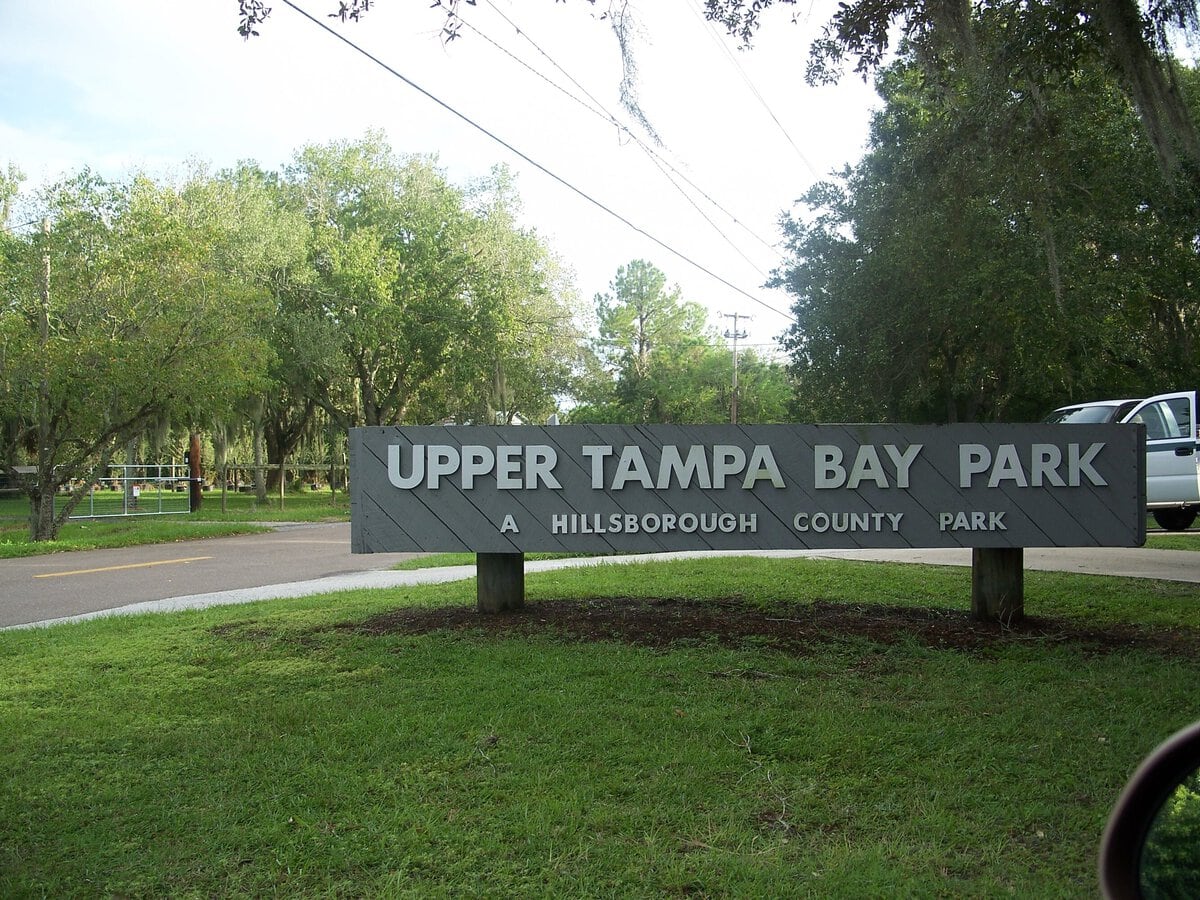
Upper Tampa Bay Conservation Park is a 596-acre Hillsborough County park at 8001 Double Branch Road in Tampa, Florida.
It opened in 1982 as Upper Tampa Bay Park, and the county still owns and runs it.
The park now has an air-conditioned nature center.
Inside are live fish, snakes and turtles kept for interpretation, plus displays on the park's environment, geology and history.
The building is also the one part of the park that closes on its own.
During the pandemic, the pay station and trails reopened while the nature center stayed closed.
In 1987 the park ran sunrise to sunset and admission was free.
It now opens at 8 a.m., closes at 6 p.m., and the gate costs $2 per vehicle for up to eight people.
New wood on the same route
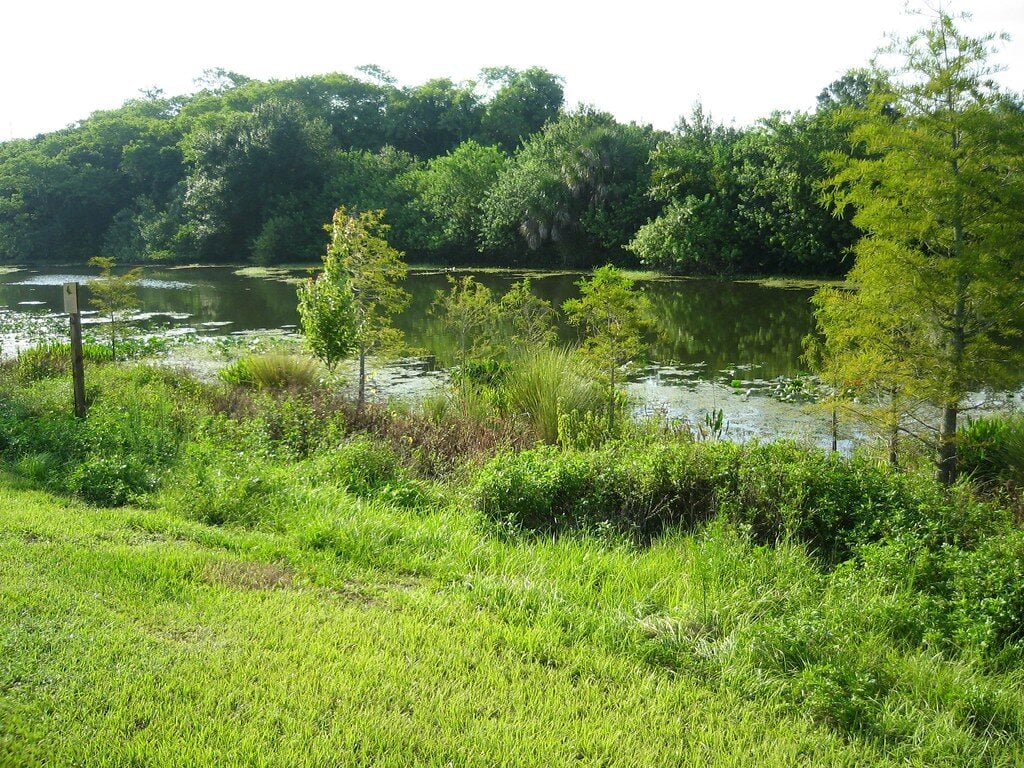
The Otter Trail crosses tidal marsh on a boardwalk. In July 2026 the whole structure was reported replaced.
Three named trails leave the developed strip. The Bobcat Trail starts behind the nature center and runs 0.4 mile.
The Otter Trail is the longest at 0.6 mile. The Eagle Trail covers 0.25 mile toward the Mobbly Bay side, through mangroves.
That's 1.25 miles of named trail, clustered around the park's developed core. Most of the 596 acres have no named trail at all.
A boardwalk roughly 300 feet long runs out to open water, with observation points at the end.
Other boardwalk sections carry the trails across tidal ground, and the habitats change as you walk: pine flatwoods and coastal hammock on the higher ground, freshwater and salt marsh lower down, mangrove along the tide line.
More than 20 archaeological sites sit inside the park. Taking artifacts from them is prohibited, including objects lying on the surface.
Two rehabilitated bobcats went back to the wild here
The canoe and kayak launch sits in the developed strip at the end of the entry road.
A boat rental is $25 for up to four hours and $10 for each hour after that, and rentals get pulled for small-craft advisories, weather, water level, or tide.
Bring your own and you just use the launch.
The same strip holds picnic shelters, grills, a playground, a sand volleyball area, restrooms and parking.
Nonprofit youth groups can book the group camping sites, which have potable water, picnic tables and fire pits, at $2 a person a night.
Everything past that is habitat, and in March 2026 it took on a job the built part can't do.
Two rehabilitated bobcats, both about a year old, were released into the park after roughly a year of care, their original den having been disturbed by construction elsewhere.
The bobcats went into the open forest.
In May 2026 a two-hour guided wetlands walk went through the park, run by Environmental Protection Commission scientists with a local Florida Native Plant Society chapter.
The walk was free. The gate fee still applied.

Independent Publisher Notice
BestAttractions is an independent editorial publisher. We are not affiliated with, endorsed by, or acting on behalf of any location, business, property owner, manager, government agency, or organization described in this article.
Comments posted on this page are not forwarded to, reviewed by, or acted upon by any entity mentioned in the article.
For official inquiries, complaints, applications, bookings, or other requests, please contact the relevant entity directly through its official website or other verified channels.