
Mableton is easiest to understand as a place where the regional location already works, while the local center is still catching up.
Today, it can function well as a suburban base for work, errands, family routines, and trips around metro Atlanta.
What it does not yet offer is a traditional downtown where several destinations fit naturally into one walkable outing.
In June 2026, Mableton received an Atlanta Regional Commission grant to prepare a master plan for a future walkable civic and commercial town center.
That is a planning step, not a completed district. The right moving question is therefore not "Will Mableton eventually have a downtown?"
It is "Would I be happy with the Mableton that exists now, even if the future center takes years to become part of daily life?"
Today, Mableton works more like a network than a downtown
The U.S. Census Bureau estimates 78,820 Mableton residents as of July 1, 2025, but population alone does not create a center.
Daily life is still distributed. Groceries, dinner, children's activities, and a larger evening out can sit in different places.
That works well if you are comfortable driving between destinations.
The commute pattern reinforces the regional character.
The Census Bureau reports a mean travel time to work of 30.7 minutes for Mableton workers age 16 and older in 2020-2024.
That number does not tell us where any individual resident works, but it is a reminder that Mableton belongs to a wider metro work geography.
For a household with jobs, friends, or regular appointments spread around Cobb County and Atlanta, that can be an advantage.
You are not buying a self-contained small town. You are buying a home base within a large metropolitan network.
Mableton Town Square is a civic anchor, not a full downtown routine
Mableton Town Square already gives the city a recognizable gathering point. That matters.
A community benefits from having a place where public events and civic activity can concentrate.
But a gathering place and a downtown do different jobs.
A square works best when something is happening there. A mature downtown works even when nothing has been scheduled.
You can arrive for coffee, walk to a restaurant, browse a shop, meet a friend, run an errand, or simply stay because several uses sit close together.
That second layer is what Mableton is still trying to build.
The practical test is simple: on a normal Tuesday at 6:30 p.m., how many things can you do around the square without getting back in the car?
If the answer is one, the square is functioning mainly as a destination.
If the answer eventually becomes three or four, it starts functioning as a center of everyday life.
That difference is more useful than asking whether Mableton "has a downtown" in name.
What replaces a traditional downtown today
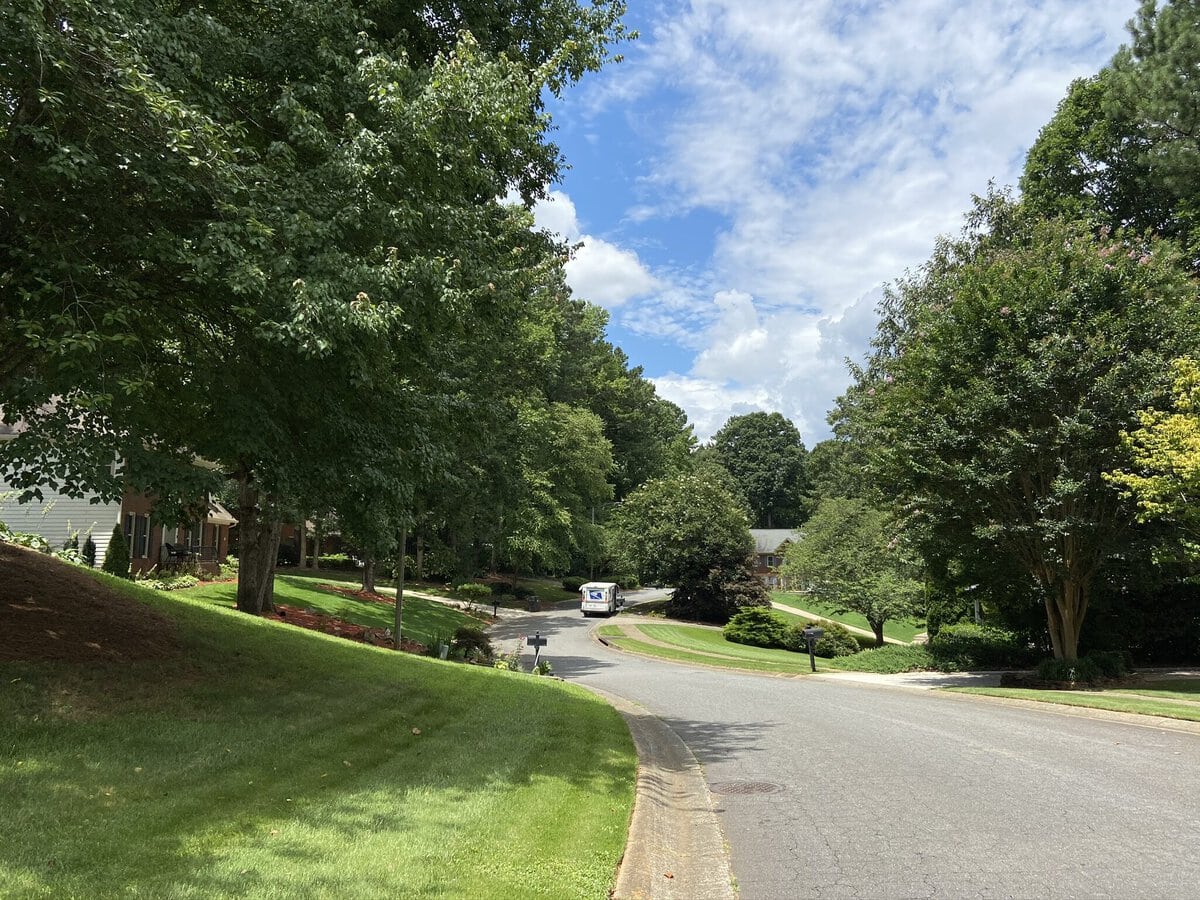
For now, Mableton's everyday center is distributed among commercial corridors, shopping clusters, civic destinations, and nearby regional centers.
That means different households can experience the city very differently.
Someone whose grocery store, gym, school, and favorite casual restaurant all sit along the same driving route may find Mableton extremely convenient.
Someone who wants to walk between dinner, drinks, and a public space may find the same city fragmented.
Smyrna, Cumberland, and Atlanta can add restaurants, shopping, entertainment, and nightlife to the weekly map.
There is no useful citywide statistic showing how often Mableton residents make those trips, so count your own.
Two trips a month for a concert or special dinner is very different from leaving four nights a week because the social life you want is elsewhere.
The June 2026 grant matters, but it does not buy a downtown
The town-center grant is important because it confirms that a more walkable civic and commercial core is an active planning objective.
What it does not confirm is equally important.
A master-plan grant does not by itself guarantee completed sidewalks, mixed-use buildings, restaurants, housing, public spaces, or a construction date.
It funds the work needed to decide how a future center should function and what projects could move it toward that goal.
Buyers should separate three stages that often get blurred together:
- Funded planning: money has been awarded to study and design a direction.
- Committed implementation: a specific project has approvals, funding, a defined scope, and a realistic schedule.
- Long-range vision: a desired future condition that may guide later decisions but is not yet something you can use on Tuesday night.
Mableton has a real reason to talk about a future center.
That is different from having permission to price the finished version into a home purchase today.
The projects that would actually change daily life are small at street level
A successful town center is not created by a sign or a new public building alone.
It changes routine when ordinary destinations become easier to connect.
The U.S. Environmental Protection Agency's National Walkability Index is useful for understanding why.
Its method looks at street intersection density, diversity of land uses, and proximity to transit.
In plain terms, walking becomes more practical when streets connect, different types of destinations sit near one another, and people have reasons to make more than one stop in the same area.
For Mableton, the most meaningful changes would therefore be things such as continuous sidewalks, safer crossings, shorter and more direct pedestrian routes, housing near shops and services, and enough different destinations to make one trip do several jobs.
Those changes can alter a week. A new streetscape that still requires driving from one isolated use to another cannot.
This is also why corridor redevelopment matters more than architectural renderings.
The question is whether a project reduces the number of separate car trips a resident makes, not whether it looks urban in a presentation.
The future center will not affect every Mableton address equally
Even if the town-center plan succeeds, Mableton will remain larger than a few walkable blocks.
A household close to the future center could experience a meaningful change if daily services, housing, public space, and restaurants begin clustering there.
Someone living farther away may still drive to the new district exactly as they drive to other destinations now.
A stronger center can give the city a clearer identity and a better place to gather without turning every neighborhood into a walkable neighborhood.
Judge the exact address on its current routine first.

Use a five-trip test before deciding Mableton fits
Take a candidate home and map five recurring parts of your week:
- work;
- groceries and routine errands;
- exercise or children's activities;
- casual dinner;
- the social outing you make most often.
Mark each one as inside Mableton, in a neighboring center, or elsewhere in metro Atlanta.
Then ask how many require a separate drive rather than fitting naturally into another trip.
This exposes the real trade.
If your week already depends on several metro destinations, Mableton's regional position may be more valuable than having a compact downtown outside your door.
If you want much of your social and errand life to happen spontaneously within one walkable district, today's Mableton asks you to accept a gap and hope future planning narrows it.
The safest way to buy here is to value the future town center as upside, not as a feature you already own.
Mableton can be a sensible choice right now for someone who likes its suburban routine and wants access to the wider Atlanta area.
The town-center effort could make that choice better over time.
It should not be the reason the current version of Mableton has to work for you.
Sources and further reading
- U.S. Census Bureau QuickFacts: Mableton city, Georgia
- U.S. Environmental Protection Agency: National Walkability Index User Guide and Methodology
- U.S. Environmental Protection Agency: Smart Location Mapping
- U.S. Census Bureau: OnTheMap
Independent Publisher Notice
BestAttractions is an independent editorial publisher. We are not affiliated with, endorsed by, or acting on behalf of any location, business, property owner, manager, government agency, or organization described in this article.
Comments posted on this page are not forwarded to, reviewed by, or acted upon by any entity mentioned in the article.
For official inquiries, complaints, applications, bookings, or other requests, please contact the relevant entity directly through its official website or other verified channels.