
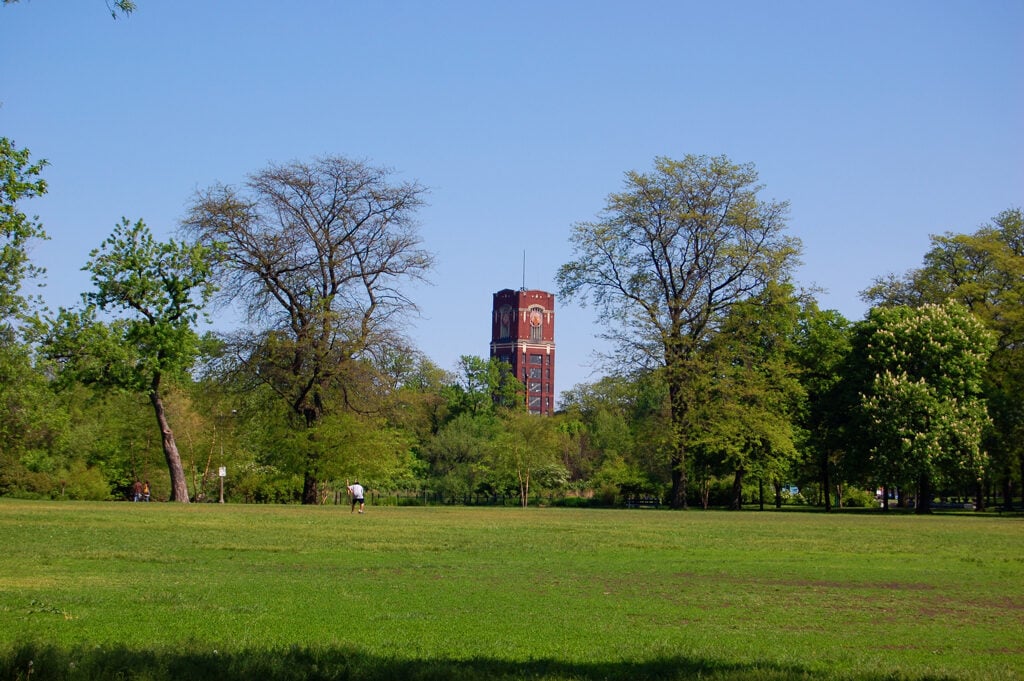
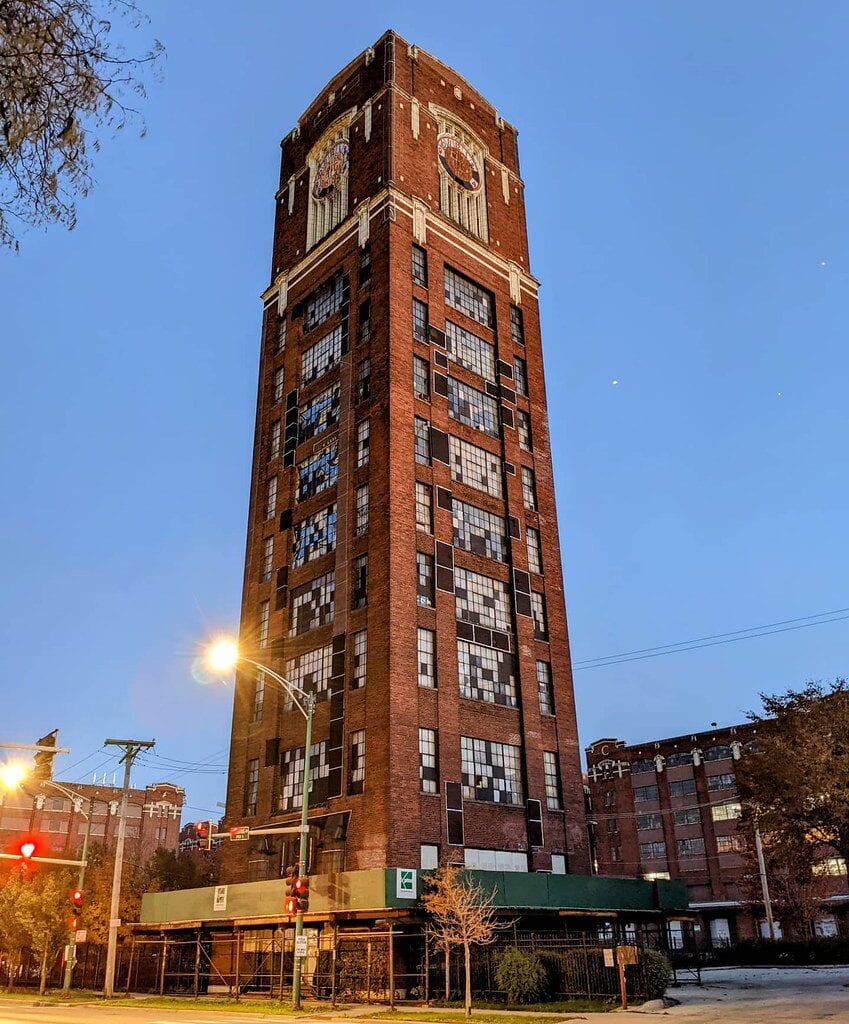
Standing on West Pershing Road at Damen Avenue in Chicago, Illinois, sits an 11-story brick tower with a clock face on each of its four walls.
It was finished in 1917 as the water tower for the Central Manufacturing District, the private industrial district that ran these warehouses.
Two tanks inside held 250,000 gallons for the sprinkler system. Offices filled the floors underneath, and Abraham Epstein started his firm on the sixth floor in 1921.
The district peaked in the 1950s, then thinned out. The tower eventually went dark. In 2006 the city sold a narrow strip of the property, including the tower's east wall, at a tax sale for $10.
Today the building is vacant. Scaffolding rings the base, netting covers parts of all four walls, and the property line still runs through the middle of it. Repairs remain deferred.
The Central Manufacturing District's fire tower
In 1917 an 11-story shaft of red brick and terra cotta went up at 2000 West Pershing Road, at Damen Avenue on Chicago's Southwest Side.
It measured 40 feet by 40, a sliver next to the warehouses around it.
Four clock faces sat near the top, carrying the Central Manufacturing District's name.
The clocks were the least of it. Inside sat two tanks holding 250,000 gallons between them. That water weighed more than 2 million pounds.
It was there for fires. A fire pump starts when system pressure drops; water held high pushes on its own.
Samuel Scott Joy, the district's architect, drew the tower.
Frederick Prince ran out of room by 1915
The district was created in 1905, after the financier Frederick Henry Prince assembled land beside the Chicago Junction Railway near the Union Stock Yards.
Tenants didn't have to build the infrastructure themselves.
It came with private streets, rail spurs, sewers, hydrants, freight handling, power, and a staff that would design and put up your building.
By 1915 the original tract north of Pershing Road held about 100 companies and had run out of room, so the district bought westward.
By 1931 it covered roughly 900 acres.
Wrigley, Ford, Westinghouse, and the Pullman Couch Company all turn up in the wider CMD, though their operations sat elsewhere in the district.
What the four clock faces were for
The clock faces were electrically lit, so the tower could be read after dark from across McKinley Park.
In a district run on freight schedules and factory shifts, that gave everyone the same time.
Behind them sat the machinery.
The lower tank's bottom was about 118 feet above the sidewalk, and the upper one began 24 feet higher, both carried on an eight-post steel frame that ran down to just above the eighth floor.
A building this narrow needed heavy steel inside it.
Below the tanks the floors worked as offices. The pipes stayed out of sight, and what you saw from Pershing Road was an office building.
The firm that started inside the clock tower
The district's own architecture and construction staff worked in the lower floors, inside the property they designed and maintained.
On July 15, 1921, Abraham Epstein opened his own architecture and structural-engineering practice in the clock tower, after seven years in Joy's office.
He stayed 25 years, working mostly for manufacturers in the district.
In 1946 the firm moved next door into a new building at 2011 Pershing Road, sized for about 35 employees.
A 1960 addition took it to roughly 35,000 square feet, and it later became the A. Epstein Center of the National Latino Education Institute.
The tower's other floors are harder to trace.
The morning the sprinkler pipe broke
On January 26, 1963, a fill pipe running to the sprinkler system broke near the ninth floor.
There was enough pressure in the line that shutting it down took more than an hour. Eight floors flooded.
The water system was still live 46 years after it opened.
Manufacturers were leaving Chicago's multi-story districts for single-floor plants on cheaper land, and the CMD emptied by degrees.
Spiegel stayed into the mid-1990s, and Iron Mountain took two Pershing Road buildings in the early 2000s.
It's unclear when the tower's last office closed, or when its tanks were retired.
A $10 tax sale split the Clock Tower
In September 2006, Klairmont Enterprises bought a narrow parcel from the City of Chicago at a tax sale.
The price was $10. That parcel takes in the tower's eastern wall and the ground beside it.
The city still owns the rest. The property line runs through the building.
Facade repair, new windows, an elevator, insurance, a construction loan, a tenant: split ownership complicates all of it.
In 2021 the tower was offered with three warehouses and adjoining land for $12 million, marketed as a residential redevelopment site. No sale closed.
Endangered, but not a Chicago landmark
On August 18, 2015, the Central Manufacturing District-Pershing Road Development Historic District went onto the National Register, tower included.
That opens a 20 percent federal tax credit on qualifying rehabilitation work. It doesn't stop a demolition that uses no federal money or permit.
Chicago's own protection is thinner: an orange rating turns a demolition permit into a waiting period, not a refusal.
On March 4, 2025, Preservation Chicago named the tower one of Chicago's seven most endangered places.
That May the ward's alderwoman asked the city for a landmark district covering the tower as part of the 17-building district.
By August 2026 no designation had been completed.
What stands at Pershing and Damen now
Scaffolding has wrapped the base for years, keeping loose brick and terra cotta off the sidewalk.
Netting covers parts of the tower. The building has been vacant for decades.
The complex around it still works: six buildings, about 1.3 million square feet, leased as the Clock Tower Industrial Center.
East along Pershing, the former Army Quartermaster Depot won preliminary approval for $30.175 million in city financing in July 2025, for apartments and labs.
That project stops short of the tower.
From McKinley Park, the tower is still the tallest thing in the CMD. Repairs remain deferred, and split ownership still complicates any restoration.

Independent Publisher Notice
BestAttractions is an independent editorial publisher. We are not affiliated with, endorsed by, or acting on behalf of any location, business, property owner, manager, government agency, or organization described in this article. Comments posted on this page are not forwarded to, reviewed by, or acted upon by any entity mentioned in the article. For official inquiries, complaints, applications, bookings, or other requests, please contact the relevant entity directly through its official website or other verified channels.