
Worcester Center Galleria and the Lost Downtown Grid
By the time Worcester's leaders went looking for salvation, downtown was slipping away.
Factories had lost jobs, families had moved to the suburbs for bigger yards, and I-290 had cut through downtown, making it easier to drive past Main Street instead of stopping there.
In the early 1960s, a study from Columbia University suggested a new solution: get rid of the struggling downtown and build an indoor mall, the Worcester Center Galleria, to bring shoppers back together in one place.
The cure required surgery on a living neighborhood. Across 34 acres between Worcester Common and Washington Square, 86 buildings were torn down.
These included row houses, corner shops, hotels, and a dense network of streets that had developed over a hundred years.
Roughly 170 graves were exhumed from the Common to clear the site.
Demolition began in September 1967 with a bit of theater, as a two-story building on Mechanic Street was dropped in eleven minutes.
The Warner Theater went next, followed by the Burton, Mayflower, Lee, Lenox, Willis, and Regis hotels. Debris was hauled to Green Hill Park and incinerated.
When a ceremonial shovel was lowered by helicopter for the June 1969 groundbreaking, the local paper exulted that a shabby quarter would become the city's greatest asset.
At $127 million, it was the biggest development Central Massachusetts had ever seen.
Arcades, Office Towers, and Endless Parking
While the demolition was dramatic, the new architecture aimed to feel sophisticated.
Worcester brought in Welton Becket, a top designer of modern office buildings whose firm was already shaping cities such as Los Angeles, Boston, and Rochester.
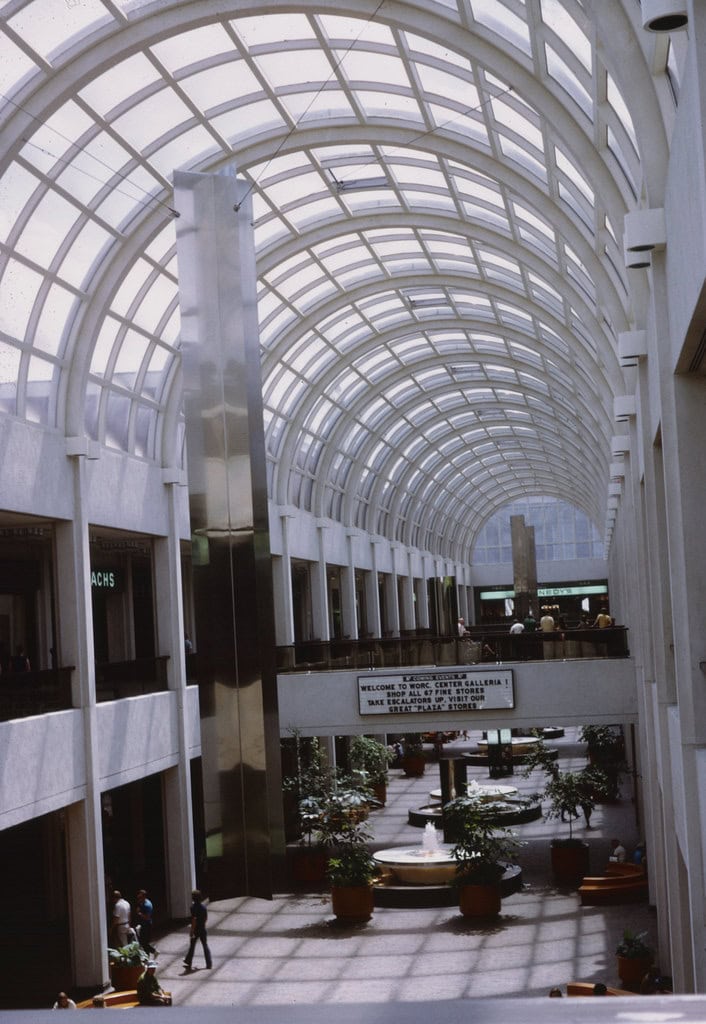
For downtown Worcester, he created an American version of Milan's famous 19th-century shopping arcade with crossing walkways and a glass and iron roof.
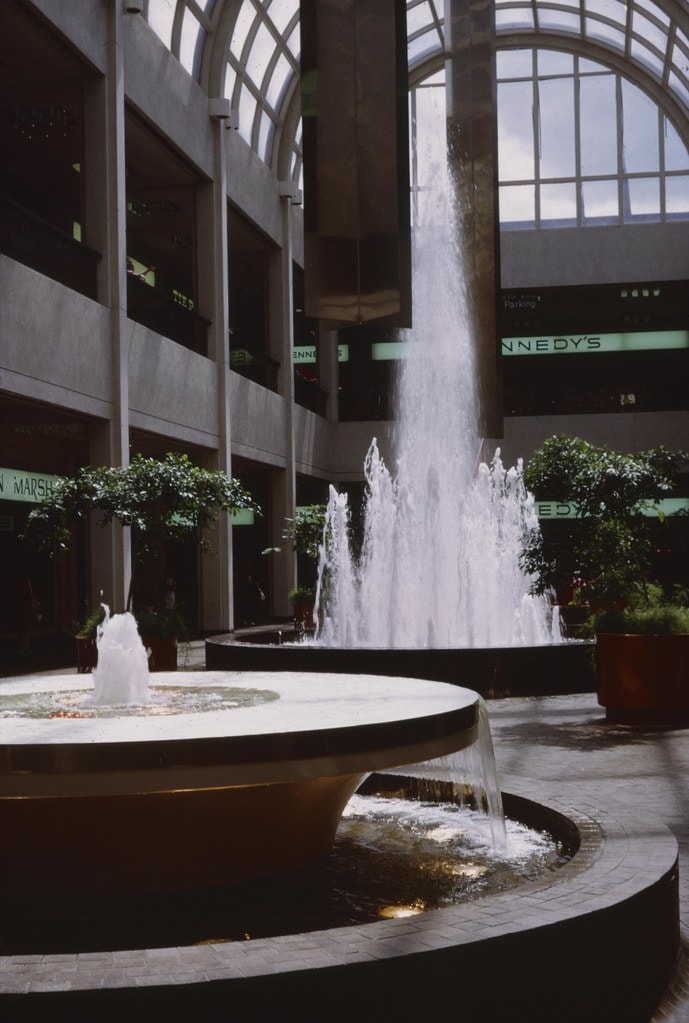
The Worcester Center Galleria became its climate-controlled cousin: a two-level interior street beneath an arched roof, bracketed by two office towers, 100 Front Street at twenty stories and 120 Front at eight.
Together, the mall and towers formed a unified commercial machine of roughly one million square feet of retail stitched to office space.
To serve the age of the automobile, the project added a 4,300-space garage, touted as the largest parking structure in the world and built entirely indoors, useful in winter and deadly to street life.
Inside, the mall opened with three patrician New England anchors - Filene's, Jordan Marsh, and Kennedy's - backed by an army of specialty shops.
Construction experts from the coasts toured the finished complex and pronounced it the finest shopping center they had ever seen.
On July 29, 1971, the public arrived, and for a while the judgment seemed sound.
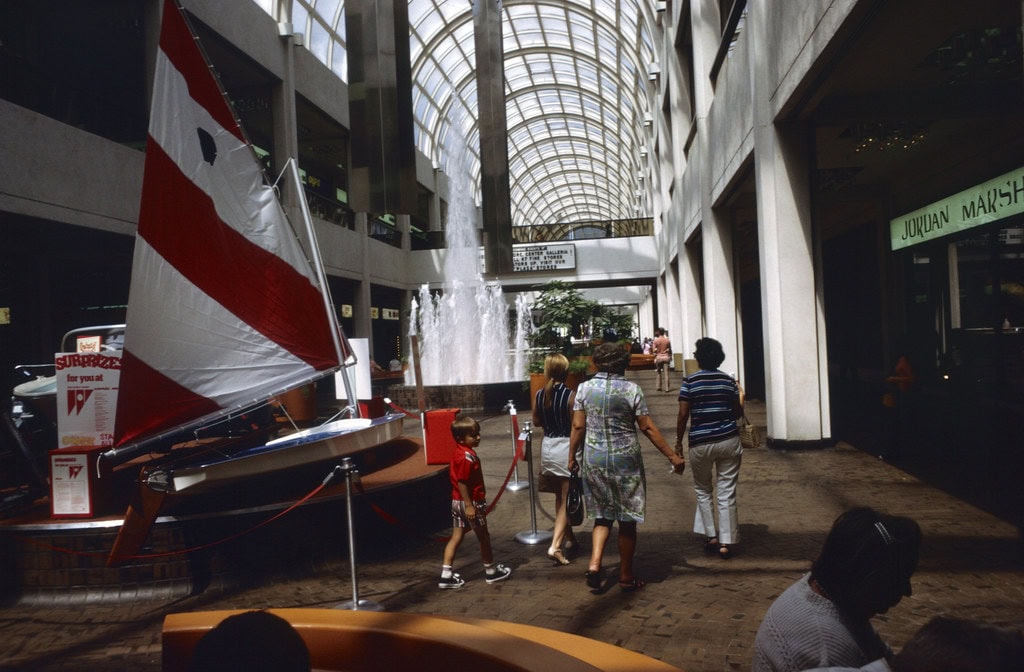
Proms, Mall Rats, and the Vanishing Downtown
For a while, the mall did what it was supposed to do. In the 1970s and early 1980s, the Worcester Center Galleria pulled in people from all over Central Massachusetts.
Everyone treated the mall as a public place before anyone said so, going there for the air conditioning, the escalators, the big-name stores resting under the glass roof.
You could see it on weekends: the food courts packed, kids running the escalators up and down, teenagers drifting in loose circles around the concourses, hanging out far more than they shopped.
When Leominster High School finally held its prom there, it only confirmed what everyone in town already knew about the place.
Inside the mall, you could see it was doing well: the hallways were busy, the big stores were open and bright, and the parking garage was finally full.
City leaders could look at the crowds and say that downtown was alive again. But outside the mall, what was missing was easier to see.
Three-deckers, small shops, and corner businesses had departed, and so had the almost-all-day street life of people living near where they worked and shopped.
Years later, Timothy Murray, who moved on to serve as mayor and later as head of the regional chamber of commerce, explained the problem plainly.
Traditional downtowns, he said, were business districts with neighbors: small stores, services, and people living upstairs.
Worcester Center Galleria wiped that out and replaced it with a closed-off interior. The action was in the middle; the edges were dead, and the building was cut off from the city it was built to help.
Suburban Malls Rise, Downtown Anchors Collapse
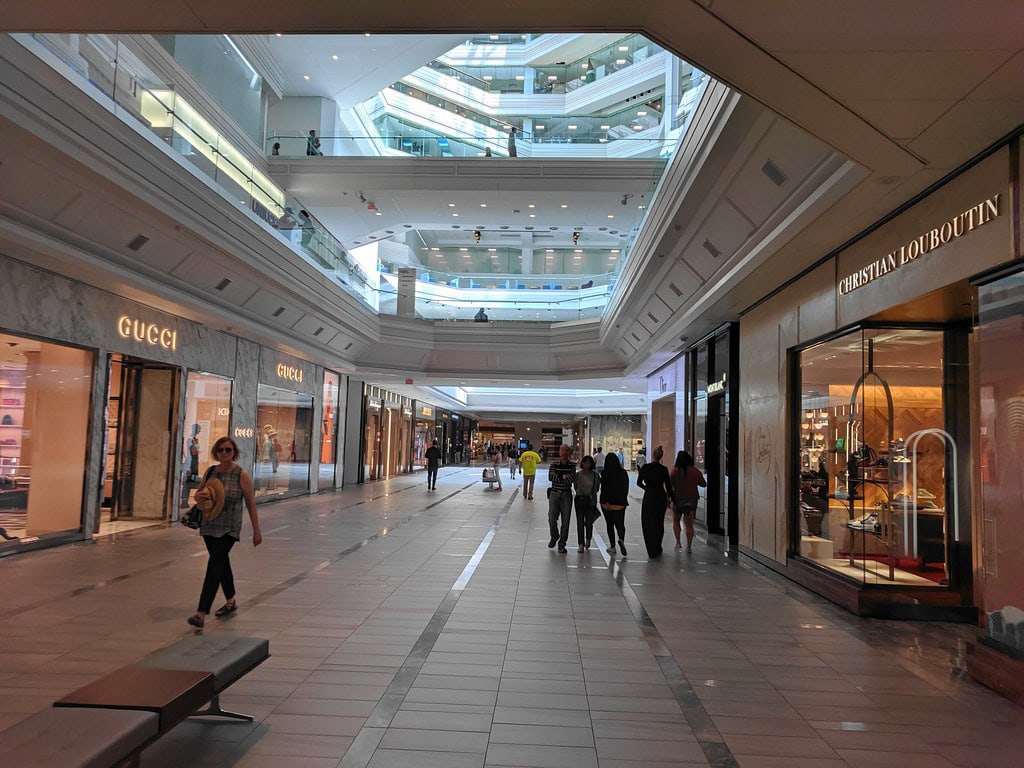
By the late 1980s, the mall built to compete with the suburbs was losing out to other malls.
Auburn Mall and Greendale Mall offered the same climate-controlled comfort, but their parking lots connected right to nearby neighborhoods.
For many shoppers, it was an easy decision: why drive downtown, deal with parking garages, and cross empty plazas when a mall was just around the corner?
Karl Seidman, an economic consultant from MIT, later summarized the arithmetic. A big downtown mall without a substantial residential base, he argued, is a fragile thing.
Unless tourists or a huge daytime workforce buoys it, it depends on convincing far-flung residents to drive in, and that will almost always lose to the convenience of shopping nearby.
The market delivered the verdict. Jordan Marsh closed in 1991. Filene's followed two years later.
With two of its three anchors gone, the Galleria lost the gravitational pull that had kept the smaller stores alive. Vacancies spread from the upper levels down.
By the early 1990s, stretches of corridor were dark or thinly occupied, and Worcester was already asking what would become of its grand downtown shopping center.
Outlet Makeover, Celebrity Marketing, and the Wrentham Effect
Help came, for a short time, through discounts.
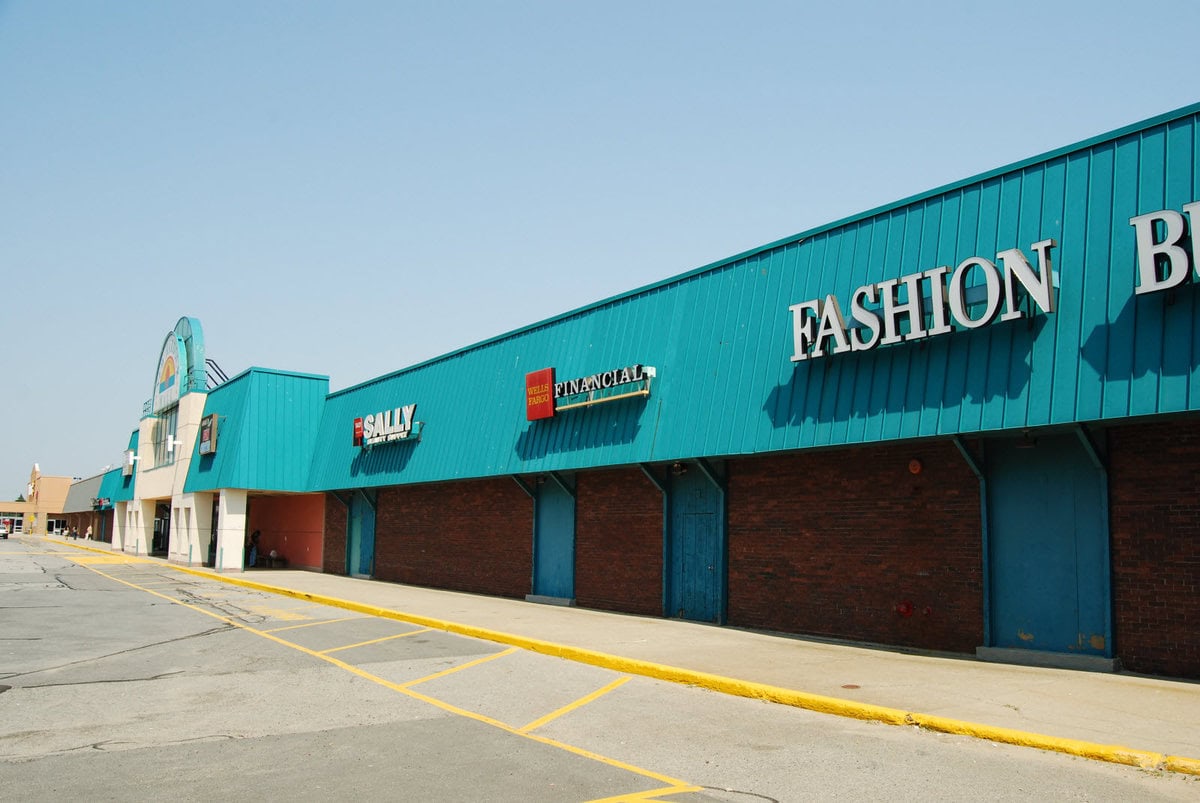
In 1994, new owners bought the struggling mall and reopened it as the Worcester Common Fashion Outlets, hoping that outlet stores could do well where regular department stores had failed.
Out went Filene's, Jordan Marsh, and Kennedy's; in came Sports Authority, Bed Bath & Beyond, Saks Off Fifth Avenue Outlet, Media Play, and Filene's Basement, later replaced by a VF Factory Outlet.
Around them, 126 outlet shops crowded the two levels.
To promote the mall's new image, developers brought in actress Judith Light. This showed just how much effort Worcester needed to market its downtown mall.
For a short time, the strategy seemed to work. In 1996, the name was shortened to Worcester Common Outlets.
The fatal blow landed the next year, thirty miles away.
Wrentham Village Premium Outlets opened off Interstate 495 with 170 stores in 616,000 square feet, an open-air village plugged straight into the regional highway grid.
It drew the same customers Worcester was courting, without asking them to navigate an aging downtown.
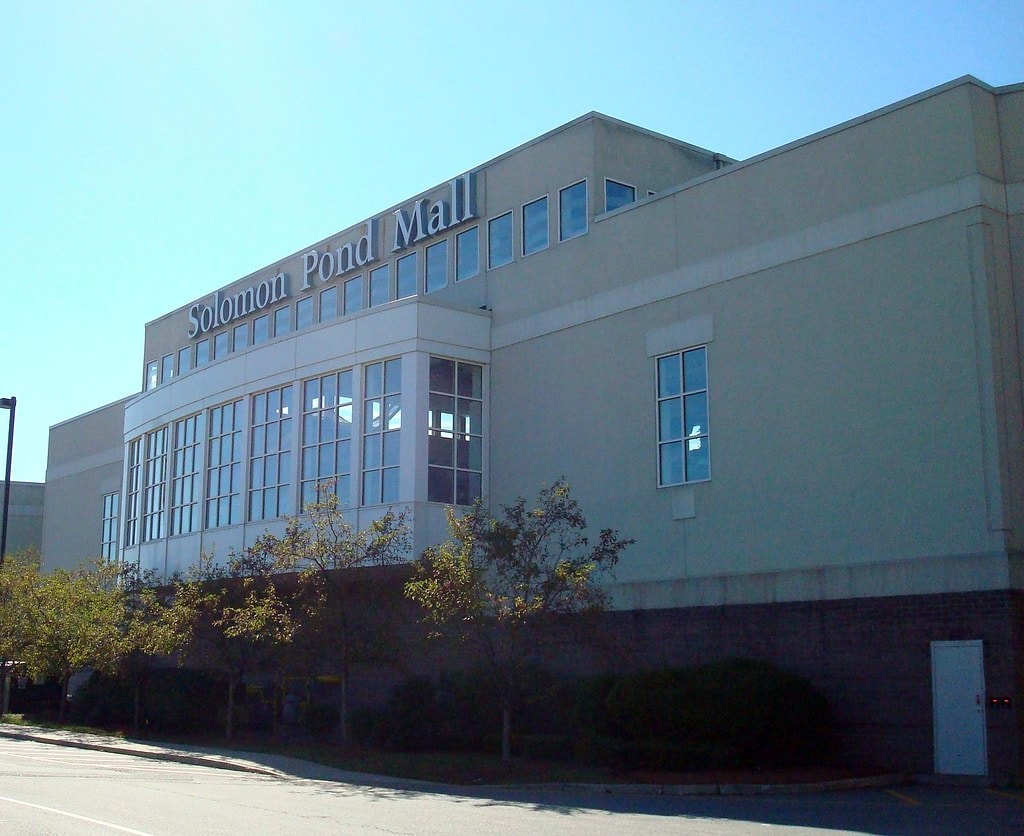
As Wrentham flourished, business in Worcester died down. Other regional centers - Greendale, Auburn, Solomon Pond - nibbled at the same market.
The Worcester Common Outlets closed in April 2006, its last sale signs fading in the dark.
From Dead Mall to CitySquare: Foothills Theatre, and the Street-Grid Idea
After the outlets closed, the Worcester Center Galleria complex stuck around like an awkward ghost. Berkeley Investments, working with Starwood Capital, bought the property in 2004 and let the last leases run out.
Instead of coming back to life, it became a huge empty mall and a mostly empty parking garage in the middle of Worcester.
For years, Berkeley suggested new ideas for the site, but none of them really worked out.
City planners had already started thinking in bigger ways.
In 1999, Daniel Benoit, an architect in the development office, suggested tearing down the mall completely and connecting Washington Square and Union Station to downtown again by bringing back the streets that had been removed.
By 2003, Timothy Murray, newly elected mayor, took up the idea in a white paper that urged the city to use eminent domain if necessary to clear the site.
The state of the building spoke for itself. Only a few tenants remained, including the Worcester Foothills Theatre, which had moved into the basement in 1987 and continued putting on plays even as the mall emptied.
The theater stopped operating in 2009 due to a lack of funding.
Berkeley's Young Park mentioned the strong local cynicism, and architectural historian Daniel Abramson pointed out that the same confidence that once drove urban renewal was now behind efforts to reverse it.
CitySquare: Demolishing the Mall, Rebuilding Downtown
In 2008, Worcester committed to CitySquare, a mixed-use replacement for the mall. In 2009, Hanover Insurance, through Opus Investment, joined the city and hired Leggat McCall Properties as development manager.
Unum's pledge to lease more than 175,000 square feet of offices unlocked $25 million in state demolition funds and helped assemble a public package of over $100 million.
Demolition began in September 2010 and reached the exterior walls by May 2011.
Crews had to separate the mall and office towers sharing structure and systems, keep 100 and 120 Front operating, and spend $12 million on asbestos, PCB, and soil cleanup.
Roughly 800,000 square feet of mall and 2,300 parking spaces vanished. Eighty thousand tons of concrete were crushed into fill for new streets; steel went to recycling.
Twelve acres opened up, threaded with new streets, sidewalks, buried utilities, a 565-car garage, and more than two acres of parks and plazas.
On that framework rose a $70 million, 214,000-square-foot Unum building, a 60,000-square-foot Saint Vincent cancer center, hundreds of apartments, the AC Marriott hotel, the Worcester Common Garage, and a repositioned Mercantile Center.
In all, about two million square feet and more than $500 million in investment turned a superblock mall into a downtown district that tries, belatedly, to restore the mixed-use life the Worcester Center Galleria erased.
You had to pay to park at the Worcester Common Outlets. I don't know how many times I chose other Malls (Auburn, Greendale, Emerald Square in Attleboro, etc.) over Worcester just because I refuse to pay to go spend money. I probably spent more in gas going to Attleboro and other malls but paying for parking was like paying for shipping is today. I won't do it. Not to go to a mall anyway. The other really big issue the "Outlets" had was they were not outlets. The prices were just as high as anywhere else and the stores weren't anything special. So why would I pay to go to a place that didn't offer me anything different than anyone else.
Your "paying for parking is like paying for shipping" comparison is dead-on. People will tolerate a fee if they're getting something special - a stadium, a concert, a downtown with unique spots. A mall needs to feel worth it, and a paid lot raises the bar instantly.
what goes around, comes around. Technology, on line shopping and good old Amazon win the day.
I think there's a mild backlash brewing. People are tired of endless boxes and returns, and some are tired of everything feeling virtual. That doesn't mean malls come roaring back, but it does mean the story isn't just "Amazon forever, everyone else disappearing."
Yeah, but now the Greendale Mall and the Auburn Mall are dead/dying.
Fair point - the "just go to the other mall" advice aged like milk. A lot of those fallback options are struggling too, which shows this isn't a Worcester-only problem. It's the whole mall ecosystem taking hits at once.