
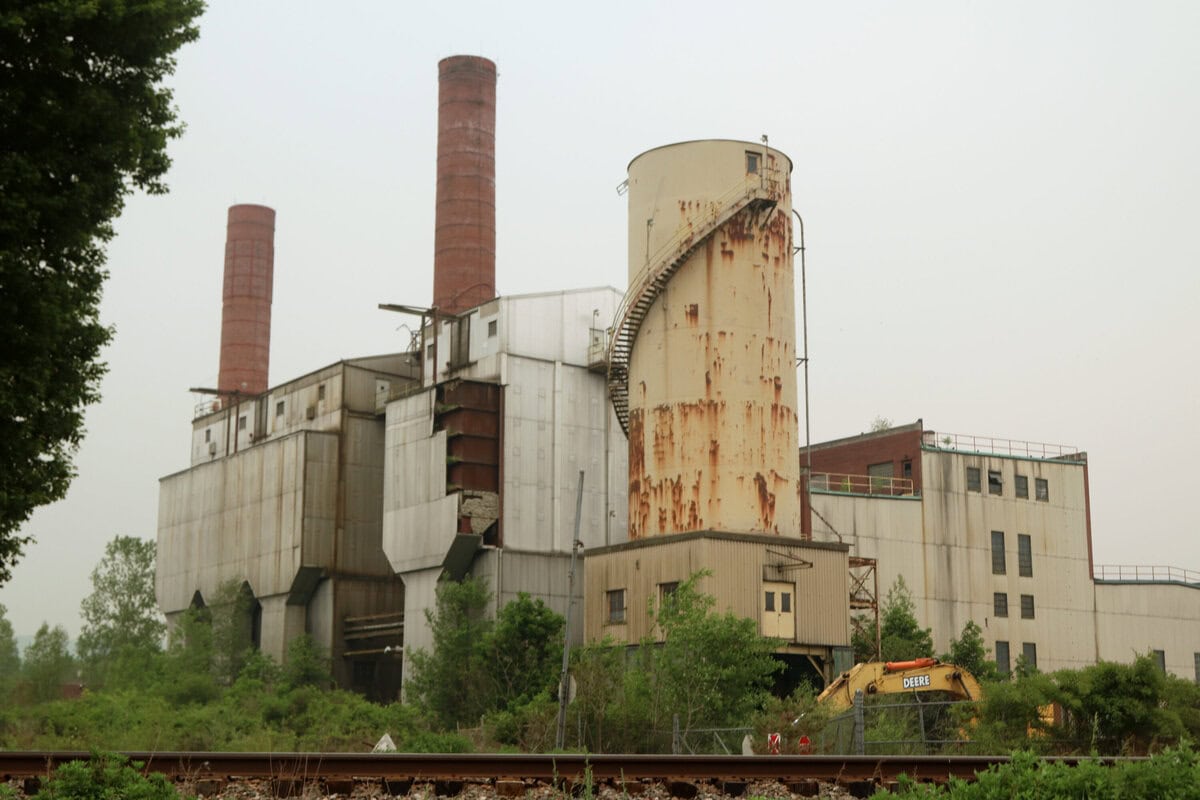
An empty powerhouse sits beside Route 7 south of Bainbridge, New York. It was Jennison Generating Station, a coal-fired plant NYSEG opened in December 1945.
A second generating unit followed in 1950, taking the station to 60 MW. It later reached 73 MW. In its last decade the boilers burned wood chips and shredded tires along with coal.
The plant closed on November 4, 2000, 18 months after AES bought it. AES later pulled out the turbines and generators and sealed the canals to the Susquehanna.
The buildings are still standing, and the site remains under state environmental oversight.
Why NYSEG built Jennison in 1944
Construction started in April 1944, with the war still on and materials under federal restriction.
New York State Electric & Gas, or NYSEG, built its coal-fired station on the west bank of the Susquehanna River, a mile south of Bainbridge, New York, on what is now Route 7.
The river supplied the water a steam plant runs on, and the Delaware & Hudson tracks passed close enough to deliver coal by the trainload.
NYSEG had wanted the plant since 1941, to add capacity and spread it across the territory.
It took the name of Ralph D. Jennison, company president since January 1, 1941, who was directing that expansion.
A bronze tablet at the entrance recorded the name and the year.
Lunch in the coal hopperhouse
NYSEG dedicated the station on Thursday, December 13, 1945, and fed nearly 250 invited guests inside the track hopperhouse, the structure beside the D&H line where coal cars were emptied.
The room worked for a luncheon while it was still clean.
The next afternoon, from 2 to 4, the plant was open to the public.
What they saw was one 30 MW turbine-generator in a plant the company advertised at 44,000 horsepower.
The building's shape came from what had to fit inside it: a boiler house for the steam generators and the coal-handling gear, and a long, high bay for the turbine.
Two more boilers and a second turbine
Demand kept climbing after the war.
In 1948 NYSEG announced a plan to raise Jennison to 90,000 horsepower, work on a second 30 MW unit began that October, and the addition entered service in August 1950.
The finished station had four Combustion Engineering traveling-grate stoker boilers feeding two turbine generators.
A traveling grate is a moving floor of linked bars: coal drops on at one end, burns as the grate carries it through the furnace, and leaves ash at the far end.
Boilers 1 and 2 fed Unit 1, boilers 3 and 4 fed Unit 2, and each pair vented through its own stack.
The combined nameplate was 60 MW. Re-ratings pushed it to 73 MW by the mid-1960s. No third unit was ever built.
Wood chips, tire chips, and contaminated soil
Stoker grates accept fuels a large pulverized-coal plant cannot take as easily, and in the last decade that became the argument for keeping Jennison running.
Wood came first.
From 1988 through the middle of 1994, Jennison and its sister plant at Hickling burned 46,000 tons of wood chips and sawmill waste between them, displacing 22,780 tons of coal.
Shredded tires followed. By 1994 tire chips were a routine part of the coal blend, and later permits let them reach 30 percent of a load.
The plant was also cleared to burn coal-tar-contaminated soil from old manufactured-gas sites.
The pollution controls saved money too.
Timers fitted in 1987 and 1988 interrupted power to the electrostatic precipitators, cutting their electricity use by more than 70 percent and saving an estimated $25,000 a year in generation costs.
The 1996 closing that didn't happen
A 73 MW plant has very few megawatts to spread its costs over.
Staffing, maintenance, permits, and pollution equipment don't shrink much when the plant does, and Jennison's machinery dated to 1945 and 1950.
So NYSEG set a date. Jennison and Hickling would close on December 1, 1996.
Then the state legislature passed a tax credit for beneficial use of waste tires, and in October the company pushed the shutdowns to the middle of 1997.
It settled nothing.
New York was already taking apart the regulated utility model the station was built inside, and the coal plants were headed for sale.
$950 million for six coal plants
The auction opened in March 1998, with 15 non-binding bids in by May 11.
Final bids landed on July 28, and on August 4 NYSEG named AES the winner: $950 million for six New York coal stations totaling 1,424 MW.
The sale closed in May 1999, and under AES the plant had to earn its keep in the wholesale market.
Trouble came fast.
State regulators alleged opacity violations at Jennison and other stations in the package, complaints about visible emissions piled up, and the plant had switched to a higher-sulfur coal.
On August 18, 2000, AES announced long-term cold standby.
Jennison generated for the last time on October 23 and closed on November 4, nearly 55 years after the luncheon in the hopperhouse.
The turbines came out in 2005
Cold standby left a restart technically possible, and the air permits still described four boilers and two generators.
On January 11, 2005, NYSEG, AES, and state regulators signed a consent decree covering Jennison and three other stations, with a $700,000 penalty against NYSEG that AES was to pay under the terms of the 1999 sale.
AES then looked at the pollution-control work a restart would need and decided against it.
The turbines and generators came out of the building, and the canals that had carried Susquehanna water in and out were sealed.
In October 2006 a $1.5 billion, 500 MW coal-and-biomass plant was floated for the property, nearly seven times the capacity of the old station.
The state's clean-coal program picked other locations, and a follow-on 650 MW interconnection request was withdrawn.
The Jennison name moves 0.9 mile west
The powerhouse still stands south of Bainbridge, with no turbines.
Environmental oversight outlasted the machinery, because ash doesn't leave when the fire goes out.
The former ash pond, the lined coal-pile area, and a groundwater program requiring quarterly tests for arsenic and other metals kept the property under state oversight, and New York's 2024 Inactive Landfill Initiative still carries Jennison Station in the Town of Bainbridge.
The working half of the site was always the substation, which NYSEG kept when it sold the plant and later spent years separating from the AES buildings, including $657,000 in 2013.
That substation is moving.
NYSEG applied in December 2024 to relocate it 0.9 mile west onto a 4.6-acre site near Mount Pleasant Road and rebuild 47.5 miles of 115 kV line, and the certificate came through on March 20, 2026.
The Jennison name now belongs to a transmission project that will rebuild circuits across Chenango and Delaware counties, and none of that work goes inside the old coal plant.

Independent Publisher Notice
BestAttractions is an independent editorial publisher. We are not affiliated with, endorsed by, or acting on behalf of any location, business, property owner, manager, government agency, or organization described in this article. Comments posted on this page are not forwarded to, reviewed by, or acted upon by any entity mentioned in the article. For official inquiries, complaints, applications, bookings, or other requests, please contact the relevant entity directly through its official website or other verified channels.