April 15, 1969. Thirty-six stores opened their doors in a brand-new enclosed mall in Northwood, Ohio, and people came. J.C. Penney opened the next day formally. LaSalle's followed on August 4.
Sears held its dedication on October 15. Two years before any of that, the spot had been 89.8 acres of mostly empty land on the east bank of the Maumee River, about 5.6 miles southeast of downtown.
The Edward J. DeBartolo Corporation broke ground in May 1967. The logic was straightforward: Northwood and the east-side suburbs were growing, and there was no enclosed mall on Toledo's east side of the Maumee.
DeBartolo intended to own that side of the market entirely. By the end of 1969, the tenant count had climbed from 36 to 87 stores and services.
DeBartolo had also drawn up plans for a follow-up project in Perrysburg Township.
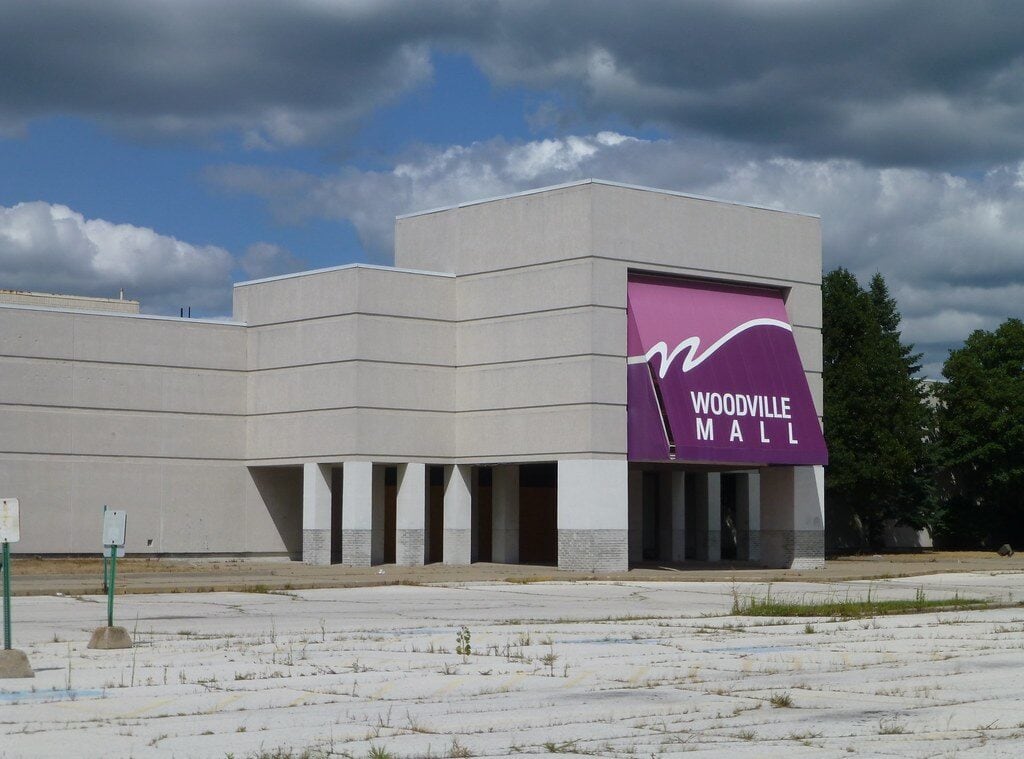
That mall was never built, leaving Woodville standing alone as the only fully enclosed regional mall east of the Maumee River - the first of its kind anywhere in northwestern Ohio - and its name came from Woodville Road, which ran past the site when planning began in the mid-1960s.
What Woodville Mall Offered Its Shoppers
One estimate put the mall's leasable space at about 871,000 square feet. Another figure counted more than 1.2 million square feet when the anchor stores were included.
Either way, it was far larger than anything the east side of Toledo had seen before.
The mall's interior shops included Home Furniture Company, Cunningham's Drug, Radio Shack, Thom McAn Shoes, Zales Jewelers, Spencer Gifts, Jo-Ann Fabrics, Fanny Farmer, Chess King, Hughes & Hatcher, and Keidan's Jewelers.
These stores sat alongside Food Town, a full grocery store, and the First National Bank of Toledo.
At the entertainment end, the Fox Woodville Mall Theatre opened with a single screen and listed "The Lost Man" as its first movie.
In the early 1970s, one concourse featured Easter bunny displays. Small train rides for children attracted families from Northwood and other communities along the east side of the Maumee River.
During its first decade, the mall's three main wings were anchored by Sears, LaSalle's, and J.C. Penney.
Competition Closes In from Every Direction
Greenwood Mall opened in 1969, the same year Woodville did. Franklin Park followed in 1971, Southwyck in 1972, and North Towne Square in 1981.
None sat east of the Maumee, but together they competed for the same regional shoppers, and Woodville's trade area had never been large enough to absorb that kind of pressure.
When DeBartolo planned the project in 1967, he assumed suburban growth on the east side would build out around the mall.
It came in more slowly than projected, leaving Woodville operating at full-scale regional-mall expense in a market smaller than the original plan assumed.
A 115,000-square-foot Woolco opened adjacent to the property in 1971, added another layer of competition, and closed in 1983, replaced by Hills.
LaSalle's became Macy's on October 1, 1981, then shut and reopened as Elder-Beerman on August 7, 1985.
JCPenney's auto center closed in 1983. Food Town left the concourse and moved into a shuttered building across Woodville Road.
Smaller stores in the JCPenney wing followed. JCPenney closed its main store in June 1987.
A $5 Million Renovation, The Andersons, and Woodville Mall's 1990s Shift
Three months before JCPenney's departure, in March 1987, the mall's owners announced a $5 million renovation. New skylights went in.
Concourse carpeting was replaced. Entrances were rebuilt, and a ten-bay food court called "Treats" was installed in the existing space.
The center court was redesigned around a town-square concept.
The Andersons, a Maumee-based retailer that sold groceries, building supplies, and lawn-and-garden goods, renovated the former Penney building and opened on September 1, 1988.
It was not a department store by any traditional measure. Only the first level - roughly 104,700 to 106,000 square feet - was used for retail, while the upper floor held offices and storage.
A garden center was built along the exterior.
A Meijer superstore opened about 1.5 miles away in 1992 and drew traffic off the site.
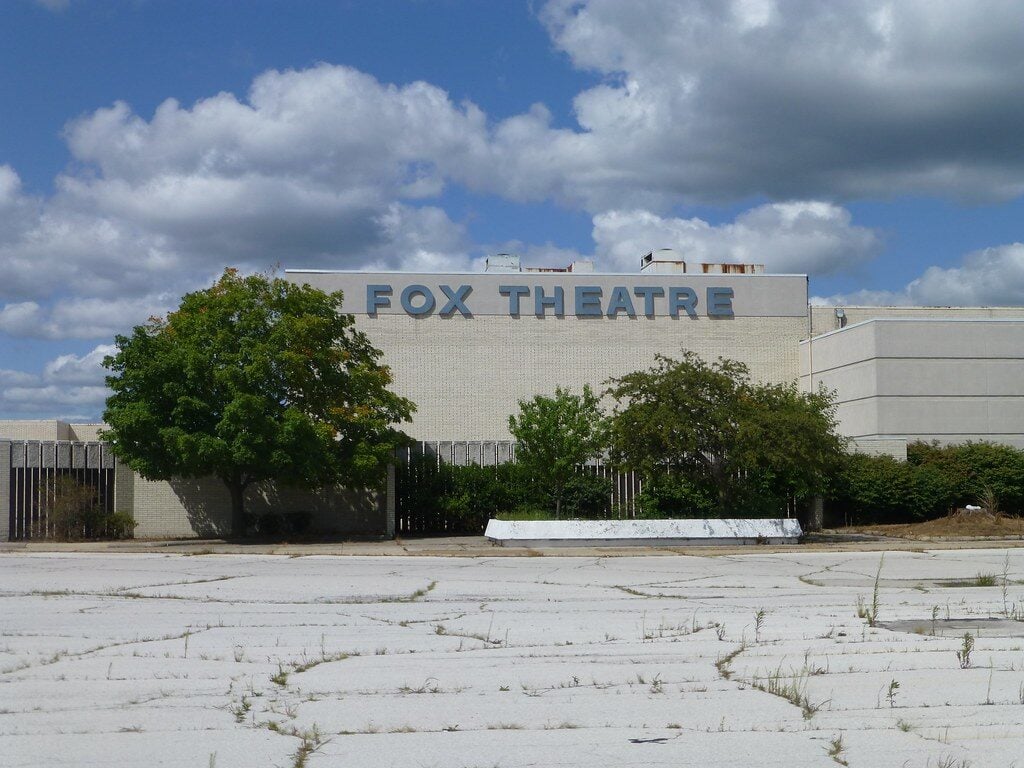
Woolworth, one of the original junior anchors from 1969, closed in 1994, its space later used as an indoor skate park. The Fox Theater continued operating after a conversion from two screens to four.
Simon Property Group absorbed Woodville through its 1996 merger with DeBartolo and put the mall up for sale by 1999.
Sold in 2004, Every Plan Falls Apart
Woodville Mall was sold on September 1, 2004, to Jack Kashani and Sammy Kahen of Beverly Hills, California, who brought in the Krone Group as their redevelopment and management agent.
One proposal called for a complete remodel with new office space, residential units, an ice rink, and a multiplex cinema.
Adjoining land was purchased, and plans for a new access road were drawn up. Nothing was built.
A second plan called for demolishing the mall itself and converting the surviving anchor buildings into an open-air retail format.
That stalled as well. By 2006 and 2007, public discussion had narrowed to renovation versus replacement, with land acquired for a new access road but no redevelopment moving forward.
Walmart opened in nearby Oregon, and Menards arrived not far from the mall. The former Hills store closed in 2008, and the Food Town across Woodville Road both closed in the early 2000s.
Elder-Beerman shut its Woodville location in September 2009 - a 167,900-square-foot space that went dark and eliminated about 60 positions.
Kohan's Reopening Attempt and the Court-Ordered Shutdown
Mike Kohan of Little Neck, New York, acquired the mall in November 2009 and tried to turn it around. Roof work was done. New flooring went in.
By spring 2011, twelve stores and services had opened - among them CJ's Breakfast and Sandwich Shop, InProcess, and MPWA Combat Sports - and a grand reopening was held in May.
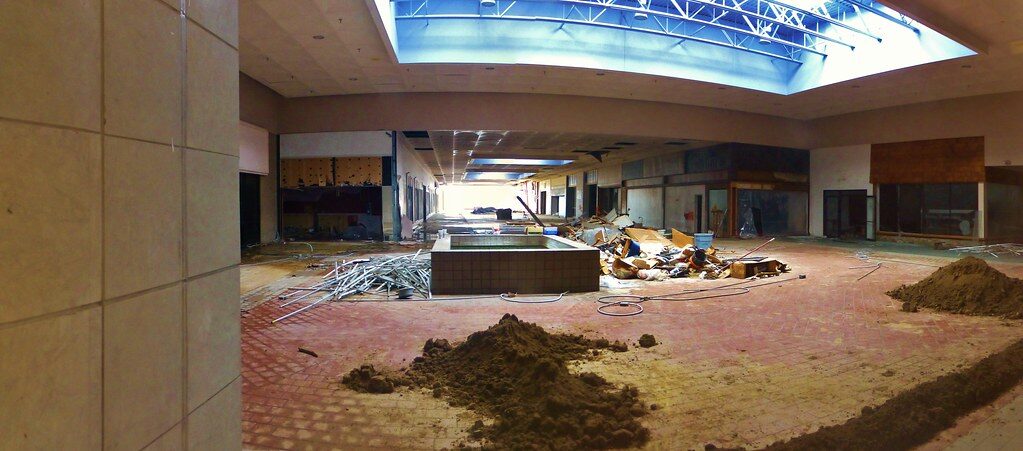
When Wood County inspectors toured the property in December 2011, they found buckling floors, mold and mildew throughout, collapsed and leaking roofs, disconnected natural gas service, and an average interior temperature of 46 degrees Fahrenheit.
The building was declared unsafe for public use, and the twelve retail tenants were told to prepare to vacate.
The Fox Theater closed on December 14, 2011. Two days later, on December 16, a court injunction shut the interior mall.
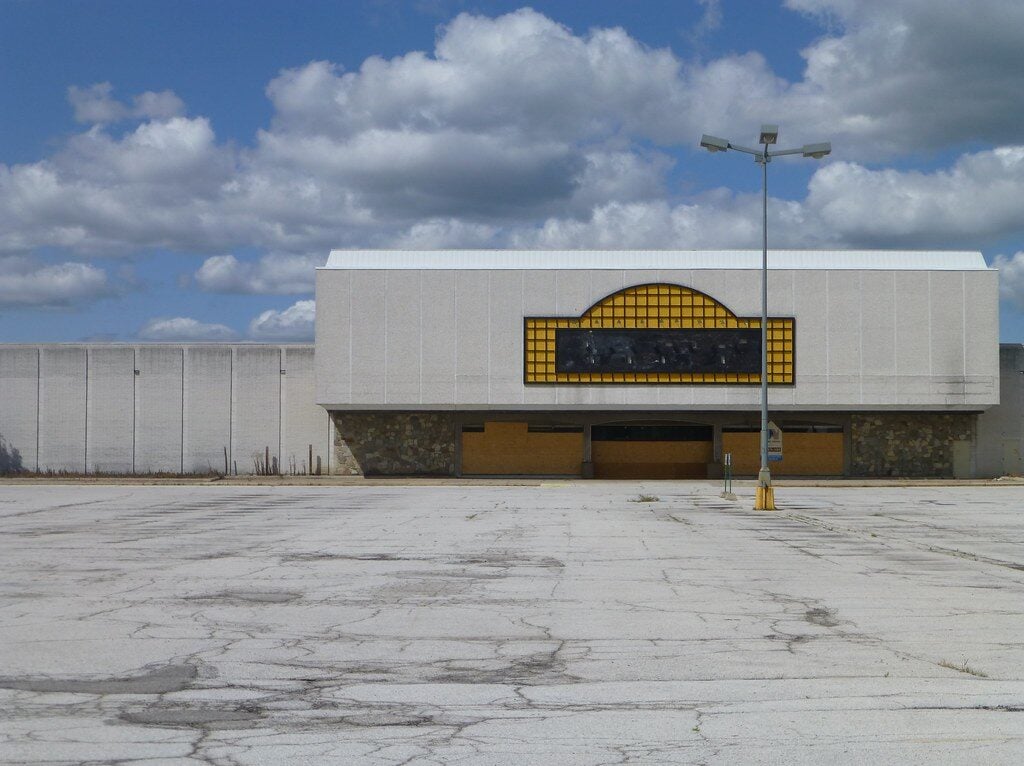
Sears and The Andersons remained open for a time because each had its own exterior entrance and could operate without entering the concourse.
In-line tenants were evicted in January 2012.
A $2.44 Million Judgment and Demolition Orders
A Wood County Court of Common Pleas judgment entered on August 8, 2013, documented what had unfolded since the injunction.
A default judgment from June 7, 2012, had already permanently barred public access to the mall interior until code violations were corrected.
They never were. By 2013, the court was recording leaking ceilings open to the sky, black mold throughout, standing water, no utilities, and no stormwater drainage or fire suppression.
The city of Northwood received a $1,690,000 lump-sum judgment against Ohio Plaza Shopping Center and Woodville Mall Realty Management, jointly and severally, and a $750,000 judgment against Woodville, LLC.
The court set a demolition deadline of May 2, 2014, and required perimeter fencing by September 2, 2013.
The Andersons announced in November 2012 that it would not renew its lease, then closed in February 2013, ending 29 full-time and 92 part-time positions.
Sears, the last operating store on the site, closed in July 2014. Demolition of the main mall began in March 2014 but stretched on for years.
A city council ordinance passed on May 11, 2017, authorized a demolition and abatement contract for the former Andersons building, the former Andersons Tireman building, and the former Elder-Beerman building at $1,947,000.
At that point, the site still held roughly 50,000 square feet of asbestos-containing floor tile and 771,800 square feet of spray-on asbestos insulation across the building footprint.
How Woodville Mall Became The Enclave
In February 2016, the city purchased the property at a sheriff's sale for $200,000. It expanded that purchase in May 2018 by adding the former Sears parcel.
Public planning sessions held in 2018 and 2019 led to a redevelopment plan called The Enclave.
The idea centered on a mixed-use neighborhood with walking trails, a central park, and a "Main Street" area. It also included housing for residents at different stages of life.
On January 24, 2019, the city passed an ordinance that changed Northwood's zoning rules to support redevelopment in the old mall corridor.
The project officially began with a groundbreaking on May 14, 2021. A master plan prepared by EMH&T covered 133 acres.
It called for single-family homes, patio homes, multi-family housing, and a senior-living facility.
Plans also included four outlots, 30 acres of mixed-use commercial space, a community center, a 3-acre central park, and a 1.5-mile loop path.
The Northwood Community Center opened on June 3, 2024. The Bridges of Northwood townhomes occupy 24 acres and are planned to include 114 units.
A separate 150-unit apartment development called The Falls received city approval.
On September 23, 2025, Wallick Communities secured financing for The Ashford at The Enclave after the Ohio Housing Finance Agency approved up to $28 million in multi-family housing bonds in August.
The $30 million assisted-living project will have 110 units. All units will be Medicaid-eligible, and 77 will be fully accessible. Construction started on October 16, 2025.